
The straight leg deadlift is a hip-hinge strength exercise that mainly trains the hamstrings, glutes, and spinal erectors while helping you build better control through the back side of your body. The movement looks simple, but it works best when you keep your spine neutral, push your hips back, and lower only as far as your hamstrings comfortably allow.
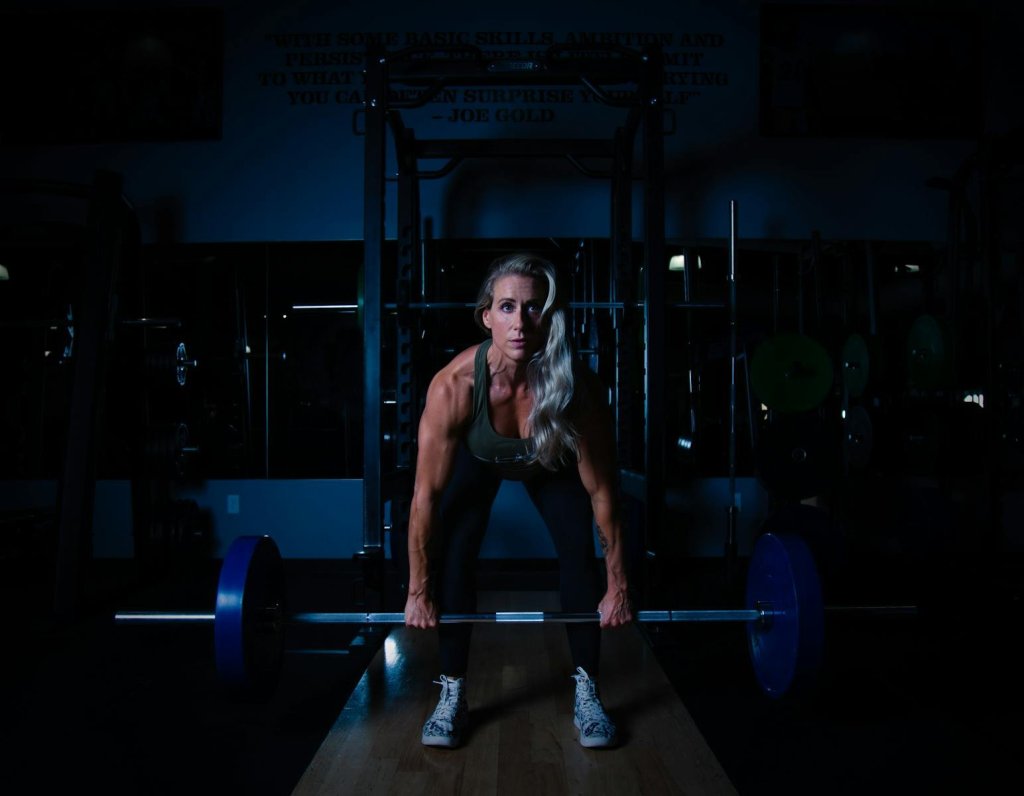
The straight leg deadlift is useful because it teaches you to load the posterior chain without turning the exercise into a squat. The American Council on Exercise notes that deadlift variations train major muscles such as the hamstrings, glutes, lower back, and trapezius, and describes the straight-leg version as especially focused on the hamstrings.
What Is the Straight Leg Deadlift?
The straight leg deadlift is a deadlift variation where you hinge at the hips while keeping your knees mostly straight or softly bent. Instead of bending the knees deeply like a conventional deadlift, you push your hips back and lower the weight toward the floor.
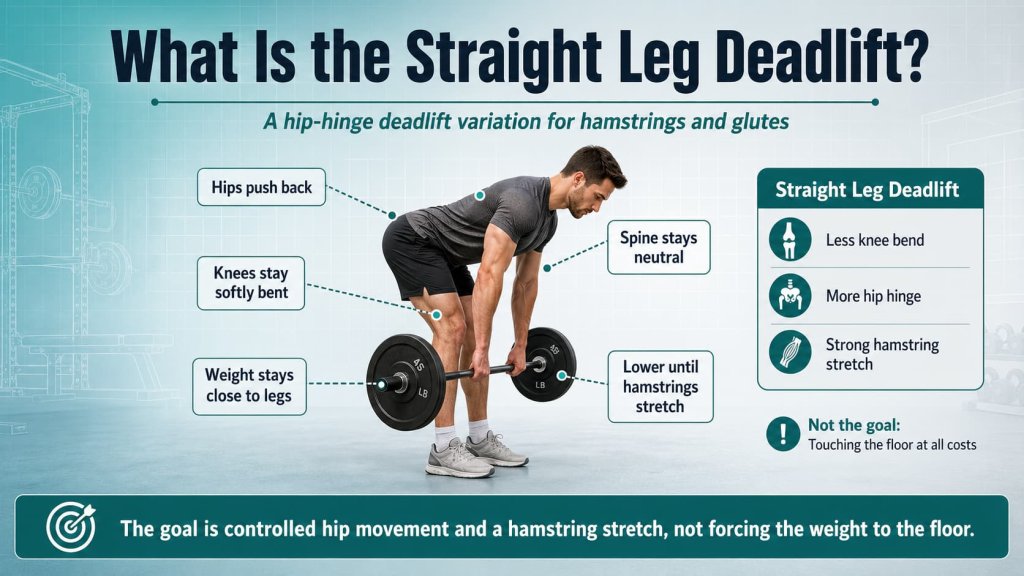
The goal is not to touch the floor at all costs. The goal is to feel a controlled stretch through the hamstrings while keeping your back organized.
In many gyms, the terms straight leg deadlift and stiff-leg deadlift are used almost the same way. Some coaches separate them slightly, but both usually describe a hip-hinge movement with less knee bend than a Romanian deadlift or conventional deadlift.
How to Do the Straight Leg Deadlift With Proper Form
Start light. This exercise should feel controlled, not rushed.
How to do it:
- Stand with your feet about hip-width apart.
- Hold a barbell, dumbbells, or kettlebells in front of your thighs.
- Keep your knees soft, but do not turn the movement into a squat.
- Brace your core and keep your chest open.
- Push your hips back as the weight travels down your thighs.
- Keep the weight close to your legs.
- Lower until you feel a comfortable hamstring stretch.
- Stop before your back rounds.
- Drive your hips forward and squeeze your glutes to stand tall.
- Reset your posture before the next rep.
Trainer Tip:
Think “hips back, weight close, spine long.” If the weight drifts away from your legs or your back rounds, reduce the range of motion.
Straight Leg Deadlift Muscles Worked
The straight leg deadlift mainly targets the posterior chain. That means the muscles on the back side of your body.
Primary muscles worked:
- Hamstrings
- Gluteus maximus
- Spinal erectors
Secondary muscles worked:
- Upper back
- Lats
- Core stabilizers
- Forearms and grip
- Adductors
- Calves, to a smaller degree
A review available through PubMed Central found that the biceps femoris, gluteus maximus, vastus lateralis, and erector spinae are among the commonly studied muscles in deadlift research. The same review reported that Romanian deadlift patterns are strongly associated with hamstring activity compared with spinal erector activity, which supports why hip-hinge deadlift variations are often used in posterior-chain training.
Straight Leg Deadlift Benefits
The straight leg deadlift is valuable because it trains strength, control, and hip-hinge mechanics at the same time.
Key benefits include:
- Builds stronger hamstrings
- Trains the glutes through hip extension
- Strengthens the spinal erectors isometrically
- Improves hip-hinge technique
- Supports better posterior-chain training balance
- Helps you practice keeping the weight close to your body
- Works with barbells, dumbbells, kettlebells, or resistance bands
It is especially helpful if your lower-body workouts are mostly squat, lunge, or leg-press focused. Those exercises are great, but they are usually more knee-dominant. The straight leg deadlift adds a hip-dominant pattern.
Straight Leg Deadlift vs Romanian Deadlift
The straight leg deadlift and Romanian deadlift are similar, but they are not always performed the same way.
| Feature | Straight Leg Deadlift | Romanian Deadlift |
|---|---|---|
| Knee bend | Very small bend or mostly straight legs | Slight knee bend |
| Main feel | Stronger hamstring stretch | Hamstrings and glutes with more control |
| Range of motion | Often slightly deeper if mobility allows | Usually stops around mid-shin |
| Beginner-friendly | More demanding on flexibility | Often easier to control |
| Best use | Hamstring-focused hinge | General posterior-chain strength |
A study available through PubMed Central explains the basic difference clearly: the Romanian deadlift is commonly performed with the knees slightly flexed, while the stiff-leg deadlift is performed with the knees more extended.
For most beginners, a Romanian deadlift is usually the better first step. After you can hinge well with a neutral spine, you can try the straight leg deadlift with a lighter weight and shorter range of motion.
Common Straight Leg Deadlift Mistakes
Small form mistakes can quickly change how this exercise feels. Use these fixes to keep the movement cleaner.
| Mistake | Why it matters | Simple fix |
|---|---|---|
| Rounding the back | Shifts stress away from the hips | Stop higher and brace harder |
| Locking the knees aggressively | Can feel uncomfortable and reduce control | Keep a soft knee bend |
| Going too low | Forces the back to round if mobility is limited | Lower only to a comfortable stretch |
| Letting the weight drift forward | Makes the lift harder to control | Keep the bar or dumbbells close |
| Squatting the movement | Reduces hamstring emphasis | Push hips back instead of bending knees deeply |
| Using too much weight | Breaks form and control | Start lighter and progress slowly |
| Looking too far up | Can strain the neck position | Keep head neutral with the spine |
How Low Should You Go?
Lower only as far as you can while keeping a neutral spine and steady control.
For many people, that means stopping around:
- Just below the knees
- Mid-shin
- Slightly above the ankles
You do not need to touch the floor. In fact, forcing the weight to the floor is one of the most common reasons people lose form.
A good stopping point is where you feel a clear hamstring stretch but can still keep your ribs, pelvis, and spine organized.
Best Straight Leg Deadlift Variations
You can adjust the straight leg deadlift based on your equipment, experience level, and training goal.
1. Dumbbell Straight Leg Deadlift
This is one of the best beginner-friendly options because dumbbells are easy to control.
How to do it:
- Hold one dumbbell in each hand.
- Keep the dumbbells close to your thighs.
- Hinge at the hips and lower with control.
- Stop when your hamstrings feel stretched.
- Stand tall by driving the hips forward.
Why it works:
Dumbbells let each side move naturally, which can feel more comfortable than a barbell.
Muscles worked:
Hamstrings, glutes, spinal erectors, core, and grip.
Trainer Tip:
Keep the dumbbells close to your legs. If they move forward, the lift usually becomes harder on your lower back.
2. Kettlebell Straight Leg Deadlift
A kettlebell version is useful for learning the hinge pattern.
How to do it:
- Hold one kettlebell with both hands.
- Stand tall with feet hip-width apart.
- Hinge back and lower the kettlebell between your legs or slightly in front.
- Stop when your hamstrings stretch.
- Stand tall with control.
Why it works:
The kettlebell keeps the load centered, which can make the movement easier to learn.
Muscles worked:
Hamstrings, glutes, lower back stabilizers, core, and grip.
Trainer Tip:
Keep the kettlebell close to your body, not far out in front.
3. Single-Leg Straight Leg Deadlift
This version trains balance and single-leg control. It is more advanced than it looks.
How to do it:
- Stand on one leg with a soft knee bend.
- Hold one or two dumbbells.
- Hinge forward as your other leg moves back.
- Keep your hips square to the floor.
- Return to standing with control.
Why it works:
Single-leg hinging challenges the glutes, hamstrings, foot stability, and core control.
Muscles worked:
Hamstrings, glutes, glute medius, core, calves, and grip.
Trainer Tip:
Start with bodyweight or one light dumbbell. Use a wall or bench for balance if needed.
How Many Sets and Reps Should You Do?
For most people, the straight leg deadlift works best with moderate reps and controlled tempo.
| Goal | Sets | Reps | Load |
|---|---|---|---|
| Beginner technique | 2–3 | 8–10 | Light |
| Muscle building | 3–4 | 8–12 | Moderate |
| Strength focus | 3–5 | 5–8 | Heavier, only with solid form |
| Warm-up or activation | 1–2 | 10–15 | Very light |
The Mayo Clinic says a weight that fatigues the muscles around 12 to 15 repetitions can build strength efficiently for many people, and it also recommends warming up for 5 to 10 minutes before strength training.
For general health, the CDC says adults need 150 minutes of moderate-intensity physical activity and 2 days of muscle-strengthening activity each week. A straight leg deadlift can fit into those strength-training days as part of a balanced lower-body routine.
How Often Should You Do Straight Leg Deadlifts?
Most people can train the straight leg deadlift 1 to 2 times per week, depending on the rest of their program.
Use this simple guide:
- Beginner: 1 day per week
- Intermediate: 1–2 days per week
- Advanced: 2 days per week if recovery is good
- If hamstrings stay sore: reduce volume or frequency
Avoid doing heavy straight leg deadlifts the day before hard sprinting, heavy squats, or another intense hamstring-focused workout. Your hamstrings need time to recover.
Where to Put Straight Leg Deadlifts in a Workout
The straight leg deadlift fits best after your warm-up and before smaller accessory exercises.
Good workout placement:
- After squats, if it is an accessory lift
- Before leg curls, glute bridges, or calf raises
- On a lower-body strength day
- On a posterior-chain focused workout
- As a secondary hinge after conventional deadlifts, using lighter weight
Sample lower-body workout:
| Exercise | Sets | Reps |
|---|---|---|
| Squat or leg press | 3 | 6–10 |
| Straight leg deadlift | 3 | 8–10 |
| Walking lunge | 2–3 | 8–12 per leg |
| Leg curl | 2–3 | 10–15 |
| Calf raise | 2–3 | 12–15 |
Who Should Be Careful With Straight Leg Deadlifts?
The straight leg deadlift is not automatically unsafe, but it does require good control and body awareness.
Be careful or get professional guidance first if you have:
- Current lower-back pain
- Recent hip, back, or hamstring injury
- A history of disc-related back issues
- Poor balance
- Very limited hamstring flexibility
- Pain that gets sharper during the movement
- Trouble keeping your back neutral while hinging
The Mayo Clinic advises people with chronic conditions or adults over 40 who have not been active recently to check with a doctor before starting a new strength or aerobic fitness program. It also recommends stopping an exercise if it causes pain and using proper technique when strength training.
Safety Tips for Better Form
Use these tips to make the straight leg deadlift safer and more effective:
- Warm up for 5 to 10 minutes.
- Start with a light weight.
- Keep your knees softly bent.
- Stop before your back rounds.
- Keep the weight close to your legs.
- Move slowly on the way down.
- Do not bounce at the bottom.
- Stand tall, but do not lean back at the top.
- Increase weight gradually only after your form is consistent.
A study indexed in PubMed on straight-legged hinge exercises notes that biomechanical differences between hinge variations can change muscle activation. In practical terms, this means small changes in setup, equipment, and range of motion can affect how the exercise feels and which muscles work hardest.
Straight Leg Deadlift Quick Form Checklist
Before each set, check these points:
- Feet about hip-width apart
- Weight close to the body
- Core braced
- Spine neutral
- Knees soft, not locked
- Hips move back first
- Hamstrings stretch, but no forced depth
- Smooth return to standing
FAQs About Straight Leg Deadlift
Is the straight leg deadlift good for hamstrings?
Yes. The straight leg deadlift is commonly used to train the hamstrings because the movement keeps the knees mostly extended while the hips hinge back. That position creates a strong hamstring stretch and loading pattern.
Is the straight leg deadlift good for glutes?
Yes. The glutes work when you extend your hips to return to standing. To feel the glutes more, keep the weight close, push your hips back, and stand by driving your hips forward instead of pulling with your lower back.
Should your legs be completely straight?
No. “Straight leg” does not mean aggressively locked knees. A small, soft bend is usually better because it helps you control the movement and avoid forcing your range of motion.
How is the straight leg deadlift different from the Romanian deadlift?
The straight leg deadlift usually uses less knee bend. The Romanian deadlift uses slightly more knee bend and often stops around mid-shin. Both train the posterior chain, but the straight leg deadlift often creates a stronger hamstring stretch.
Should the bar touch the floor?
Not always. Many people should stop above the floor to keep good form. Your range of motion depends on hamstring flexibility, hip control, and your ability to keep a neutral spine.
Can beginners do straight leg deadlifts?
Yes, but beginners should start light and use a short range of motion. A dumbbell Romanian deadlift may be a better first step if the straight leg version feels too intense or hard to control.
How heavy should I go?
Use a weight you can control without rounding your back or rushing the movement. For most people, moderate weight and clean reps are better than heavy weight with poor form.
Conclusion
The straight leg deadlift is one of the best hip-hinge exercises for building stronger hamstrings and glutes. It works well when you keep the movement controlled, use a comfortable range of motion, and focus on pushing the hips back instead of bending the knees deeply.
Start light, master the hinge, and progress slowly. Your goal is not to lift the most weight right away. Your goal is to build strong, repeatable form that supports long-term lower-body training.
References
- American Council on Exercise: 4 Deadlift Variations You Need to Try
- American Council on Exercise: Deadlift Exercise Library
- Mayo Clinic: Strength Training Get Stronger Leaner Healthier
- CDC: Adding Physical Activity as an Adult
- PubMed Central: Electromyographic Activity in Deadlift Exercise and Its Variants
- PubMed Central: An Electromyographic Analysis of Romanian Step-Romanian and Stiff-Leg Deadlift
- PubMed Central: A Comparison of Muscle Recruitment Across Three Straight-Legged Hinge Exercises
- World Health Organization: Physical Activity