
Nitric oxide benefits include helping blood vessels relax, supporting healthy blood flow, and possibly improving certain types of exercise performance—especially when your body makes more nitric oxide from nitrate-rich foods like beets and leafy greens. The key is to understand the difference between normal nitric oxide production, food-based nitrate intake, and supplement marketing claims.
Nitric oxide is not a magic performance shortcut. It is a short-lived signaling molecule your body naturally makes. It plays a role in blood vessel function, oxygen delivery, muscle contraction, and exercise efficiency. But the evidence is strongest for dietary nitrate from foods and beetroot juice, not for every “nitric oxide booster” sold as a pre-workout supplement.
What Is Nitric Oxide?
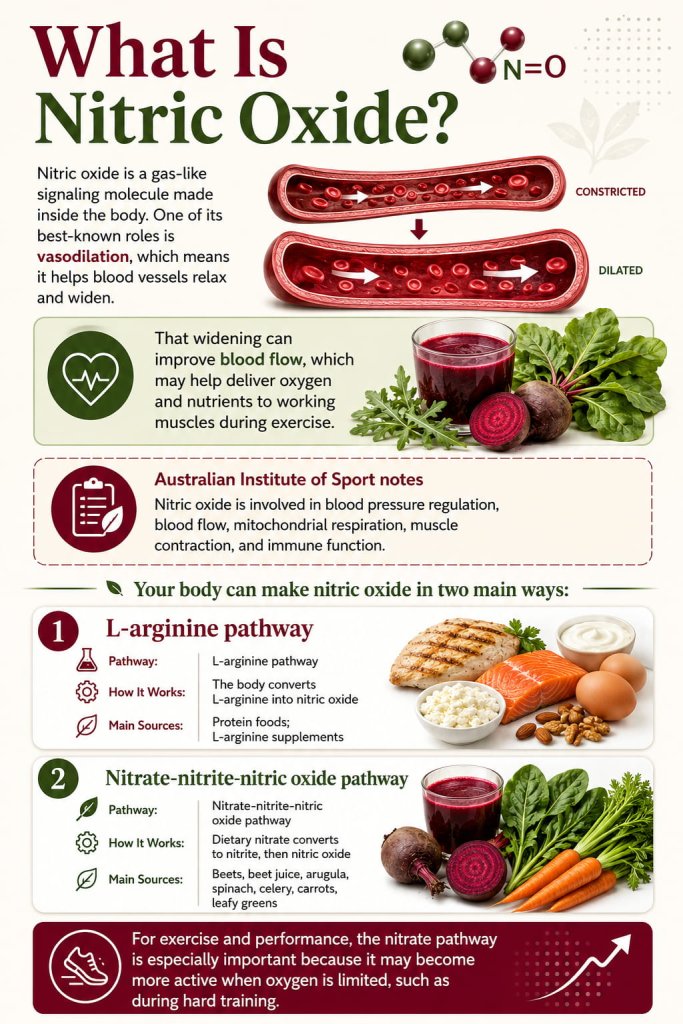
Nitric oxide is a gas-like signaling molecule made inside the body. One of its best-known roles is vasodilation, which means it helps blood vessels relax and widen.
That widening can improve blood flow, which may help deliver oxygen and nutrients to working muscles during exercise. The Australian Institute of Sport notes that nitric oxide is involved in blood pressure regulation, blood flow, mitochondrial respiration, muscle contraction, and immune function.
Your body can make nitric oxide in two main ways:
| Pathway | How It Works | Main Sources |
|---|---|---|
| L-arginine pathway | The body converts L-arginine into nitric oxide | Protein foods; L-arginine supplements |
| Nitrate-nitrite-nitric oxide pathway | Dietary nitrate converts to nitrite, then nitric oxide | Beets, beet juice, arugula, spinach, celery, carrots, leafy greens |
For exercise and performance, the nitrate pathway is especially important because it may become more active when oxygen is limited, such as during hard training.
Are Nitrates in Vegetables the Same as Nitrates in Processed Meat?
Not exactly. Nitrates from vegetables and nitrates or nitrites used in processed meats are discussed differently because they come in very different food contexts.
Vegetables such as beets, spinach, arugula, kale, lettuce, celery, and carrots naturally contain nitrate. Oregon State University Extension explains that the body can use nitrates from whole vegetables and some fruits—especially dark leafy greens and beetroot—to help produce nitric oxide. These foods also provide water, fiber, potassium, vitamin C, polyphenols, and other plant compounds that support overall diet quality.
Processed meats are different. Bacon, ham, deli meat, sausage, and hot dogs are treated through smoking, curing, salting, fermentation, or preservatives. The American Cancer Society states that processed meat is a known carcinogen and that processed meats can contain nitrates and nitrites that may damage DNA and increase cancer risk.
For this article, “dietary nitrate” mainly refers to nitrate from vegetables and beetroot products—not bacon, deli meat, hot dogs, sausage, or other processed meats.
Nitric Oxide Benefits: What the Evidence Actually Supports
Nitric oxide benefits are often overstated in supplement ads, but some benefits are biologically plausible and supported by research—especially when the focus is dietary nitrate.
1. It Helps Support Healthy Blood Flow

Nitric oxide helps relax blood vessel walls. When blood vessels relax, blood can move more easily through them.
That is why nitric oxide is often discussed in relation to circulation, exercise, and vascular health. This does not mean nitric oxide supplements are a treatment for heart disease or high blood pressure. It means nitric oxide is part of the body’s normal blood vessel function.
2. It May Improve Exercise Efficiency

Dietary nitrate may help the body use oxygen more efficiently during some forms of exercise. The NIH Office of Dietary Supplements explains that beets and beet juice are among the best food sources of nitrate, and the body can convert some of that nitrate into nitric oxide. This may increase blood flow and oxygen delivery to exercising muscles.
In practical terms, some people may feel that a steady endurance effort takes slightly less oxygen or feels more sustainable. This appears more likely in recreationally active people than in highly trained elite endurance athletes.
3. It May Support Endurance Performance

Beetroot juice has been studied most often for endurance-style activities such as running, cycling, swimming, and rowing.
According to the NIH Office of Dietary Supplements, many—but not all—studies have found that beet juice can improve performance and endurance in aerobic activities. The NIH also notes that beet juice appears more likely to help recreational exercisers than highly trained athletes.
A 2025 umbrella review in Sports Medicine found that dietary nitrate supplementation improved some exercise outcomes, including time-to-exhaustion tasks, total distance covered, muscular endurance, peak power output, and time to peak power output. However, the review also found no significant improvements for several other outcomes and noted quality limitations in many included reviews.
The best way to phrase this benefit is: dietary nitrate may help certain exercise outcomes, but results are not guaranteed.
How Big Are the Performance Benefits?
Nitric oxide support from dietary nitrate is best viewed as a small performance edge, not a dramatic boost. In studies, benefits often show up in specific outcomes such as time to exhaustion, repeated high-intensity efforts, or exercise efficiency.
That means one person may notice a slightly better endurance session, while another may feel no clear difference. Results depend on training status, dose, timing, diet, fitness level, and the type of exercise. Highly trained athletes may see smaller effects because their bodies are already very efficient at oxygen delivery and use.
4. It May Help Muscles During High-Intensity Efforts

Nitric oxide is involved in muscle contraction and mitochondrial function. Because of this, dietary nitrate may have potential benefits during certain high-intensity efforts, repeated sprints, or muscular endurance tasks.
The evidence is still mixed. The 2025 umbrella review found benefits for muscular endurance and peak power output, but not for every measure of strength, time trial performance, or maximal oxygen uptake.
So, nitric oxide support may be more relevant for:
- Repeated hard intervals
- Endurance training
- Time-to-exhaustion efforts
- Muscular endurance workouts
- Some team-sport demands
It is less reliable as a direct strength or muscle-building booster.
5. It May Support Normal Blood Pressure Regulation

Nitric oxide helps blood vessels relax, which is one reason it is connected to blood pressure regulation. Dietary nitrate has also been studied for vascular effects.
The Australian Institute of Sport notes that dietary nitrate supplementation has been shown to reduce blood pressure even in people with normal blood pressure. A 2024 review in the Journal of Functional Foods also reported that dietary nitrate supplementation may improve resting blood pressure and vascular function markers, though more research is needed on long-term use, dose, and safety. (sciencedirect.com)
This does not mean beet juice or nitric oxide supplements should be used as blood pressure treatment. Anyone with high blood pressure, low blood pressure, heart disease, kidney disease, or medication use should speak with a healthcare professional before using nitrate or nitric-oxide-related supplements.
Best Food Sources for Nitric Oxide Support
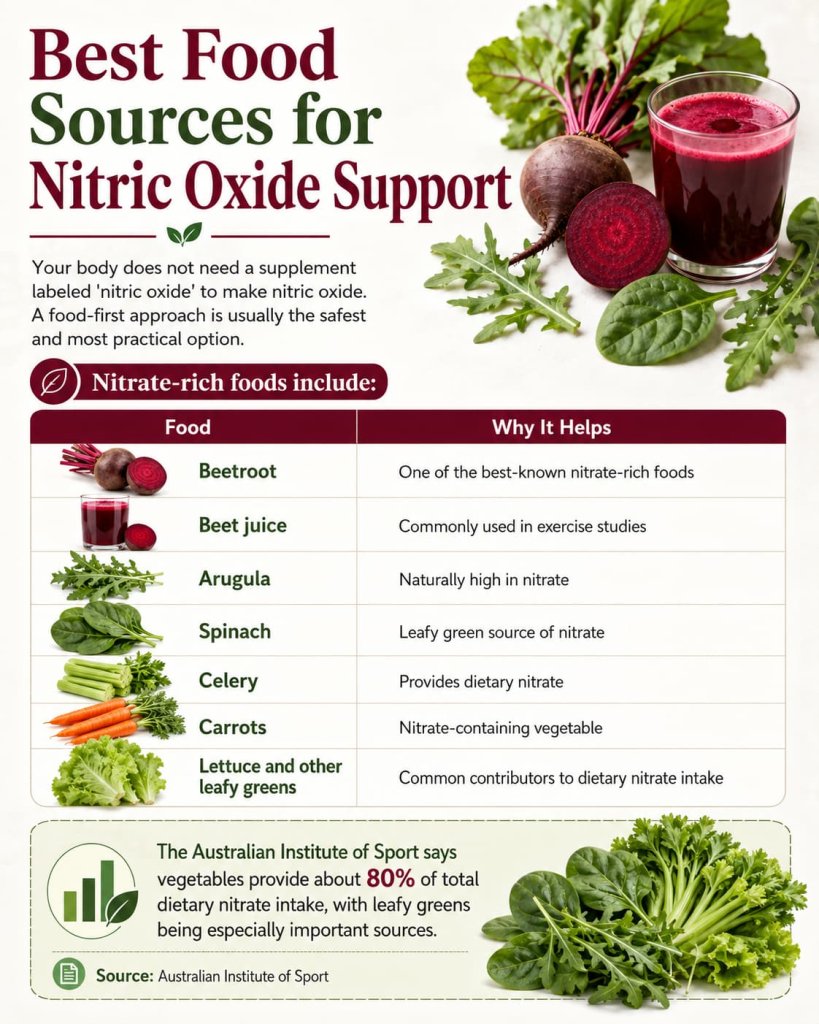
Your body does not need a supplement labeled “nitric oxide” to make nitric oxide. A food-first approach is usually the safest and most practical option.
Nitrate-rich foods include:
| Food | Why It Helps |
|---|---|
| Beetroot | One of the best-known nitrate-rich foods |
| Beet juice | Commonly used in exercise studies |
| Arugula | Naturally high in nitrate |
| Spinach | Leafy green source of nitrate |
| Celery | Provides dietary nitrate |
| Carrots | Nitrate-containing vegetable |
| Lettuce and other leafy greens | Common contributors to dietary nitrate intake |
The Australian Institute of Sport says vegetables provide about 80% of total dietary nitrate intake, with leafy greens being especially important sources.
Beetroot Juice and Nitric Oxide Benefits
Beetroot juice is the most researched food-based option for increasing nitrate intake before exercise.
The typical approach used in many studies is about 2 cups of beet juice roughly 2.5 to 3 hours before exercise, according to the NIH Office of Dietary Supplements.
The Australian Institute of Sport also reports that a typical research dose is around 6–8 mmol nitrate, or about 350–500 mg nitrate, often from a beetroot juice concentrate taken about 2–3 hours before exercise.
Simple Pre-Workout Beetroot Timing
| Goal | Practical Timing |
|---|---|
| Endurance workout | Beet juice or nitrate-rich meal 2–3 hours before |
| Race or event | Test during training first, never for the first time on race day |
| Daily food-based support | Eat nitrate-rich vegetables regularly |
| Sensitive stomach | Start with smaller amounts and assess tolerance |
Plasma nitrite levels may peak around 2.5 hours after dietary nitrate intake, which explains why taking beetroot juice immediately before exercise may not give the same effect.
When Beetroot Juice May Not Be Worth It Before Exercise
Beetroot juice is not necessary before every workout. It may be less useful for short, easy sessions, casual walks, light strength workouts, or days when stomach comfort matters more than performance.
You may also want to skip it before training if it causes bloating, nausea, diarrhea, reflux, or urgent bathroom trips. For races or competitions, test beetroot juice during normal training first so you know how your body responds. Never try a new beetroot product for the first time on race day.
Do Nitric Oxide Supplements Work?
It depends on the ingredient.
Many products marketed as nitric oxide boosters contain L-arginine, L-citrulline, beetroot powder, nitrates, caffeine, or multi-ingredient pre-workout blends. The label may sound simple, but the evidence varies a lot.
L-Arginine
L-arginine is an amino acid found in protein foods. The body can use it to make nitric oxide.
However, L-arginine supplements are not strongly supported for exercise performance. The NIH Office of Dietary Supplements states that arginine supplements appear to have little to no effect on strength training, muscle-building exercise, or aerobic activities such as running and cycling.
Arginine may also cause gastrointestinal discomfort at higher intakes and may slightly lower blood pressure. The NIH notes that up to 9 grams per day for several days or weeks appears safe in studies, while higher amounts can cause GI symptoms and blood pressure effects.
L-Citrulline
L-citrulline is another amino acid connected to nitric oxide. Your kidneys convert much of it into arginine, which can then be converted into nitric oxide.
Citrulline may raise blood arginine levels more efficiently than arginine itself, but exercise-performance results are still mixed. It should not be presented as a guaranteed strength, pump, or endurance enhancer.
Beetroot Powder
Beetroot powder can be useful if it provides a reliable nitrate dose, but products vary widely. Some beetroot powders may not contain the same nitrate amount used in studies.
The Australian Institute of Sport notes that few beetroot-based supplements have been independently tested for nitrate content, and preliminary research supports beetroot juice concentrates more than some other forms.
Multi-Ingredient Pre-Workouts
Be careful with pre-workout products that promise extreme pumps, blood flow, strength, fat loss, or stimulant energy. These formulas may combine nitric-oxide-related ingredients with caffeine, stimulants, sweeteners, or proprietary blends.
The FDA says dietary supplements are not approved for safety and effectiveness before they are marketed. Companies are responsible for making sure their products meet safety and labeling requirements.
Food vs Supplements: Which Is Better?
For most people, food is the better starting point.
| Option | Pros | Cons |
|---|---|---|
| Nitrate-rich vegetables | Nutrient-rich, food-first, supports overall diet quality | Nitrate dose can vary |
| Beet juice | Best-studied food-based option for exercise | May upset stomach; can stain urine/stool pink or red |
| Beetroot concentrate | Convenient; often used in sports settings | Product nitrate content can vary |
| L-arginine | Popular and widely available | Weak exercise-performance evidence |
| L-citrulline | Plausible mechanism | Mixed evidence; still a supplement |
| Pre-workout blends | Convenient | Higher risk of stimulants, hidden ingredients, and exaggerated claims |
USADA recommends a food-first approach for athletes interested in nitric oxide support and advises third-party-tested products if athletes choose supplements despite the risks.
Who May Benefit Most From Nitric Oxide Support?
Nitric oxide support through nitrate-rich foods may be most useful for:
- Recreational endurance athletes
- Runners, cyclists, rowers, and swimmers
- People doing repeated intervals or high-intensity sessions
- Active adults who do not already eat many vegetables
- People looking for a food-based pre-workout option
It may be less noticeable for:
- Highly trained endurance athletes
- People expecting major strength gains
- People who already eat a vegetable-rich diet
- Anyone using an underdosed or poorly tested supplement
- People whose main performance limits are sleep, training, recovery, hydration, or total calorie/protein intake
Who Should Be Careful?
Be cautious with nitric-oxide-related supplements if you:
- Take blood pressure medication
- Use nitrates such as nitroglycerin
- Take erectile dysfunction medication such as sildenafil
- Use blood thinners or anti-platelet medication
- Take diabetes medication
- Have kidney disease
- Have a history of calcium oxalate kidney stones or have been told to limit high-oxalate foods
- Have low blood pressure
- Have a history of heart attack
- Have asthma or allergy concerns
- Are pregnant, nursing, or trying to become pregnant
- Are scheduled for surgery
- Are buying stimulant-heavy pre-workout products
- Compete in drug-tested sports
Beets and spinach are nutritious, but they are also higher-oxalate foods. The National Kidney Foundation notes that people who form calcium oxalate kidney stones may benefit from limiting high-oxalate foods such as spinach, beets, Swiss chard, and rhubarb. If you have a kidney stone history, ask your clinician or dietitian how beetroot juice or high-spinach intake fits your personal plan.
Mayo Clinic notes that L-arginine may interact with blood pressure drugs, diabetes drugs, nitrates, anticoagulants, anti-platelet drugs, potassium-sparing diuretics, and sildenafil. Mayo Clinic also says L-arginine is not recommended for people who recently had a heart attack.
Safety Box: Nitric Oxide Supplements
Food-based nitrate from vegetables is usually the safest starting point. Supplements require more caution.
Before using a nitric oxide supplement, check the label carefully and talk with a healthcare professional if you take medication or have a medical condition.
Avoid products that promise unrealistic results such as instant muscle growth, extreme vascularity, fat loss, or disease-related benefits. The National Center for Complementary and Integrative Health warns that supplement labels may not always match what is inside the product, and some supplements can interact with medications or pose risks for certain people.
How to Increase Nitric Oxide Naturally
You can support normal nitric oxide production with basic lifestyle habits.
Eat More Nitrate-Rich Vegetables
Add arugula, spinach, beets, celery, lettuce, and carrots to meals. A salad with leafy greens and beets is a simple food-first option.
Try Beet Juice Before Key Workouts
For endurance or interval training, try beet juice 2–3 hours before exercise. Test it during training before using it before a race or competition.
Do Regular Exercise
Exercise itself supports blood vessel function and cardiovascular fitness over time. Nitric oxide is part of the body’s normal response to physical activity.
Avoid Antibacterial Mouthwash Around Nitrate Intake
The nitrate-to-nitrite conversion process depends partly on bacteria in the mouth. The Australian Institute of Sport notes that antibacterial mouthwash may blunt the rise in plasma nitrite after nitrate intake.
Focus on Sleep, Hydration, and Recovery
Nitric oxide support will not make up for poor recovery. If your goal is performance, your foundation still matters most: consistent training, adequate sleep, enough calories, enough protein, hydration, and smart progression.
Common Mistakes With Nitric Oxide Boosters
Expecting a Supplement to Replace Training
Nitric oxide support may give a small edge in certain conditions, but it will not replace progressive training, conditioning, or recovery.
Taking It Too Close to Exercise
Beetroot juice and dietary nitrate need time. Taking them immediately before exercise may miss the ideal window.
Assuming All Beet Products Are Equal
Beet juice, beetroot powder, beet chews, capsules, and concentrates can contain different nitrate amounts. A product with beet on the label is not automatically equivalent to what was used in research.
Using Antibacterial Mouthwash at the Wrong Time
Because oral bacteria help convert nitrate to nitrite, strong antibacterial mouthwash near nitrate intake may reduce the desired effect.
Ignoring Medication Interactions
This is especially important for blood pressure drugs, nitrates, erectile dysfunction medications, diabetes drugs, and blood thinners.
Nitric Oxide Benefits for Men and Women
Nitric oxide plays similar biological roles in men and women, including blood vessel relaxation and blood flow regulation. However, many exercise supplement studies have included more men than women, so the evidence is not always equally strong across sexes.
The best general advice is the same: start with nitrate-rich foods, test any performance strategy during normal training, and avoid overclaiming results.
Nitric Oxide Benefits for “Pump” and Muscle Growth
Many gym supplements promote nitric oxide for a better “pump.” A muscle pump happens when blood flow and fluid increase in working muscles during training.
A better pump can feel motivating, but it does not automatically mean more muscle growth. Muscle growth depends more on progressive resistance training, enough protein, enough total calories when needed, sleep, and consistency.
Nitric oxide support may help blood flow during exercise, but it should not be framed as a direct muscle-building shortcut.
Simple Food-Based Nitric Oxide Meal Ideas
Try these options if you want a natural, food-first approach:
- Beet and arugula salad with chicken, salmon, tofu, or beans
- Spinach smoothie with berries and plain Greek yogurt
- Roasted beets with eggs or lean protein
- Turkey or hummus wrap with spinach and shredded carrots
- Beet juice mixed into a smoothie before endurance training
- Celery, carrot, and leafy green salad with olive oil and vinegar
For everyday health, the goal is not to chase a perfect nitrate dose. It is to build a consistent pattern of vegetable-rich meals.
FAQ About Nitric Oxide Benefits
What are the main nitric oxide benefits?
The main nitric oxide benefits include supporting blood vessel relaxation, healthy blood flow, oxygen delivery, and some exercise-performance outcomes. The strongest practical evidence is for dietary nitrate from beetroot juice and nitrate-rich vegetables.
Is nitric oxide good for workouts?
It may help certain workouts, especially endurance exercise, time-to-exhaustion efforts, and some muscular endurance tasks. It is not guaranteed to improve every workout or every type of performance.
What foods increase nitric oxide naturally?
Beets, beet juice, arugula, spinach, celery, carrots, lettuce, and other leafy greens can support nitric oxide production because they provide dietary nitrate.
Is beet juice better than nitric oxide pills?
For most people, beet juice or nitrate-rich foods are better first choices because they are food-based and better studied for exercise than many nitric oxide booster pills. Supplements vary in quality, dose, and ingredient transparency.
Does L-arginine increase nitric oxide?
L-arginine can be converted into nitric oxide in the body, but L-arginine supplements have limited evidence for improving exercise performance. The NIH Office of Dietary Supplements says arginine supplements appear to have little to no effect on strength, muscle-building exercise, or aerobic activities.
How long before exercise should I take beet juice?
Many studies use beet juice about 2.5 to 3 hours before exercise. This gives the body time to convert nitrate into nitrite and nitric oxide.
Can nitric oxide supplements lower blood pressure too much?
Some nitric-oxide-related supplements may affect blood pressure, especially when combined with blood pressure medication, nitrates, or erectile dysfunction drugs. Ask a healthcare professional before using them if you take medication or have a heart or blood pressure condition.
Are nitric oxide supplements safe for athletes?
They carry extra risk for drug-tested athletes because supplement labels may not always reflect the full contents. USADA recommends food first and third-party-certified supplements if an athlete chooses to use supplements.
Conclusion
Nitric oxide benefits are real, but they are often exaggerated. The most useful takeaway is simple: your body already makes nitric oxide, and you can support that process through nitrate-rich foods such as beets, beet juice, arugula, spinach, celery, and carrots.
For exercise, beetroot juice and dietary nitrate may help some people improve endurance, exercise efficiency, or muscular endurance, especially when taken a few hours before training. But supplements are not guaranteed to work, and some can interact with medications or create safety concerns.
Start with food, test any strategy during regular training, and talk with a healthcare professional before using nitric-oxide-related supplements if you take medication or have a medical condition.
This content is for informational purposes only and not medical advice.
Sources/References
- NIH Office of Dietary Supplements — Dietary Supplements for Exercise and Athletic Performance
- Australian Institute of Sport — Dietary Nitrate / Beetroot Juice
- Sports Medicine — Dietary Nitrate Supplementation and Exercise Performance: An Umbrella Review
- Journal of Functional Foods — Dietary Nitrate Supplementation and Cardiovascular Health
- FDA — Information for Consumers on Using Dietary Supplements
- USADA — Do Athletes Really Need Nitric Oxide Supplements to Boost Performance?
- NCCIH — Using Dietary Supplements Wisely