
Lettuce is very low in calories. Most plain raw lettuce has about 10 to 15 calories per serving, and common types such as iceberg, leaf lettuce, and romaine are typically in the mid-teens per 100 grams. According to the USDA, lettuce is one of the easiest foods to add for volume, crunch, and freshness without adding many calories.
That matters if you are trying to build lighter meals, manage portions, or choose foods that help you feel satisfied without pushing calories up fast. The exact number depends on the type of lettuce and how much you eat, but plain lettuce is almost always a low-calorie choice.
How Many Calories Are in Lettuce?
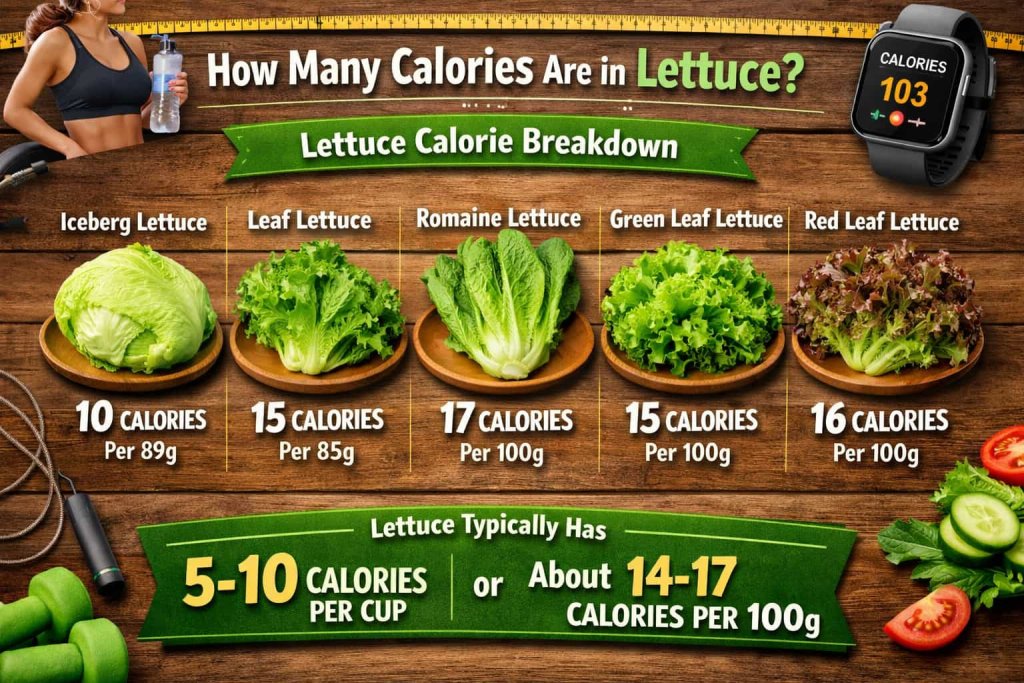
For a practical everyday answer, here are the calorie numbers most readers need:
- Iceberg lettuce: about 10 calories per 89 grams
- Leaf lettuce: about 15 calories per 85 grams
- Romaine lettuce: about 17 calories per 100 grams
- Green leaf lettuce: about 15 calories per 100 grams
- Red leaf lettuce: about 16 calories per 100 grams
A simple takeaway is that lettuce usually has about 5 to 10 calories per cup and about 14 to 17 calories per 100 grams, depending on the variety.
Calories in 1 Cup of Lettuce
For a quick household guide, plain shredded lettuce is usually very low in calories:
- 1 cup shredded iceberg lettuce: about 10 calories
- 1 cup shredded romaine lettuce: about 8 calories
- 1 cup shredded green leaf lettuce: about 5 calories
The exact number depends on how tightly the cup is packed and which lettuce type you use, but for most readers, lettuce stays in the single digits to around 10 calories per cup.
Lettuce Calories by Type
Iceberg Lettuce Calories
The FDA lists iceberg lettuce at 10 calories for 1/6 of a medium head, or 89 grams. Iceberg is especially popular when people want crunch, bulk, and a very low-calorie base for sandwiches, wraps, and salads.
Leaf Lettuce Calories
The FDA also lists leaf lettuce at 15 calories for 1 1/2 cups shredded, or 85 grams. This includes the loose-leaf styles many people use in salads and burger toppings.
Romaine Lettuce Calories
According to USDA FoodData Central, romaine lettuce has about 17 calories per 100 grams. Romaine is still very low in calories, but it usually offers a bit more nutritional value than iceberg.
Green Leaf and Red Leaf Lettuce Calories
USDA data commonly place green leaf lettuce at about 15 calories per 100 grams and red leaf lettuce at about 16 calories per 100 grams. In real meals, both are low-calorie foods that work well when you want a more nutrient-dense salad base.
Nutrition Profile of Lettuce
Lettuce is low in calories, but it still contributes useful nutrients.
Here is a simple nutrition snapshot:
| Type of lettuce | Serving reference | Calories | Notable nutrition points |
|---|---|---|---|
| Iceberg | 89 g | 10 | Very low calorie, provides some vitamin A and small amounts of fiber |
| Leaf lettuce | 85 g | 15 | Low calorie, higher vitamin A than iceberg |
| Romaine | 100 g | 17 | Low calorie, useful source of vitamin A, vitamin K, and folate |
| Green leaf | 100 g | 15 | Low calorie, good source of vitamin K and vitamin A |
| Red leaf | 100 g | 16 | Low calorie, provides vitamin K, vitamin A, and some vitamin C |
Lettuce is mostly water, which is one reason it is so low in calories. It also provides small amounts of carbohydrate and fiber, with darker leafy types generally offering more vitamins than paler types.
Key Nutrients in Lettuce
Lettuce is not a high-calorie food, but it can still help improve the nutrient quality of a meal.
Vitamin K
According to MedlinePlus, green leafy vegetables such as romaine and green leaf lettuce are sources of vitamin K. This vitamin plays an important role in normal blood clotting.
Vitamin A
The FDA raw vegetable chart shows that leaf lettuce provides much more vitamin A than iceberg in a similar serving format. That is one reason darker lettuce varieties are often considered more nutrient-dense.
Folate
Romaine and other leafy lettuces can also add folate, a nutrient involved in normal cell growth and function.
Small Amounts of Fiber and Potassium
Lettuce is not a major fiber source compared with beans, oats, or berries, but it still adds some fiber and potassium to meals, especially when you eat larger salad portions.
Is Lettuce Good for Weight Management?
Yes, lettuce can be helpful for weight management.
The reason is simple: it adds volume, texture, and meal size for very few calories. That can make meals feel more substantial without adding much energy.
According to the Harvard T.H. Chan School of Public Health, eating non-starchy vegetables and green leafy vegetables may support weight loss and help with appetite control as part of an overall healthy eating pattern.
Lettuce is most useful for weight management when you use it in ways like these:
- Build a large salad with lean protein and beans
- Add lettuce to sandwiches and wraps to increase volume
- Use lettuce as a base under grilled chicken, tuna, eggs, or tofu
- Replace part of a higher-calorie side dish with a simple salad
Lettuce alone does not cause weight loss, but it can support a lower-calorie, higher-volume eating pattern.
That said, lettuce by itself is usually not very filling for long because it is so low in calories, protein, and fiber. For a more satisfying meal, pair it with foods such as chicken, eggs, tuna, tofu, beans, Greek yogurt dressing, nuts, or other higher-protein and higher-fiber ingredients.
Why Lettuce Calories Change in Real Meals
Plain lettuce is very low in calories. The bigger calorie jump usually comes from what goes on it.
A salad can go from very light to very calorie-dense when you add:
- Creamy dressings
- Large amounts of cheese
- Fried toppings
- Candied nuts
- Croutons
- Bacon
- Heavy amounts of oil
A bowl of lettuce itself may be very low in calories, but the full salad can be much higher depending on the extras. That is why it helps to look at the entire meal, not just the lettuce.
In many salads, the dressing changes the calorie total more than the lettuce does. A light vinaigrette used sparingly may keep calories reasonable, while large amounts of creamy dressing can quickly turn a very low-calorie salad base into a much heavier meal.
Are Lettuce Wraps a Good Lower-Calorie Swap?
Yes, lettuce wraps can be a helpful lower-calorie swap when you want to reduce the calories from bread, buns, or tortillas.
The lettuce itself adds very few calories, while a bun, wrap, or slices of bread can add far more. Using large lettuce leaves for burgers, tacos, or sandwich-style wraps can help lower the total calorie count of a meal while still adding crunch and volume.
This works best when the filling is balanced. If the wrap is packed with fried foods, creamy sauces, or heavy cheese, the meal can still end up high in calories. The biggest benefit comes from using lettuce to replace a refined carb base while keeping the fillings simple and protein-rich.
Who Should Be a Little More Careful?
Lettuce is a healthy choice for most people, but there are a few situations where extra care makes sense.
People Taking Warfarin
MedlinePlus notes that green leafy vegetables, including some types of lettuce, contain vitamin K. If you take warfarin, the goal is usually not to avoid lettuce completely. The key is to keep your vitamin K intake reasonably consistent from week to week and follow your clinician’s guidance.
People at Higher Risk From Foodborne Illness
Because lettuce is often eaten raw, safe handling matters. The CDC says unwashed fresh fruits and vegetables, including lettuce and other leafy greens, are a riskier choice, while washed produce is safer.
Anyone Eating Bagged or Fresh Lettuce Without Washing It
The CDC guidance makes washing especially important when lettuce will be eaten raw. Safe handling and refrigeration help lower food-safety risk at home.
How to Wash and Store Lettuce Safely
Food safety is worth mentioning in any lettuce article because lettuce is usually eaten raw.
Use these basics:
- Wash lettuce under running water
- Do not use soap or detergent
- Keep lettuce away from raw meat and poultry
- Refrigerate perishable produce promptly
- Discard lettuce that looks slimy or spoiled
The FDA produce safety guidance recommends washing produce thoroughly under running water before preparing or eating it and says soap, detergent, and commercial produce wash are not recommended. The FDA also advises storing perishable produce like lettuce in a clean refrigerator at 40°F or below.
Best Lettuce Choice for Calories and Nutrition
The best choice depends on your goal.
Best for the Fewest Calories and Extra Crunch
Iceberg is a great fit when you want a crisp texture and very low calories.
A quick way to think about iceberg vs romaine is this: iceberg is slightly lower in calories, but romaine usually gives you more vitamins per bite. The calorie difference is small, so nutrition and taste are usually the better deciding factors.
Best for More Vitamins
Romaine, green leaf, and red leaf are usually the better picks when you want more vitamin A, vitamin K, and folate.
Best Overall Practical Choice
Romaine is often the most balanced option because it stays very low in calories while offering a stronger nutrition profile than iceberg.
Simple Takeaway on How Many Calories in Lettuce
Lettuce is one of the lowest-calorie foods you can eat. Plain lettuce usually provides about 10 to 15 calories per serving and around 14 to 17 calories per 100 grams, depending on the variety.
That makes it a smart food for adding bulk to meals, building lighter salads, and supporting weight-management goals. If you want the most nutrition, darker leafy types like romaine, green leaf, and red leaf are usually the stronger choices. If you want the crispest, lightest option, iceberg still works well.
A simple way to use lettuce well is to focus on the full meal: keep the lettuce, add a quality protein, and be mindful of high-calorie toppings and dressings.
FAQs
How Many Calories Are in 1 Cup of Lettuce?
It depends on the type, but lettuce is usually very low in calories. A cup of shredded lettuce often falls around 5 to 10 calories.
Is Lettuce Good for Weight Loss?
Lettuce can support weight loss because it is very low in calories and adds volume to meals. It works best as part of an overall balanced eating pattern.
Which Lettuce Has the Fewest Calories?
Iceberg lettuce is usually among the lowest-calorie options, but the differences between common lettuce types are small.
Is Romaine Healthier Than Iceberg?
Romaine is usually considered more nutrient-dense because it provides more vitamin A, vitamin K, and folate, while still staying very low in calories.
Sources/References
- USDA — FoodData Central
- FDA — Nutrition Information for Raw Vegetables
- Harvard T.H. Chan School of Public Health — Vegetables and Fruits
- MedlinePlus — Vitamin K: MedlinePlus Medical Encyclopedia
- CDC — Safer Food Choices
- FDA — Selecting and Serving Produce Safely