
The best trap workouts for men combine shrugs, rows, carries, and lower-trap-focused raises so you build the upper, middle, and lower trapezius, not just the top of the muscle. That matters because the traps help support posture, shoulder blade control, neck movement, and upper-back stability, so a better trap routine can improve both size and function. The trapezius is a large upper-back muscle with upper, middle, and lower fibers, according to Cleveland Clinic.
If your goal is a bigger upper back, the smartest approach is simple: train traps through heavy loaded movements, direct shrug work, and balanced upper-back exercises at least twice per week as part of an overall resistance-training plan. The CDC recommends muscle-strengthening activity at least 2 days per week, and the new ACSM resistance-training update emphasizes that consistency matters more than a complicated program.
Why Trap Workouts for Men Matter
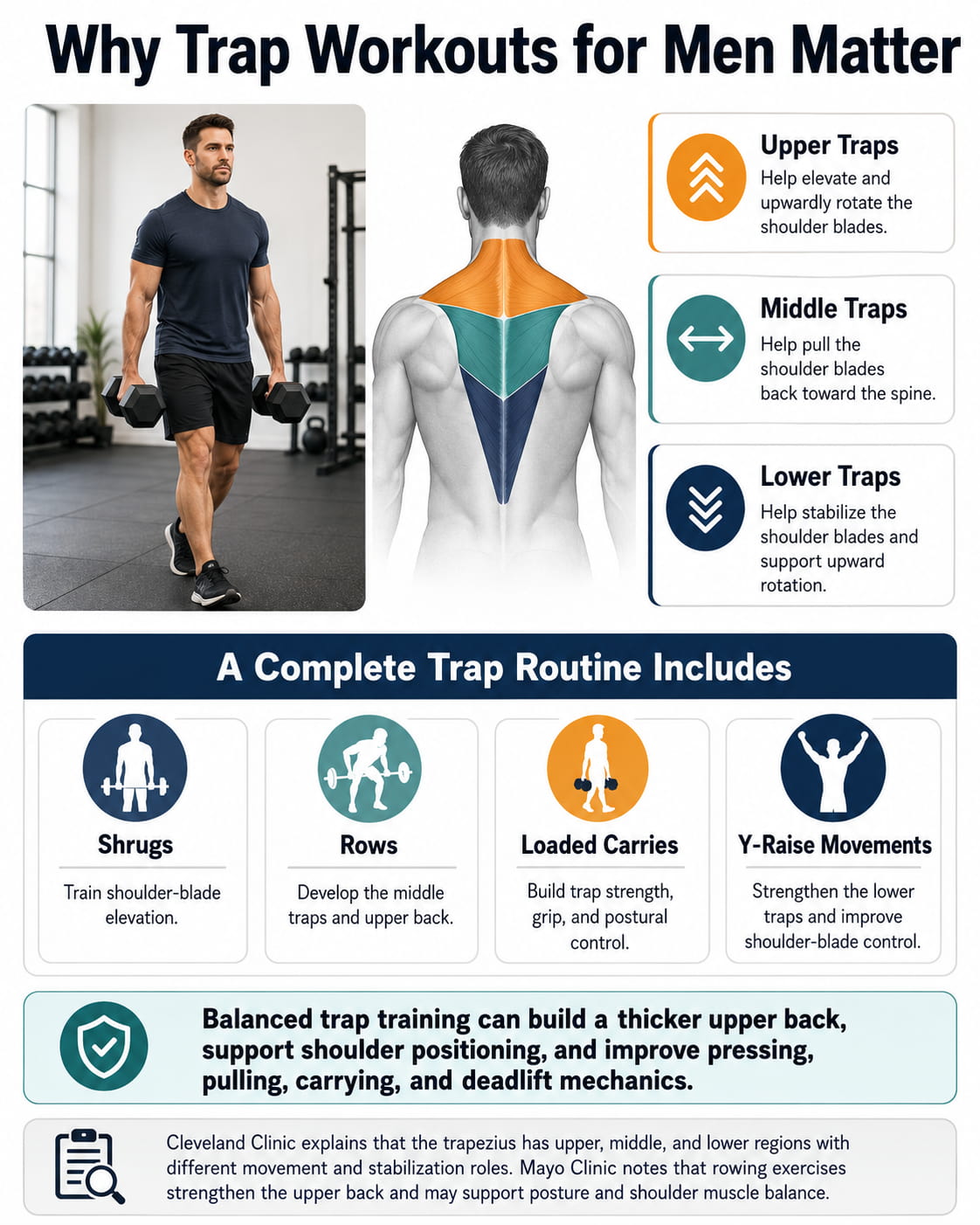
Many men train traps mostly with shrugs, but that leaves out a big part of what the trapezius actually does. The upper fibers help elevate and upwardly rotate the scapula, the middle fibers help retract it, and the lower fibers help stabilize and assist with upward rotation. That is why the best trap workouts for men usually include shrugs, rows, carries, and Y-raise-style movements rather than one exercise pattern alone, as explained by Cleveland Clinic.
A balanced trap routine can help you build a thicker upper back, improve shoulder positioning, and support better lifting mechanics in pressing, pulling, and deadlift patterns. Mayo Clinic notes that row variations work the upper back and can help posture and muscle balance in the shoulder.
12 Best Trap Workouts for Men
Build a bigger upper back with these 12 best trap workouts for men, including shrugs, rows, carries, and lower-trap moves for complete development. Learn which exercises help improve trap size, strength, posture, and overall upper-back balance.
1. Barbell Shrug
Why it works: Barbell shrugs are one of the most direct ways to load the upper traps heavily. A study indexed by PubMed found the shoulder shrug produced the greatest upper-trapezius activity among the tested exercises.
Muscles worked: Upper trapezius, levator scapulae, forearms.
How to do it:
- Stand tall holding a barbell with hands about shoulder-width apart.
- Keep your chest up and core braced.
- Lift your shoulders straight up toward your ears.
- Pause briefly at the top.
- Lower under control.
- Do not roll the shoulders.
Trainer Tip: Think straight up and straight down. Rolling the shoulders adds motion but not useful trap work. ACE warns against shoulder rolling during shrugs.
2. Dumbbell Shrug
Why it works: Dumbbell shrugs let your shoulders move more naturally and are easy to scale. They are a practical choice for home gyms and for men who find a barbell setup awkward. ACE cues a braced torso and controlled shoulder movement for the standing shrug.
Muscles worked: Upper trapezius, forearms, grip muscles.
How to do it:
- Hold a dumbbell in each hand at your sides.
- Stand tall with your ribs stacked over your pelvis.
- Lift both shoulders upward as high as you can control.
- Pause at the top without jutting the chin forward.
- Lower slowly.
Trainer Tip: Use straps only after grip becomes the limiting factor. First, make sure the traps are actually doing the work.
3. Farmer’s Carry
Why it works: Farmer’s carries train the traps as stabilizers under load while also challenging grip, core stiffness, and posture. This makes them useful for men who want traps that look strong and perform well in real lifting patterns. The trapezius helps maintain posture and stabilize the shoulder girdle, according to Cleveland Clinic.
Muscles worked: Upper traps, forearms, grip, core, glutes.
How to do it:
- Pick up a heavy dumbbell or kettlebell in each hand.
- Stand tall and keep your shoulders set.
- Walk slowly with short, controlled steps.
- Keep your neck neutral and avoid leaning side to side.
- Set the weights down with control.
Trainer Tip: Do not shrug on purpose the whole time. Let the load challenge your posture while you stay tall.
4. Rack Pull
Why it works: Rack pulls overload the upper back and traps with heavier weights than many men can use in a full deadlift. They are especially useful for building upper-back thickness. Because traps work hard to stabilize the shoulder girdle during heavy pulling, rack pulls fit well in a trap-building plan, based on trapezius function described by Cleveland Clinic.
Muscles worked: Upper traps, middle traps, spinal erectors, glutes, hamstrings.
How to do it:
- Set a barbell on pins just below or around knee height.
- Stand close to the bar with feet hip-width apart.
- Brace your core and hinge at the hips.
- Grip the bar and pull it to standing.
- Lock out without leaning back hard.
- Lower to the pins with control.
Trainer Tip: Keep the movement strict. Turning a rack pull into a bouncing partial deadlift usually shifts focus away from the upper back.
5. Bent-Over Row
Why it works: Bent-over rows build the middle traps and the rest of the upper back while helping balance out pressing-heavy routines. Mayo Clinic cues a straight spine and controlled pull until the elbow lines up near shoulder level.
Muscles worked: Middle traps, rhomboids, lats, rear delts, biceps.
How to do it:
- Hold a dumbbell or barbell and hinge forward at the hips.
- Keep your spine neutral and core tight.
- Let your arms hang below your shoulders.
- Pull the weight toward your lower ribs or waist.
- Squeeze your shoulder blades together.
- Lower slowly.
Trainer Tip: If your lower back tires before your upper back, reduce the load or switch to a chest-supported row.
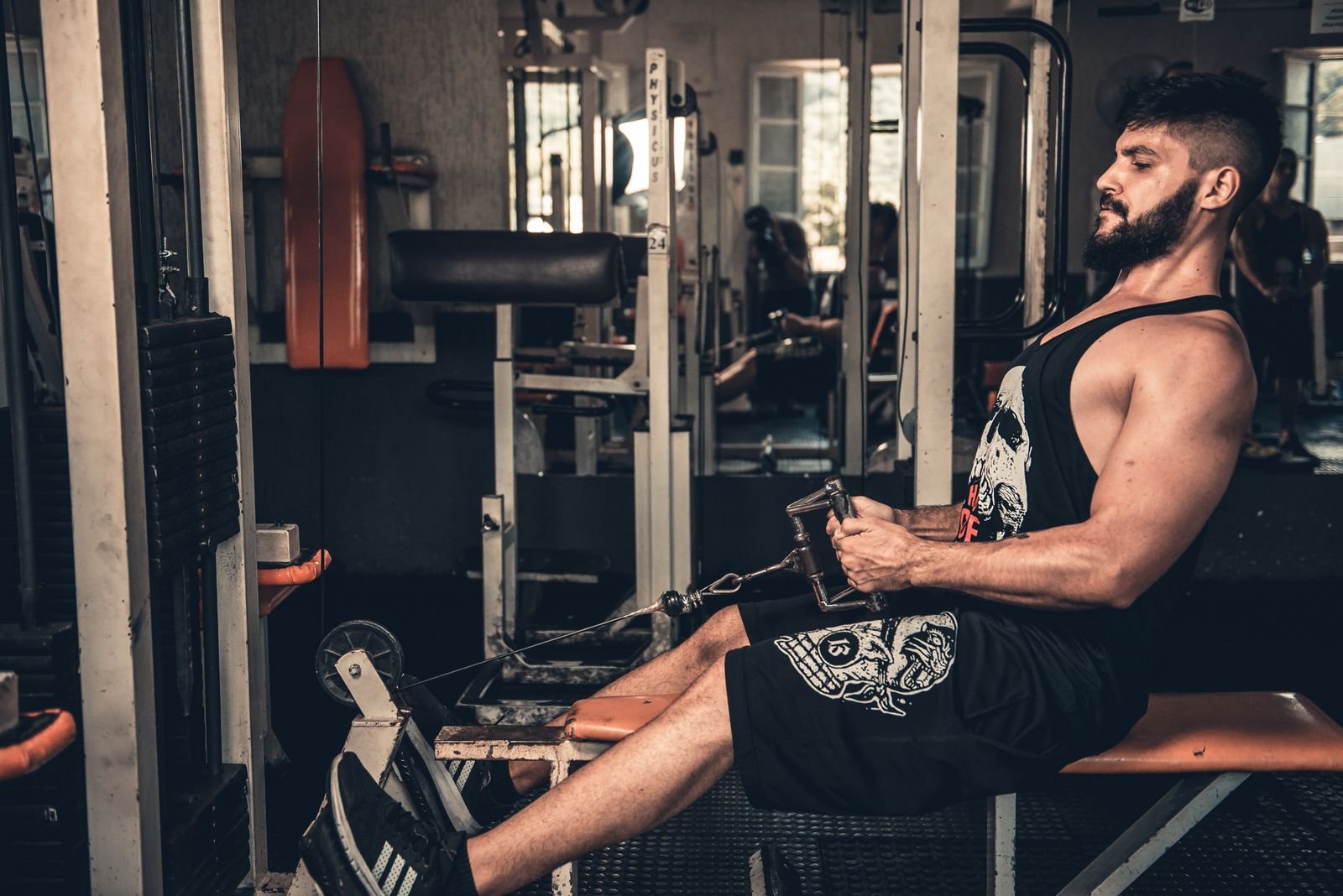
6. Seated Cable Row
Why it works: Seated cable rows are easy to control and great for training scapular retraction. Mayo Clinic describes the seated row as an upper-back exercise that supports posture and shoulder balance.
Muscles worked: Middle traps, rhomboids, lats, rear delts, biceps.
How to do it:
- Sit with your chest tall and knees slightly bent.
- Reach forward to grasp the handle.
- Pull the handle toward your waist.
- Bring your shoulders back without shrugging.
- Pause briefly.
- Return with control.
Trainer Tip: Do not turn every row into a lower-back lean. Keep the movement mostly in the arms and shoulder blades.
7. Chest-Supported Row
Why it works: Chest-supported rows reduce lower-back fatigue and let you focus more directly on the upper and middle back. That makes them especially useful when your goal is pure upper-back volume after heavy pulling. This fits the trapezius role in upper-back function described by Cleveland Clinic.
Muscles worked: Middle traps, rhomboids, rear delts, lats, biceps.
How to do it:
- Lie face down on an incline bench.
- Hold dumbbells with arms hanging straight down.
- Pull the weights back until your elbows pass your torso.
- Squeeze your shoulder blades together.
- Lower under control.
Trainer Tip: Slightly flaring the elbows can increase upper-back emphasis, but keep the shoulder position comfortable.
8. Face Pull
Why it works: Face pulls help train the upper back, rear delts, and scapular control. They are also a useful balance exercise for men who do a lot of bench pressing or front-dominant shoulder work. Research available in PMC supports using exercises that improve periscapular muscle ratios and control rather than only chasing upper-trap load.
Muscles worked: Middle traps, lower traps, rear delts, external rotators.
How to do it:
- Set a rope attachment at upper-chest or face height.
- Grab the rope with both hands.
- Step back to create tension.
- Pull the rope toward your face with elbows high.
- Let the shoulder blades move back naturally.
- Return slowly.
Trainer Tip: Keep the ribs down. If you lean back to cheat the rep, you lose the clean upper-back work.
9. Reverse Fly
Why it works: Reverse flyes help build the rear shoulder and upper back, and some EMG work has shown strong upper-trapezius activation during reverse-fly patterns. They are a good lighter accessory after rows or shrugs, based on findings discussed in ResearchGate.
Muscles worked: Middle traps, rear delts, rhomboids, upper traps.
How to do it:
- Hinge forward or lie on an incline bench.
- Hold light dumbbells with palms facing each other.
- Raise the arms out to the sides.
- Stop when the arms are near shoulder level.
- Lower slowly.
Trainer Tip: Use lighter weights than you think. Reverse flyes usually work better with clean motion than with momentum.
10. Upright Row
Why it works: Upright rows can train the upper traps and shoulders together, making them a time-efficient option for some lifters. They are not essential, but they can fit well when performed with a comfortable range and grip width. Because shoulder tolerance varies, this is one of the exercises to approach more carefully. This practical caution fits the broader functional view of the trapezius from Cleveland Clinic.
Muscles worked: Upper traps, deltoids, forearms.
How to do it:
- Hold a barbell, EZ-bar, or dumbbells in front of your thighs.
- Pull the weight upward close to your body.
- Stop around lower chest to upper chest height if that feels comfortable.
- Lower with control.
- Keep the wrists neutral as much as possible.
Trainer Tip: A wider grip or dumbbells often feel better than a very narrow straight-bar grip.
11. Prone Y-Raise
Why it works: The prone Y-raise is one of the best-known lower-trap exercises. The classic EMG study in PubMed found that the overhead arm raise in line with the lower trapezius produced maximum lower-trapezius activity, and newer work still describes the prone Y as a gold-standard lower-trap option.
Muscles worked: Lower traps, middle traps, rear delts, rotator cuff stabilizers.
How to do it:
- Lie face down on an incline bench or stability ball.
- Hold very light dumbbells or no load.
- Raise your arms in a Y shape overhead.
- Keep your thumbs pointed up.
- Pause briefly.
- Lower slowly.
Trainer Tip: This is not a heavy exercise. Small weights and excellent control usually work best.
12. Scapular Retraction Drill
Why it works: Not every trap movement needs to be heavy. EMG research in PMC found that scapular retraction markedly activated the lower trapezius in the tested conditions. That makes simple retraction drills useful for balance, warm-ups, and finishing work.
Muscles worked: Middle traps, lower traps, rhomboids.
How to do it:
- Use a cable, band, or light row handle.
- Start with the arms extended.
- Pull the shoulder blades back first.
- Keep the elbows mostly straight or only slightly bent, depending on the setup.
- Pause at the squeezed position.
- Return with control.
Trainer Tip: Think shoulder blades first, arms second. That cue usually improves the quality of the rep.
How to Build the Best Trap Workout for Men
The best trap workouts for men usually mix one heavy overload move, one direct trap move, one row, and one lower-trap or scapular-control exercise. That gives you size work without ignoring balance and shoulder mechanics. The latest ACSM guidance supports tailoring training variables to the goal while keeping the main priority on regular, sustainable resistance training.
A practical trap workout for hypertrophy could look like this:
- Rack Pull: 3 to 4 sets of 5 to 8 reps
- Barbell Shrug: 3 to 4 sets of 8 to 12 reps
- Chest-Supported Row: 3 sets of 8 to 12 reps
- Face Pull: 2 to 3 sets of 12 to 15 reps
- Prone Y-Raise: 2 to 3 sets of 10 to 15 reps
A practical pull-day trap add-on could look like this:
- Dumbbell Shrug: 3 sets of 10 to 15 reps
- Seated Cable Row: 3 sets of 8 to 12 reps
- Reverse Fly: 2 to 3 sets of 12 to 15 reps
- Farmer’s Carry: 3 rounds of 20 to 40 meters
How Often Should Men Train Traps?
Most men do well training traps 2 times per week as part of a pull day, upper-body day, or full-body plan. That matches broader public-health guidance on muscle-strengthening frequency from the CDC and WHO. The new ACSM update also emphasizes that going from no resistance training to consistent training produces the biggest benefits.
For size, start with roughly 10 to 16 total hard trap-focused sets per week across different movement patterns, then adjust based on recovery, soreness, and progress. That weekly range is a practical evidence-informed coaching estimate built from current hypertrophy principles rather than a fixed official rule.
Common Mistakes in Trap Workouts for Men
The biggest mistake is training only the upper traps. That can leave your routine incomplete and may not do much for the middle and lower fibers that help with scapular control and upper-back balance, as explained by Cleveland Clinic.
Other common mistakes include:
- Going too heavy on shrugs and turning them into partial-body jerks
- Rolling the shoulders during shrugs
- Letting rows become lower-back swings
- Skipping lower-trap work like Y-raises or scapular retraction drills
- Training traps hard every day without enough recovery
Are Trap Workouts for Men Enough to Build a Bigger Upper Back?
Trap workouts help a lot, but they work best inside a broader upper-back plan that also includes lats, rear delts, and other scapular muscles. The trapezius is a major part of upper-back size, but it is not the only part. If your goal is a visibly bigger upper back, combine trap training with rows, pulldowns or pull-ups, rear-delt work, and steady progressive overload.
FAQs About Trap Workouts for Men
Are shrugs enough for trap growth?
No. Shrugs are excellent for upper traps, but the best trap workouts for men also include rows, carries, and lower-trap work so the whole muscle gets trained more completely. The muscle-activation findings in PubMed support that more than one movement pattern matters.
What are the best trap workouts for men at home?
Dumbbell shrugs, farmer’s carries, bent-over rows, reverse flyes, and prone Y-raises are some of the best home-friendly choices because they cover upper, middle, and lower trap functions without needing large machines.
How many trap exercises should men do in one workout?
Usually 2 to 4 trap-focused exercises in one session is enough, especially if your plan already includes deadlifts, rows, or pull-ups. More is not always better if form and recovery start to drop. This is a practical programming recommendation based on current resistance-training guidance, not a fixed official limit.
Can trap workouts improve posture?
They can help support posture when they are part of a balanced program, especially when you include rows and scapular-control work. Mayo Clinic notes that seated rows can help posture and shoulder muscle balance.
Should I train traps on pull day or shoulder day?
Either can work. Many men put most trap work on pull day because rows, carries, and rack pulls fit naturally there, while shrugs can also work well on shoulder day.
Are upright rows necessary for bigger traps?
No. They can be useful for some lifters, but you can build big traps without them by using shrugs, carries, rows, rack pulls, and Y-raises.
What if trap workouts bother my neck or shoulders?
Reduce the load, tighten up form, and switch to better-tolerated options like chest-supported rows, lighter shrugs, or carries. If symptoms are sharp, worsening, or persistent, get individualized guidance before pushing through.
Conclusion
The best trap workouts for men are not just heavy shrugs. They combine direct upper-trap work, rowing patterns, loaded carries, and lower-trap exercises so you can build a bigger upper back that also moves and stabilizes well. Start with controlled form, train traps at least twice per week inside a balanced strength plan, and progress load gradually over time. That simple approach is far more useful than chasing flashy exercises.