
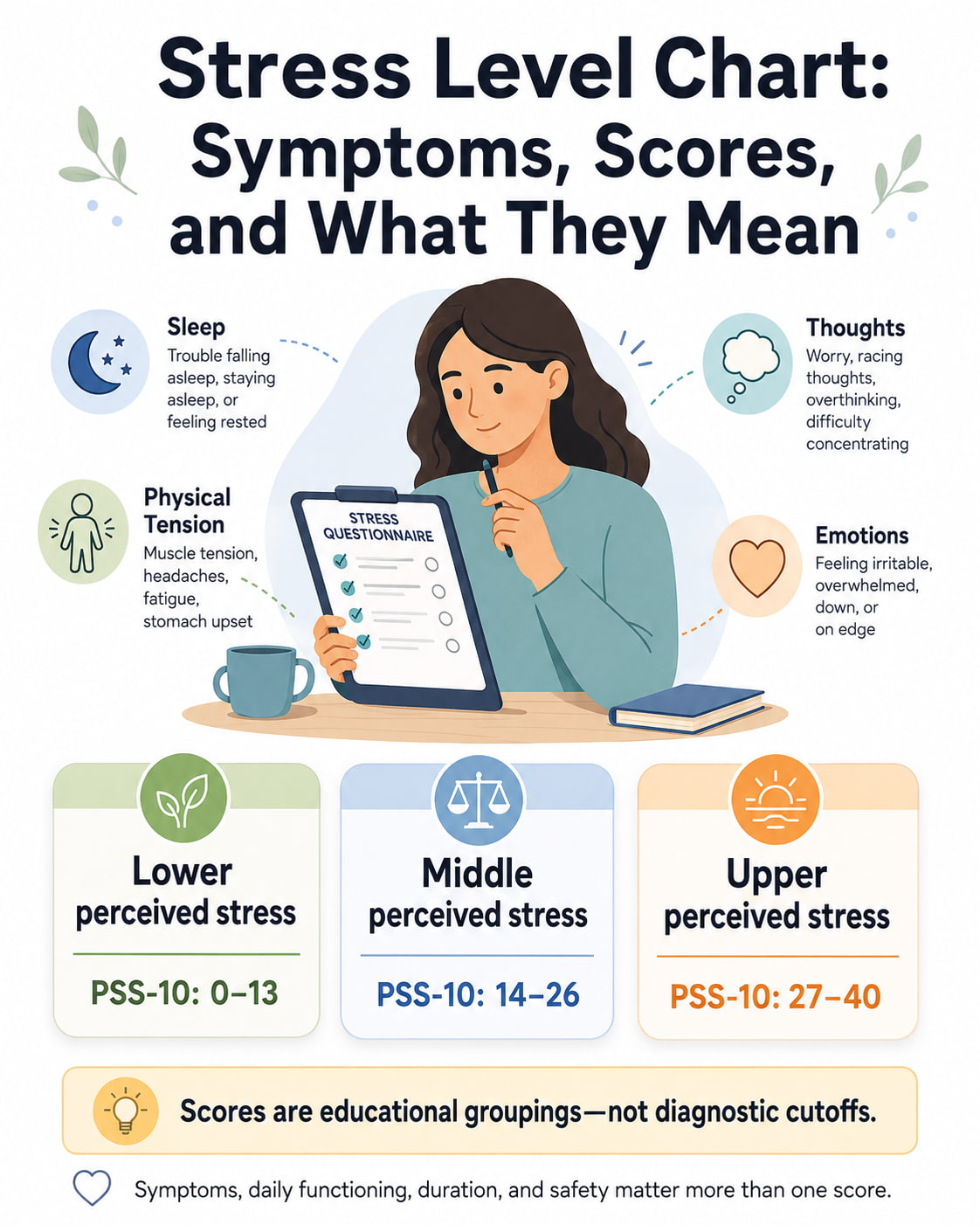
A stress level chart can help you compare your symptoms and Perceived Stress Scale score, but it cannot diagnose stress, anxiety, or another mental health condition. Your ability to function, how long symptoms last, and whether you feel safe matter more than any single number.
Stress is a natural response to demands, uncertainty, or difficult situations. A small amount may improve alertness or motivation, but persistent stress can affect sleep, concentration, mood, behavior, and physical well-being. The World Health Organization emphasizes that people respond to stress differently, so the same situation or score may affect two people in very different ways.
This guide explains commonly used stress score ranges, possible symptoms, and practical next steps.
Stress Level Chart at a Glance
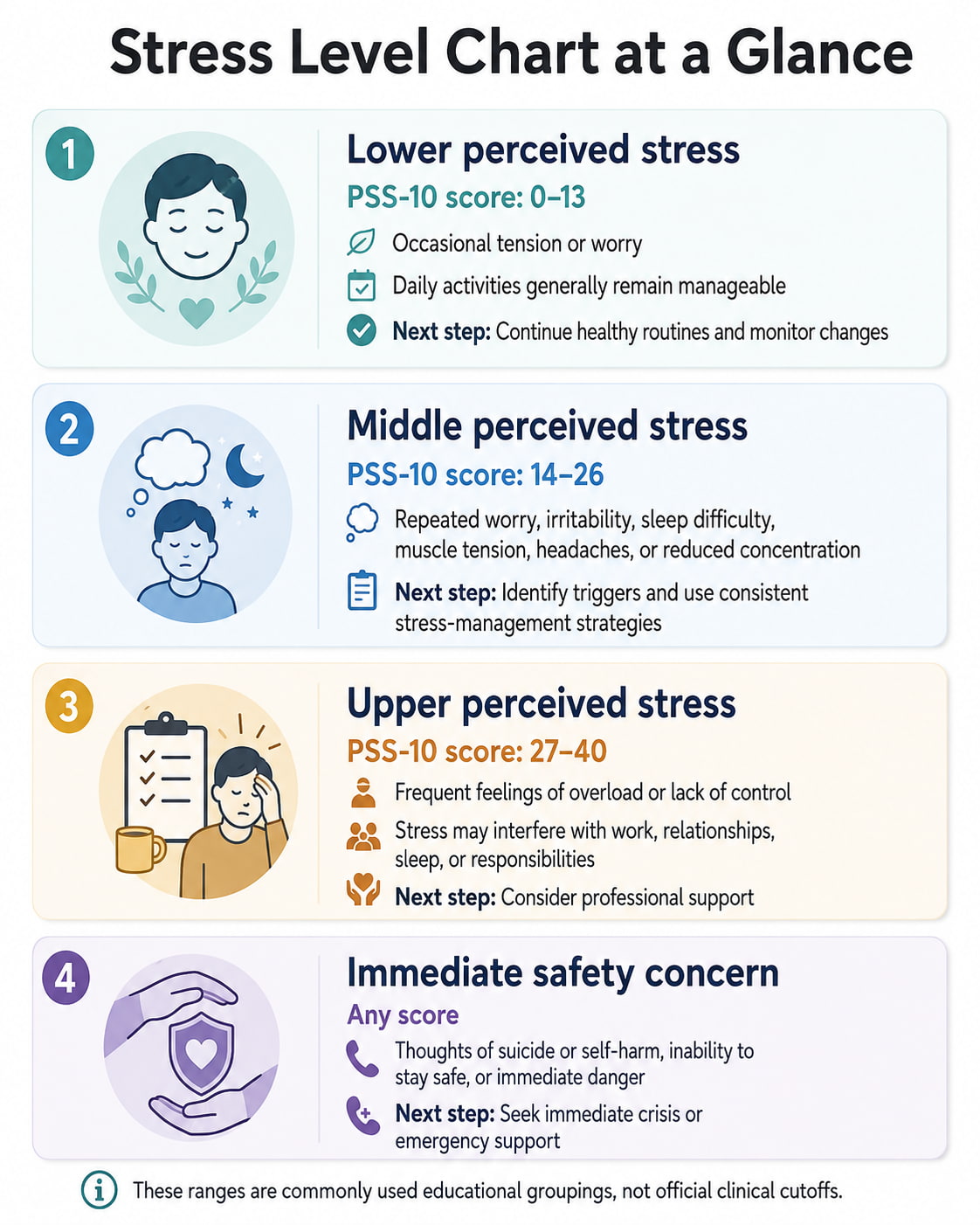
The following stress level chart combines commonly used PSS-10 score groupings with symptoms and daily functioning. It is an educational guide, not an official clinical grading system.
| General stress level | PSS-10 score range | Possible experience | Suggested next step |
|---|---|---|---|
| Lower perceived stress | 0–13 | Occasional tension or worry that generally resolves; daily activities remain manageable | Continue healthy routines and monitor changes |
| Middle perceived stress | 14–26 | Repeated worry, irritability, sleep difficulty, muscle tension, headaches, or reduced concentration | Identify triggers and use consistent stress-management strategies |
| Upper perceived stress | 27–40 | Frequent feelings of overload or lack of control; stress may interfere with work, relationships, sleep, or responsibilities | Consider discussing symptoms with a healthcare or mental health professional |
| Immediate safety concern | Any score | Thoughts of suicide or self-harm, feeling unable to stay safe, or immediate danger | Seek immediate crisis or emergency support |
The 0–13, 14–26, and 27–40 bands are commonly used educational categories, including in materials from Georgetown University. However, the scale’s developer states that the PSS is not a diagnostic tool and has no official clinical cutoffs.
A lower score does not mean that serious symptoms should be ignored. Likewise, an upper-range score does not prove that someone has an anxiety disorder, depression, or another medical condition.
What Is a Stress Level?
A stress level describes how strongly stress is affecting your thoughts, emotions, body, behavior, and ability to manage daily life.
There is no blood test, wearable reading, or universal questionnaire score that provides a complete measurement of psychological stress. Heart rate, blood pressure, sleep data, and stress scores may offer useful clues, but each can also change for reasons unrelated to stress.
A practical assessment should consider:
- How intense the symptoms feel
- How often they happen
- How long they have lasted
- Whether they interfere with daily activities
- Whether they are improving or worsening
- Whether coping behaviors are becoming harmful
- Whether there is an immediate safety concern
Symptoms and functioning often provide more meaningful information than a label such as “low,” “moderate,” or “high.”
Stress Level Chart Using the PSS-10
The Perceived Stress Scale is a commonly used questionnaire that assesses how unpredictable, uncontrollable, and overwhelming life has felt. The 10-item version, called the PSS-10, asks about experiences during the previous month.
Scores can range from 0 to 40. A higher score indicates greater perceived stress, not necessarily more stressful events or a mental health disorder.
| PSS-10 score | General interpretation | What the score does not mean |
|---|---|---|
| 0–13 | Lower section of the possible score range | Stress is absent or symptoms are unimportant |
| 14–26 | Middle section of the possible score range | A person has clinically “moderate stress” |
| 27–40 | Upper section of the possible score range | A person has a mental health disorder or needs emergency care solely because of the score |
The Carnegie Mellon University Perceived Stress Scale resources specifically warn that the scale is not diagnostic and that its developer did not create clinical score cutoffs.
What a Lower PSS-10 Score May Mean
A score from 0 to 13 falls in the lower part of the possible range. You may generally feel able to manage responsibilities and recover after stressful events.
However, a lower score should not overrule significant symptoms. Seek help when symptoms are severe, unusual, worsening, or affecting your safety—even when the total score is low.
What a Middle PSS-10 Score May Mean
A score from 14 to 26 falls in the middle part of the range. You may feel stressed more frequently or have difficulty maintaining your usual sense of control.
This may be a useful signal to review:
- Sleep quality
- Workload or caregiving demands
- Financial or relationship pressures
- Physical symptoms
- Time available for rest and recovery
- Reliance on alcohol, tobacco, or other substances
The score does not automatically mean that professional care is required. The effect on your daily life is more important.
What an Upper PSS-10 Score May Mean
A score from 27 to 40 falls in the upper part of the range. It suggests that life has recently felt especially overwhelming, unpredictable, or difficult to control.
Consider talking with a healthcare professional when the score is accompanied by persistent sleep problems, inability to concentrate, emotional distress, withdrawal, increased substance use, or difficulty performing normal activities.
An upper-range score by itself is not a diagnosis and does not determine whether a situation is an emergency.
How to Calculate a PSS-10 Score
The PSS-10 contains 10 questions. Each response receives a value from 0 to 4 based on how frequently a person experienced a particular thought or feeling during the previous month.
To calculate the score:
- Record the value for each of the 10 responses.
- Reverse the values for questions 4, 5, 7, and 8.
- For those four questions, convert 0 to 4, 1 to 3, 2 to 2, 3 to 1, and 4 to 0.
- Add all 10 adjusted values.
- The final score will be between 0 and 40.
The official Carnegie Mellon University PSS scoring instructions confirm that questions 4, 5, 7, and 8 require reverse scoring.
PSS-10 Scoring Example
Suppose the 10 response values add up to 21 after the four positive questions are reverse-scored.
A score of 21 falls within the commonly used middle grouping of 14–26. It indicates more perceived stress than a score of 10, but it does not reveal the cause, identify a disorder, or determine which type of support is appropriate.
The score becomes more useful when combined with symptoms, daily functioning, and changes over time.
Stress Symptoms Chart
Stress can affect the body, thoughts, emotions, and behavior. Symptoms do not always appear in a predictable order, and no symptom belongs exclusively to one stress level.
| Practical level | Possible symptoms | Effect on daily life |
|---|---|---|
| Short-term or manageable stress | Temporary nervousness, mild tension, increased alertness, brief sleep disruption | Responsibilities remain manageable and symptoms improve after the situation passes |
| Building or repeated stress | Irritability, headaches, muscle tension, poor sleep, stomach discomfort, racing thoughts, difficulty concentrating | Tasks may require more effort, but the person can generally continue normal activities |
| Persistent or high-impact stress | Ongoing exhaustion, significant sleep or appetite changes, withdrawal, frequent anger, inability to relax, reduced motivation | Work, school, relationships, self-care, or household responsibilities are affected |
| Crisis or safety concern | Feeling unable to cope, thoughts of suicide or self-harm, or immediate danger | Immediate support is needed regardless of the PSS score |
This is a practical symptom guide, not a validated medical severity scale. Stress affects people differently, and similar symptoms may occur with anxiety, depression, sleep disorders, medication effects, thyroid conditions, heart problems, or other health issues.
Physical Symptoms of Stress
Possible physical signs include:
- Headaches
- Tight or painful muscles
- Jaw clenching
- Faster heartbeat
- Sweating
- Shaking
- Upset stomach
- Nausea or digestive changes
- Tiredness
- Difficulty falling or staying asleep
- Eating more or less than usual
- Unexplained aches or discomfort
These symptoms are not proof that stress is the cause. Seek medical evaluation for symptoms that are new, severe, persistent, or concerning.
Chest pain, severe breathing difficulty, fainting, sudden weakness, or other possible emergency symptoms should not be assumed to be caused by stress.
Emotional Symptoms of Stress
Stress may affect emotions by causing:
- Irritability
- Anger
- Frustration
- Worry
- Nervousness
- Sadness
- Restlessness
- Feeling overwhelmed
- Difficulty relaxing
- Reduced enjoyment
Occasional emotional changes during a difficult period are common. Concern increases when symptoms remain intense, continue after the situation has passed, or interfere with normal life.
Cognitive Symptoms of Stress
Stress can make thinking and decision-making more difficult. Possible cognitive signs include:
- Poor concentration
- Forgetfulness
- Racing thoughts
- Indecisiveness
- Repeated negative thoughts
- Difficulty organizing tasks
- Feeling mentally overloaded
- Making more mistakes than usual
These effects can create a cycle. Falling behind may increase pressure, which may further reduce concentration and make responsibilities feel even harder.
Behavioral Symptoms of Stress
Behavioral changes may include:
- Avoiding responsibilities
- Withdrawing from other people
- Procrastinating
- Sleeping too much or too little
- Eating more or less
- Nail biting or skin picking
- Becoming more argumentative
- Spending excessive time online
- Using more alcohol, tobacco, or other substances
Increasing substance use as a coping strategy is an important reason to seek support. MedlinePlus advises getting help when stress leads to more frequent alcohol or drug use or when a person feels unable to cope.
Acute Stress vs. Chronic Stress
The length of time stress lasts may be as important as its immediate intensity.
| Type of stress | Duration | Common pattern |
|---|---|---|
| Acute stress | Minutes, hours, or a relatively short period | Occurs around an immediate challenge and usually decreases after the situation ends |
| Repeated acute stress | Frequent short episodes | Deadlines, arguments, emergencies, or daily disruptions repeatedly trigger stress |
| Chronic stress | Weeks, months, or longer | The source continues, or the body and mind do not have enough time to recover |
Short-term stress can sometimes improve alertness or help someone respond quickly. Chronic stress, however, may contribute to sleep problems, headaches, digestive symptoms, emotional distress, and worsening of existing health conditions.
Someone living with chronic stress may gradually become accustomed to the symptoms. Tracking changes in sleep, mood, energy, concentration, and behavior can make patterns easier to recognize.
Stress vs. Anxiety
Stress and anxiety can feel similar, but they are not always the same.
| Stress | Anxiety |
|---|---|
| Often connected to an identifiable demand or external situation | May continue without an immediate external threat |
| May decrease when the situation improves | Apprehension or dread may persist |
| Can be positive or negative | Can interfere with daily life when persistent or excessive |
| May involve worry, tension, headaches, or sleep problems | May involve many of the same symptoms |
The National Institute of Mental Health explains that stress generally has an external cause, while anxiety may persist even when there is no immediate threat. Both can affect the body and mind.
A stress score cannot diagnose an anxiety disorder. Persistent anxiety, panic, avoidance, or fear that interferes with daily activities deserves professional evaluation.
What to Do Based on Your Stress Level
When Stress Feels Manageable
Continue routines that support recovery:
- Maintain a regular sleep schedule.
- Eat regular, balanced meals.
- Make time for movement or physical activity.
- Take short breaks during demanding tasks.
- Stay connected with supportive people.
- Notice which situations trigger tension.
- Protect time for enjoyable, low-pressure activities.
The goal is not to eliminate all stress. It is to recover effectively and prevent manageable stress from accumulating.
When Stress Is Building
Start by identifying what has changed.
Write down your main stressors and separate them into three categories:
- Problems you can act on now
- Problems that require planning or support
- Situations you cannot directly control
Choose one realistic action rather than trying to solve everything at once. That action might include asking for help, reducing a nonessential commitment, discussing a workload issue, making a medical appointment, or creating a simple schedule.
Healthy coping strategies recommended by the Centers for Disease Control and Prevention include taking breaks from upsetting media, breathing or meditation exercises, journaling, spending time outdoors, connecting with trusted people, getting enough sleep, and increasing physical activity gradually.
When Stress Is Persistent or High-Impact
Consider professional support when stress:
- Interferes with work, school, caregiving, or household tasks
- Causes ongoing sleep or appetite changes
- Makes concentration or simple decisions difficult
- Leads to withdrawal from other people
- Causes you to lose interest in normal activities
- Continues despite consistent self-care
- Is becoming more intense
- Leads to increased alcohol or drug use
A primary care professional can check for physical conditions that may contribute to symptoms. A psychologist, counselor, therapist, or other qualified mental health professional can help identify patterns and develop appropriate coping strategies.
When Should You Seek Professional Help?
The National Institute of Mental Health recommends considering professional help when severe or distressing symptoms continue for two weeks or longer. Examples include significant sleep or appetite changes, difficulty concentrating, loss of interest, low energy, or inability to complete normal activities.
You do not need to wait two weeks when:
- Symptoms are rapidly worsening.
- You cannot perform essential daily activities.
- You are experiencing panic-like episodes.
- You are using substances to cope.
- You have new or concerning physical symptoms.
- You feel unable to cope.
- You are worried about your safety.
A stress chart should guide attention—not delay appropriate care.
When Stress Requires Immediate Help
Seek immediate assistance if you or someone else:
- Has thoughts of suicide or self-harm
- Has urges to hurt another person
- Cannot stay safe
- Is experiencing a life-threatening emergency
- Is severely confused or disconnected from reality
In the United States, call or text the 988 Suicide & Crisis Lifeline or use its online chat. The service is available 24 hours a day, every day, and conversations are free and confidential. Call 911 for a life-threatening emergency.
Crisis support is based on immediate needs and safety—not on a questionnaire score.
Frequently Asked Questions
What is a normal stress level?
There is no single medically defined “normal” stress score. Some stress is a normal part of life, and reactions vary between people. A manageable level generally means you can recover after stressful situations and continue normal daily activities without persistent distress.
What is a good PSS-10 score?
A lower PSS-10 score indicates less perceived stress than a higher score, but there is no official target or clinical cutoff. The scale is most useful for noticing patterns, comparing scores over time, or supporting a broader discussion about symptoms.
Is a PSS-10 score of 27 high?
A score of 27 falls within the commonly used upper grouping of 27–40. It suggests relatively high perceived stress during the previous month. It does not diagnose a disorder, but professional support may be helpful when the score is accompanied by persistent distress or impaired daily functioning.
Can you determine stress level from symptoms alone?
Symptoms can help identify how stress may be affecting you, but they cannot provide an exact stress score. Headaches, sleep problems, poor concentration, stomach discomfort, and a fast heartbeat may also have other causes.
Can a low stress score still be concerning?
Yes. A person may have a low total score but still experience an important symptom, a sudden decline in functioning, or an immediate safety concern. Symptoms and safety should never be dismissed because of a questionnaire result.
How often should you check your stress level?
There is no required schedule. Checking periodically may help when you are monitoring a demanding period or evaluating whether coping strategies are helping. Avoid repeating the test so frequently that small daily changes become misleading. The PSS-10 was designed to ask about experiences over the previous month.
Is high stress the same as anxiety?
No. Stress often relates to an external situation and may improve when that situation resolves. Anxiety can remain even without an immediate threat. They can overlap, and both may cause worry, tension, headaches, and sleep problems.
Conclusion
A stress level chart is most useful when it helps you notice patterns—not when it assigns a rigid label. PSS-10 scores can provide a general picture of perceived stress, but they should always be considered alongside symptoms, duration, daily functioning, coping behaviors, and safety.
Start with small, realistic changes when stress is manageable. Seek professional guidance when symptoms persist, worsen, or disrupt daily life. Immediate safety concerns require prompt help regardless of your score.
This content is for informational purposes only and not medical advice.
References
- World Health Organization, Stress: Questions and Answers.
- Carnegie Mellon University, Perceived Stress Scale Resources and Scoring.
- Georgetown University, Cohen Perceived Stress Scale PSS-10.
- National Institute of Mental Health, My Mental Health: Do I Need Help?.
- Centers for Disease Control and Prevention, Managing Stress.
- National Library of Medicine MedlinePlus, Stress.
- 988 Suicide & Crisis Lifeline, Get Emotional Support.