
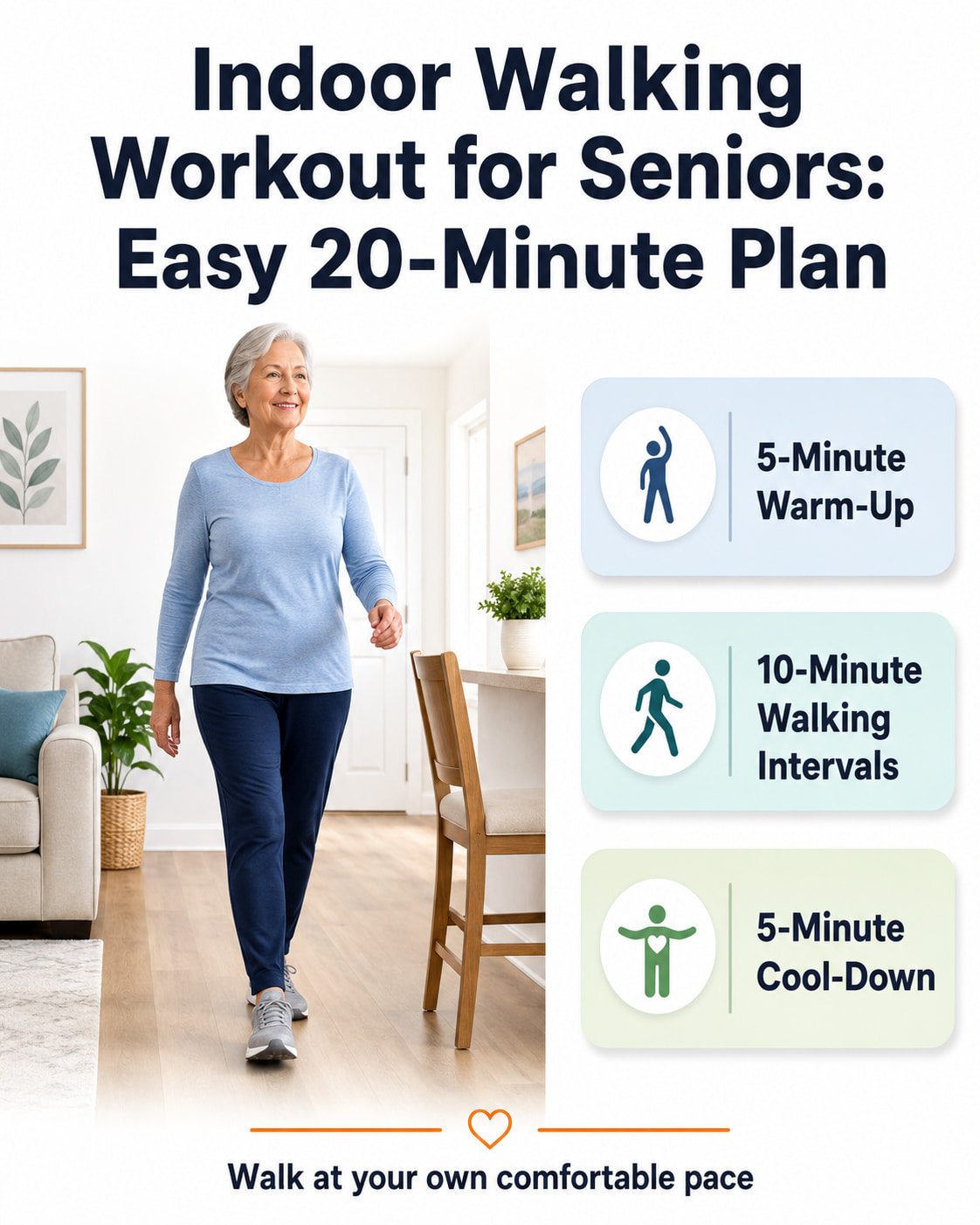
An indoor walking workout can give many seniors a simple, low-impact way to increase daily movement without needing a treadmill, gym membership, or good weather. This 20-minute indoor walking workout for seniors includes a gradual five-minute warm-up, 10 minutes of comfortable walking intervals, and a five-minute cool-down.
You can walk through a clear room or hallway, march in place, or use a sturdy counter for balance. Move at your own pace, take smaller steps when needed, and use your prescribed cane or walker rather than exercising without it.
Is Indoor Walking a Good Workout for Seniors?
Indoor walking can be a useful aerobic activity for older adults. It may support stamina, mobility, heart health, sleep, physical function, and the ability to complete daily activities.
The Centers for Disease Control and Prevention recommends that adults age 65 and older work toward:
- At least 150 minutes of moderate-intensity aerobic activity each week
- Muscle-strengthening activities on at least two days each week
- Activities that improve balance
Older adults who cannot meet the full recommendation should remain as active as their health and abilities allow.
Walking around your home or marching in place can contribute to your aerobic activity total. What matters is how long you move and how hard your body is working, not how far you travel.
The current Office of Disease Prevention and Health Promotion guidance also states that physical activity no longer needs to occur in sessions of at least 10 minutes. Shorter periods of movement can provide benefits and contribute to your weekly total.
What You Need for This Indoor Walking Workout
You do not need special exercise equipment. Prepare:
- Supportive, nonslip athletic shoes
- A timer, clock, or phone
- A clear walking area
- A sturdy counter, railing, or non-rolling chair if you need support
- Your prescribed cane or walker, if applicable
- Water nearby
Choose a room, hallway, or open path that allows you to move without making sudden turns.
Make Your Indoor Walking Area Safer
Safety should come before speed. More than 14 million adults age 65 and older report falling each year in the United States, according to CDC data on older adult falls.
Before starting:
- Remove loose rugs, electrical cords, footstools, and clutter.
- Keep pets in another room during the workout.
- Turn on enough lighting to see the entire walking path.
- Avoid walking in socks or loose slippers.
- Keep a phone or medical alert device nearby.
- Place a sturdy chair against a wall if you need support.
- Avoid holding a rolling, folding, or swivel chair.
- Make sure your walking surface is dry and level.
Do not rush around furniture or make sharp turns. Walking back and forth along a short, clear route is safer than weaving between objects.
Indoor Walking Workout for Seniors: 20-Minute Plan
This routine uses alternating easy and slightly faster walking. The faster intervals are optional. Beginners can maintain one comfortable pace for the entire session.
Effort Guide
Use a personal effort scale from 0 to 10:
- Easy pace: 2–3 out of 10. Breathing remains relaxed.
- Comfortable pace: 3–4 out of 10. You feel warm but can speak easily.
- Moderate pace: 5–6 out of 10. You breathe faster but can still talk.
Your normal walking pace may feel more challenging on some days. Reduce the speed whenever necessary.
The 20-Minute Routine
| Time | Movement | What to Do |
|---|---|---|
| 0:00–2:00 | Slow walk or march | Take small, comfortable steps. Keep your shoulders relaxed and look forward. |
| 2:00–3:00 | Gentle heel taps | Alternate placing one heel slightly in front of you. Hold a counter if needed. |
| 3:00–4:00 | Step-touch or easy march | Step gently to one side and bring the other foot in. Replace this with marching if side steps affect your balance. |
| 4:00–5:00 | Comfortable walk | Gradually increase your pace. Add a small natural arm swing only if you feel steady. |
| 5:00–15:00 | Walking intervals | Alternate one minute at a slightly faster pace with one minute at an easy pace. Repeat five times. |
| 15:00–17:00 | Easy walk | Shorten your steps and gradually slow your breathing. |
| 17:00–18:00 | Gentle heel taps | Keep the movement small and controlled. |
| 18:00–20:00 | Very slow walk | Continue moving slowly until your breathing and heart rate begin returning toward normal. |
How to Do the Walking Intervals
During each faster minute:
- Increase your pace slightly rather than taking very large steps.
- Keep your feet low to the floor.
- Land softly instead of stomping.
- Let your arms move naturally if that does not affect your balance.
- Continue breathing normally.
During each easy minute:
- Reduce your speed.
- Relax your shoulders and hands.
- Check whether you feel steady.
- Take a longer recovery period if needed.
The goal is controlled movement, not maximum speed. You should never feel pressured to keep up with a video, music beat, step count, or another person.
How Hard Should Seniors Walk Indoors?
A moderate-intensity pace is relative to your current fitness level. A speed that feels easy to an active person may feel demanding to someone returning to exercise after an illness or a long period of inactivity.
CDC guidance describes moderate effort as approximately 5 or 6 on a 0-to-10 scale. It also recommends the talk test: during moderate activity, you should generally be able to talk but not sing.
You do not have to reach moderate intensity during every workout. An easy session may be more appropriate when you are new to exercise, managing fatigue, or having a lower-energy day.
Slow down when:
- You cannot speak a complete sentence comfortably.
- Your steps become unsteady.
- You begin holding your breath.
- You feel that you must rush to maintain the pace.
- Your pain increases as you continue.
Indoor Walking Form Tips
Good walking form does not require exaggerated posture or large movements.
Keep Your Head and Chest Comfortable
Look ahead rather than continuously looking at your feet. Keep your chest comfortably upright without forcing your shoulders backward.
If you need to watch the floor because of vision or balance concerns, use a clear, familiar walking route and seek individualized advice from a physical therapist or healthcare professional.
Take Short, Controlled Steps
Long strides can make it harder to control your balance. Use shorter steps and keep your feet relatively close to the floor.
Avoid rapid pivots. When changing direction, slow down and turn using several small steps.
Use Your Arms Only When Safe
A gentle arm swing may increase the effort of the workout. However, keeping one hand near a sturdy support may be more appropriate if you feel unstable.
Do not add hand weights during walking unless a qualified professional has advised you to do so. Carrying weights can change your posture and balance.
Breathe Normally
Do not hold your breath or force unusually deep breathing. You should be able to breathe in a comfortable rhythm throughout the workout.
Modifications for Different Ability Levels
The routine should match the person—not the other way around.
For Beginners or Low Endurance
Start with five or 10 minutes instead of the full workout. You can also divide the routine into two 10-minute sessions or four five-minute sessions during the day.
Increase the duration gradually as the workout becomes easier. You do not need to increase both speed and time at once.
For Balance Problems
- Walk beside a sturdy counter or railing.
- Replace side steps with a slow march.
- Keep your feet slightly wider apart.
- Avoid fast turns and backward walking.
- Ask another person to remain nearby when appropriate.
A chair can provide support, but it should be stable and positioned against a wall. Do not pull or lean heavily on the chair.
For Cane or Walker Users
Use your mobility device throughout the workout if it has been prescribed for walking. Choose a route wide enough for the device and avoid movements that interfere with its safe use.
Do not attempt side steps, high knees, or quick pace changes unless you can perform them safely with your device. A physical therapist can help adapt the routine to your walking pattern.
For Knee or Hip Discomfort
Try:
- Shorter steps
- A slower pace
- Lower knee lifts
- Marching instead of side steps
- A shorter workout
- Longer easy intervals
Mild stiffness may ease as you warm up, but sharp, sudden, or steadily worsening pain is a reason to stop. Exercise should not require you to push through significant joint pain.
For People Who Cannot Walk Safely for 20 Minutes
Seated marching may offer a way to move while remaining supported. Sit in a sturdy chair with your feet on the floor and alternate lifting one foot at a time.
However, seated marching is not identical to walking. Someone who has recently lost walking ability or developed new weakness should seek medical or physical therapy guidance rather than relying only on a general online routine.
How Often Should Seniors Do This Workout?
A beginner might start with the routine two or three days per week. As endurance improves, add another day or extend some walks gradually.
For comparison:
| Schedule | Weekly Walking Time |
|---|---|
| 20 minutes, 3 days per week | 60 minutes |
| 20 minutes, 5 days per week | 100 minutes |
| 20 minutes, 7 days per week | 140 minutes |
| 25 minutes, 6 days per week | 150 minutes |
Doing this 20-minute workout daily provides 140 minutes per week. One additional 10-minute walk would bring the total to 150 minutes.
Another option is to complete the workout five days per week and add one or two shorter walks on those days. Household activities and other moderate-intensity exercises may also contribute to the weekly aerobic total.
Indoor walking does not replace every type of exercise. Older adults should also include appropriate strength and balance activities because each type of movement serves a different purpose.
Benefits of a Regular Indoor Walking Routine
A consistent walking routine may:
- Improve walking endurance
- Support heart and lung fitness
- Reduce long periods of sitting
- Make daily movement feel easier
- Support sleep and emotional well-being
- Help maintain mobility and independence
- Provide an activity option during hot, cold, rainy, or icy weather
These benefits depend on consistency, intensity, health status, and the total amount of weekly activity. Walking is helpful, but it should not be presented as a guaranteed way to prevent falls or manage a medical condition by itself.
When to Check With a Healthcare Professional
Moderate physical activity is safe for many people, including many adults with chronic health conditions. However, some seniors need individualized guidance before beginning or changing an exercise routine.
Speak with a healthcare professional if you have:
- A recent fall, fracture, surgery, or hospitalization
- Frequent dizziness, fainting, or unexplained balance problems
- New chest discomfort or unusual shortness of breath
- A heart, lung, neurological, or metabolic condition that limits activity
- Severe joint pain or a recent lower-body injury
- New weakness or a sudden change in walking ability
- Instructions to limit exercise
- Uncertainty about using a cane, walker, or oxygen during activity
CDC guidance recommends working with a healthcare professional when a chronic condition limits your ability to be active so that your plan can match your abilities.
When to Stop the Workout
Stop walking and sit or lie down safely if you experience:
- Chest pain or pressure
- Dizziness or feeling faint
- Nausea
- Severe or unusual shortness of breath
- A sudden racing or irregular heartbeat
- New weakness or loss of coordination
- Sharp or severe pain
- New confusion or vision changes
The National Institute on Aging advises that aerobic activity should not cause dizziness, chest pain or pressure, or nausea. It also recommends light activity before and after aerobic exercise rather than starting or stopping abruptly.
Call 911 for chest pressure, severe breathing difficulty, fainting, or signs of a stroke. Do not restart the workout until it is safe to do so.
Frequently Asked Questions
Does walking in place count as exercise for seniors?
Yes. Walking or marching in place can count as aerobic activity when it raises your breathing and heart rate. The effort should still match your ability, and you should remain steady enough to perform the movement safely.
Is 20 minutes of walking a day enough for seniors?
Twenty minutes is a useful amount of daily activity, especially for someone building a routine. However, 20 minutes every day totals 140 minutes per week, which is slightly below the general 150-minute moderate-intensity aerobic target.
Not every minute must be moderate intensity. Beginners should prioritize safe, consistent movement and gradually build toward a suitable weekly total.
Can seniors do an indoor walking workout every day?
Many seniors can walk daily if the intensity is comfortable and they recover well. Consider an easier or shorter session when you feel unusually tired, sore, ill, or unsteady.
People with medical restrictions or recurring pain should follow guidance from their healthcare professional.
Does slow indoor walking provide benefits?
Slow walking still adds movement and reduces sitting time. It can be an appropriate starting point for someone with limited endurance.
To count as moderate-intensity aerobic activity, the pace generally needs to increase breathing and heart rate to a moderate level. However, some movement is usually better than none when it can be performed safely.
Can I hold a chair while walking in place?
Yes, but use a sturdy, non-rolling chair placed against a wall. Rest one or both hands lightly on the chair for balance without pulling it toward you.
A kitchen counter or secure railing may provide better stability than a chair.
Can seniors with arthritis do indoor walking?
Many people with arthritis can remain active, but the workout may need to be modified. Use shorter steps, slower intervals, supportive shoes, and a shorter duration.
Stop if pain becomes sharp, severe, or progressively worse. A healthcare professional or physical therapist can provide advice for persistent joint symptoms.
What is the best time of day for an indoor walking workout?
The best time is when you feel alert, steady, and able to exercise consistently. Some people prefer the morning, while others move more comfortably after their joints have loosened later in the day.
Avoid exercising immediately after a large meal or at a time when medication side effects make you dizzy or sleepy.
Conclusion
An indoor walking workout for seniors can make regular movement more convenient and manageable. Start with a clear walking space, supportive shoes, and a pace that allows you to remain steady and in control.
Complete the full 20-minute plan when comfortable, or begin with a shorter version and build gradually. Track your weekly minutes, add appropriate strength and balance activities, and adjust the routine whenever your body needs an easier day.
This content is for informational purposes only and not medical advice.
References
- Centers for Disease Control and Prevention (CDC) — Older Adults: Adding Activity Recommendations
- CDC — What Counts as Physical Activity for Older Adults
- Office of Disease Prevention and Health Promotion — Physical Activity Guidelines for Americans
- National Institute on Aging — Three Types of Exercise Can Improve Your Health and Physical Ability
- CDC — Older Adult Falls Data
- National Institute on Aging — Tips for Getting and Staying Active as You Age