
High knees are a no-equipment cardio exercise where you run or march in place while lifting your knees toward hip height. The high knees exercise can raise your heart rate, warm up your lower body, train coordination, and challenge your core when done with control.
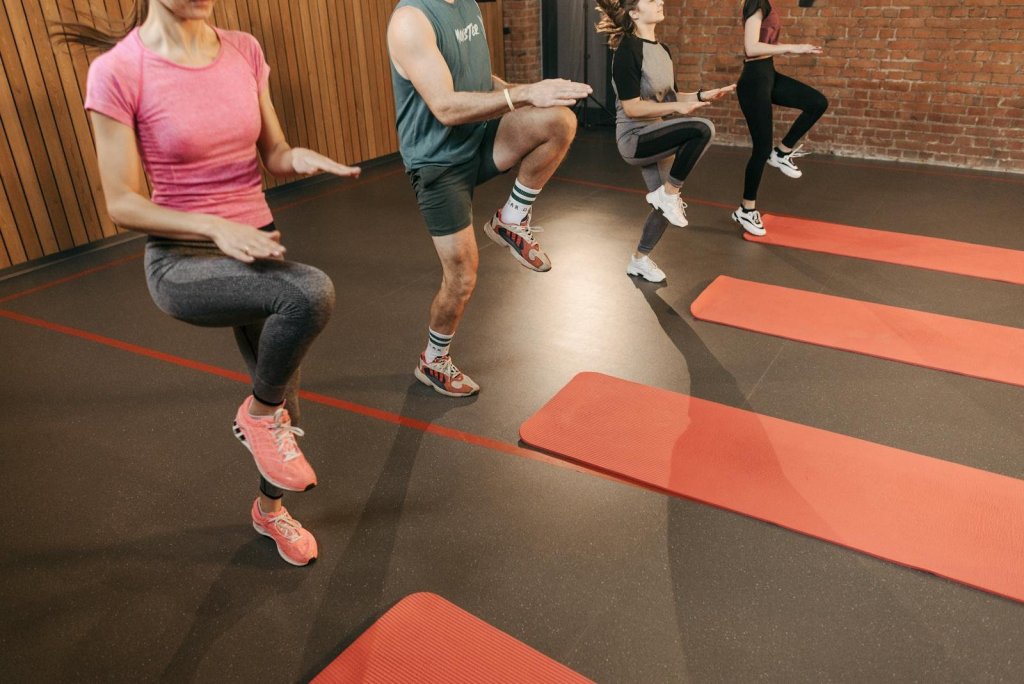
This move is simple, but form matters. To get the most from it, keep your posture tall, land softly, lift your knees with control, and choose the right version for your fitness level.
High Knees Exercise: The Quick Answer
High knees are best used as a warm-up drill, cardio finisher, running drill, or HIIT exercise.
You can do them in two main ways:
| Version | Best For | Impact Level |
|---|---|---|
| Marching high knees | Beginners, warm-ups, low-impact workouts | Low |
| Running high knees | Cardio, conditioning, athletic drills | Higher |
A good starting point is 20 to 30 seconds per round, followed by rest. Beginners can start slower with marching high knees, while more advanced exercisers can use faster intervals.
The American Heart Association recommends warming up for 5 to 10 minutes before exercise, which makes high knees a useful option when performed gradually and with control.
What Are High Knees?
High knees are a cardio and coordination exercise performed by quickly lifting one knee at a time while moving your arms as if you are running.
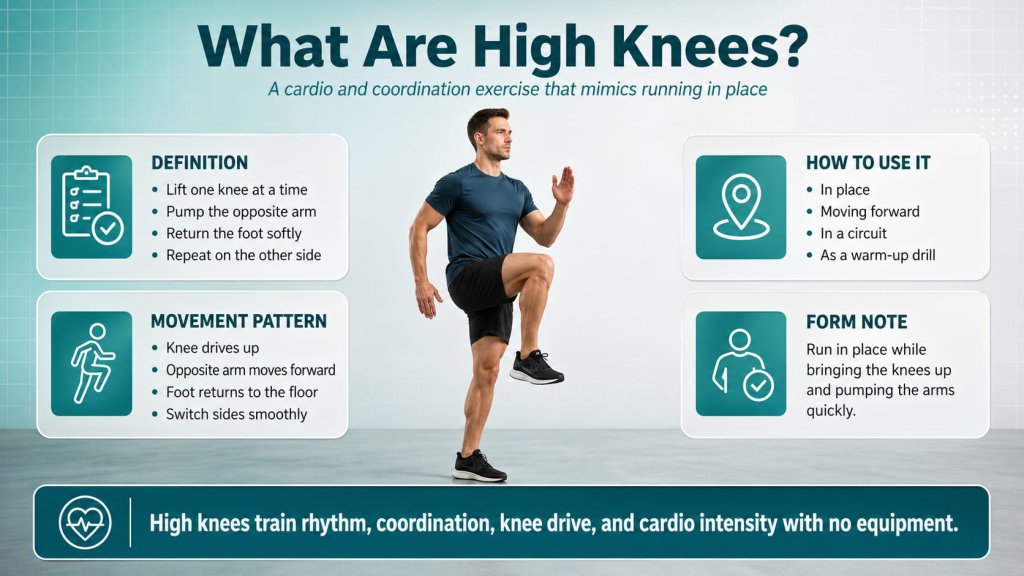
The movement looks simple:
- One knee drives up.
- The opposite arm pumps forward.
- The foot returns to the floor.
- The other knee repeats the same pattern.
You can perform high knees in place, moving forward, or as part of a circuit.
The American Council on Exercise describes high knee running as running in place while bringing the knees up toward the chest and pumping the arms quickly.
High Knees Muscles Worked
High knees are not a heavy strength exercise, but they do involve several major muscle groups.
Primary muscles worked:
- Hip flexors: Lift your knees upward.
- Quadriceps: Help control knee movement and support quick leg action.
- Glutes: Help stabilize the hips and support lower-body power.
- Calves: Help with quick foot contacts and springy movement.
- Hamstrings: Assist with leg recovery and control.
Secondary muscles worked:
- Core muscles: Help keep your torso upright.
- Obliques: Assist with trunk control during fast arm and leg movement.
- Shoulders and arms: Support the arm drive.
Benefits of High Knees
High knees are popular because they are simple, fast, and require no equipment.
They raise your heart rate quickly
High knees can make your breathing and heart rate increase fast, especially when performed at a running pace. This makes them useful for short cardio intervals, warm-ups, and conditioning circuits.
The CDC recommends adults get at least 150 minutes of moderate-intensity physical activity per week and 2 days of muscle-strengthening activity each week. High knees can help add short bursts of cardio, but they should not replace a complete fitness plan.
They work well as a dynamic warm-up
High knees can help prepare your legs, hips, and core before running, sports, or lower-body training.
Mayo Clinic explains that warming up gradually helps prepare the body for aerobic activity, which supports using high knees as part of a progressive warm-up rather than jumping straight into maximum effort.
They improve coordination
High knees require your arms and legs to move in opposite patterns. This can improve rhythm, timing, and body control.
That is why high knees are often used in running drills, sports warm-ups, and athletic conditioning.
They train core control
Your core works to keep your torso tall while your legs move quickly. If your torso leans back, twists, or collapses forward, the movement becomes less controlled.
A strong high knees drill should feel quick but organized.
They need no equipment
You can do high knees almost anywhere:
- At home
- In a gym
- In a warm-up area
- On a track
- In a bodyweight circuit
You only need enough space to move safely and a floor surface that does not feel slippery.
How to Do High Knees With Proper Form
Use this version first before increasing speed.
How to do it
- Stand tall with your feet hip-width apart.
- Keep your chest lifted and your core lightly braced.
- Bend your elbows about 90 degrees.
- Lift your right knee toward hip height.
- At the same time, drive your left arm forward.
- Lower your right foot softly to the floor.
- Repeat on the other side.
- Continue alternating sides in a smooth rhythm.
- Keep your steps light, quick, and controlled.
Form cues
Think:
- Tall posture
- Soft landings
- Fast arms
- Knees up
- Core tight
- Feet under hips
Avoid turning high knees into sloppy stomping. The goal is quick, controlled movement, not just moving as fast as possible.
Marching High Knees for Beginners
Marching high knees are the best starting version if you are new to the exercise, warming up, or trying to reduce impact.
How to do it
- Stand tall with feet hip-width apart.
- Lift one knee toward hip height.
- Pause briefly at the top.
- Lower the foot under control.
- Repeat on the other side.
- Keep your arms moving naturally.
- Move slowly enough to stay balanced.
Why it works
Marching high knees train the same basic movement pattern with less impact. They are easier to control and may be better for beginners, older adults, or anyone who does not want a jumping-style cardio drill.
Trainer tip
Start with 30 to 60 seconds of marching before trying faster high knees. If marching feels unstable, do not rush into the running version.
Running High Knees
Running high knees are the faster, more intense version.
How to do it
- Stand tall and brace your core.
- Begin jogging in place.
- Drive one knee up quickly.
- Pump the opposite arm forward.
- Land softly on the ball of the foot.
- Switch sides quickly.
- Keep your feet under your hips.
- Continue for the planned time.
Why it works
Running high knees are useful for cardio intervals, athletic warm-ups, and conditioning workouts because they combine fast leg drive, arm swing, and core stability.
Common High Knees Mistakes
High knees can look easy, but these mistakes are very common.
| Mistake | Why It Matters | Quick Fix |
|---|---|---|
| Leaning backward | Reduces control and may stress the lower back | Keep ribs stacked over hips |
| Stomping the feet | Adds unnecessary impact | Land softly and quietly |
| Knees staying too low | Turns the move into a lazy jog | Lift knees toward hip height |
| Arms not moving | Reduces rhythm and intensity | Pump opposite arm with opposite knee |
| Moving too fast too soon | Form breaks down quickly | Start slower, then build speed |
| Holding your breath | Makes the exercise feel harder | Breathe steadily through the set |
| Landing with stiff knees | Increases impact | Keep knees slightly soft |
High Knees Benefits for Warm-Ups
High knees can be a strong warm-up choice because they raise body temperature and prepare the hips, legs, and core for movement.
Use them before:
- Running
- Sprint drills
- Jump rope
- Lower-body workouts
- HIIT circuits
- Sports practice
A simple warm-up could look like this:
| Exercise | Time |
|---|---|
| Easy march or walk | 1 minute |
| Arm circles | 30 seconds |
| Marching high knees | 30 seconds |
| Bodyweight squats | 30 seconds |
| Running high knees | 20 seconds |
| Easy movement | 1 minute |
Keep the warm-up controlled. You should feel more prepared, not exhausted.
High Knees vs Running in Place
High knees and running in place look similar, but they are not exactly the same.
| Exercise | Main Focus | Knee Height | Best Use |
|---|---|---|---|
| Running in place | General cardio | Low to moderate | Easy cardio intervals |
| High knees | Knee drive, coordination, intensity | Moderate to high | Warm-ups, drills, HIIT |
| Marching high knees | Control and low impact | Moderate | Beginners and warm-ups |
Running in place is usually easier. High knees are more demanding because you lift the knees higher and use a stronger arm drive.
How Long Should You Do High Knees?
The right time depends on your fitness level and workout goal.
| Goal | Work Time | Rest Time | Rounds |
|---|---|---|---|
| Beginner warm-up | 15–20 seconds | 30–45 seconds | 2–3 |
| Low-impact cardio | 30 seconds | 30 seconds | 3–5 |
| HIIT finisher | 20–30 seconds | 30–60 seconds | 4–8 |
| Running drill | 10–20 meters or 10–20 seconds | Full recovery | 3–6 |
The American Heart Association’s 10-minute workout resource uses 30-second cardio breaks such as high knees, marching in place, or jogging in place, with rest as needed.
How to Add High Knees to a Workout
High knees fit best in short bursts. They are not usually meant to be done for long, nonstop periods.
Option 1: Warm-up
Do this before a lower-body workout or run:
- March in place: 60 seconds
- Bodyweight squats: 10 reps
- Marching high knees: 30 seconds
- Walking lunges: 8 reps per side
- Running high knees: 20 seconds
Option 2: Cardio circuit
Repeat 3 to 5 rounds:
- High knees: 30 seconds
- Bodyweight squats: 12 reps
- Plank: 20–30 seconds
- Rest: 45–60 seconds
Option 3: Low-impact beginner circuit
Repeat 3 rounds:
- Marching high knees: 30 seconds
- Wall push-ups: 10 reps
- Glute bridges: 12 reps
- Rest: 60 seconds
Option 4: HIIT finisher
Repeat 4 to 6 rounds:
- Running high knees: 20 seconds
- Rest: 40 seconds
Stop the set if your form breaks down. Quality matters more than forcing extra seconds.
Who Should Be Careful With High Knees?
High knees are generally simple, but the running version can be high impact.
Be careful or choose a lower-impact option if you have:
- Knee, hip, ankle, or foot pain
- Recent lower-body injury
- Balance issues
- Pain with jumping or running
- Pelvic floor symptoms during impact exercise
- Dizziness, chest discomfort, or unusual shortness of breath during exercise
Choose marching high knees, slower intervals, or a different warm-up if running high knees do not feel good.
If pain is sharp, worsening, or does not settle after you stop, avoid pushing through it and consider guidance from a qualified healthcare or fitness professional.
High Knees Variations
1. Low-Impact High Knees
This is the best option if you want cardio without jumping.
How to do it:
- March in place.
- Lift one knee at a time.
- Keep one foot on the floor.
- Move your arms with control.
- Increase speed only if posture stays steady.
2. High Knees With Reach
This version adds more coordination.
How to do it:
- Lift one knee.
- Reach both hands toward the lifted knee.
- Lower with control.
- Repeat on the other side.
Keep the reach gentle. Do not round your back aggressively to touch your knee.
3. High Knees Forward
This version is often used by runners.
How to do it:
- Move forward slowly while doing high knees.
- Keep steps short and quick.
- Stay tall.
- Use strong arm drive.
4. High Knees in Place
This is the most common home-workout version.
How to do it:
- Stay in one spot.
- Lift knees quickly.
- Pump arms.
- Keep landings soft.
High Knees Safety Tips
Use these tips to make high knees safer and more effective:
- Warm up gradually before going fast.
- Wear supportive shoes if you are on a hard floor.
- Use a non-slippery surface.
- Keep your torso tall.
- Land quietly.
- Start with short intervals.
- Rest when your form gets sloppy.
- Use marching high knees if impact feels uncomfortable.
Do not treat high knees as a test of toughness. They should feel challenging, but still controlled.
FAQs About High Knees
Are high knees good for beginners?
Yes. Beginners should start with marching high knees instead of running high knees. This lowers impact and makes it easier to control posture, balance, and breathing.
What are high knees good for?
High knees are good for warming up, raising heart rate, improving coordination, training knee drive, and adding quick cardio intervals to a workout.
Do high knees build muscle?
High knees can activate the hip flexors, quads, glutes, calves, hamstrings, and core, but they are not a replacement for strength training. For muscle and strength, combine them with exercises like squats, lunges, deadlifts, step-ups, and calf raises.
How many high knees should I do?
Start with 2 to 4 rounds of 20 to 30 seconds. Rest as needed. If you are new to exercise, begin with marching high knees for 30 seconds at a time.
Should high knees be fast or controlled?
They should be controlled first, then faster later. Poor form at high speed can lead to heavy landings, poor posture, and wasted effort.
Are high knees bad for your knees?
High knees are not automatically bad for your knees, but the running version can be high impact. If your knees hurt, switch to marching high knees, reduce speed, or choose a lower-impact cardio option.
Can I do high knees every day?
You can use gentle marching high knees often as part of a warm-up. Intense running high knees should be used more carefully, especially if your legs, knees, ankles, or feet feel sore.
Conclusion
High knees are a simple, no-equipment exercise that can improve cardio fitness, coordination, warm-up quality, and core control. Start with marching high knees, focus on soft landings and tall posture, then progress to faster running high knees when your form feels steady.
For best results, use high knees in short, controlled intervals as part of a balanced workout plan that includes strength training, mobility, recovery, and regular aerobic activity.
References
- American Heart Association: Best for supporting the warm-up and cool-down section, including the 5- to 10-minute warm-up recommendation.
- CDC: Best for supporting weekly adult physical activity guidance and the role of cardio within a complete fitness plan.
- Mayo Clinic: Best for explaining how warming up gradually prepares the body before aerobic activity.
- American Council on Exercise: Best for supporting high knees as a cardio and HIIT-style exercise.
- American Council on Exercise: Best for supporting high knees in bodyweight workouts and dynamic warm-up routines.
- American Heart Association 10-Minute Workout: Best for supporting short cardio intervals using high knees, marching, or jogging in place.
- WHO: Best for broad global physical activity guidance, including aerobic activity and muscle-strengthening recommendations.
- Mayo Clinic Press: Best for supporting the importance of gradually raising heart rate and preparing muscles before exercise.