
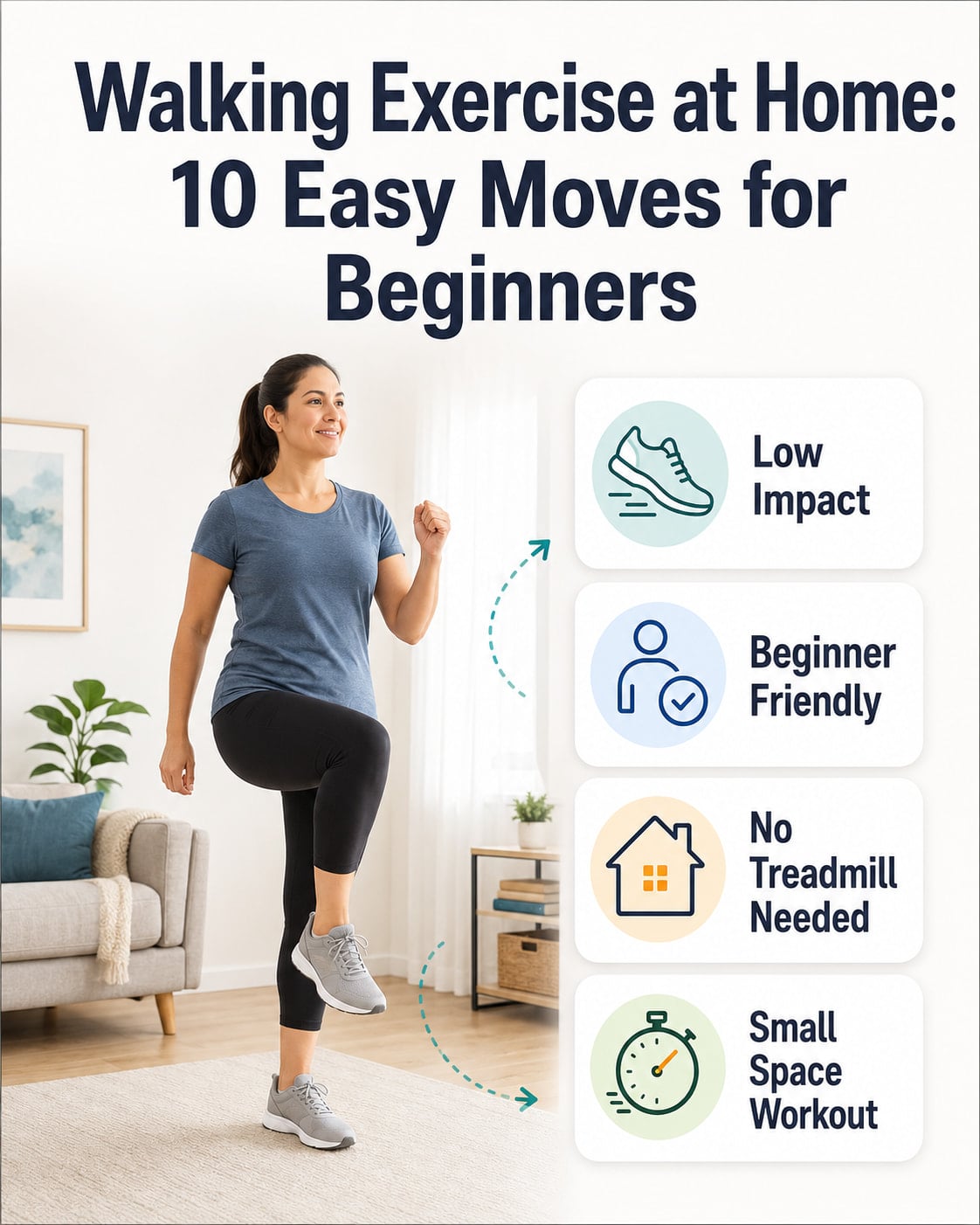
Walking exercise at home is a simple, low-impact way to raise your heart rate, improve stamina, and add more movement to your day without a treadmill or large workout space. Beginners can start with easy movements such as marching in place, step-touches, heel digs, and controlled knee lifts.
You do not need to complete a long or intense workout for it to be worthwhile. A short indoor walking session can count toward your weekly aerobic activity when it makes you breathe faster and increases your heart rate. Start at a comfortable pace, use support when needed, and gradually increase the duration as your fitness improves.
What Is Walking Exercise at Home?
Walking exercise at home combines walking in place with simple forward, backward, and side-to-side steps. Unlike walking continuously along a road or trail, you perform the movements in a small indoor area.
A typical at-home walking workout may include:
- Marching in place
- Side steps
- Heel taps
- Knee lifts
- Hamstring curls
- Short forward-and-back walking patterns
These movements can create a low-impact cardio workout because at least one foot usually remains in contact with the floor. You can also adjust the pace, step size, arm movement, and workout duration to match your current ability.
Walking at home can be especially useful when the weather is poor, outdoor walking areas are unsafe, you have limited time, or you simply prefer exercising privately.
Does Walking at Home Count as Exercise?
Yes. Walking at home can count as aerobic exercise when you perform it at an intensity that raises your heart rate and makes you breathe more deeply. Your body responds to the effort, not the location.
One easy way to judge your intensity is the talk test:
- Light intensity: You can talk and sing comfortably.
- Moderate intensity: You can talk, but singing would be difficult.
- Vigorous intensity: You cannot say more than a few words without pausing for breath.
The Centers for Disease Control and Prevention’s intensity guidance describes moderate effort as approximately 5 or 6 on a scale from 0 to 10. However, intensity is relative. A pace that feels light to one person may feel moderate to someone who is new to exercise.
You do not need to reach moderate intensity immediately. Light walking is a reasonable place to begin if you have been inactive or are still learning the movements.
Benefits of Walking Exercise at Home
Indoor walking is accessible, inexpensive, and easy to modify. You do not need a gym membership, treadmill, or advanced coordination.
Increases Daily Physical Activity
A home walking routine can help break up long periods of sitting. Even brief activity sessions contribute to your overall movement for the day.
The CDC states that any amount of physical activity can provide some health benefits. Adults can also divide their weekly exercise into smaller sessions rather than completing it all at once.
Supports Cardiovascular Fitness
Moving continuously makes the heart and lungs work harder to deliver oxygen to the muscles. Over time, consistent aerobic activity may improve your ability to walk, climb stairs, and complete daily tasks with less fatigue.
May Support Mood and Sleep
Regular physical activity can support sleep quality, thinking, mood, and emotional well-being. Some benefits, including reduced short-term feelings of anxiety, may occur after a single moderate-to-vigorous exercise session.
Offers a Low-Impact Cardio Option
Walking movements generally place less impact on the body than running or jumping exercises. You can reduce the impact further by keeping your feet close to the floor and using smaller steps.
Low impact does not mean no stress on the joints. Choose a comfortable range of motion and stop or modify a movement if it causes pain.
May Support Weight Management
Walking exercise increases movement and energy expenditure, so it may support weight management when combined with appropriate eating habits and other healthy behaviors.
However, walking does not guarantee weight loss. The amount of activity needed for weight management varies among individuals, and overall calorie intake also matters.
Is Convenient and Easy to Repeat
A home workout removes many common barriers. There is no commute, special equipment, or weather concern. You can complete one short session or divide your activity into several brief sessions throughout the day.
The American Heart Association’s walking guidance notes that walking is relatively easy to begin, requires few specialized skills, and can be divided into shorter sessions.
What You Need Before Starting
You need only a few basic items for this walking exercise at home routine.
A Clear Exercise Area
Remove anything that could cause you to slip or trip, including:
- Loose rugs
- Electrical cords
- Shoes and bags
- Low furniture
- Children’s toys
- Wet or polished floor areas
You do not need a large room. Most movements can be performed within a space that allows two or three steps in each direction.
Comfortable Clothing
Wear clothing that allows you to lift your knees and move your arms freely. Avoid pants that drag on the floor.
Supportive Footwear
Comfortable walking or athletic shoes can improve traction and support, particularly on hard floors. Make sure the shoes fit securely and that the soles are not excessively worn.
Optional Balance Support
Keep a stable chair, countertop, or wall nearby if you are unsure about your balance. Do not use a rolling chair, lightweight table, or object that could slide.
Water
Keep water nearby, especially when exercising in a warm room. People who have been instructed to limit fluids should follow their health care professional’s advice.
Walking Exercise at Home: 10 Easy Moves for Beginners
Begin slowly and focus on control. You can perform the entire routine without jumping.
1. March in Place
Marching in place is the foundation of most indoor walking workouts.
How to do it:
- Stand tall with your feet about hip-width apart.
- Shift your weight to one leg.
- Lift the opposite foot a few inches from the floor.
- Lower it gently and switch sides.
- Allow your arms to swing naturally.
Keep your chest lifted and look forward instead of down at your feet.
Beginner modification: Keep the toes close to the floor or perform a seated march in a stable chair.
2. Step-Touch
The step-touch adds gentle side-to-side movement.
How to do it:
- Step to the right with your right foot.
- Bring your left foot toward the right without crossing your legs.
- Step to the left with your left foot.
- Bring the right foot toward it.
- Continue alternating sides.
Keep your knees relaxed and point your toes forward.
Beginner modification: Make each side step smaller and keep one hand on a chair or counter.
3. Alternating Heel Digs
Heel digs move the legs forward while keeping the pattern controlled.
How to do it:
- Stand tall with your knees slightly bent.
- Place your right heel on the floor in front of you.
- Keep the toes lifted.
- Return the right foot to the starting position.
- Repeat with the left heel.
Swing or gently bend your arms to increase upper-body movement.
Beginner modification: Tap the heel only a few inches in front of the body.
4. Forward Toe Taps
Forward toe taps improve rhythm and shift your weight without requiring much space.
How to do it:
- Stand with your feet under your hips.
- Tap your right toes lightly on the floor in front of you.
- Return the foot to the starting position.
- Tap the left toes forward.
- Continue alternating.
Keep most of your body weight on the standing leg. The tapping foot should land lightly.
Beginner modification: Hold a stable surface and reduce the tapping distance.
5. Forward-and-Back Steps
This movement more closely resembles walking through a room.
How to do it:
- Take one controlled step forward with your right foot.
- Bring the left foot forward.
- Step backward with your right foot.
- Bring the left foot back to the starting position.
- Change which foot leads halfway through the interval.
Look ahead and check that the space behind you is clear before starting.
Beginner modification: Step one foot forward and return it instead of taking two full steps.
6. Two-Step Side Walk
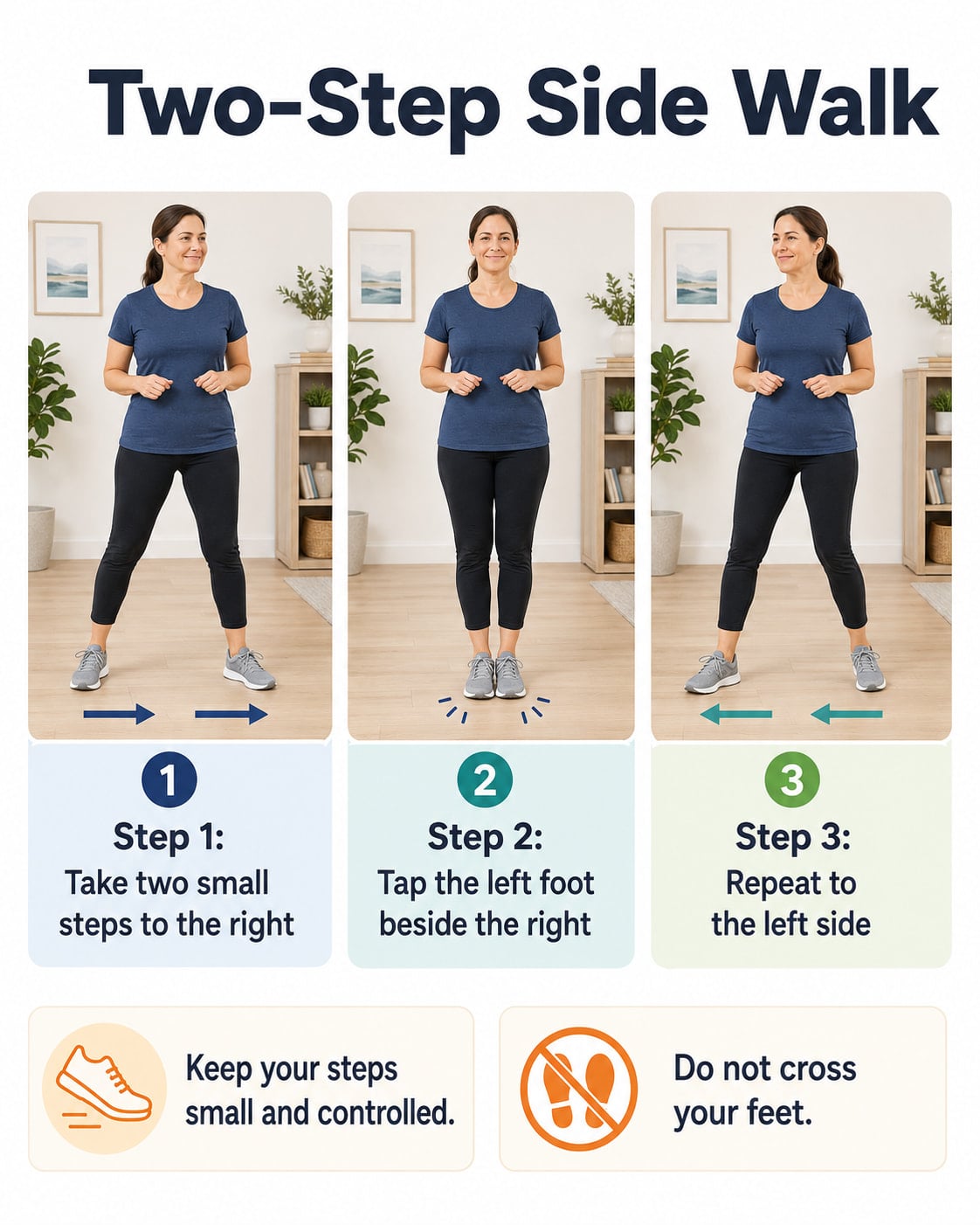
The two-step side walk adds more continuous lateral movement than a basic step-touch.
How to do it:
- Take two small steps to the right.
- Tap the left foot beside the right.
- Take two small steps to the left.
- Tap the right foot beside the left.
- Continue moving from side to side.
Keep your feet from crossing and maintain a slight bend in your knees.
Beginner modification: Take one step in each direction rather than two.
7. Alternating Knee Lifts
Knee lifts can increase the intensity because they require more hip and core involvement.
How to do it:
- Stand tall and lightly brace your midsection.
- Lift your right knee to a comfortable height.
- Lower the foot gently.
- Lift the left knee.
- Continue alternating without leaning backward.
Your knee does not need to reach hip height. Lift only as high as you can while maintaining control.
Beginner modification: Use a wall or chair for balance and keep the knee lift low.
8. Standing Hamstring Curls
Standing hamstring curls involve bending one knee at a time.
How to do it:
- Stand with your feet hip-width apart.
- Shift your weight onto your left foot.
- Bend your right knee and bring the heel toward the back of your thigh.
- Lower the foot.
- Repeat on the other side.
Keep your knees relatively close together and avoid arching your lower back.
Beginner modification: Make the bend smaller and hold a stable support.
9. V-Step
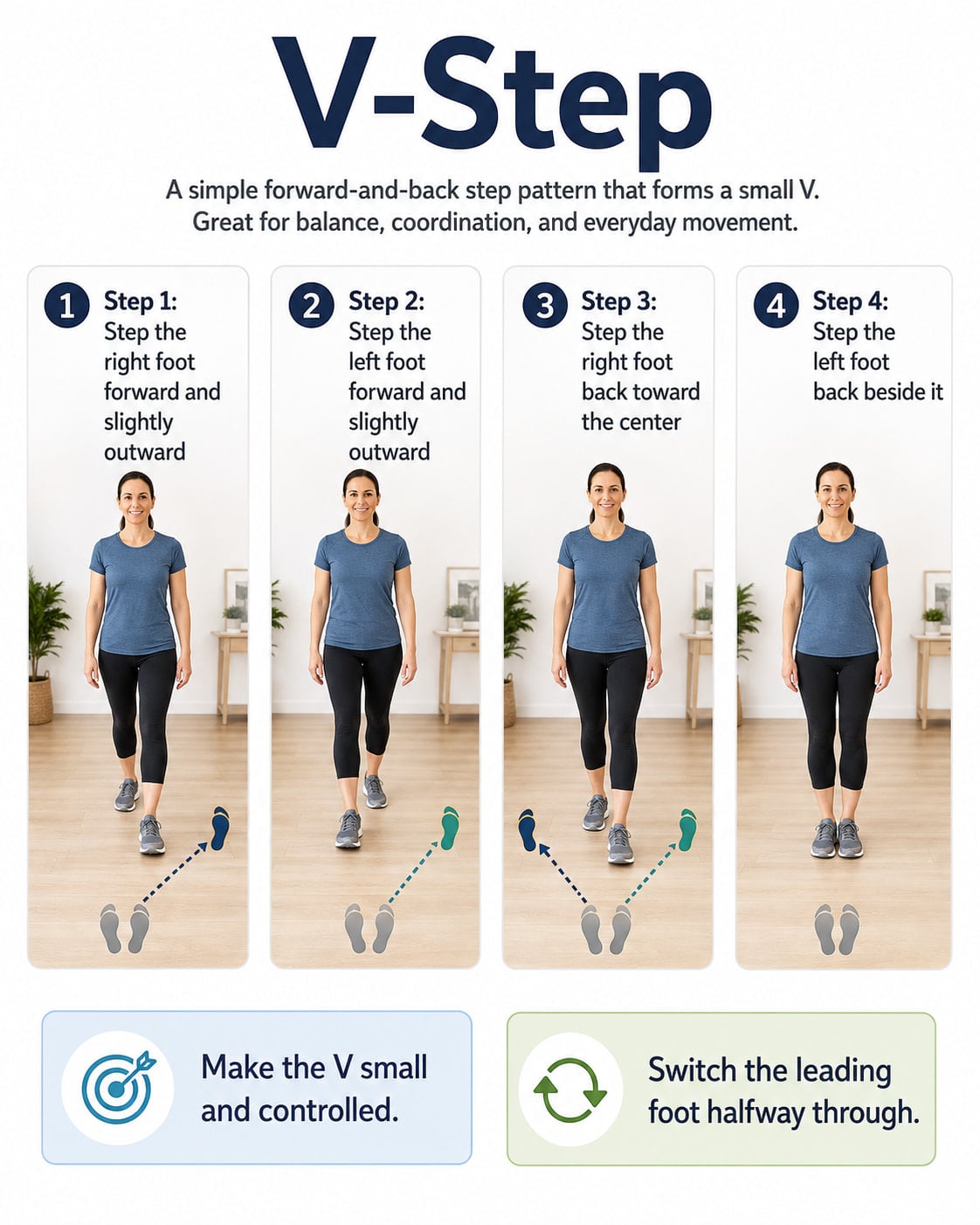
The V-step combines forward and diagonal walking.
How to do it:
- Begin with your feet close together.
- Step your right foot forward and slightly outward.
- Step your left foot forward and slightly outward.
- Step the right foot back toward the center.
- Step the left foot back beside it.
Your feet create a wide “V” when moving forward and return to a narrower position when moving back.
Switch the leading foot halfway through the interval.
Beginner modification: Make the V very small or practice one side at a time.
10. Around-the-Room Walk
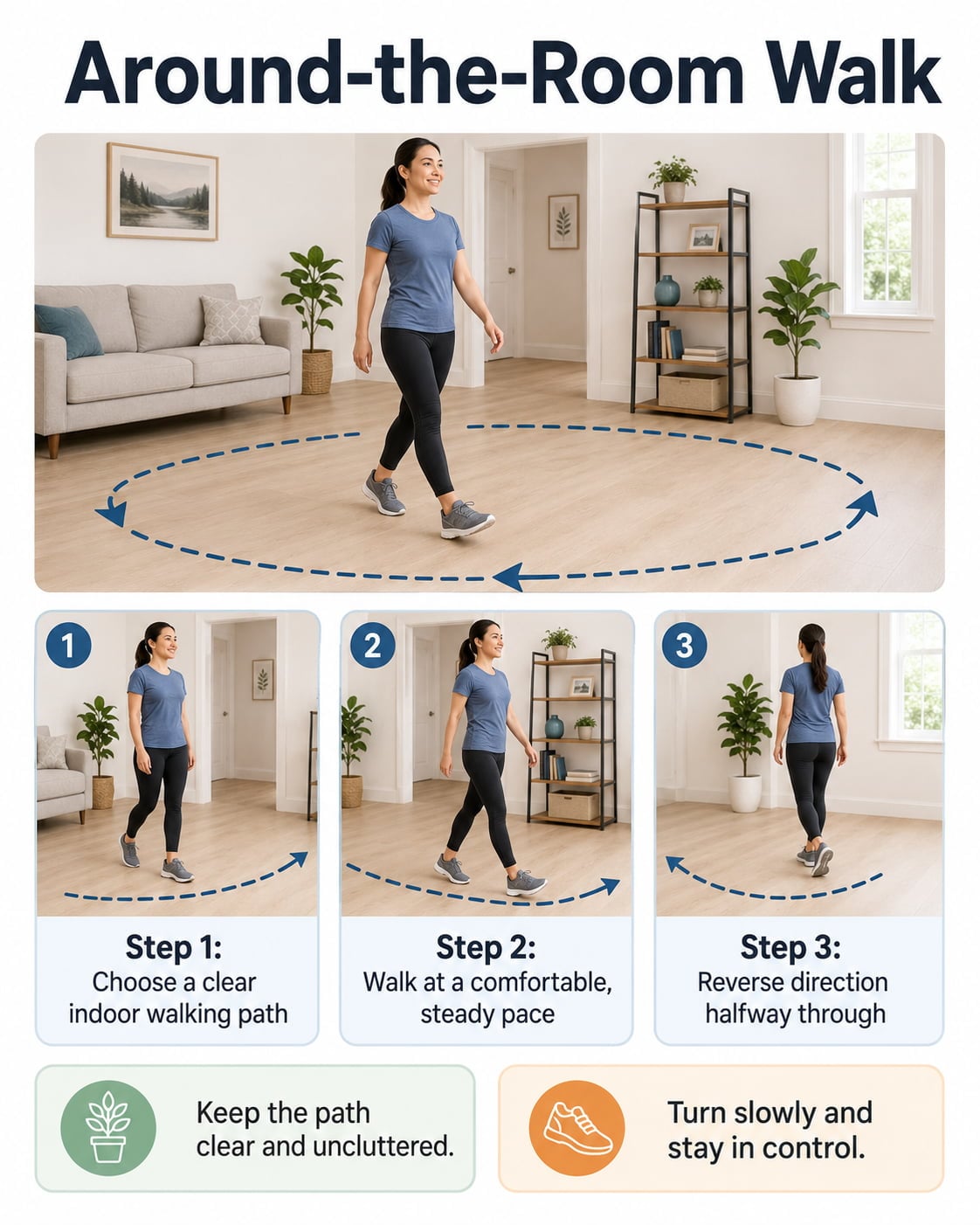
Finish the circuit with continuous walking along a safe indoor route.
How to do it:
- Choose a clear path around the room or through a hallway.
- Walk at a comfortable, steady pace.
- Keep your steps controlled when turning.
- Reverse direction halfway through so you do not always turn the same way.
A simple oval or figure-eight path works well when space permits.
Beginner modification: Continue marching in place if walking around furniture feels unsafe.
10-Minute Walking Exercise at Home Routine
The following circuit provides 10 minutes of structured movement. Add a short warm-up and cool-down, making the full session approximately 14–16 minutes.
Warm-Up: 2–3 Minutes
Begin with:
- Easy marching
- Small step-touches
- Gentle shoulder rolls
- Slow arm swings
The warm-up should feel light. Its purpose is to gradually increase movement and prepare you for the main circuit.
Main Circuit: 10 Minutes
| Move | Work Time | Transition |
|---|---|---|
| March in Place | 45 seconds | 15 seconds |
| Step-Touch | 45 seconds | 15 seconds |
| Alternating Heel Digs | 45 seconds | 15 seconds |
| Forward Toe Taps | 45 seconds | 15 seconds |
| Forward-and-Back Steps | 45 seconds | 15 seconds |
| Two-Step Side Walk | 45 seconds | 15 seconds |
| Alternating Knee Lifts | 45 seconds | 15 seconds |
| Standing Hamstring Curls | 45 seconds | 15 seconds |
| V-Step | 45 seconds | 15 seconds |
| Around-the-Room Walk | 45 seconds | 15 seconds |
During each 15-second transition, march slowly, prepare for the next move, or pause if you need more recovery.
Cool-Down: 2–3 Minutes
Gradually reduce your pace with:
- Slow marching
- Gentle step-touches
- Relaxed breathing
- Easy ankle movements
Do not stop suddenly after a faster interval. Continue moving gently until your breathing begins returning toward normal.
The National Institute on Aging’s aerobic exercise guidance recommends light activity before and after aerobic exercise as a warm-up and cool-down.
How Long Should Beginners Walk at Home?
There is no single starting duration that works for everyone. Choose an amount you can complete with good form and without excessive fatigue.
A practical beginner progression is:
| Week | Suggested Main Workout |
|---|---|
| Week 1 | 5–10 minutes, 3 days |
| Week 2 | 10–12 minutes, 3–4 days |
| Week 3 | 12–15 minutes, 3–4 days |
| Week 4 | 15–20 minutes, 4–5 days |
This is an example, not a mandatory schedule. Repeat a week when needed, or progress more slowly if you experience lingering soreness or unusual fatigue.
As of August 2026, the current Physical Activity Guidelines for Americans remain the second edition. Adults should work toward at least 150 minutes of moderate-intensity aerobic activity each week and muscle-strengthening activity on at least two days. The aerobic minutes can be divided into smaller sessions, and people who are inactive should increase gradually.
The 150-minute target is a goal, not a minimum requirement before exercise becomes beneficial. A five- or ten-minute session is still a meaningful starting point.
How Hard Should an Indoor Walking Workout Feel?
Most beginners should aim for light to moderate effort.
Light Effort
You feel warm, but your breathing remains comfortable. You can speak and sing without difficulty.
Use light effort for:
- Warming up
- Cooling down
- Learning new steps
- Recovery days
- Returning after a break
Moderate Effort
Your breathing becomes deeper and your heart rate increases, but you can still speak in complete sentences. Singing would be difficult.
You can increase your effort by:
- Marching slightly faster
- Moving your arms more
- Taking somewhat larger steps
- Reducing unnecessary pauses
- Adding another circuit
Do not sacrifice balance or movement quality just to increase intensity.
How to Make Walking Exercise at Home Easier
Reduce the challenge when you are learning the routine or having a lower-energy day.
Try one or more of these options:
- Shorten each interval to 20–30 seconds.
- Rest for 30–60 seconds between movements.
- Keep your feet close to the floor.
- Make your steps smaller.
- Reduce the speed.
- Keep your arms relaxed at your sides.
- Use a stable chair or countertop.
- Perform marching, heel digs, and toe taps while seated.
- Complete five movements instead of all ten.
A shorter modified workout is better than forcing movements you cannot perform safely.
How to Make the Workout More Challenging
Once you can complete the routine comfortably, change only one element at a time.
You might:
- Increase each movement to 60 seconds.
- Repeat the complete circuit.
- Add stronger but controlled arm swings.
- Increase your pace slightly.
- Take wider side steps.
- Lift your knees a little higher.
- Alternate one brisk minute with one easier minute.
- Walk for longer before cooling down.
Avoid adding ankle weights unless a qualified professional has recommended them. Ankle weights can change your walking mechanics and may place extra stress on the knees, hips, or ankles.
Common Indoor Walking Mistakes
Starting Too Fast
Beginning at your fastest pace can cause early fatigue and make it harder to finish. Start with easy movement and build your pace gradually.
Stomping the Feet
Heavy landings create unnecessary impact. Place each foot down quietly and maintain control.
Taking Steps That Are Too Large
Large steps can make balance more difficult and may strain the hips or knees. Use a comfortable stride.
Looking Down Constantly
Looking at the floor can encourage a rounded posture. Keep your gaze forward while occasionally checking the path for obstacles.
Holding the Breath
Breathe continuously. Slow your pace if you cannot maintain steady breathing.
Leaning Back During Knee Lifts
Lift the knee only as high as you can without leaning backward. A small, controlled knee lift is more useful than a high, unstable one.
Using an Unsafe Exercise Area
Walking around rugs, cords, pets, or crowded furniture increases fall risk. Clear the area before starting rather than trying to step around obstacles during the workout.
Progressing Everything at Once
Increasing speed, duration, range of motion, and frequency simultaneously can cause excessive fatigue. Change one factor and allow your body time to adjust.
Walking Exercise at Home Safety Tips
Moderate physical activity is generally safe for most people, but the workout should match your health, mobility, and current fitness.
Before beginning:
- Clear the floor and improve lighting.
- Keep a stable support nearby when needed.
- Start with small, slow movements.
- Warm up before increasing your pace.
- Drink water as appropriate.
- Avoid exercising on a slippery surface.
- Stop any movement that causes sharp or increasing pain.
Speak with a health care professional about appropriate exercise types and amounts if you have a chronic condition such as heart disease, diabetes, or arthritis. Guidance may also be appropriate if you recently had surgery, have frequent dizziness, experience significant balance problems, or have been advised to limit physical activity. The CDC specifically recommends individualized guidance for people managing chronic health conditions.
Stop exercising if you develop:
- Chest pain or pressure
- Dizziness or lightheadedness
- Nausea
- Faintness
- Extreme or unusual shortness of breath
- Sudden weakness
- New or severe pain
Aerobic exercise should not cause dizziness, chest pain or pressure, or nausea. Seek urgent medical care for severe, sudden, or persistent symptoms.
Frequently Asked Questions
Does walking in place count as exercise?
Yes. Walking in place can count as aerobic activity when performed continuously at an effort that raises your heart rate and breathing. Move your arms and maintain a steady rhythm to increase the intensity.
Can walking exercise at home help with weight loss?
It may support weight loss by increasing daily movement and energy expenditure. However, results also depend on food intake, workout duration, intensity, sleep, medications, health conditions, and other individual factors. Walking alone does not guarantee a specific amount of weight loss.
How long should a beginner walk at home?
A beginner may start with 5–10 minutes and gradually add time. You can also complete several short sessions throughout the day. The right starting duration is one you can perform safely with controlled movement.
Is walking at home as effective as walking outside?
Both can provide aerobic activity when the effort and duration are similar. Outdoor walking may offer hills, changing surfaces, and more natural forward movement, while indoor walking provides convenience, climate control, and fewer weather-related barriers. Choose the option you can perform consistently and safely.
Can I do an indoor walking workout every day?
Many people can perform light or moderate walking regularly. However, your frequency should reflect your fitness, health, and recovery. Reduce the duration or intensity if you experience lingering soreness or fatigue, and include other activities such as strength and mobility work in a balanced routine.
Do I need to wear shoes when walking at home?
Supportive shoes are recommended for many people, especially on hard or slippery floors. They may improve traction, cushioning, and comfort. Make sure the shoes fit properly and remain securely fastened.
What should I do if I have knee pain or poor balance?
Use smaller steps, keep your feet closer to the floor, slow the pace, and hold a stable chair or counter. A seated march may be a better starting option. Stop if the movement increases pain, and seek professional guidance for persistent pain, unexplained swelling, recurrent falls, or significant balance difficulty.
Conclusion
Walking exercise at home makes it possible to become more active with minimal space and no specialized equipment. Start with the ten beginner moves at a pace you can control, use the easier options whenever needed, and focus on consistency rather than intensity.
Complete one manageable circuit today. As the routine becomes easier, gradually add a few minutes, slightly increase your pace, or repeat the circuit. Small sessions accumulated consistently can help you move toward a more active lifestyle.
References
- Office of Disease Prevention and Health Promotion — Current Physical Activity Guidelines
- Centers for Disease Control and Prevention — Adding Physical Activity as an Adult
- Centers for Disease Control and Prevention — Measuring Physical Activity Intensity
- American Heart Association — Why Is Walking the Most Popular Form of Exercise?
- National Institute on Aging — Three Types of Exercise That Can Improve Health and Physical Ability