
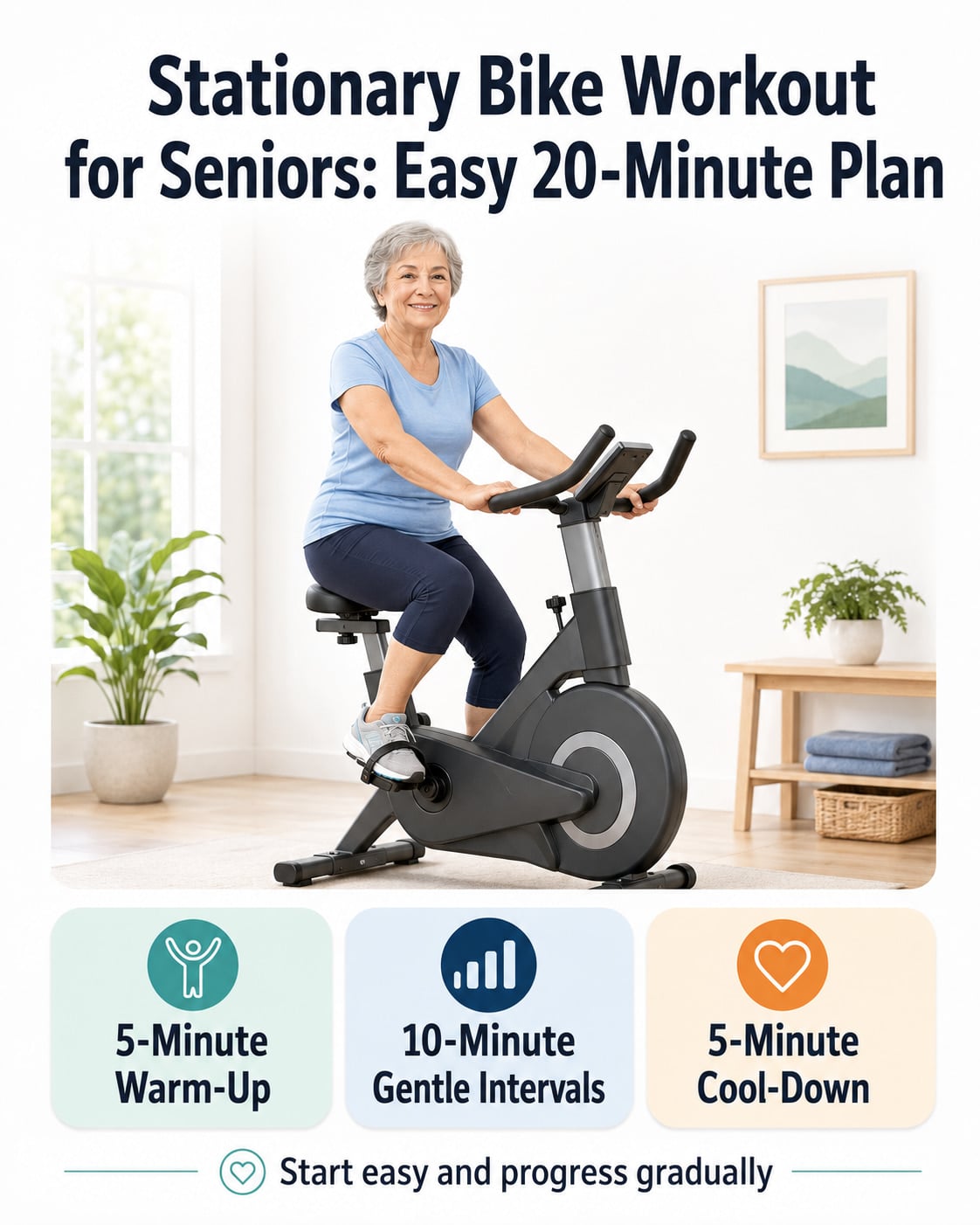
For many older adults, an easy stationary bike workout can include a five-minute warm-up, 10 minutes of gentle intervals, and a five-minute cool-down. Keep the resistance light, pedal at a controlled pace, and use the talk test to avoid working too hard.
This stationary bike workout for seniors provides a practical way to build aerobic endurance without the impact of running or jumping. Because you remain seated and control the resistance, an exercise bike may also be suitable for people who feel unsteady walking outdoors.
Updated December, 2025, the CDC recommends that adults age 65 and older get at least 150 minutes of moderate-intensity aerobic activity each week. Older adults should also perform muscle-strengthening activities on at least two days and include regular balance exercises. This 20-minute bike routine is a manageable starting point, but it should be part of a varied weekly activity plan.
Is a Stationary Bike Good for Seniors?
A stationary bike can be a good exercise option for seniors because it provides low-impact, seated aerobic activity in a controlled environment. You do not have to deal with traffic, uneven sidewalks, bad weather, or outdoor hills.
Regular stationary cycling may help support:
- Cardiovascular endurance
- Lower-body stamina
- Joint movement
- Exercise confidence
- The ability to complete daily activities without tiring as quickly
A systematic review published in BMC Geriatrics on January, 2026, included 47 stationary-bike studies involving adults age 60 and older, including 28 randomized controlled trials. Across the included studies, researchers reported improvements in areas such as aerobic capacity, cycling efficiency, mobility, cognition, executive function, and quality of life. However, the study methods and participant groups varied, and the authors called for more high-quality trials to determine the best exercise prescriptions.
Stationary cycling is not a complete exercise program by itself. Because it is seated and non-weight-bearing, it does not replace dedicated strength, balance, flexibility, or weight-bearing activities.
Who Should Check With a Healthcare Professional First?
Many people can begin with gentle physical activity and gradually build up. The National Institute on Aging notes that moderate activities such as riding a bike are safe for many older adults, including people with chronic conditions, when they start slowly and follow an appropriate plan.
Ask your healthcare professional or physical therapist for individualized guidance before starting when you have:
- New or unexplained chest discomfort
- Fainting or frequent unexplained dizziness
- An unstable heart or lung condition
- A recent operation, joint replacement, or serious injury
- Severe joint pain, swelling, locking, or instability
- A medical condition for which you have been told to restrict exercise
- Difficulty getting on or off the bike safely
People in cardiac or pulmonary rehabilitation should follow the workout intensity prescribed by their rehabilitation team rather than a general online routine.
Choose the Right Stationary Bike
The best exercise bike is one you can enter, adjust, and pedal comfortably.
| Bike type | Main features | Who may prefer it |
|---|---|---|
| Recumbent bike | Wide seat, back support, and pedals in front | People with balance, mobility, wrist, back, or seating-comfort concerns |
| Upright bike | Smaller seat with pedals below the body | People who can sit upright comfortably and get on and off securely |
| Spin bike | Forward-leaning position, heavy flywheel, and lower handlebars | Experienced exercisers who are comfortable with a more demanding riding position |
The Arthritis Foundation describes recumbent bikes as generally more stable and comfortable for people with mobility or balance limitations. Upright bikes may be uncomfortable for some people with back, shoulder, or wrist problems.
A step-through design can make mounting easier. Before using a bike at a gym, ask a staff member to show you how to adjust the seat, stop the pedals, and change the resistance.
How to Adjust Your Bike Before Exercising
An incorrect bike setup can contribute to knee, hip, back, shoulder, or neck discomfort. Take a few minutes to adjust the bike before beginning.
Set the Seat Position
On an upright bike, start with the seat at approximately hip height. Sit on the bike and place one pedal at its lowest point. Your knee should remain slightly bent rather than locked or deeply bent.
On a recumbent bike, move the seat forward or backward until your farthest leg still has a small bend at the knee. You should not have to reach with your toes, lift your hip, or straighten your knee completely to finish a pedal rotation.
Adjust the Handlebars
You should be able to reach the handlebars without:
- Rounding your back
- Raising your shoulders
- Locking your elbows
- Leaning heavily through your hands
- Stretching your arms uncomfortably
Keep your shoulders relaxed and your elbows slightly bent.
Position Your Feet Securely
Wear supportive, closed-back athletic shoes. Avoid slippers, flip-flops, loose sandals, or clothing that could catch in the pedals.
Place each foot securely on the pedal. When pedal straps are provided, make sure they are comfortable and that you know how to release your feet before starting.
Practice Getting On and Off
Hold the bike’s stable support handles and make sure the pedals are completely stopped before mounting or dismounting. Do not use the moving handlebars, screen, or seat adjustment lever for support.
How Hard Should Seniors Pedal?
Use perceived effort rather than trying to match a universal speed or resistance number. Exercise-bike settings vary considerably between machines.
The CDC uses a zero-to-10 effort scale. Moderate intensity is approximately five or six out of 10. At that level, you can talk but cannot comfortably sing.
| Effort level | How it should feel |
|---|---|
| 2 out of 10 | Very easy; normal breathing |
| 3 out of 10 | Easy; comfortable conversation |
| 4 out of 10 | Comfortable but purposeful |
| 5 to 6 out of 10 | Moderate; breathing faster but still able to talk |
| 7 or higher | Hard; generally unnecessary for this beginner plan |
Beginners can keep the entire workout around three or four out of 10. Once the routine feels comfortable, the slightly faster intervals may gradually reach five or six.
A generic target-heart-rate formula is not necessary for this workout. Fitness level, health conditions, and medications can affect exercise heart rate. Follow a personalized heart-rate range when your healthcare professional has given you one.
20-Minute Stationary Bike Workout for Seniors
Set the resistance low enough that you can complete smooth pedal rotations without straining. There should be enough resistance to keep the pedals controlled, but your legs should not feel as though they are pushing a heavy load.
Stay seated throughout the routine.
| Time | What to do | Effort |
|---|---|---|
| 0:00–2:00 | Pedal very slowly with minimal resistance | 2 out of 10 |
| 2:00–5:00 | Gradually settle into a comfortable, steady pace | 3 out of 10 |
| 5:00–15:00 | Alternate 1 minute of slightly faster pedaling with 1 minute of easy pedaling. Repeat five times. | Faster: 4–5; easy: 2–3 |
| 15:00–18:00 | Lower the resistance and return to an easy pace | 2–3 out of 10 |
| 18:00–20:00 | Pedal very slowly and let your breathing return toward normal | 1–2 out of 10 |
The American Heart Association recommends spending five to 10 minutes gradually preparing for aerobic activity and slowing down afterward. Stopping suddenly can contribute to lightheadedness because heart rate and blood pressure may decrease quickly.
What the Workout Should Feel Like
During the workout:
- Your pedal stroke should remain smooth.
- Your upper body should feel relaxed.
- Your breathing may become faster but should remain controlled.
- You should be able to speak in complete sentences.
- You should not feel sharp, shooting, or steadily worsening pain.
Do not worry about reaching a particular number of revolutions per minute. A comfortable cadence for one person may be too fast or too slow for another.
Easier Modifications for Beginners
You do not have to complete the interval plan during your first ride.
Pedal Easily for the Full 20 Minutes
Maintain a relaxed effort of two or three out of 10. Use only enough resistance to keep the pedals moving smoothly.
Use Shorter Intervals
Instead of alternating one minute faster and one minute easy, try:
- 30 seconds slightly faster
- 90 seconds easy
- Repeat five times
Divide the Workout
Complete two 10-minute rides or four five-minute rides at different times of day. Short sessions can be especially useful when fatigue, pain, breathing limitations, or reduced endurance make 20 continuous minutes difficult.
Begin With 10 Minutes
Use:
- Three-minute warm-up
- Four minutes of easy riding
- Three-minute cool-down
Add one or two minutes when the routine feels comfortable and you recover normally afterward.
How Often Should Seniors Use a Stationary Bike?
A new exerciser can begin with two or three stationary bike sessions per week. Leave a rest or lighter-activity day between sessions when your legs feel unusually tired or sore.
As your endurance improves, you may gradually work toward three to five rides per week. Some experienced riders can cycle more frequently, but every session does not need to be challenging.
Five 20-minute sessions provide 100 minutes of total movement. However, only the portions performed at moderate intensity count toward the CDC’s 150-minute moderate-intensity aerobic target. You may gradually extend some rides or combine cycling with walking, swimming, or another aerobic activity.
Continue including:
- Strength exercises on at least two days per week
- Regular balance practice
- Comfortable mobility or flexibility activities
Stationary cycling reduces the balance demand during exercise, but it does not replace activities that directly challenge standing balance.
How to Progress Without Overdoing It
Make one small change at a time. Do not increase duration, frequency, speed, and resistance during the same week.
A sensible progression order is:
- Become comfortable getting on and off the bike.
- Complete smooth, pain-free pedal rotations.
- Reach 20 minutes at an easy effort.
- Add another weekly session.
- Increase the faster intervals slightly.
- Add a small amount of resistance last.
An increase of two to five minutes is enough when you are ready for a longer ride. There is no need to double the workout duration or make large resistance jumps.
Reduce the next session when you experience unusual fatigue, increased joint pain, or soreness that interferes with normal daily movement.
Is a Stationary Bike Good for Seniors With Bad Knees?
Stationary cycling may be a comfortable low-impact option for some people with knee arthritis because the feet remain supported and the exercise does not involve repeated ground impact. Research summarized by the Arthritis Foundation suggests stationary cycling may help reduce pain and support function in some people with knee osteoarthritis, although individual responses vary.
To make cycling more knee-friendly:
- Check that the seat is not too low.
- Begin with very light resistance.
- Keep the knees pointing in the same direction as the feet.
- Avoid grinding slowly against heavy resistance.
- Increase speed or duration before adding substantial resistance.
- Stop for sharp, shooting, or worsening pain.
Mild muscle tiredness is different from joint pain. Contact a healthcare professional if cycling causes significant swelling, knee locking, buckling, persistent pain, or difficulty walking afterward.
People recovering from knee surgery or joint replacement should follow the range-of-motion and resistance limits provided by their surgeon or physical therapist.
Common Stationary Bike Mistakes to Avoid
Starting With Too Much Resistance
Heavy resistance can place unnecessary demand on the knees and hips. Begin light and increase gradually.
Setting the Seat Too Low
A low seat keeps the knee excessively bent through the pedal stroke. Move the seat until the knee retains only a slight bend at the farthest pedal position.
Hunching Over the Handlebars
Sit tall, relax your shoulders, and avoid gripping the handlebars tightly. Adjust the handlebars or choose a recumbent bike when an upright position causes discomfort.
Pedaling Fast Without Control
Faster is not automatically better. Maintain smooth, controlled rotations without bouncing in the seat.
Skipping the Cool-Down
Do not stop immediately after the faster intervals. Continue pedaling slowly for the final five minutes.
Depending Only on Cycling
A stationary bike provides aerobic activity and some lower-body work, but seniors still need separate strength and balance training.
When to Stop Exercising
Stop pedaling, reduce the resistance, and rest when you experience:
- Chest pain, pressure, tightness, or heaviness
- Dizziness or lightheadedness
- An irregular or pounding heartbeat with symptoms
- Unusual or severe shortness of breath
- Nausea, cold sweating, or sudden weakness
- Sharp or shooting joint pain
- A sudden loss of coordination or control
MedlinePlus lists dizziness, chest pain, irregular heartbeat, shortness of breath, and nausea among symptoms that can indicate excessive strain during exercise. Symptoms that are severe, do not improve after stopping, or include fainting or significant breathing difficulty require prompt medical attention.
Frequently Asked Questions
Is 20 Minutes on a Stationary Bike Enough for Seniors?
Twenty minutes is a useful starting workout, particularly for someone who has been inactive. It may improve exercise tolerance when performed consistently. However, one 20-minute session does not meet the full weekly activity recommendation.
Gradually combine bike workouts with other aerobic, strength, and balance activities based on your abilities.
How Long Should a 70-Year-Old Ride a Stationary Bike?
There is no single time limit based only on age. A healthy, active 70-year-old may be able to ride longer than a younger person with significant health or mobility limitations.
A beginner can start with five to 10 minutes and gradually build toward 20 minutes. Comfort, symptoms, recovery, and current fitness are more useful guides than age alone.
Is a Recumbent or Upright Bike Better for Seniors?
A recumbent bike is often easier for people with balance difficulties, back discomfort, wrist pain, reduced mobility, or difficulty supporting themselves on a narrow seat. An upright bike can work well for someone who mounts it safely and remains comfortable in a more traditional cycling position.
The better option is the bike that fits your body and allows pain-free, controlled pedaling.
Is a Stationary Bike Safe for Seniors With Knee Pain?
It may be appropriate for some types of knee pain, particularly when the seat is adjusted correctly and the resistance remains light. It is not suitable for every knee condition.
Stop and seek professional guidance if you experience sharp pain, substantial swelling, locking, buckling, or symptoms that continue after exercise.
What Resistance Level Should a Senior Use?
Start at the lowest practical resistance that allows controlled pedaling. Because resistance numbers are not standardized, “level three” on one bike may feel completely different on another.
Use perceived effort instead. Beginners should generally remain around three or four out of 10 during most of the workout.
Can Seniors Ride a Stationary Bike Every Day?
Some seniors can complete easy rides on consecutive days, but beginners usually benefit from starting two or three days per week. Increase frequency only when you recover comfortably and do not develop persistent pain or fatigue.
Alternate harder rides with easy rides rather than making every session challenging.
Does a Stationary Bike Improve Balance?
A stationary bike provides a more stable environment than outdoor cycling and can help build leg endurance. However, because the exercise is seated and supported, it does not directly challenge standing balance enough to replace dedicated balance exercises.
Conclusion
A stationary bike workout for seniors does not need heavy resistance, high speed, or complicated programming. Start with a five-minute warm-up, alternate gentle and easy pedaling for 10 minutes, and finish with a gradual five-minute cool-down.
Adjust the bike carefully, keep the first sessions comfortable, and track how you feel during and after each ride. Once you can complete the workout comfortably, progress by adding a session, a few minutes, or a small amount of resistance—one change at a time.