
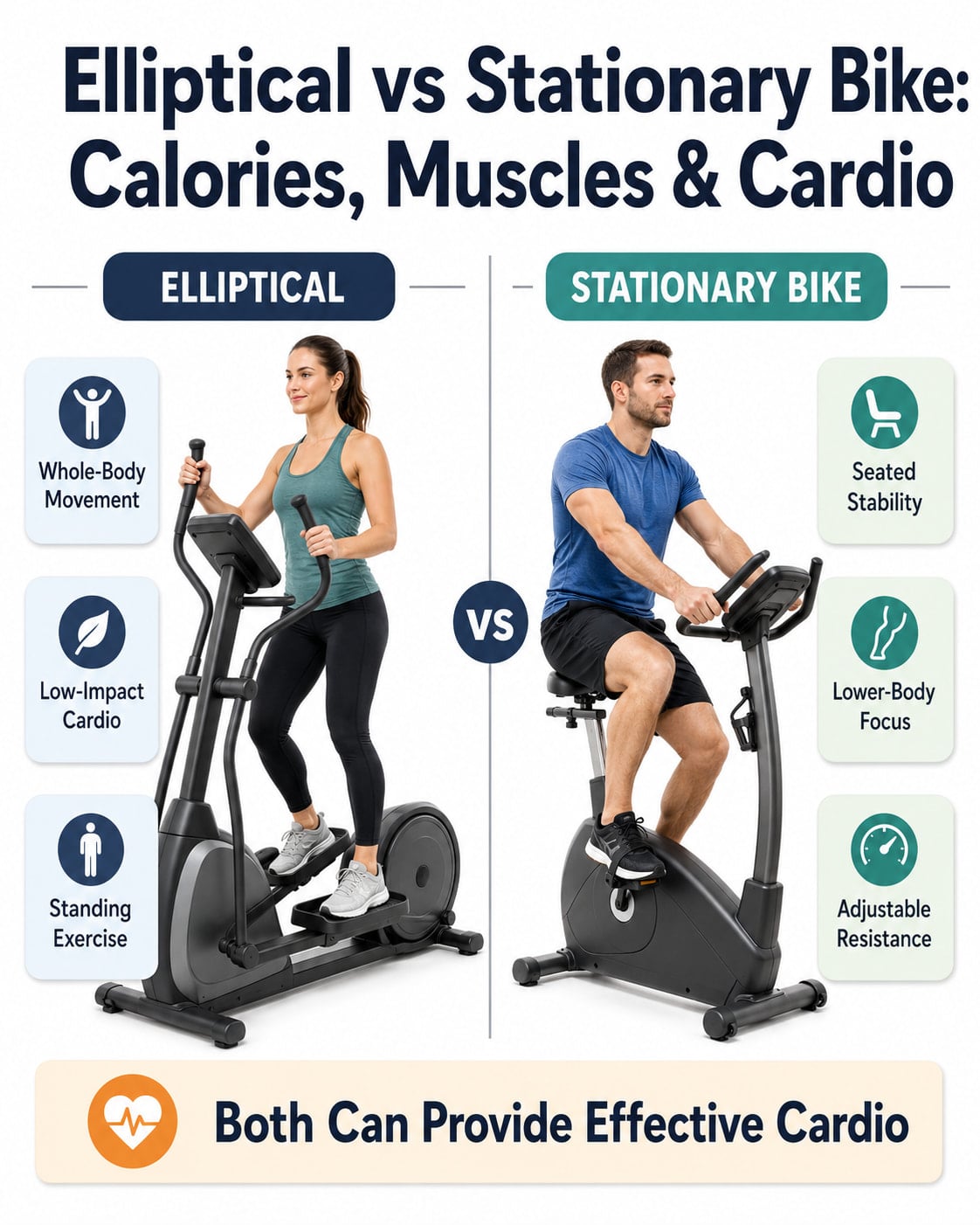
The elliptical is generally better for whole-body movement and may burn slightly more calories at the same perceived effort, while the stationary bike is better for seated stability and focused lower-body training. Both machines can provide an effective cardiovascular workout when your intensity and duration are similar.
Your best choice depends on your joints, balance, fitness level, training goals, and which machine you will use consistently. Resistance, pace, workout length, and effort usually matter more than the machine itself.
This elliptical vs stationary bike comparison explains the differences in calorie burn, muscles worked, cardiovascular benefits, joint impact, weight-loss potential, and practical uses.
Elliptical vs Stationary Bike: Quick Comparison
| Category | Elliptical | Stationary bike |
|---|---|---|
| Calorie burn | May burn slightly more at the same perceived effort | Varies widely; hard cycling can equal or exceed elliptical training |
| Main muscles | Quadriceps, glutes, hamstrings, and calves | Quadriceps, glutes, hamstrings, and calves |
| Upper-body involvement | Moving handles can involve the arms and upper body | Minimal during most seated cycling |
| Cardio potential | Moderate to vigorous | Moderate to vigorous |
| Body position | Standing | Seated |
| Joint impact | Low impact but weight-bearing | Low impact and largely non-weight-bearing |
| Balance demand | Moderate | Low, especially on a recumbent bike |
| Best for | Whole-body movement and upright cardio | Seated cardio, leg-focused work, and controlled intervals |
| Beginner-friendly | Yes, if balance and coordination are adequate | Yes, especially for people who prefer more support |
| Weight-loss potential | Effective when used consistently | Effective when used consistently |
The elliptical may produce a modest calorie advantage when effort is matched because you are standing and can use your arms and legs together. However, a challenging spin-bike or high-resistance cycling workout can burn more calories than a moderate elliptical session.
Elliptical vs Stationary Bike Calories
Neither machine always burns more calories.
The 2024 Adult Compendium of Physical Activities assigns MET values to different activities and exercise intensities. One MET represents the approximate energy cost of resting, while higher MET values indicate greater energy expenditure.
According to the Compendium:
- Moderate elliptical exercise is rated at 5.0 METs.
- Vigorous elliptical exercise is rated at 9.0 METs.
- Stationary cycling ranges from 3.5 METs at a very light workload to more than 10 METs at demanding power outputs.
- A stationary spin or RPM class is rated at 9.0 METs.
Estimated Calories Burned in 30 Minutes
The following estimates are for a 155-pound adult. They were calculated using the listed MET values and a standard MET-based calorie formula.
| Exercise and intensity | METs | Estimated calories in 30 minutes |
|---|---|---|
| Stationary bike, 25–30 watts, very light effort | 3.5 | About 129 calories |
| Stationary bike, 50 watts, light effort | 4.0 | About 148 calories |
| Elliptical, moderate effort | 5.0 | About 185 calories |
| Stationary bike, 60 watts, light-to-moderate effort | 5.0 | About 185 calories |
| Stationary bike, 70–80 watts | 5.8 | About 214 calories |
| Stationary bike, 90–100 watts | 6.0 | About 221 calories |
| Stationary bike, general effort | 6.8 | About 251 calories |
| Stationary bike, 126–150 watts | 8.0 | About 295 calories |
| Elliptical, vigorous effort | 9.0 | About 332 calories |
| Stationary spin or RPM class | 9.0 | About 332 calories |
These numbers are estimates, not guaranteed results. Actual calorie expenditure can be higher or lower depending on your body size, fitness level, movement efficiency, resistance, cadence, and workout duration.
Machine-console calorie readings should also be treated as estimates. Two machines may display different numbers even when the workouts feel equally difficult.
What Direct Comparison Research Found
A 2024 indoor cardio machine study compared seven exercise machines in 30 recreationally active middle-aged men. Participants completed short exercise bouts at a perceived exertion of 17, described as very hard, and at maximum effort.
At the very-hard intensity, average calorie expenditure was:
| Machine | Average calories per minute |
|---|---|
| Elliptical | 12.82 |
| Spin bike | 12.45 |
| Upright bike | 11.94 |
| Recumbent bike | 11.07 |
At maximum effort, the elliptical averaged 14.67 calories per minute. The spin bike averaged 14.33, the upright bike averaged 13.63, and the recumbent bike averaged 13.25 calories per minute.
This suggests a small elliptical advantage when perceived effort is similar. However, the study involved only 30 active men and used short, unusually demanding exercise bouts. Its calorie figures should not be treated as expected results for every beginner or regular gym user.
Which Machine Burns More Calories?
The elliptical may burn slightly more calories at the same perceived effort, but exercise intensity is the deciding factor.
For example:
- A vigorous elliptical session will usually burn more than easy stationary cycling.
- A high-resistance bike interval workout may burn more than a moderate elliptical session.
- A spin class can have an energy demand similar to vigorous elliptical training.
- A supported recumbent-bike workout may burn less per minute but allow some people to exercise longer.
The machine that produces the highest sustainable effort for you may ultimately burn the most calories over time.
What Affects Your Calorie Burn?
Your calorie expenditure depends on:
- Body weight and body composition
- Resistance level
- Pedaling or striding speed
- Workout duration
- Upright, recumbent, or spin-bike design
- How actively you use the elliptical handles
- Fitness and exercise efficiency
- Interval structure
- Whether you hold or lean heavily on the machine
Increasing resistance can make either workout harder without requiring uncontrolled speed. However, resistance should not be so high that your posture, range of motion, or movement quality breaks down.
Elliptical vs Stationary Bike Muscles Worked
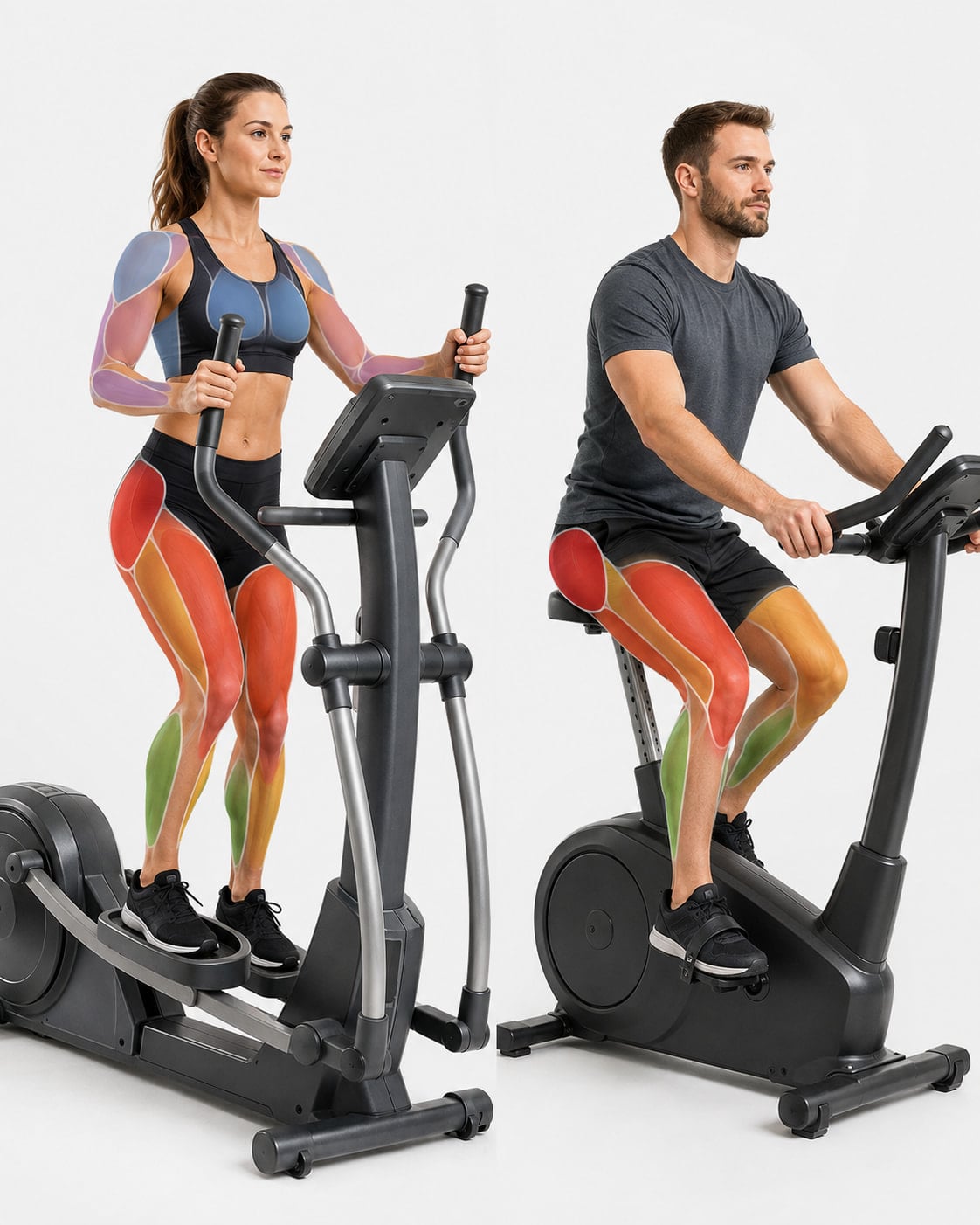
Both machines primarily train the lower body. The elliptical can involve more of the upper body when it has moving handles and you actively push and pull them.
Muscles Worked on an Elliptical
The main muscles used during elliptical exercise include:
Quadriceps
Your quadriceps straighten your knees as you press the pedals downward and forward.
They include:
- Rectus femoris
- Vastus lateralis
- Vastus medialis
- Vastus intermedius
Gluteus Maximus
Your gluteus maximus helps extend your hips as you drive through each stride.
Increasing the resistance or incline may make the glutes work harder, but the effect depends on the specific machine and your technique.
Hamstrings
Your hamstrings help bend the knees and extend the hips during the elliptical’s continuous movement.
Calves
Your gastrocnemius and soleus assist with ankle movement and help stabilize the lower leg.
Upper-Body Muscles
When you actively push and pull moving handles, the elliptical may involve the:
- Shoulders
- Chest
- Upper back
- Biceps
- Triceps
The amount of upper-body work depends on your effort. Lightly holding the handles provides much less muscle involvement than deliberately pushing and pulling against resistance.
Core and Postural Muscles
Your abdominal and back muscles help you remain upright and stable. However, you should not expect the elliptical to train your core as thoroughly as targeted resistance exercises.
Muscles Worked on a Stationary Bike
The main muscles used while cycling include:
Quadriceps
The quadriceps are heavily involved as you press the pedal downward. They are often the most noticeable working muscles during stationary cycling.
Glutes
The gluteus maximus contributes to hip extension during the power phase of the pedal stroke.
Greater resistance generally increases the force your legs must produce. However, you should be able to pedal smoothly without rocking your hips.
Hamstrings
The hamstrings contribute to knee flexion and hip extension throughout the pedaling cycle.
They may become more involved when using cycling shoes that attach to the pedals, although you should still avoid aggressively pulling upward.
Calves
The calves help control the ankle and transfer force through the foot into the pedal.
Hip Flexors
The hip flexors help bring the thigh upward as the pedal returns toward the top of the cycle.
Core and Upper Body
Your core helps stabilize your torso, particularly on an upright or spin bike. However, most stationary cycling provides very little dynamic upper-body exercise.
A recumbent bike requires even less postural stabilization because the seat and backrest support your torso.
Which Machine Works More Muscles?
The elliptical generally works more muscle groups because it combines standing lower-body movement with optional pushing and pulling through the handles.
A small electromyography study involving 10 healthy young adults found greater rectus femoris activity and greater quadriceps–hamstring coactivation during elliptical training than during stationary cycling and several walking conditions. However, muscle activation during one session does not prove that the elliptical produces greater long-term muscle growth.
Which Machine Builds More Muscle?
Neither machine is ideal for maximizing muscle growth.
Higher resistance can challenge your legs and improve muscular endurance, especially if you are a beginner. However, traditional strength exercises provide a clearer path for progressive overload.
A complete program may include:
- Squats or supported squat variations
- Lunges or split squats
- Leg presses
- Hip hinges
- Calf raises
- Upper-body pushing and pulling exercises
The elliptical’s moving handles do not replace dedicated upper-body strength training. The same is true for cycling: harder pedaling can challenge your legs, but it does not replace a structured resistance-training program.
Which Machine Gives You a Better Cardio Workout?
Both the elliptical and stationary bike can improve cardiovascular fitness when you exercise at an appropriate intensity.
Your heart and lungs respond to the demand placed on them. Therefore, the better cardio machine is often the one that lets you maintain a challenging but manageable effort without joint pain, poor technique, or excessive fatigue.
The elliptical may produce a slightly higher heart rate and oxygen demand at a matched perceived effort because you are standing and may be moving your arms and legs together. The 2024 cardio-machine study found that the elliptical produced greater average energy expenditure and heart rate than the spin, upright, and recumbent bikes during the tested high-intensity conditions.
That does not mean cycling provides an inferior cardio workout. Increasing bike resistance, cadence, interval frequency, or workout duration can create a demanding cardiovascular session.
How Much Cardio Should You Do?
The current Physical Activity Guidelines for Americans recommend that adults complete:
- 150–300 minutes of moderate-intensity aerobic activity per week, or
- 75–150 minutes of vigorous-intensity aerobic activity per week, or
- An equivalent combination of moderate and vigorous activity
Adults should also perform muscle-strengthening activities on at least two days each week. Smaller amounts of activity still provide benefits, especially when someone is moving from an inactive lifestyle toward regular exercise.
How to Measure Your Intensity
The CDC’s intensity guide recommends the talk test as a practical way to judge aerobic effort.
- Light intensity: You can talk and sing comfortably.
- Moderate intensity: You can talk, but singing would be difficult.
- Vigorous intensity: You can say only a few words before pausing for breath.
You can also use a simple 1–10 effort scale:
| Effort level | Approximate intensity |
|---|---|
| 2–3 | Easy warm-up |
| 4–6 | Moderate |
| 7–8 | Vigorous |
| 9–10 | Very hard to maximum |
Most beginners should spend the majority of their early workouts at an easy-to-moderate effort rather than immediately attempting maximum-intensity intervals.
Elliptical vs Stationary Bike for Weight Loss
Both machines may support weight loss by increasing the number of calories your body uses.
The elliptical may provide a small calorie advantage per minute at a similar perceived effort. However, that advantage is unlikely to matter if you dislike the elliptical, cannot use it comfortably, or stop after a few minutes.
The stationary bike may be the better weight-loss tool when it allows you to:
- Exercise for longer
- Train more frequently
- Complete intervals safely
- Recover comfortably
- Remain consistent for months
Physical activity is only one part of weight management. The CDC explains that using more energy through activity, combined with reducing calorie intake, creates the calorie deficit needed for weight loss. Sleep, eating patterns, medications, medical conditions, stress, hormones, age, and other factors can also affect weight.
Practical Tips for Weight-Loss Workouts
Use these strategies on either machine:
- Begin with a manageable schedule. Start with two or three weekly sessions if you are currently inactive.
- Increase duration gradually. Add approximately five minutes when your current workout feels comfortable.
- Progress resistance before using extreme speed. Higher resistance can increase effort while allowing controlled movement.
- Include moderate intervals. Alternate one or two harder minutes with two or three easier minutes.
- Avoid relying on the console alone. Track duration, resistance, perceived effort, and consistency rather than focusing only on displayed calories.
- Include strength training. Preserving and building muscle supports physical function and improves the completeness of your program.
Which Is Easier on the Knees and Joints?
Both machines are considered low impact because your feet remain supported and you do not repeatedly land after becoming airborne.
However, low impact does not mean pain-free for everyone.
Elliptical Joint Impact
The elliptical is a standing, weight-bearing exercise, but the pedals support your feet throughout the movement.
In a study of 75 adults without symptoms, average loading measured through the foot was lower during elliptical exercise than during overground walking, overground jogging, or treadmill jogging. The researchers noted that this reduced loading could be useful in some exercise and rehabilitation settings. Results may vary with machine design, resistance, incline, stride length, and individual movement.
The elliptical may still be uncomfortable when:
- The machine’s stride length does not suit your body
- Your knees move inward
- The resistance is too high
- You force an excessive range of motion
- You lean heavily on the handles
- Standing or balancing causes discomfort
Stationary Bike Joint Impact
A stationary bike supports your body weight through the seat. This often makes it easier for people who have difficulty tolerating prolonged standing.
A systematic review of stationary cycling for knee osteoarthritis included 11 studies and 724 participants. Compared with no exercise, stationary cycling was associated with reduced pain and improved sports-related function. Improvements in several other outcomes, including stiffness, daily function, and quality of life, were not always large enough to meet clinically important thresholds.
This means cycling may be an appropriate option for some people with knee osteoarthritis, but it should not be described as a guaranteed solution for knee pain.
Bike setup matters. A seat that is too low creates excessive knee bending, while a seat that is too high may cause the hips to rock and the legs to overreach.
Which Is Better for Bad Knees?
A stationary bike—particularly a recumbent bike—may be easier when you need more support or cannot comfortably tolerate standing exercise.
An elliptical may be preferable when cycling causes discomfort from repeated deep knee flexion but you can tolerate the elliptical’s standing stride.
Choose the movement that feels smooth and controlled. Exercise should not produce sharp pain, increasing swelling, joint instability, or worsening symptoms after the workout.
Persistent or worsening joint pain should be assessed by a qualified healthcare professional, especially after a recent injury or surgery.
Which Is Better for Beginners?
The stationary bike often has the easier learning curve because you exercise while seated.
It may be especially practical when you:
- Have limited balance
- Feel uncertain using standing cardio equipment
- Prefer precise resistance adjustments
- Need a recumbent seat and backrest
- Want to read, watch a screen, or follow a guided workout
The elliptical may still be a good beginner option when you can stand comfortably and coordinate the arm and leg movement.
Beginner Elliptical Workout
Try this simple 20-minute session:
- 5 minutes: Easy warm-up
- 10 minutes: Moderate, steady effort
- 3 minutes: Slightly harder resistance
- 2 minutes: Easy cool-down
Keep your stride smooth. You should finish feeling that you could have continued for a few more minutes.
Beginner Stationary Bike Workout
Try this simple 20-minute session:
- 5 minutes: Easy pedaling
- 10 minutes: Moderate resistance
- 3 minutes: Alternate 30 seconds slightly harder and 30 seconds easy
- 2 minutes: Easy cool-down
Maintain a smooth cadence without bouncing in the seat or rocking your hips.
Proper Elliptical and Stationary Bike Form
Correct setup can make either workout more comfortable and effective.
Elliptical Form Tips
- Stand tall with your head and chest facing forward.
- Keep your shoulders relaxed.
- Maintain a light grip instead of leaning on the handles.
- Keep your feet flat and supported on the pedals.
- Allow your knees to track in the same general direction as your toes.
- Push and pull the moving handles deliberately if you want more upper-body involvement.
- Use a resistance that allows a controlled, continuous stride.
- Avoid bouncing, twisting, or shifting your weight excessively from side to side.
Stationary Bike Setup and Form Tips
- Adjust the seat so your knee remains slightly bent at the bottom of the pedal stroke.
- Keep your hips level without rocking.
- Position your feet securely on the pedals.
- Keep your knees tracking forward rather than collapsing inward.
- Maintain a neutral, comfortable back position.
- Relax your shoulders and grip the handlebars lightly.
- Select resistance that lets you pedal smoothly.
- Avoid using so little resistance that your legs move without control.
On a recumbent bike, adjust the seat distance rather than the seat height. Your knee should remain slightly bent when the pedal is farthest from your body.
Elliptical vs Stationary Bike for Older Adults
Both machines may be appropriate for older adults, but the stationary bike often provides greater stability.
A 2026 systematic review examined 47 stationary-bike intervention studies involving adults aged 60 and older. Reported benefits included improvements in aerobic capacity, cycling efficiency, mobility, cognition, executive function, and quality of life. The authors also noted that the evidence varied and that more high-quality randomized trials are needed.
A stationary bike may be preferable when an older adult:
- Needs seated support
- Has difficulty balancing while standing
- Fatigues quickly in an upright position
- Prefers a recumbent seat and backrest
- Needs a simple, repeatable movement
An elliptical may be suitable when the person has adequate balance, coordination, and standing tolerance. The handles provide contact points, but they should not be considered a substitute for independent balance ability.
Older adults should also include appropriate muscle-strengthening and balance activities rather than relying exclusively on cardio equipment.
Pros and Cons of an Elliptical
Advantages
- Provides low-impact, weight-bearing cardio
- Can involve both the upper and lower body
- May burn slightly more calories at a matched perceived effort
- Allows forward or backward movement on some machines
- Provides adjustable resistance and incline
- Avoids repeated running-related landing forces
Disadvantages
- Requires standing balance and coordination
- Fixed stride length may not feel natural for every user
- Can become too easy if you rely heavily on momentum
- Upper-body benefits are limited if you passively hold the handles
- May be difficult for someone with poor balance or limited standing tolerance
- Large home models can require substantial floor space
Pros and Cons of a Stationary Bike
Advantages
- Provides seated, low-impact exercise
- Requires less balance than an elliptical
- Allows precise control of resistance and cadence
- Works well for steady cardio and intervals
- Recumbent models provide back support
- Spin bikes can support demanding workouts
- Often easier for beginners to learn
Disadvantages
- Provides minimal upper-body movement
- Poor seat setup can contribute to discomfort
- Prolonged sitting may become uncomfortable
- Very light pedaling may not provide enough challenge
- A recumbent model may burn fewer calories per minute at a similar perceived effort
- Cycling alone does not provide a complete strength program
How to Choose Between an Elliptical and Stationary Bike
Use your main goal to guide your decision.
| Your goal or situation | Likely better choice |
|---|---|
| Whole-body cardio movement | Elliptical |
| Seated stability | Stationary bike |
| Limited balance | Recumbent or upright bike |
| Slightly higher calorie expenditure at matched effort | Elliptical |
| Controlled cadence and power intervals | Stationary or spin bike |
| Low-impact, weight-bearing movement | Elliptical |
| Focused lower-body endurance | Stationary bike |
| Back support | Recumbent bike |
| Vigorous group-style training | Spin bike |
| Cardiovascular fitness | Either |
| Weight loss | The machine you can use consistently |
| Variety and reduced boredom | Alternate between both |
Also consider:
- Which movement feels more natural?
- Can you maintain good form?
- Does either machine cause pain?
- Which machine is available when you normally exercise?
- Which workout do you enjoy more?
- Can you gradually increase resistance or duration?
- Will you use it regularly?
Enjoyment is not a minor consideration. A theoretically superior machine provides little benefit when you avoid using it.
Can You Use Both Machines?
Yes. Alternating between an elliptical and stationary bike can add variety and distribute training stress across slightly different movement patterns.
A simple weekly schedule might look like this:
| Day | Workout |
|---|---|
| Monday | 25–30 minutes of moderate elliptical exercise |
| Wednesday | 20–25 minutes of stationary-bike intervals |
| Friday or Saturday | 30–40 minutes on your preferred machine |
| Two nonconsecutive days | Full-body strength training |
You can also combine both machines in one session:
- 5 minutes of easy cycling
- 10 minutes of moderate elliptical exercise
- 5 minutes of harder cycling intervals
- 5 minutes of easy elliptical exercise
- 3–5 minutes of cooling down
Reduce the duration or intensity when starting. Progress only when you can complete the current workload with controlled form and comfortable recovery.
Frequently Asked Questions
Does an elliptical burn more calories than a stationary bike?
The elliptical may burn slightly more calories at the same perceived effort because it uses a standing position and can involve the arms and legs. However, high-resistance cycling or a vigorous spin workout can equal or exceed a moderate elliptical session.
Is an elliptical or stationary bike better for weight loss?
Both can support weight loss. The elliptical may offer a small calorie advantage per minute, while the bike may allow some people to exercise longer or more frequently. The better choice is the one that helps you accumulate consistent weekly activity while supporting an appropriate overall eating plan.
Which is better for belly fat?
Neither machine can selectively remove abdominal fat. Both can increase energy expenditure and support overall fat loss when combined with sustainable nutrition, adequate sleep, and consistent activity.
Is 30 minutes on an elliptical or stationary bike enough?
Thirty minutes can be a useful workout. Completing five 30-minute moderate sessions would provide 150 minutes of weekly aerobic activity, meeting the minimum guideline for substantial health benefits. Your ideal duration still depends on your intensity, fitness level, health, and goals.
Which is better for bad knees?
A stationary or recumbent bike is often easier when seated support is needed. An elliptical may feel better for someone who tolerates standing but dislikes the bike’s knee-bending pattern. Individual comfort and machine setup are more important than a universal rule.
Does the elliptical build more leg muscle than cycling?
Not necessarily. The elliptical may involve more muscles and greater quadriceps–hamstring coactivation, while cycling can place substantial resistance on the legs. Neither is as effective for maximizing muscle growth as progressive resistance training.
Is an elliptical or stationary bike better for older adults?
A stationary bike is often easier for older adults who need more stability or back support. An elliptical may be appropriate for someone with adequate balance and standing tolerance. The safest choice depends on the individual’s mobility, symptoms, medical history, and experience.
Conclusion
The elliptical has a slight overall advantage for whole-body movement and may burn more calories when effort is matched. The stationary bike offers better seated support, more focused leg training, and easy control of cadence and resistance.
For cardio fitness, the result is effectively a tie. Either machine can provide moderate or vigorous exercise when you adjust the workload appropriately.
Choose the elliptical when you prefer upright, low-impact movement and want to involve your arms and legs. Choose the stationary bike when you value seated stability, precise intervals, or reduced balance demands. Alternating between both machines can provide variety and make your exercise program easier to maintain.
Start at a comfortable intensity, focus on proper form, and gradually increase your workout duration or resistance as your fitness improves.
References
- 2024 Adult Compendium of Physical Activities — Conditioning Exercise
- 2024 Adult Compendium of Physical Activities — Bicycling
- Energy Expenditure, Oxygen Consumption, and Heart Rate Across Seven Indoor Cardio Machines — 2024
- Comparison of Elliptical Training and Stationary Cycling Muscle Activity
- Foot Loading During Walking, Jogging, and Elliptical Exercise
- Stationary Cycling Exercise for Knee Osteoarthritis: Systematic Review and Meta-Analysis
- Stationary Bike Interventions for Older Adults: 2026 Systematic Review
- Physical Activity Guidelines for Americans
- CDC Guide to Measuring Physical Activity Intensity
- CDC Guidance on Physical Activity and Weight