
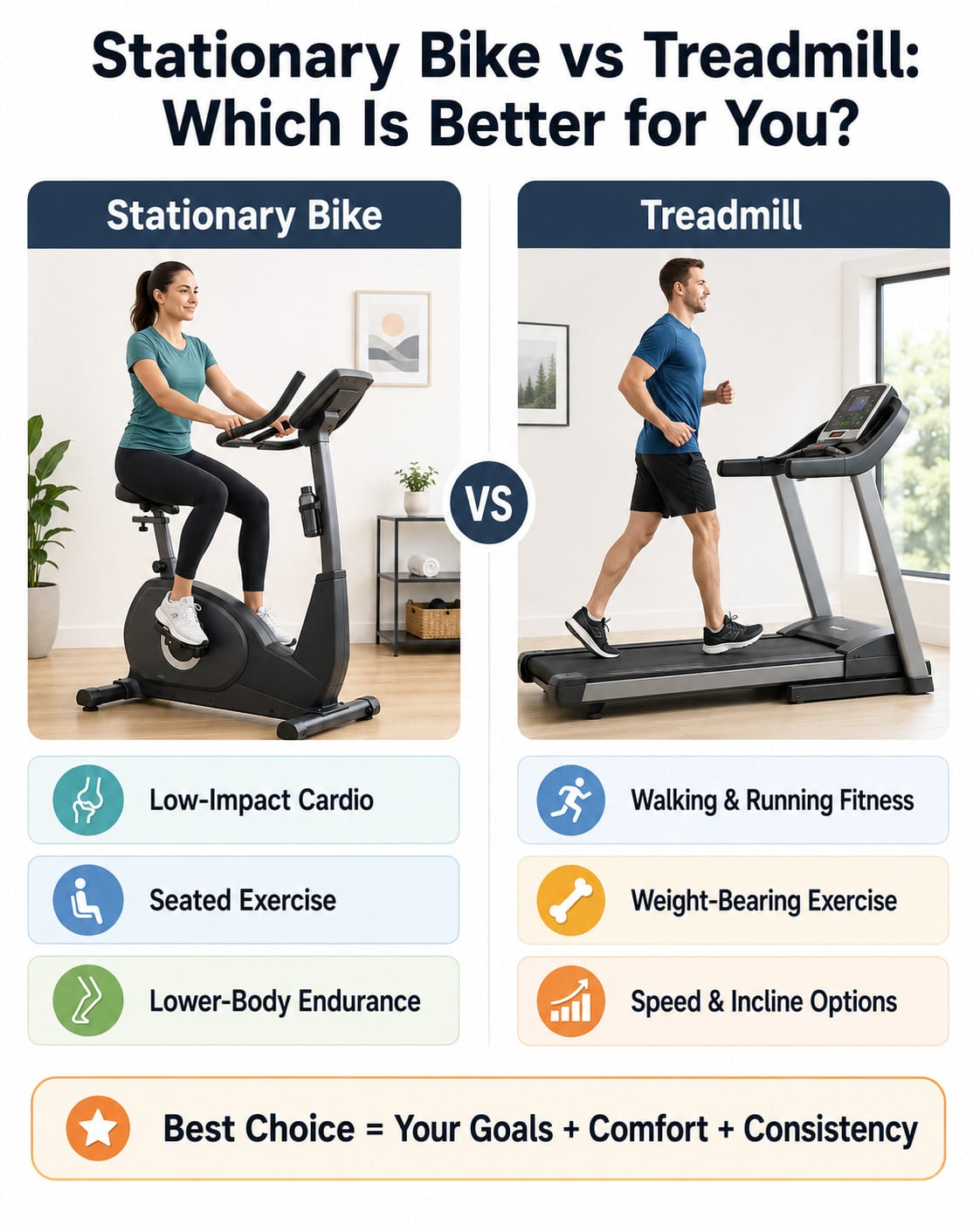
A stationary bike is generally better if you want low-impact cardio, while a treadmill is better for walking or running training and weight-bearing exercise. Neither is automatically better for everyone. Both machines can improve cardiovascular fitness, support weight management, and provide an effective indoor workout.
When comparing a stationary bike vs treadmill, consider your joints, fitness goals, preferred exercise intensity, balance, and which activity you are most likely to do consistently.
Current CDC guidance recommends that adults get at least 150 minutes of moderate-intensity aerobic activity or 75 minutes of vigorous activity each week, plus muscle-strengthening activity on at least two days. Either machine can help you reach the aerobic portion of that goal.
Stationary Bike vs Treadmill: Quick Comparison
| Category | Stationary Bike | Treadmill | Better Choice |
|---|---|---|---|
| Cardiovascular fitness | Excellent | Excellent | Tie |
| Low-impact cardio | Excellent | Walking is relatively low impact; running adds more impact | Bike |
| Calorie expenditure | Low to very high depending on resistance | Low to very high depending on speed and incline | Depends on intensity |
| Running preparation | Limited | Directly trains running | Treadmill |
| Walking fitness | Limited | Directly trains walking | Treadmill |
| Weight-bearing exercise | Minimal | Yes | Treadmill |
| Knee-friendly option | Often easier to tolerate | Depends on walking/running speed and the individual | Often bike |
| HIIT workouts | Excellent | Excellent | Tie |
| Balance demands | Low while seated | Higher | Bike |
| Lower-body muscular endurance | Excellent | Good | Bike |
| Bone-loading stimulus | Limited | Greater because you support your body weight | Treadmill |
The most important point is that the settings matter. A vigorous cycling workout may be considerably harder than an easy treadmill walk, while treadmill running may demand more energy than moderate stationary cycling.
Stationary Bike vs Treadmill for Calories Burned
There is no single calorie-burn number for either machine.
Your energy expenditure depends on:
- Body size
- Workout duration
- Cycling resistance
- Pedaling power and cadence
- Treadmill speed
- Treadmill incline
- Fitness level
- Actual exercise intensity
The 2024 Compendium of Physical Activities illustrates how widely exercise intensity can vary.
| Activity | Approximate MET Value |
|---|---|
| Treadmill walking at 3.0–3.4 mph, 0% incline | 3.8 |
| Treadmill walking at 3.5–3.9 mph, 0% incline | 4.8 |
| Stationary cycling, general | 6.8 |
| Stationary cycling at 126–150 watts | 8.0 |
| Stationary-bike HIIT | 8.8 |
| Spin/RPM bike class | 9.0 |
| Running around 6–6.3 mph | 9.3 |
A MET is a standardized way to estimate the energy cost of an activity. These values are useful for comparing activities but should not be treated as exact personal calorie-burn numbers.
This comparison shows why saying that one machine always burns more calories is misleading.
For example:
- Easy treadmill walking may use less energy than moderate cycling.
- Hard cycling can use substantially more energy than casual walking.
- Treadmill running commonly reaches higher energy demands than moderate cycling.
- High-resistance cycling can reach very vigorous intensities too.
What Does the Latest Research Say?
A study published in BMC Sports Science, Medicine and Rehabilitation on July, 2026 compared treadmill running and cycle-ergometer exercise in 52 men at fixed workloads.
Researchers found that exercise type, intensity, and participant characteristics influenced energy expenditure and fuel use. Importantly, the authors said future comparisons should use equivalent relative physiological intensities before drawing strong conclusions about differences between cycling and treadmill exercise.
In practical terms, compare workouts by how hard and how long you exercise—not simply by which machine you use.
Is a Stationary Bike or Treadmill Better for Weight Loss?
Either can support weight loss.
A treadmill may produce greater calorie expenditure per minute when you run or perform challenging incline workouts. However, a stationary bike can also provide vigorous exercise when resistance and cadence are high.
More importantly, exercise is only one part of weight management.
The CDC explains that physical activity increases calorie use and can contribute to the calorie deficit needed for weight loss. However, most weight loss generally comes from reducing calorie intake, while regular physical activity is particularly important for maintaining weight loss.
So instead of asking only which machine burns more calories, consider:
- Which workout can you perform consistently?
- Which machine lets you exercise comfortably for an appropriate duration?
- Which one can you progressively make harder?
- Which activity do you actually enjoy?
A 40-minute cycling workout you consistently complete may be more useful than a 20-minute treadmill workout you frequently skip.
What About Belly Fat?
Neither machine can specifically target belly fat.
Where your body loses fat is influenced by factors such as genetics, overall energy balance, hormones, age, and body composition. Doing more abdominal exercise—or choosing a particular cardio machine—does not allow you to selectively remove fat from the abdomen.
For fat loss, focus on sustainable nutrition, regular physical activity, adequate sleep, and habits you can maintain.
Which Is Better for Cardiovascular Fitness?
Both are excellent choices for cardiovascular exercise.
Cycling and treadmill workouts can both raise your heart rate and breathing enough to reach moderate or vigorous intensity.
The CDC currently recommends at least:
- 150 minutes per week of moderate-intensity aerobic activity, or
- 75 minutes per week of vigorous-intensity aerobic activity, or
- An equivalent combination of the two.
Adults should also perform muscle-strengthening activities at least twice weekly.
That means you could improve your weekly aerobic activity with:
- Brisk treadmill walking
- Incline treadmill walking
- Treadmill jogging or running
- Moderate stationary cycling
- High-resistance cycling
- Cycling intervals
- Treadmill intervals
For general cardiovascular fitness, the quality and consistency of your training matter more than choosing one specific machine.
Stationary Bike vs Treadmill for Joint Impact
If minimizing impact is a major concern, the stationary bike has an advantage.
When cycling, your body weight is supported by the seat. Your feet also stay in contact with the pedals, so there are no repeated landing impacts like those produced during running.
Treadmill walking is much lower impact than running, but you still support your body weight with every step.
Running adds repeated loading as each foot contacts the treadmill belt. That loading is not inherently harmful for healthy people, but it may be uncomfortable or inappropriate for some people depending on their symptoms, injury history, or medical conditions.
A stationary bike may therefore be useful for people who:
- Prefer seated cardio
- Do not tolerate running comfortably
- Want to reduce repetitive impact
- Are returning gradually to cardiovascular exercise
- Want to increase exercise intensity without increasing running speed
However, low impact does not automatically mean pain-free. Incorrect bike setup, excessive resistance, or an unsuitable range of motion can still cause discomfort.
Which Is Better for Your Knees?
For someone who specifically wants to reduce weight-bearing impact, stationary cycling is often the more practical option.
The American Academy of Orthopaedic Surgeons includes riding a stationary bicycle as an example of a low-impact warm-up activity in its knee conditioning guidance.
There is also research specifically involving people with knee osteoarthritis.
A systematic review and meta-analysis evaluated 11 studies involving 724 participants. Compared with no exercise, stationary cycling was associated with reduced pain and improvements in sport-related function. However, improvements in several other measures did not exceed thresholds considered clinically important, so cycling should not be portrayed as a universal solution for knee problems.
Your best option depends on the cause of your knee symptoms.
If exercise causes persistent or increasing knee pain, swelling, instability, or loss of function, get appropriate medical guidance rather than simply switching machines and exercising through the problem.
Muscles Worked: Stationary Bike vs Treadmill
Both machines primarily use the lower body, although the movement patterns differ.
Muscles Worked on a Stationary Bike
Stationary cycling mainly involves the:
- Quadriceps
- Glutes
- Hamstrings
- Calves
- Hip musculature
Increasing resistance generally makes the leg muscles work harder.
Cycling can be particularly useful for building lower-body muscular endurance, but it should not be considered a replacement for a complete resistance-training program.
Muscles Worked on a Treadmill
Walking and running involve the:
- Quadriceps
- Hamstrings
- Glutes
- Calves
- Hip muscles
- Muscles that stabilize the trunk and pelvis
Increasing treadmill incline can increase the muscular demand of walking without requiring you to run.
Which Builds More Muscle?
Neither is ideal if significant muscle growth is your primary goal.
Cycling against resistance and incline treadmill work can challenge the legs, especially in beginners, but progressive resistance training with exercises such as squats, hinges, presses, rows, and other appropriately selected movements is a more direct way to build strength and muscle.
Which Is Better for Bone Health?
The treadmill has an advantage because walking and running are weight-bearing activities.
The National Institute of Arthritis and Musculoskeletal and Skin Diseases lists brisk walking, jogging, running, stair climbing, and similar activities as weight-bearing exercises because they produce forces that make bones work against gravity.
Cycling is largely weight-supported, so it does not provide the same type of skeletal loading.
A 2023 systematic review and meta-analysis involving 28 randomized trials and 2,985 participants found that moderate- to high-impact exercise improved certain measures of bone density and bone structure, although benefits differed by skeletal site and population.
This does not mean everyone should begin running for stronger bones.
People with osteoporosis, low bone density, previous fractures, or other physical limitations may require individualized exercise recommendations. NIAMS specifically advises people with low bone density or osteoporosis to discuss appropriate exercise with a health care professional.
Which Is Better for Beginners?
Both can work well for beginners.
Choose a Stationary Bike If You:
- Prefer sitting while exercising
- Want to minimize impact
- Are not comfortable jogging
- Want resistance that can be adjusted easily
- Have difficulty with prolonged weight-bearing exercise
- Feel more confident exercising in a seated position
A simple beginner session might involve easy cycling for 10–20 minutes at a pace where you can comfortably maintain control.
Choose a Treadmill If You:
- Already walk comfortably
- Want to improve walking endurance
- Plan to progress toward jogging or running
- Are preparing for outdoor walking or running
- Prefer changing both speed and incline
A beginner treadmill workout can be as simple as comfortable walking with gradual increases in duration before adding substantial speed or incline.
You do not need to start with HIIT, steep inclines, or hard resistance.
Which Is Better for Older Adults?
Age alone does not determine which machine is better.
According to updated CDC guidance from December 2025, adults age 65 and older should aim for a combination of aerobic activity, muscle-strengthening activity, and balance training each week.
A stationary bike can be appealing because the workout is seated and low impact. A treadmill can provide valuable weight-bearing walking and directly train walking endurance.
However, treadmill use also requires sufficient:
- Balance
- Coordination
- Walking ability
- Confidence getting on and off the moving belt
For someone with substantial balance problems or a history of falls, individual assessment may be more important than choosing a machine based on age.
A recumbent stationary bike may also be easier for some people because it provides back support and a wider seated position.
Stationary Bike vs Treadmill for HIIT
Both machines work well for interval training.
Stationary Bike Intervals
You can increase:
- Resistance
- Pedaling cadence
- Power output
- A combination of resistance and cadence
One simple format is:
- Warm up for 5 minutes.
- Cycle hard for 30 seconds.
- Cycle easily for 60–90 seconds.
- Repeat several times according to your fitness level.
- Cool down gradually.
Treadmill Intervals
You can increase:
- Walking or running speed
- Incline
- Both speed and incline
For people who do not want to sprint, incline walking can provide a challenging interval without requiring high running speeds.
HIIT is optional. You can improve health and fitness with steady moderate-intensity exercise too.
Pros and Cons of a Stationary Bike
Pros
- Low impact
- Seated and stable during exercise
- Resistance is easy to adjust
- Suitable for steady cardio or intervals
- Can reach vigorous intensities
- Often comfortable for longer sessions
- Useful when running is not well tolerated
Cons
- Does not directly train walking or running
- Provides less weight-bearing stimulus for bones
- Poor saddle adjustment can cause discomfort
- Long sessions may cause seat discomfort
- Does not replace whole-body strength training
Pros and Cons of a Treadmill
Pros
- Trains natural walking and running movements
- Provides weight-bearing activity
- Allows precise control of speed and incline
- Useful for walking, jogging, running, and intervals
- Directly supports walking or running goals
- Incline can increase intensity without requiring fast running
Cons
- Running involves greater impact than cycling
- Requires more balance and coordination
- Falls are possible if speed exceeds your ability
- Running may not be comfortable for some joint conditions
- Large speed or incline increases can make workouts unnecessarily difficult
How to Choose Between a Stationary Bike and Treadmill
Ask yourself what you want the machine to accomplish.
Choose the Stationary Bike for:
- Low-impact cardio: Your body is supported and there are no repeated running landings.
- Seated exercise: Useful if you simply prefer exercising without standing.
- Cycling fitness: The movement directly supports indoor or outdoor cycling.
- Lower-body endurance: Resistance can create sustained muscular work.
Choose the Treadmill for:
- Walking fitness: You directly practice the movement you want to improve.
- Running fitness: Running-specific adaptations are best developed by running.
- Weight-bearing exercise: Walking and running place more load through the skeleton than cycling.
- Flexible incline training: You can increase effort while continuing to walk.
Choose Both If You Enjoy Both
You do not have to pick only one.
For example:
- Monday: stationary-bike intervals
- Wednesday: treadmill walking
- Friday: stationary-bike steady cardio
- Saturday: treadmill incline walking or jogging
Alternating modalities can provide variety and allow you to change the stresses placed on your body.
Safety Tips for Both Machines
Whichever machine you choose:
- Start at an intensity you can control.
- Increase duration before making large increases in intensity.
- Wear appropriate footwear on a treadmill.
- Adjust the bike seat so you can pedal comfortably without excessive knee or hip strain.
- Use the treadmill safety clip when available.
- Avoid stepping onto a rapidly moving treadmill belt.
- Do not depend on treadmill handrails during normal walking or running.
- Reduce speed or resistance if your form becomes uncontrolled.
- Stop exercising if you develop concerning symptoms such as chest pain, fainting, or severe unusual shortness of breath.
The CDC notes that moderate physical activity is safe for most people, but people with chronic health conditions may need guidance on appropriate types and amounts of exercise. People who have been inactive and plan to begin vigorous exercise should also consider discussing that change with a health care professional.
Stationary Bike vs Treadmill: Final Verdict
Choose a stationary bike if low-impact, seated cardiovascular exercise is your main priority. Choose a treadmill if you want to improve walking or running, perform weight-bearing exercise, or train specifically for those activities.
For calorie burning and cardiovascular fitness, there is no universal winner. Workout intensity, duration, fitness level, and consistency make a major difference.
If both machines are comfortable and accessible, you can also use both. Alternating cycling and treadmill workouts gives you more variety and makes it easier to adjust your training according to your goals and how your body feels.
Ultimately, the best cardio machine is the one you can use safely, progressively, and consistently.
Frequently Asked Questions
Is a stationary bike or treadmill better for weight loss?
Either can support weight loss. Treadmill running may expend more energy per minute than moderate cycling, but vigorous cycling can exceed the energy cost of easy treadmill walking. Overall activity, nutrition, workout duration, intensity, and consistency matter more than the machine name.
Which burns more calories, a treadmill or stationary bike?
It depends on the workout. According to the 2024 Compendium, treadmill walking at 3.0–3.4 mph is about 3.8 METs, general stationary cycling is about 6.8 METs, and running at roughly 6–6.3 mph is about 9.3 METs. Hard cycling can also exceed 9 METs. These values show that intensity is essential when comparing calorie expenditure.
Is a stationary bike or treadmill better for belly fat?
Neither specifically targets abdominal fat. Both can contribute to overall physical activity and energy expenditure. Overall energy balance, nutrition, genetics, sleep, and other factors influence changes in body fat.
Which is better for knees, a stationary bike or treadmill?
A stationary bike is generally lower impact because you exercise in a seated, weight-supported position. It may be more comfortable for some people with knee symptoms, but the right choice depends on the cause of the symptoms. Persistent pain, swelling, instability, or functional problems should be evaluated appropriately.
Is 30 minutes on a stationary bike better than 30 minutes of walking?
Not necessarily. A challenging 30-minute bike workout can be more intense than easy walking, while fast or inclined treadmill walking can substantially increase effort. Compare intensity and how your body responds rather than duration alone.
Is a stationary bike or treadmill better for seniors?
Either may be appropriate. A stationary bike offers seated, low-impact cardio, while a treadmill provides weight-bearing walking. Older adults also need strength and balance activities, so neither machine provides a complete fitness program by itself.
Can I use a stationary bike and treadmill in the same workout?
Yes. For example, you could perform 15–20 minutes on each machine to add variety. Beginners should keep the total workload manageable rather than making both portions hard. You can also alternate the machines on different days.
References
- Centers for Disease Control and Prevention — Adding Physical Activity as an Adult, updated December, 2025. CDC physical activity guidance
- Centers for Disease Control and Prevention — Physical Activity and Your Weight and Health. CDC weight and physical activity guidance
- 2024 Compendium of Physical Activities — Adult Compendium, Bicycling, Walking, and Running MET values. 2024 Compendium of Physical Activities
- National Institute of Arthritis and Musculoskeletal and Skin Diseases — Exercise for Your Bone Health. NIAMS exercise and bone health guidance
- Luan L, et al. Stationary Cycling Exercise for Knee Osteoarthritis: A Systematic Review and Meta-analysis. PubMed stationary cycling and knee osteoarthritis review
- Ng CA, et al. Effects of Moderate- to High-Impact Exercise Training on Bone Structure Across the Lifespan: A Systematic Review and Meta-Analysis of Randomized Controlled Trials. PubMed impact exercise and bone health review
- Xue J, et al. The Energy Expenditure and Substrate Oxidation of Treadmill Running and Cycle Ergometer Exercise in Normal-Weight and Obese Men. Published July, 2026. PubMed 2026 treadmill and cycling study