
The Senior Fitness Test is a six-part functional fitness assessment that measures the strength, endurance, flexibility, agility, and balance older adults use in daily life. It includes practical movements such as standing from a chair, lifting a light weight, walking, reaching, and changing direction.
Adults ages 60–94 can compare their scores with age- and sex-specific reference ranges. However, the results are not a medical diagnosis or a pass-or-fail judgment. They are best used to identify areas that may need attention and to track changes over time.
The official Human Kinetics Senior Fitness Test Manual provides standardized testing instructions, percentile norms, and guidance for modifying the test when someone has a limiting health condition.
What Is the Senior Fitness Test?
The Senior Fitness Test was developed by researchers Roberta Rikli and C. Jessie Jones to assess the physical abilities that support independent daily activities.
The original national study included 7,183 community-residing adults ages 60–94 from 267 testing sites in 21 US states. Results were reported separately for men and women in five-year age groups. The assessment covers lower- and upper-body strength, aerobic endurance, lower- and upper-body flexibility, agility, and dynamic balance.
The test manual describes seven test items, but most people complete six stations. The 6-minute walk and 2-minute step test are alternative ways to measure aerobic endurance, so you generally choose one rather than completing both.
The Senior Fitness Test can help you:
- Establish a functional fitness baseline
- Identify comparatively weaker areas
- Plan a more balanced exercise routine
- Monitor progress after several months of activity
- Recognize changes that may deserve professional evaluation
It cannot diagnose heart disease, arthritis, balance disorders, frailty, or fall risk by itself.
Senior Fitness Test: 6 Exercises at a Glance
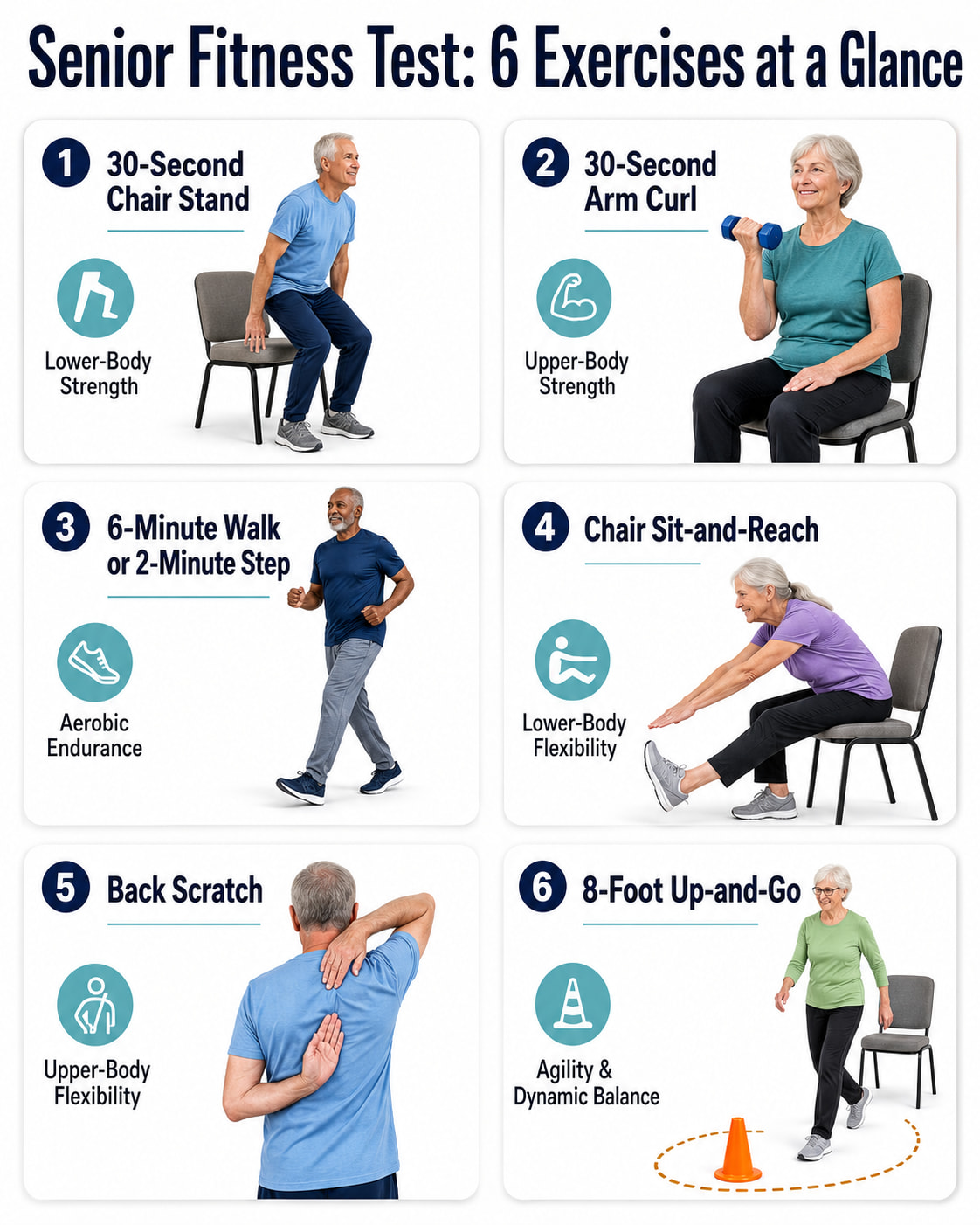
| Exercise | What it measures | Score recorded |
|---|---|---|
| 30-Second Chair Stand | Lower-body strength and muscular endurance | Complete stands in 30 seconds |
| 30-Second Arm Curl | Upper-body strength and muscular endurance | Complete curls in 30 seconds |
| 6-Minute Walk or 2-Minute Step | Aerobic endurance | Distance walked or right-knee raises |
| Chair Sit-and-Reach | Lower-body flexibility | Fingertip-to-toe distance |
| Back Scratch | Shoulder and upper-body flexibility | Distance between or overlap of fingertips |
| 8-Foot Up-and-Go | Agility and dynamic balance | Completion time in seconds |
The Southwest Nebraska Public Health Department Senior Fitness Test Kit provides practical setup, administration, and scoring instructions for these stations.
Equipment Needed for the Senior Fitness Test
A standardized setup makes your scores more meaningful. Gather the following equipment before starting:
- A stable, armless chair with a seat about 17 inches high
- A stopwatch or timer
- A 5-pound dumbbell for the traditional women’s protocol
- An 8-pound dumbbell for the traditional men’s protocol
- An 18-inch ruler
- Measuring tape
- A cone or another visible floor marker
- Tape for marking knee height during the step test
- A level, measured walking area for the 6-minute walk
Place the chair against a wall so it cannot slide or tip. Clear loose rugs, cords, furniture, pets, and other obstacles from the testing area.
Because several tests involve standing, walking, or turning, another adult should be nearby when balance is uncertain.
Senior Fitness Test Safety Guidelines
The test was designed for older adults, but that does not mean every exercise is appropriate for every person without modification.
Talk with a healthcare professional before testing when you have:
- A recent operation, fracture, fall, or acute injury
- Unstable heart or breathing symptoms
- Frequent fainting or unexplained dizziness
- Severe osteoporosis
- Significant balance or walking difficulty
- New or worsening pain during everyday movement
- Medical instructions that limit lifting, walking, bending, or reaching
Stop the test if you experience chest pain or pressure, dizziness, nausea, unusual weakness, staggering, sudden pain, or breathlessness that feels severe or different from your usual exertion. Chest discomfort, faintness, and shortness of breath can be warning signs that need urgent medical attention.
How to Perform the 6 Senior Fitness Test Exercises
1. 30-Second Chair Stand Test
The chair stand assesses the lower-body strength used to rise from a chair, get out of a car, climb stairs, and stand from a toilet.
How to do it
- Place the chair securely against a wall.
- Sit in the middle of the seat with your back straight.
- Keep your feet flat, approximately shoulder-width apart.
- Cross your arms at the wrists and hold them against your chest.
- On “go,” stand completely upright.
- Sit down until your hips contact the chair.
- Continue for 30 seconds without using your hands.
How to score it
Count the number of complete stands performed in 30 seconds.
A repetition counts when you stand fully and return to the chair with control. If you must push from the chair with your hands, record that the test was modified. A modified score should not be compared directly with the standard age norms.
2. 30-Second Arm Curl Test
The arm curl measures the upper-body strength used for carrying groceries, lifting household objects, opening heavy doors, and completing other daily tasks.
How to do it
- Sit upright on an armless chair.
- Hold the dumbbell in your dominant or stronger hand.
- Begin with the arm straight beside your body and your palm facing inward.
- Keep your upper arm close to your side.
- Bend the elbow while gradually turning your palm upward.
- Lower the weight until your elbow is fully straight again.
- Complete as many controlled repetitions as possible in 30 seconds.
How to score it
Count each full curl completed with proper control.
The traditional protocol uses:
- 5 pounds for women
- 8 pounds for men
The age-norm tables assume these weights. Using a lighter or heavier dumbbell may still help you track personal progress, but the result cannot be compared directly with the standard norms.
3. 6-Minute Walk Test
The 6-minute walk measures aerobic endurance—the ability of your heart, lungs, circulation, and muscles to support continuous activity.
How to do it
- Use a flat, measured, obstacle-free walking course.
- Begin walking when the timer starts.
- Walk as far as you safely can in six minutes.
- Choose a pace you can sustain.
- Slow down or rest if necessary, but keep the timer running.
- Resume walking when you are ready.
How to score it
Record the total distance walked, traditionally in yards.
Do not estimate the distance using an unmeasured hallway or an inconsistent step count. Course length and turning frequency can influence the score.
Alternative: 2-Minute Step Test
The 2-minute step test may be more practical when a suitable walking course is unavailable.
How to do it
- Stand next to a wall or stable chair.
- Find the midpoint between your kneecap and the top of your hip bone.
- Mark that height on the wall.
- March in place for two minutes.
- Raise each knee toward the marked height.
- Hold a stable support if needed.
How to score it
Count the number of times your right knee reaches the marked height.
Resting is allowed, but the timer continues. Complete either the 6-minute walk or the 2-minute step test as your aerobic assessment—not both as a combined score.
4. Chair Sit-and-Reach Test
The chair sit-and-reach measures lower-body flexibility, particularly around the hamstrings and lower leg.
How to do it
- Sit near the front edge of a stable chair.
- Keep one foot flat on the floor.
- Extend the other leg with the knee straight.
- Place the heel on the floor and point the toes upward.
- Place one hand on top of the other with the middle fingers aligned.
- Keeping your back controlled, reach toward the toes.
- Hold the furthest comfortable position for about two seconds.
- Avoid bouncing or forcing the stretch.
Perform two trials and record the better result.
How to score it
Measure the distance between your middle fingertips and toes:
- Negative score: Your fingers stop short of the toes.
- Zero: Your fingers touch the toes.
- Positive score: Your fingers reach beyond the toes.
Record the result to the nearest 0.5 inch when using the simplified field protocol. Stop if the movement causes pain.
5. Back Scratch Test
The back scratch assesses shoulder and upper-body flexibility needed for dressing, reaching behind your body, washing your back, and putting on a jacket.
How to do it
- Stand upright.
- Reach one hand over the same-side shoulder and down your back.
- Reach your other hand behind your waist and up your back.
- Move the middle fingers toward one another.
- Keep the fingers aligned rather than reaching diagonally.
- Do not pull the arms together or force the shoulders.
Practice the movement before recording two trials. Use the better score.
How to score it
Measure the distance between the middle fingertips:
- Negative score: A gap remains between the fingers.
- Zero: The fingertips touch.
- Positive score: The fingers overlap.
A more positive result represents greater flexibility.
6. 8-Foot Up-and-Go Test
The 8-foot up-and-go measures how efficiently you can stand, walk, turn, return, and sit. It combines lower-body function, walking speed, coordination, agility, and dynamic balance.
How to do it
- Place a cone exactly eight feet in front of a stable chair.
- Sit with your feet flat and hands resting on your thighs.
- On “go,” stand and walk quickly but safely toward the cone.
- Walk around the cone.
- Return to the chair.
- Sit down with control.
Complete one practice attempt followed by two timed trials.
How to score it
Record the faster of the two timed trials to the nearest 0.1 second.
Unlike the other exercises, a lower 8-foot up-and-go time represents better performance.
A cane or walker may be used when it is your usual walking aid. Record its use and compare future scores under the same conditions. A modified result may not be directly comparable with an unassisted age norm.
How Senior Fitness Test Scores Work
The following age norms represent approximately the 25th through 75th percentiles, or the middle 50% of the original reference group.
That means:
- A result within the range is in the middle half of scores for that age and sex group.
- A result beyond the better end of the range is above the 75th percentile.
- A result beyond the weaker end is below the 25th percentile.
- Each exercise is interpreted separately.
- There is no official total score created by adding all six results together.
For repetitions, walking distance, steps, and flexibility, higher scores generally indicate stronger performance. For the 8-foot up-and-go, a shorter time is better.
Example
A 72-year-old woman who completes 14 chair stands is within the middle reference range of 10–15 repetitions.
A 72-year-old man who completes the 8-foot up-and-go in 7.0 seconds is slower than the middle reference range of 4.4–6.2 seconds. That result does not diagnose a balance disorder, but it may help identify mobility and agility as areas to work on.
Senior Fitness Test Age Norms for Women
The values below are the 25th–75th percentile ranges from the 2013 Senior Fitness Test Manual tables. They are displayed with the original percentile precision. Public handouts sometimes round walking distances to the nearest five yards and flexibility scores to the nearest half-inch.
| Age | Chair stand, reps | Arm curl, reps | 6-minute walk, yards | Sit-and-reach, inches | Back scratch, inches | 8-foot up-and-go, seconds |
|---|---|---|---|---|---|---|
| 60–64 | 12–17 | 13–19 | 547–659 | −0.6 to +4.8 | −3.0 to +1.6 | 4.4–6.0 |
| 65–69 | 11–16 | 12–18 | 500–636 | −0.4 to +4.4 | −3.7 to +1.3 | 4.8–6.4 |
| 70–74 | 10–15 | 12–17 | 482–614 | −1.1 to +3.9 | −4.2 to +0.8 | 4.9–7.1 |
| 75–79 | 10–15 | 11–17 | 433–585 | −1.3 to +3.7 | −4.8 to +0.6 | 5.2–7.4 |
| 80–84 | 9–14 | 10–16 | 384–540 | −2.0 to +3.0 | −5.4 to +0.2 | 5.7–8.7 |
| 85–89 | 8–13 | 10–15 | 340–512 | −2.6 to +2.4 | −6.9 to −0.9 | 6.2–9.6 |
| 90–94 | 4–11 | 8–13 | 273–441 | −4.4 to +1.0 | −8.0 to −1.0 | 7.3–11.5 |
Senior Fitness Test Age Norms for Men
| Age | Chair stand, reps | Arm curl, reps | 6-minute walk, yards | Sit-and-reach, inches | Back scratch, inches | 8-foot up-and-go, seconds |
|---|---|---|---|---|---|---|
| 60–64 | 14–19 | 16–22 | 612–736 | −2.6 to +3.8 | −6.6 to −0.2 | 3.8–5.6 |
| 65–69 | 12–18 | 15–21 | 562–700 | −3.1 to +3.1 | −7.4 to −0.8 | 4.3–5.9 |
| 70–74 | 12–17 | 14–21 | 544–680 | −3.1 to +3.0 | −7.8 to −1.2 | 4.4–6.2 |
| 75–79 | 11–17 | 13–19 | 471–639 | −4.2 to +2.0 | −9.0 to −2.2 | 4.6–7.2 |
| 80–84 | 10–15 | 13–19 | 444–604 | −5.3 to +1.4 | −9.3 to −2.1 | 5.2–7.6 |
| 85–89 | 8–14 | 11–17 | 382–572 | −5.2 to +0.4 | −9.4 to −3.0 | 5.5–8.9 |
| 90–94 | 7–12 | 10–14 | 304–502 | −6.5 to −0.7 | −10.4 to −4.0 | 6.2–10.0 |
For metric conversions:
- 1 yard equals approximately 0.91 meters.
- 1 inch equals 2.54 centimeters.
Two-Minute Step Test Age Norms
Use this table only when you perform the 2-minute step test instead of the 6-minute walk. The score is the number of times the right knee reaches the marked target height.
| Age | Women, right-knee raises | Men, right-knee raises |
|---|---|---|
| 60–64 | 75–107 | 87–115 |
| 65–69 | 73–107 | 86–116 |
| 70–74 | 68–101 | 80–110 |
| 75–79 | 68–100 | 73–109 |
| 80–84 | 60–90 | 71–103 |
| 85–89 | 55–85 | 59–91 |
| 90–94 | 44–72 | 52–86 |
These values also represent the middle 50% of the original reference group.
Important Limitations of the Senior Fitness Test Age Norms
The norms are not newly collected 2026 data
The commonly used US norms come from a nationwide study conducted in the late 1990s and were retained in the 2013 second edition of the manual. They remain widely used, but they should not be described as a newly collected sample of today’s older-adult population.
The participants were community-residing volunteers
The reference group largely represented adults living in community settings. The tables may be less appropriate for people in hospitals, rehabilitation facilities, skilled nursing facilities, or those with substantial mobility limitations.
Age norms are not minimum independence standards
A percentile norm compares your score with other people. It does not show the exact minimum ability required for independent living.
The second edition of the manual also includes separate criterion-referenced standards associated with maintaining functional mobility. Those standards answer a different question and should not be mixed with the percentile tables.
Testing modifications affect comparisons
Your score may not be directly comparable with the table when you:
- Use your hands during the chair stand
- Change the chair height
- Use a different arm-curl weight
- Shorten the walking course
- Receive physical assistance
- Change the step-test knee height
- Use a walking aid that was not part of previous testing
Modified tests can still be useful for tracking your own progress. Record the exact setup and use it consistently.
Health, pain, and fatigue can change a score
Sleep, illness, joint pain, medication effects, recent exercise, motivation, footwear, and familiarity with the movement can all influence performance. Avoid treating a single score as a complete picture of your health.
How to Improve Senior Fitness Test Scores
Use your results to choose a balanced training focus rather than repeatedly practicing only the test itself.
| Test area | Activities that may support improvement |
|---|---|
| Chair stand | Supported sit-to-stands, mini squats, low step-ups, leg strengthening |
| Arm curl | Light dumbbell curls, resistance-band rows, wall push-ups |
| Walk or step test | Regular walking, stationary cycling, water exercise, short walking intervals |
| Chair sit-and-reach | Gentle hamstring and calf stretches after warming up |
| Back scratch | Wall slides, chest stretches, controlled shoulder mobility |
| 8-foot up-and-go | Supported direction changes, heel-to-toe walking, sit-to-stand practice, safe stepping drills |
Begin at a level you can complete with good control. Increase duration, resistance, or difficulty gradually rather than changing everything at once.
Current CDC physical activity guidance for older adults, updated December, 2025, recommends a weekly combination of aerobic activity, muscle-strengthening activity on at least two days, and balance activities. The general aerobic target is at least 150 minutes of moderate-intensity activity or 75 minutes of vigorous activity, but adults who cannot meet the full target should be as active as their abilities and health conditions allow.
When to Discuss Your Results With a Professional
Consider discussing your scores with a doctor, physical therapist, or qualified exercise professional when:
- Your performance has declined noticeably without a clear reason.
- You cannot stand from the chair without using your hands.
- Walking or turning causes frequent unsteadiness.
- You have fallen or nearly fallen more than once.
- One side is much weaker or less flexible than the other.
- Exercise produces persistent joint, chest, or muscle pain.
- You experience dizziness, faintness, or unusual breathlessness.
- A low score is interfering with everyday activities.
The CDC’s STEADI resources use clinical assessments such as the 30-second chair stand and Timed Up and Go as part of a broader fall-risk evaluation. The Senior Fitness Test’s 8-foot up-and-go is not interchangeable with every clinical Timed Up and Go protocol, so do not apply an unrelated cutoff to your score.
How Often Should You Repeat the Senior Fitness Test?
You do not need to perform the complete test every week.
A practical schedule is:
- Once before beginning a structured exercise program
- Again after approximately two to six months
- Annually for long-term tracking
Use the same chair, dumbbell weight, course, footwear, testing order, and scoring method each time. Consistency makes it easier to tell whether a change reflects your fitness rather than a different setup. The public-health testing kit recommends baseline, two-to-six-month, and annual assessments.
Frequently Asked Questions
What is a good Senior Fitness Test score?
A good score depends on your age, the standardized protocol used, and the individual exercise. A result above the better end of the 25th–75th percentile range is above average for the reference group.
For the 8-foot up-and-go, a lower time is better. For the other tests, more repetitions, greater distance, or a more positive flexibility score is generally better.
Is the Senior Fitness Test pass or fail?
No. The percentile norms are comparison ranges, not pass-or-fail cutoffs. A below-range result can identify an area that may deserve attention, but it does not prove that you are unhealthy or unable to live independently.
Can I perform the Senior Fitness Test at home?
Several stations can be performed at home with a stable chair, timer, ruler, dumbbell, and adequate space. However, the 6-minute walk and 8-foot up-and-go require accurate measurements and a safe, uncluttered course.
Have another adult nearby if you have balance concerns. Professional supervision is preferable when you have significant medical or mobility limitations.
Should I complete both the 6-minute walk and 2-minute step test?
Usually, no. They are alternative aerobic endurance assessments. Choose the 6-minute walk when you have a safe measured course and can walk steadily. Use the 2-minute step when the walking test is not practical or when your testing professional recommends it.
Can I use my arms, cane, or walker?
Safety comes first. You may use support when necessary, but document the modification.
Using your hands during the chair stand changes the standardized test. A cane or walker may be used during the 8-foot up-and-go when it is your usual mobility aid, but compare future results under the same conditions rather than assuming the standard unassisted norms apply exactly.
What should I do if my score is below average?
First, confirm that you followed the correct setup and scoring method. Then consider whether pain, fatigue, illness, unfamiliarity, or medication effects influenced the result.
Use the score to choose appropriate exercises and retest after a consistent training period. Seek professional guidance when the weakness is new, severe, worsening, or affecting daily activities.
Can adults older than 94 use the test?
Adults over 94 may still complete suitable parts of the test when it is safe, but the standard US age-norm tables stop at age 94. Results can be used to track personal change rather than to make a direct age-group comparison.
Conclusion
The Senior Fitness Test provides a practical snapshot of the physical abilities that support everyday movement. Its six exercise categories cover strength, aerobic endurance, flexibility, agility, and dynamic balance without requiring expensive equipment.
Use the age norms as reference points—not medical labels. Record your setup, focus on your weaker areas, exercise consistently, and repeat the assessment under the same conditions. When a score changes suddenly or movement causes pain, dizziness, repeated unsteadiness, or unusual breathlessness, seek professional guidance instead of simply trying to push through the test.
References
- Human Kinetics: Senior Fitness Test Manual, Second Edition
- Rikli and Jones: Functional Fitness Normative Scores for Community-Residing Older Adults, Ages 60–94
- StrongPeople Program: Normal Values for the Senior Fitness Test
- Southwest Nebraska Public Health Department: Senior Fitness Test Kit
- CDC: Physical Activity Recommendations for Older Adults