
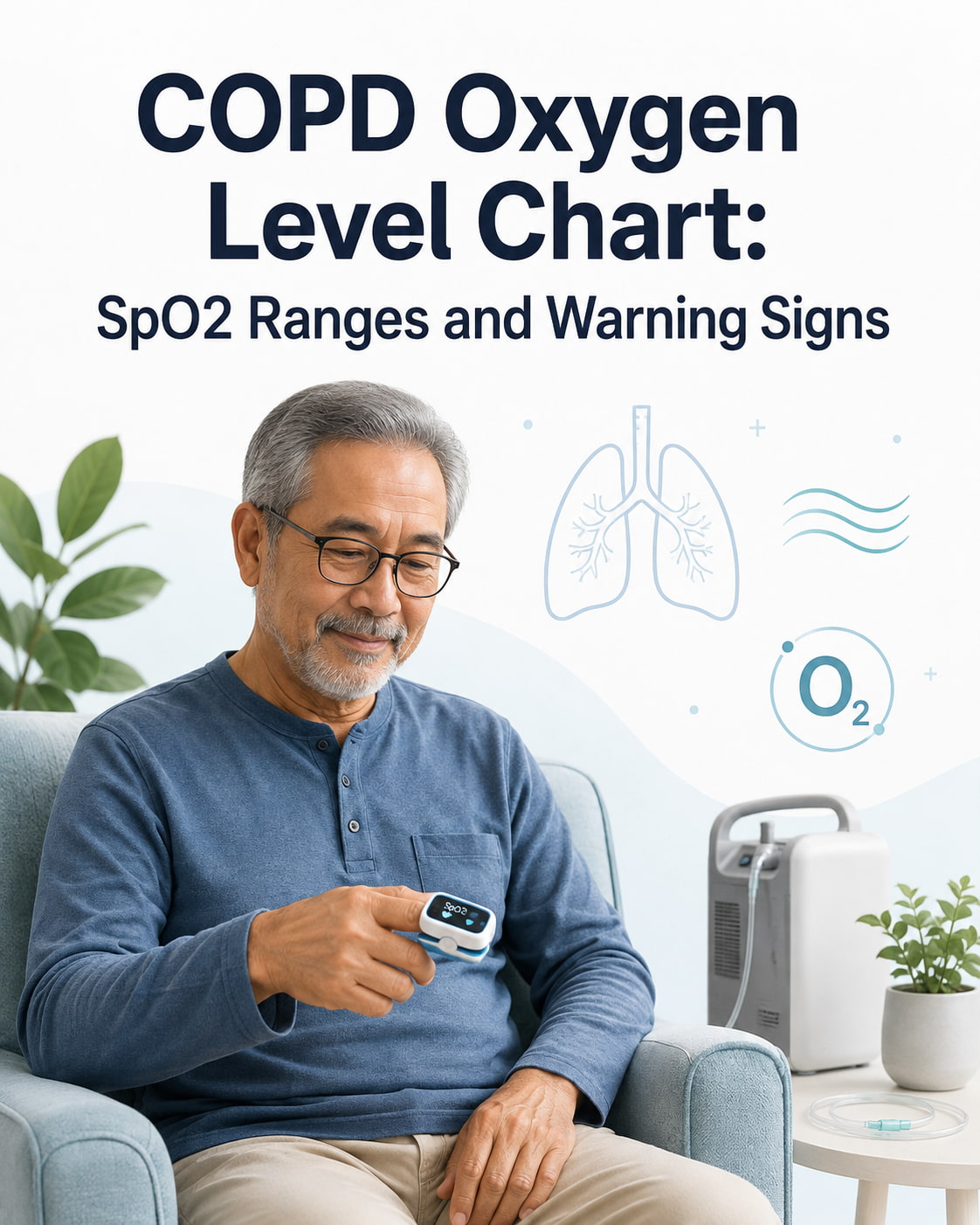
A safe oxygen level for someone with COPD depends on their usual baseline and clinician-prescribed target. The often-quoted SpO2 range of 88% to 92% mainly applies to controlled oxygen during an acute COPD exacerbation when carbon dioxide retention may be a concern—not to every person with stable COPD.
Your symptoms, changes from your normal reading, arterial blood gas results, altitude, and use of supplemental oxygen all affect how a reading should be interpreted. Never change an oxygen flow rate based only on a general chart unless your COPD action plan specifically instructs you to do so.
COPD Oxygen Level Chart
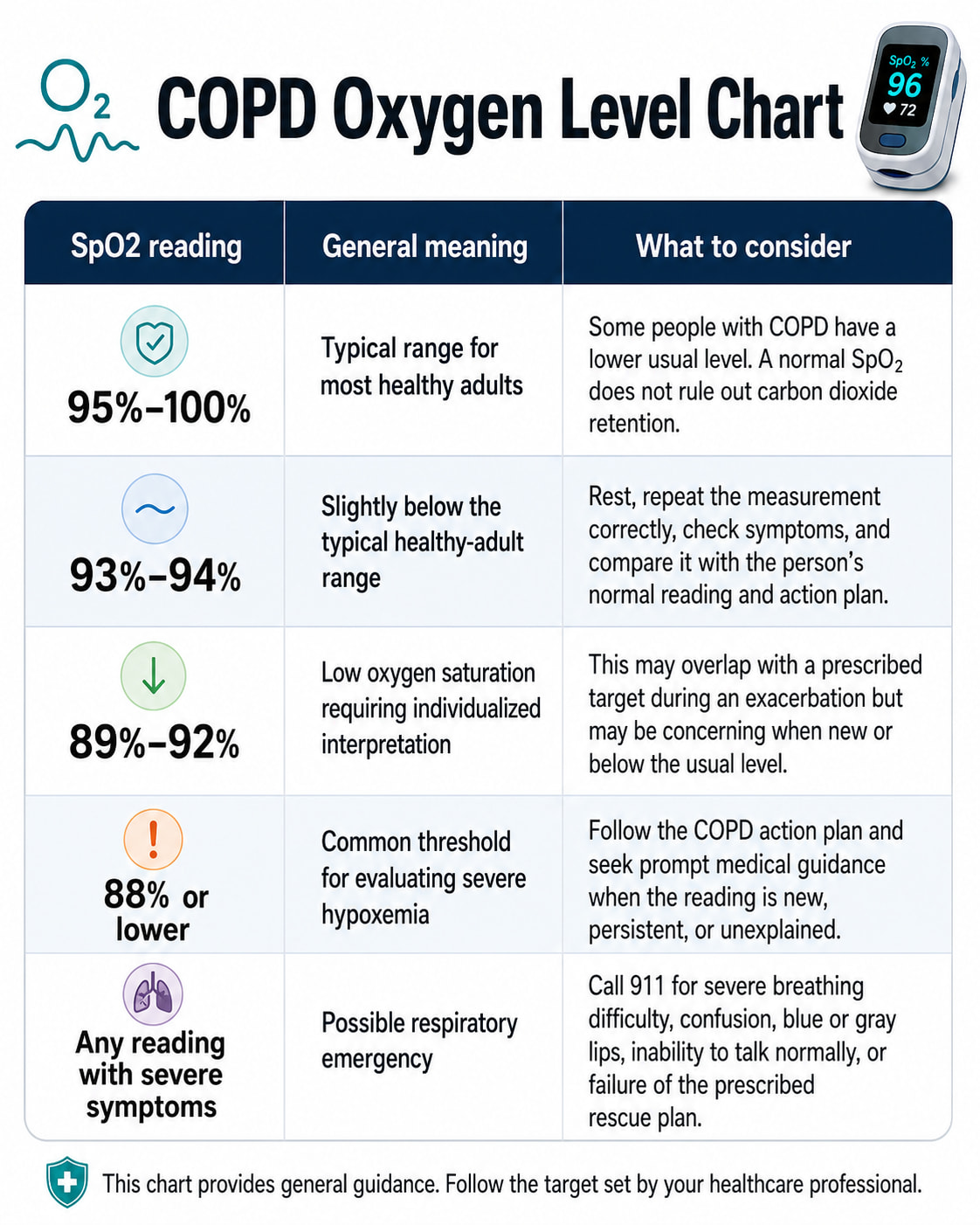
This COPD oxygen level chart provides general guidance for adults checking their oxygen saturation with a fingertip pulse oximeter.
| SpO2 reading | General meaning | What to consider |
|---|---|---|
| 95%–100% | Typical range for most healthy adults | Some people with COPD have a lower usual level. A normal SpO2 does not rule out carbon dioxide retention. |
| 93%–94% | Slightly below the typical healthy-adult range | Rest, repeat the measurement correctly, check for symptoms, and compare it with your normal reading and action plan. |
| 89%–92% | Low oxygen saturation that requires individualized interpretation | This may overlap with a prescribed target during an exacerbation, but it may be concerning when it is new or below your usual level. |
| 88% or lower | Common threshold for evaluating severe hypoxemia | Follow your COPD action plan and seek prompt medical guidance if the reading is new, persistent, or unexplained. Severe symptoms require emergency care. |
| Any reading with severe symptoms | Possible respiratory emergency | Call 911 for severe breathing difficulty, confusion, blue or gray lips, inability to talk normally, or symptoms that are not responding to the prescribed rescue plan. |
The U.S. Food and Drug Administration states that most healthy people have an oxygen saturation between 95% and 100%. However, readings may be lower in people with lung or heart disease and in those living at higher elevations.
This chart should not replace the personalized target provided by a pulmonologist, respiratory therapist, or other qualified healthcare professional.
What Does SpO2 Mean?
SpO2 stands for peripheral oxygen saturation. It estimates the percentage of hemoglobin in the blood that is carrying oxygen.
A pulse oximeter usually displays:
- SpO2: Estimated oxygen saturation as a percentage
- PR or pulse rate: Heartbeats per minute
- Signal indicator: A measure of how well the device is detecting a pulse
A pulse oximeter shines light through the fingertip and uses the returned signal to estimate oxygen saturation. It does not directly test the blood.
That distinction matters because a pulse oximeter cannot tell you:
- How much carbon dioxide is in your blood
- Whether your blood is becoming too acidic
- Why your oxygen level is low
- Whether a COPD flare-up, infection, heart problem, or equipment issue caused the change
The number should always be interpreted alongside symptoms, your normal baseline, and your written COPD action plan.
What Is a Safe Oxygen Level for Someone With COPD?
There is no universal safe SpO2 number for every person with COPD.
One person with stable COPD may usually remain at 94% to 96%, while another person with advanced disease and prescribed oxygen may have a target closer to 88% to 92%. A clinician may also prescribe different oxygen flow settings for rest, walking, exercise, and sleep.
Your personal target may depend on:
- COPD severity
- Your stable resting oxygen level
- Whether oxygen falls during activity or sleep
- Arterial blood gas results
- Previous carbon dioxide retention
- Heart or pulmonary circulation complications
- Altitude
- Recent infections or exacerbations
A new drop from your normal level may be more important than comparing your result with someone else’s reading.
For example, a change from a usual SpO2 of 96% to 91% may require attention even though another patient has a prescribed target of 88% to 92%.
Why Is 88% to 92% Often Recommended for COPD?
The 88% to 92% range is commonly used when healthcare professionals give emergency oxygen during an acute COPD exacerbation, especially when the patient could be at risk of hypercapnic respiratory failure.
Hypercapnia means that carbon dioxide has built up in the blood. In susceptible patients, uncontrolled high-concentration oxygen can increase carbon dioxide levels and contribute to respiratory acidosis.
The National Institute for Health and Care Excellence recommends maintaining oxygen saturation between 88% and 92% in people receiving emergency oxygen for an acute COPD exacerbation. Oxygen delivery and blood gas testing may then be adjusted according to the individual’s response.
This does not mean:
- Every person with COPD should normally remain between 88% and 92%.
- An SpO2 above 92% is automatically dangerous.
- A patient should reduce prescribed oxygen without medical guidance.
- A reading below 92% automatically means that home oxygen is needed.
The correct target depends on the clinical situation and blood gas results.
Stable COPD Oxygen Levels Versus an Acute Exacerbation
It is important to distinguish stable COPD from an acute flare-up.
Stable COPD
Stable COPD means symptoms are close to their usual level. A stable reading should be taken while the person is:
- Resting quietly
- Breathing room air or using the prescribed oxygen setting
- Free from a recent major exacerbation
- Not immediately recovering from walking or exercise
A persistent resting SpO2 of 92% or lower generally deserves clinical evaluation rather than self-treatment. NICE recommends arterial blood gas assessment for people with stable COPD whose resting oxygen saturation remains at or below 92%.
COPD Exacerbation
A COPD exacerbation is a sudden worsening beyond normal day-to-day changes. It may involve:
- Increased breathlessness
- More frequent coughing
- Increased mucus
- Yellow, green, or unusually thick mucus
- Wheezing or chest tightness
- Fever
- Reduced ability to complete normal activities
- Oxygen readings lower than usual
Contact your healthcare provider promptly when symptoms suddenly worsen, even when your SpO2 has not fallen dramatically.
COPD Oxygen Warning Signs
Do not rely on the pulse oximeter number alone when deciding whether a situation is serious.
Call 911 for Severe Symptoms
The National Heart, Lung, and Blood Institute advises emergency help when someone with COPD:
- Has serious difficulty catching their breath
- Cannot speak normally because of breathlessness
- Develops blue or gray lips or fingernails
- Becomes confused or less mentally alert
- Has a very fast heartbeat
- Does not improve after following the prescribed rescue plan
Severe chest pain, unusual drowsiness, collapse, or rapidly worsening breathing also requires emergency assessment.
Contact a Healthcare Professional Promptly When
Seek guidance according to your COPD action plan when:
- Your SpO2 is repeatedly lower than your normal level.
- A reading of 88% or lower is new or unexplained.
- Oxygen remains low after resting and repeating the measurement correctly.
- Your breathing, cough, or mucus is worsening.
- You need rescue medication more frequently than usual.
- Your prescribed oxygen no longer keeps you within your target range.
- Oxygen levels fall repeatedly while walking or sleeping.
Someone with major breathing difficulty may need emergency help even when the pulse oximeter displays a seemingly acceptable number.
What to Do With an Unexpectedly Low Reading
A single unexpected reading may result from a measurement problem. When symptoms are not severe, try the following:
- Stop walking or exercising and sit quietly.
- Warm your hands if they are cold.
- Remove nail polish from the measured finger when possible.
- Place the oximeter securely on a relaxed finger.
- Keep your hand still and below heart level.
- Wait until the reading becomes steady.
- Repeat the measurement on another finger.
- Record the reading, symptoms, time, activity, and oxygen setting.
Follow your written action plan after rechecking.
Do not delay emergency care to repeat measurements when you have severe breathing difficulty, confusion, blue or gray lips, chest pain, or another serious symptom.
How Accurate Are Home Pulse Oximeters?
A pulse oximeter is useful for identifying trends, but the displayed result is an estimate rather than an exact blood measurement.
Accuracy may be affected by:
- Cold hands
- Poor circulation
- Movement or shaking
- Nail polish or artificial nails
- Skin thickness
- Skin pigmentation
- Tobacco use
- Incorrect sensor placement
- Weak pulse signal
- Low-quality or unvalidated equipment
The FDA notes that pulse oximeters may perform differently across skin tones and that readings may sometimes overestimate oxygen saturation in people with darker skin pigmentation. The agency issued draft recommendations in January 2025 intended to improve how medical pulse oximeters are evaluated across a wider range of skin tones.
Many inexpensive devices sold for sports or general wellness have not been evaluated by the FDA for clinical decision-making. A device reading should therefore support—not replace—an assessment of symptoms.
When Does COPD Qualify for Home Oxygen?
Long-term oxygen therapy is generally considered for people with severe chronic hypoxemia confirmed by properly supervised testing.
The American Thoracic Society recommends long-term oxygen for COPD with severe chronic resting hypoxemia. It does not recommend routine long-term oxygen for every person with moderate resting desaturation.
Common Severe Hypoxemia Criteria
Clinical and insurance criteria commonly include:
- PaO2 of 55 mmHg or lower, or
- Arterial oxygen saturation of 88% or lower
Oxygen may also be considered at:
- PaO2 of 56–59 mmHg, or
- Arterial oxygen saturation of 89%
when certain complications are present, such as pulmonary hypertension, cor pulmonale, dependent edema suggesting heart failure, or significant erythrocytosis.
Current Medicare Coverage Criteria
As of February, 2026, the Centers for Medicare & Medicaid Services uses an arterial PO2 of 55 mmHg or lower or an arterial oxygen saturation of 88% or lower as a major Group I qualification threshold. Separate criteria apply to oxygen needed during sleep or exercise. Group II includes a PO2 of 56–59 mmHg or saturation of 89% with specified complications.
These are coverage criteria. They are not:
- Universal emergency thresholds
- Automatic oxygen prescriptions
- Personal target ranges
- Proof that oxygen will benefit every patient
Testing must be ordered and evaluated by a qualified healthcare professional.
Oxygen Levels During Walking and Exercise
Some people have an acceptable resting oxygen level but experience a significant drop while walking, climbing stairs, or exercising.
This is called exertional desaturation.
A clinician may evaluate it with:
- A supervised walk test
- Continuous pulse oximetry during activity
- A six-minute walk test
- Testing with and without supplemental oxygen
A low reading during activity does not automatically mean that oxygen should be started. The clinician must consider how far the level falls, how long it remains low, symptoms, test quality, and whether oxygen improves the measured hypoxemia.
Never copy another person’s exercise oxygen flow rate. Portable devices also differ in how much oxygen they deliver, particularly when comparing continuous-flow systems with pulse-dose concentrators.
Oxygen Levels During Sleep
Breathing can become slower during sleep, and some people experience nocturnal oxygen desaturation even when their daytime reading appears acceptable.
Possible clues include:
- Morning headaches
- Poor-quality sleep
- Unusual daytime sleepiness
- Waking with breathlessness
- A partner noticing breathing pauses
- Low overnight oximetry results
Overnight oxygen should not be started solely from a consumer wearable reading. A healthcare professional may recommend overnight oximetry, a sleep study, or another assessment to determine whether COPD, sleep apnea, or another condition is contributing.
Can Too Much Oxygen Be Harmful in COPD?
Supplemental oxygen is a medication. It should be used at the flow rate and schedule written on the prescription.
Some people with COPD are vulnerable to carbon dioxide retention. Giving more oxygen than needed during an exacerbation can raise carbon dioxide levels and worsen blood acidity in susceptible patients.
This is why healthcare teams often:
- Use controlled oxygen delivery
- Set a specific saturation target
- Measure arterial blood gases
- Reassess oxygen and carbon dioxide after treatment begins
- Adjust the device or flow rate based on results
The American Thoracic Society advises patients to use oxygen as prescribed and not reduce or stop it without instructions from their healthcare provider.
Do not turn oxygen up simply to reach 100%, and do not turn it down because a general online chart suggests that your level is too high. Follow your own prescription and action plan.
SpO2, SaO2, and PaO2: What Is the Difference?
| Measurement | What it means | How it is measured |
|---|---|---|
| SpO2 | Estimated peripheral oxygen saturation | Pulse oximeter placed on a finger, toe, or earlobe |
| SaO2 | Arterial oxygen saturation | Arterial blood sample |
| PaO2 | Partial pressure of oxygen in arterial blood | Arterial blood gas, reported in mmHg |
| PaCO2 | Partial pressure of carbon dioxide | Arterial blood gas |
| pH | How acidic or alkaline the blood is | Arterial blood gas |
An arterial blood gas provides more information than a pulse oximeter because it measures oxygen, carbon dioxide, and blood pH directly. It may be especially important when a person has a significant exacerbation, possible carbon dioxide retention, or persistently low resting SpO2.
Practical Examples
Example 1: SpO2 of 94% Without New Symptoms
A stable reading of 94% may be acceptable for some people with COPD. Compare it with your normal baseline and clinician-provided target. Recheck it correctly if the result is unexpected.
Example 2: SpO2 Falls to 88% While Walking
Sit down, rest, and repeat the measurement. Follow your action plan if the result remains low. Repeated exertional drops may require supervised exercise testing rather than an unsupervised change in oxygen flow.
Example 3: SpO2 of 90% With Severe Breathlessness and Confusion
This is an emergency because of the symptoms, regardless of whether 90% appears within a range shown on a chart. Call 911.
Example 4: SpO2 of 89% on Prescribed Oxygen
Check the oxygen tubing, connection, cannula placement, and equipment while following the emergency instructions in your action plan. Do not independently change the flow unless the plan specifically directs you to do so.
Frequently Asked Questions
What is a safe oxygen level for someone with COPD?
The safe level is the target established by the person’s healthcare professional. An SpO2 of 88% to 92% is often used during an acute exacerbation when carbon dioxide retention is a concern, but it is not the universal daily target for everyone with COPD.
Is an oxygen saturation of 92% low with COPD?
A reading of 92% is lower than the typical healthy-adult range. It may fall within an individualized target for some patients, but a new or persistent reading of 92% or lower should be discussed with a healthcare professional.
Is 88% oxygen normal for COPD?
An SpO2 of 88% should not be described as universally normal. It is a common severe-hypoxemia evaluation threshold and may be the lower end of a prescribed acute-care target. Its meaning depends on the patient’s baseline, symptoms, oxygen prescription, and blood gas results.
At what oxygen level should someone with COPD go to the hospital?
No single number applies to every person. Seek prompt medical guidance for a new, persistent, or unexplained low reading. Call 911 for severe difficulty breathing, inability to talk normally, confusion, blue or gray lips, marked drowsiness, chest pain, or failure of the prescribed rescue plan.
Can too much oxygen be harmful for someone with COPD?
Yes, uncontrolled oxygen can raise carbon dioxide and worsen respiratory acidosis in some susceptible patients. Oxygen should be used at the prescribed flow rate and target range.
Does an SpO2 of 88% automatically qualify for home oxygen?
An arterial oxygen saturation of 88% or lower is an important clinical and Medicare qualification threshold, but formal testing, documentation, medical evaluation, and other coverage rules apply. One reading from a personal device is not enough by itself.
Why does my pulse oximeter reading keep changing?
Readings can change with breathing, movement, activity, cold hands, circulation, sensor placement, nail polish, device quality, and signal strength. COPD symptoms may also fluctuate. Focus on stable readings, trends, and symptoms rather than every moment-to-moment change.
Conclusion
A COPD oxygen level chart can help you recognize important ranges, but it cannot determine your personal oxygen prescription or diagnose respiratory failure.
Know your usual resting level, your prescribed target, and the instructions in your COPD action plan. Measure oxygen carefully, pay attention to changes from your baseline, and take severe symptoms seriously even when the oximeter number does not appear extremely low.
This content is for informational purposes only and not medical advice.
References
- Global Initiative for Chronic Obstructive Lung Disease: 2026 GOLD Report and Pocket Guide
- U.S. Food and Drug Administration: Pulse Oximeter Basics
- American Thoracic Society: Home Oxygen Therapy for Adults With Chronic Lung Disease
- Centers for Medicare & Medicaid Services: Oxygen and Oxygen Equipment
- National Heart, Lung, and Blood Institute: COPD Symptoms and Warning Signs
- NICE: Emergency Oxygen During a COPD Exacerbation