
Tai Chi walking for seniors is a slow, controlled stepping practice that may support balance, mobility, coordination, and confidence. It uses short steps, gradual weight transfers, relaxed breathing, and careful foot placement rather than speed or distance.
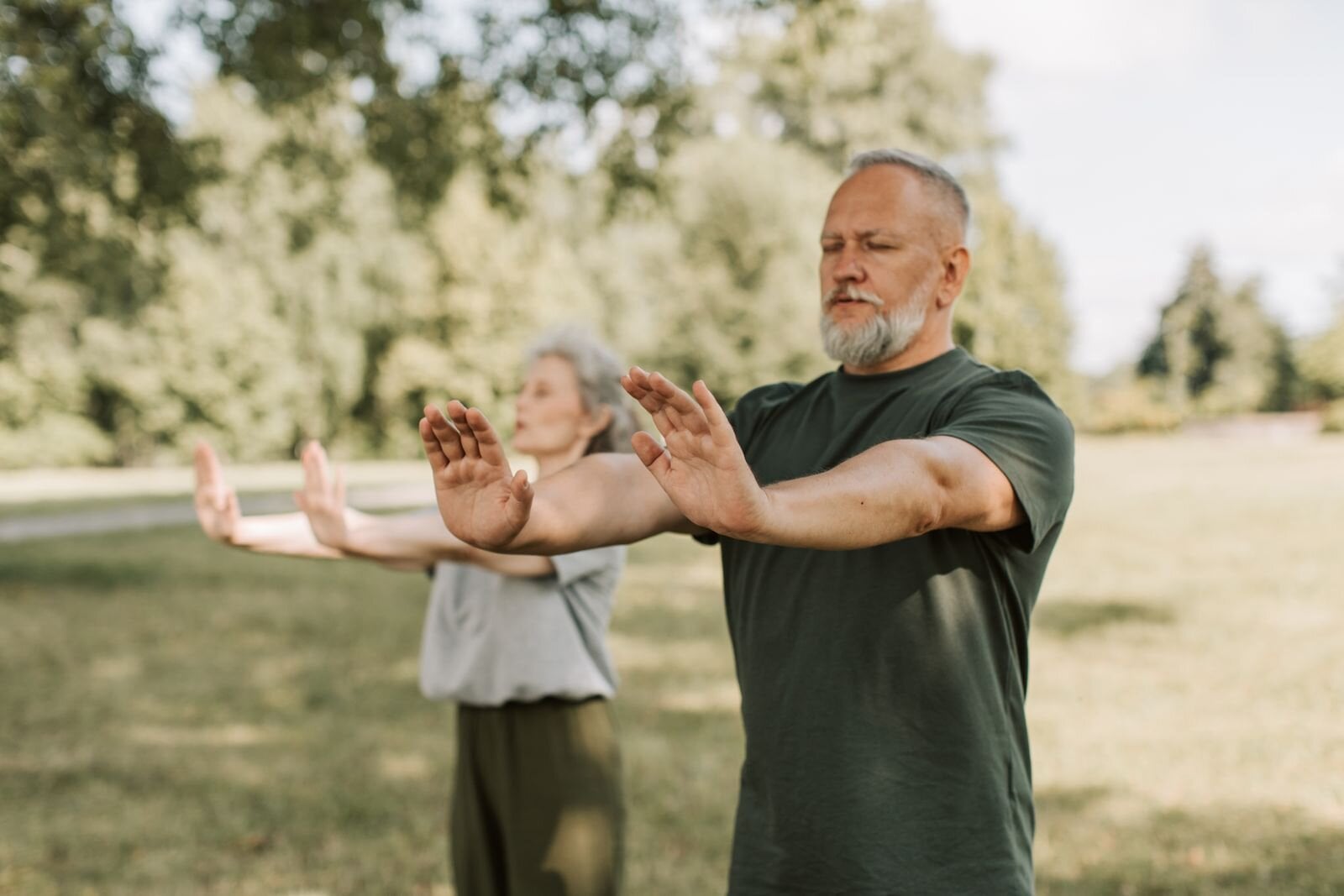
This type of movement can be especially useful for older adults because balance problems and falls become more common with age. According to CDC older adult falls data published in February 2026, more than 14 million US adults age 65 and older—approximately one in four—report falling each year.
Tai Chi walking can be practiced in a small indoor space, beside a sturdy chair or countertop, and adapted to different ability levels. However, seniors with recent falls, unexplained dizziness, significant mobility limitations, or certain health conditions should get personalized guidance before practicing without support.
What Is Tai Chi Walking for Seniors?
Tai Chi walking is a foundational exercise used in many Tai Chi styles. Instead of walking automatically, you pay close attention to each part of the step:
- Establish a stable posture.
- Shift your weight onto one leg.
- Allow the other foot to become light.
- Place that foot gently in front of you.
- Transfer your weight gradually.
- Repeat on the other side.
The movement is normally slower and more deliberate than everyday walking. This gives you time to notice your posture, foot position, knee alignment, breathing, and balance.
Tai Chi walking may be practiced by itself as a basic balance drill, but it is also used to prepare beginners for complete Tai Chi forms.
Important evidence note: Most research examines structured Tai Chi programs containing multiple movements—not Tai Chi walking as an isolated exercise. The walking drill may help seniors practice skills used in those programs, but it should not be assumed to produce every benefit seen in full Tai Chi classes.
The National Center for Complementary and Integrative Health’s Tai Chi overview describes Tai Chi as a practice combining slow, gentle movements, physical postures, controlled breathing, and focused awareness.
Tai Chi Walking vs. Regular Walking
Tai Chi walking and regular walking are both valuable, but they usually serve different purposes.
| Feature | Tai Chi Walking | Regular Walking |
|---|---|---|
| Speed | Very slow and deliberate | Natural, brisk, or fast |
| Step length | Usually short | Varies with speed and height |
| Main focus | Weight transfer, balance, posture, and control | Transportation, endurance, fitness, or recreation |
| Breathing | Relaxed and coordinated with movement | Usually automatic |
| Space needed | A small indoor or outdoor area | Usually a longer route |
| Typical intensity | Light | Light to moderate, depending on pace |
| Support options | Chair, counter, railing, or professional supervision | Cane, walker, railing, or another person when needed |
Tai Chi walking is not automatically better than regular walking. A slow Tai Chi drill may provide more balance practice, while brisk walking is more likely to raise the heart rate enough to count as moderate-intensity aerobic exercise.
Many seniors can benefit from combining both activities according to their abilities.
How to Do Tai Chi Walking for Seniors
The following instructions describe a simple forward-walking drill. Footwork varies among Tai Chi styles, so follow the method taught by your instructor when taking a formal class.
Step 1: Prepare a Safe Practice Space
Choose a firm, level, dry floor with good lighting. Remove:
- Loose rugs
- Electrical cords
- Shoes and bags
- Small furniture
- Pets or other unexpected obstacles
A sturdy countertop, heavy chair, wall-mounted railing, or other fixed support should be within easy reach.
Do not rely on a lightweight chair that can slide or tip. Avoid practicing near stairs, on wet tile, or on an uneven outdoor surface.
Step 2: Stand in a Comfortable Starting Position
Stand with your feet approximately hip-width apart. Keep your toes pointing mostly forward.
Your posture should feel tall but relaxed:
- Head level
- Eyes looking forward
- Chin slightly tucked
- Shoulders relaxed
- Chest comfortable rather than lifted forcefully
- Knees soft, not locked
- Arms relaxed or hands resting lightly on support
Do not force your back completely straight if that causes discomfort. Aim for a natural, upright position.
Step 3: Center Your Weight
Begin with your weight distributed comfortably between both feet.
Notice the contact between each foot and the floor. You should feel the heel and the areas beneath the base of the big toe and little toe.
Take two or three natural breaths. Avoid holding your breath or forcing unusually deep breathing.
Step 4: Shift Your Weight Onto One Leg
Slowly move most of your weight onto your left leg.
Keep both feet on the floor while shifting. Your upper body should move with your hips rather than leaning sideways from the waist.
Stop before you feel unstable. Beginners do not need to transfer 100% of their weight onto one leg.
Step 5: Allow the Other Foot to Become Light
As your weight moves onto the left leg, the right foot should begin to feel lighter.
Gently lift the right heel or slightly unweight the entire foot. Do not lift it high.
This is an important Tai Chi principle: make the foot light before trying to move it.
Step 6: Place the Light Foot Forward
Move the right foot a short distance forward. In a common beginner method, the heel touches the floor first.
Keep the step shorter than your normal stride. Reaching too far forward makes it harder to maintain balance and may place unnecessary stress on the knee.
At this stage, most of your body weight should remain on the rear leg.
Step 7: Lower the Front Foot Gently
Gradually lower the rest of the right foot until it is fully in contact with the floor.
Pause briefly. Make sure the foot feels secure before transferring your weight.
Avoid slapping the foot down or dropping your body forward.
Step 8: Transfer Your Weight to the Front Leg
Move your hips and body forward slowly as the right leg accepts more weight.
Keep the front knee generally aligned with the toes. Do not allow it to collapse noticeably inward.
Your torso should remain upright. Avoid pushing your head and shoulders ahead of your hips.
Step 9: Repeat on the Other Side
Once the right leg is supporting you securely, allow the left foot to become light.
Bring the left foot forward using the same sequence:
- Shift.
- Unweight.
- Place.
- Lower.
- Transfer.
Continue for several slow steps while breathing naturally.
Step 10: Stop and Turn Safely
Finish with both feet on the floor and your weight centered.
When you need to change direction, do not twist quickly on one planted knee. Instead:
- Pause.
- Hold stable support if needed.
- Take several small steps to turn.
- Reestablish your starting position.
- Begin again.
Beginners with balance limitations should avoid backward Tai Chi walking unless supervised by a qualified professional.
Benefits of Tai Chi Walking for Seniors
1. Practices Balance While the Body Is Moving
Standing still requires balance, but walking adds another challenge: part of each step is completed while one foot carries most of the body’s weight.
Tai Chi walking slows this process down. It gives you time to stabilize over the supporting leg before moving the other foot. This may help develop better awareness of where your body weight is positioned.
A 2026 meta-analysis of 21 randomized controlled trials found that structured Tai Chi programs improved balance, walking speed, and confidence related to fall prevention in healthy older adults.
2. Teaches More Controlled Weight Shifting
A common reason people feel unstable is that they begin moving a foot before the other leg is ready to support them.
Tai Chi walking teaches a more organized sequence:
- Shift the body weight first.
- Make the moving foot light.
- Place it gently.
- Transfer the weight only after the foot is secure.
This does not guarantee that a person will avoid falling, but it can provide useful practice in controlling the transition from one leg to the other.
3. Supports Walking Coordination and Mobility
Tai Chi walking coordinates several actions at once:
- Leg and foot movement
- Posture control
- Visual attention
- Breathing
- Direction changes
- Awareness of the surrounding space
Research on complete Tai Chi programs has reported improvements in walking speed and functional mobility. These abilities are relevant to daily activities such as getting out of a chair, beginning to walk, changing direction, and approaching a doorway.
4. May Help Lower Fall Risk as Part of a Complete Program
NCCIH reports that a large exercise review found:
- Low-certainty evidence that Tai Chi may reduce the overall rate of falls by 19%
- High-certainty evidence that it may reduce the number of people experiencing a fall by 20%
The studies included complete Tai Chi interventions with varying schedules and methods. Other forms of balance and functional exercise were also helpful.
In another randomized clinical trial involving 670 high-risk older adults, participants attended two 60-minute sessions per week for 24 weeks. A therapeutically modified Tai Ji Quan program produced a 58% lower fall incidence than stretching and a 31% lower incidence than a multimodal exercise program.
These results are encouraging, but the program involved professional instruction and more than simple forward walking. Practicing a few Tai Chi steps at home should not be presented as equivalent to that intervention.
5. Gently Engages the Lower Body
Slow stepping uses the:
- Quadriceps at the front of the thighs
- Gluteal muscles around the hips
- Hamstrings at the back of the thighs
- Calves
- Muscles around the ankles and feet
- Core and postural muscles
Keeping the knees slightly bent can increase muscular effort, but seniors should not use a deep stance. A shallow, comfortable knee bend is safer and usually sufficient for beginner practice.
Tai Chi walking may support muscular control and endurance. However, it should not replace progressive strength training when a person can perform strengthening exercises safely.
6. May Improve Confidence During Movement
Fear of falling can cause some older adults to take stiff, hesitant steps or avoid activity. Reduced activity may then contribute to further loss of strength and confidence.
Practicing predictable movements beside stable support may help a senior become more comfortable with controlled stepping. Complete Tai Chi programs have also been associated with improved confidence in avoiding falls.
7. Is Adaptable to Different Ability Levels
Tai Chi walking does not require a gym, specialized machine, or long walking route. It can be modified by:
- Making the steps shorter
- Keeping both hands on a countertop
- Practicing only side-to-side weight shifts
- Reducing the knee bend
- Performing preparatory movements from a chair
- Working with a physical therapist or qualified senior Tai Chi instructor
Adaptations should make the exercise safer, not simply easier. Someone who cannot stand securely with support should not attempt unsupported Tai Chi walking.
A Simple 10-Minute Tai Chi Walking Routine for Seniors
This routine is a practical starting option, not a medically prescribed program. Reduce the time or perform only supported weight shifts when needed.
Minutes 0–1: Posture and Breathing
Stand beside your support with both feet planted.
Relax your shoulders and take several natural breaths. Check that your knees are soft and your eyes are looking ahead.
Minutes 1–3: Side-to-Side Weight Shifts
Move your weight slowly toward the left foot and then toward the right.
Keep both feet on the floor. Use only a comfortable range. Do not lean sharply from side to side.
Minutes 3–7: Slow Forward Steps
Practice three to five short forward steps.
Pause after each step long enough to feel stable. Stop, reset your posture, and turn using small steps with support.
Repeat in the opposite direction.
Minutes 7–9: Step and Pause Practice
Take one slow step and pause with both feet on the floor.
Check:
- Is the front foot fully planted?
- Is the front knee aligned with the toes?
- Is the torso upright?
- Are the shoulders relaxed?
- Are you breathing?
Return to the starting position or take another controlled step.
Minutes 9–10: Cool Down
Stand with your weight evenly distributed.
Gently move the ankles, relax the legs, and take several comfortable breaths. Sit down slowly if you feel tired.
How Often Should Seniors Practice Tai Chi Walking?
There is no universally established research-based schedule for Tai Chi walking by itself.
A reasonable beginner progression is:
| Stage | Practice Time | Suggested Frequency |
|---|---|---|
| Starting stage | 3–5 minutes | 3 days per week |
| Early progression | 5–10 minutes | 3–5 days per week |
| Comfortable practice | 10–20 minutes | Most days, if well tolerated |
Increase only one part of the routine at a time. For example, add a few minutes before trying longer steps, narrower foot positions, more difficult turns, or less hand support.
Clinical Tai Chi studies often use 30- to 60-minute classes two or more times per week for several months. Those sessions include instruction, warm-ups, multiple movements, and gradual progression—not just walking practice.
Consistency is usually more useful than occasional long sessions. Five controlled minutes practiced regularly can be a better starting point than a difficult 30-minute session that leaves you fatigued or unsteady.
Tai Chi Walking Modifications for Seniors
Chair- or Counter-Supported Tai Chi Walking
Place one or both hands lightly on a stable support.
Practice transferring your weight from side to side before adding steps. As confidence improves, you may reduce how heavily you press through your hands.
Do not remove hand support merely to make the exercise harder. Continue using it whenever it helps you maintain safe form.
If you must grip or pull strongly to remain upright, supported standing Tai Chi walking may still be too challenging. A seated variation or professional assessment may be more appropriate.
Walker-Supported Practice
A senior who normally uses a walker should not set it aside to practice Tai Chi walking.
The safest setup depends on the type of walker, the reason it is needed, and the person’s stepping pattern. A physical therapist or qualified instructor should demonstrate how to practice weight shifts without placing the walker too far ahead or leaving it behind.
Do not improvise with a rolling walker on an unlocked or uneven surface.
Seated Weight-Shifting Practice
Seated practice is useful for learning awareness and coordination when standing is not yet safe.
Sit toward the front of a firm chair with both feet on the floor.
Practice:
- Shifting gentle pressure toward one foot
- Lifting the opposite heel
- Lowering the heel
- Alternating heel and toe taps
- Coordinating the movement with relaxed breathing
Seated practice does not challenge standing balance in the same way as walking, but it can introduce the movement sequence safely.
Tai Chi Walking Safety Tips for Seniors
Use Stable Support
Practice close enough to a secure surface that you can reach it without lunging. A countertop or fixed railing is usually safer than movable furniture.
Wear Secure Footwear
Choose flat, well-fitting shoes with nonslip soles. Avoid loose slippers, high heels, smooth-soled shoes, and walking in socks on a slippery floor.
The National Institute on Aging also advises older adults with balance problems to use nonskid, rubber-soled, low-heeled footwear and to use a cane or walker when needed.
Keep the Steps Small
A longer step is not necessarily a better step. Small steps make it easier to control weight transfer and keep the feet within a stable base of support.
Avoid Deep Knee Bends
Tai Chi is sometimes shown with low, wide stances. Seniors do not need to copy these positions.
Use a shallow knee bend or keep the legs nearly straight if that is more comfortable. The knees should not be forced forward, inward, or into pain.
Look Ahead
Constantly looking down can pull the head and upper body forward. Look toward the floor several feet ahead when necessary, but avoid dropping your chin toward your chest.
Good lighting and a clear floor are more important than watching every foot placement.
Do Not Hold Your Breath
Breathe normally throughout the exercise. Stop and reset if you notice yourself straining, gripping with the toes, or holding your breath.
Avoid Fatigue-Related Practice
Balance may worsen as the legs become tired. End the session while your steps are still controlled.
Sit down and rest when you notice increasing wobbling, dragging of a foot, poor knee control, or difficulty concentrating.
Stop for Warning Symptoms
Stop practicing if you develop:
- Dizziness or lightheadedness
- Chest pain or pressure
- Unusual shortness of breath
- Nausea
- Sudden weakness or numbness
- New vision changes
- Sharp or increasing joint pain
- A feeling that you are about to fall
Seek urgent medical help for severe chest symptoms, fainting, sudden one-sided weakness, facial drooping, or difficulty speaking.
Use Supervision When Fall Risk Is High
Have a family member, caregiver, physical therapist, or qualified instructor nearby if you:
- Have fallen recently
- Frequently lose your balance
- Need assistance to stand
- Have difficulty turning
- Are learning to use a new walking aid
- Become confused during multistep movements
Who Should Talk With a Healthcare Professional First?
Many seniors can begin gentle activity safely, but individualized advice is important when medical or mobility concerns are present.
Speak with a healthcare professional or physical therapist before unsupported Tai Chi walking if you have:
- A recent fall, fracture, injury, or operation
- Unexplained dizziness, fainting, or vertigo
- New difficulty walking
- Severe or rapidly worsening joint pain
- Significant vision or sensation loss
- A neurological condition affecting balance or movement
- Unstable heart or lung symptoms
- A medical restriction on standing or weight-bearing
- A new cane, walker, brace, or prosthesis
- Been advised not to exercise without supervision
A professional can help determine whether you should begin with seated movement, supported weight shifts, conventional physical therapy, or a structured fall-prevention program.
Common Tai Chi Walking Mistakes
Stepping Before Shifting the Weight
Trying to move a foot that is still carrying substantial weight can make the step feel stuck or unstable.
Correction: Transfer enough weight onto the supporting leg that the moving foot feels light.
Taking Steps That Are Too Long
Long steps make it harder to control the landing and transfer.
Correction: Use a shorter step than usual. Increase the distance only when you can remain upright and stable.
Leaning the Torso Forward
Some beginners reach forward with the head and shoulders before the hips move.
Correction: Think of the head, chest, and hips traveling together as one upright unit.
Letting the Knee Collapse Inward
The knee may drift toward the center of the body during weight transfer.
Correction: Keep the knee moving in approximately the same direction as the toes. Reduce the step length or knee bend if alignment is difficult.
Moving Too Quickly
Rushing removes the controlled weight-transfer practice that makes the drill useful.
Correction: Pause whenever needed. Tai Chi walking does not need to be continuous.
Becoming Rigid
Trying too hard to balance can cause clenched toes, raised shoulders, locked knees, and held breath.
Correction: Use stable support and a smaller movement so you can remain relaxed.
Progressing Away From Support Too Soon
Less support is not always better.
Correction: Keep using the chair, counter, cane, or walker until a qualified professional agrees that reduced support is appropriate.
Does Tai Chi Walking Count as a Complete Exercise Program?
Tai Chi walking can contribute to balance practice and light physical activity, but it should not be the only form of exercise for most seniors.
Current CDC physical activity guidance for adults age 65 and older recommends each week:
- At least 150 minutes of moderate-intensity aerobic activity, or an equivalent alternative
- Muscle-strengthening activity on at least two days
- Activities that improve balance
Older adults who cannot meet the full recommendations should be as active as their abilities and health conditions allow.
Very slow Tai Chi walking may not raise your breathing and heart rate enough to count as moderate-intensity aerobic exercise. Consider combining it with appropriate activities such as:
- Regular or brisk walking
- Stationary cycling
- Water exercise
- Chair-based aerobic exercise
- Resistance-band exercises
- Light weights
- Sit-to-stand practice
The best combination depends on your health, mobility, goals, and professional guidance.
Frequently Asked Questions
Is Tai Chi walking good for seniors?
Tai Chi walking can be a useful low-impact balance and coordination exercise for many seniors. It emphasizes slow weight transfer, posture, foot placement, and controlled stepping.
Its suitability depends more on a person’s balance, mobility, and health than on age alone. A healthy 80-year-old may manage it comfortably, while a younger person with severe balance problems may need seated practice or professional supervision.
Can Tai Chi walking prevent falls?
It cannot guarantee that a fall will not happen. Evidence shows that complete, structured Tai Chi programs may reduce falls and improve balance in older adults, but isolated Tai Chi walking has not been studied as extensively.
Fall prevention should also address medications, eyesight, footwear, home hazards, leg strength, blood pressure changes, and the appropriate use of walking aids.
How many minutes of Tai Chi walking should a senior do?
A beginner may start with three to five minutes and gradually progress toward 10–20 minutes as control and endurance improve.
Stop before fatigue affects your balance. A shorter, well-controlled session is safer than continuing after your steps become unsteady.
Can seniors do Tai Chi walking while holding a chair?
Yes. A sturdy chair, counter, or fixed railing can provide useful support. The support must not slide, tip, or move unexpectedly.
If you need to pull strongly through your arms to stay upright, practice seated movements or seek guidance before adding steps.
Can Tai Chi walking be done with a walker?
Possibly, but the setup should be demonstrated by a physical therapist or instructor familiar with assistive devices. Do not leave your walker behind or move it in a way that conflicts with the instructions given by your healthcare team.
Is Tai Chi walking safe for knee arthritis?
Many people with knee arthritis may tolerate modified Tai Chi movements, especially when using short steps, shallow stances, and support. NCCIH reports that full Tai Chi programs may support pain, stiffness, physical function, and balance in people with knee osteoarthritis, although results and appropriate exercise levels vary.
Stop if you experience sharp pain, increasing swelling, buckling, or pain that changes how you walk. A physical therapist can help adjust the stance and step length.
Is Tai Chi walking better than regular walking?
The two activities have different strengths. Tai Chi walking places more attention on balance and movement control. Regular walking—especially at a brisk pace—is generally better for building walking endurance and contributing to aerobic activity.
For many seniors, a combination of both is more useful than choosing only one.
Conclusion
Tai Chi walking for seniors offers a practical way to practice slow stepping, posture, coordination, and controlled weight transfer. It can be adapted with a chair, countertop, or seated variation, making it accessible to many ability levels.
Begin with a clear floor, supportive footwear, stable hand support, and steps that feel comfortably short. Practice for only a few minutes at first, and stop while your movement is still controlled. Seniors with recent falls, dizziness, significant walking difficulties, or medical restrictions should begin with professional guidance.
Tai Chi walking works best as one part of a broader routine that also includes appropriate aerobic, strength, and balance activities. A senior-focused Tai Chi class or physical therapy program can provide personalized instruction and safer progression.
References
- CDC: Older Adult Falls Data
- CDC: Physical Activity Guidelines for Older Adults
- NCCIH: Tai Chi—What You Need to Know
- PubMed: Effects of Tai Chi on Balance and Fall Prevention in Healthy Older Adults
- PubMed: Therapeutic Tai Ji Quan and Fall Prevention in High-Risk Older Adults
- National Institute on Aging: Older Adults and Balance Problems