
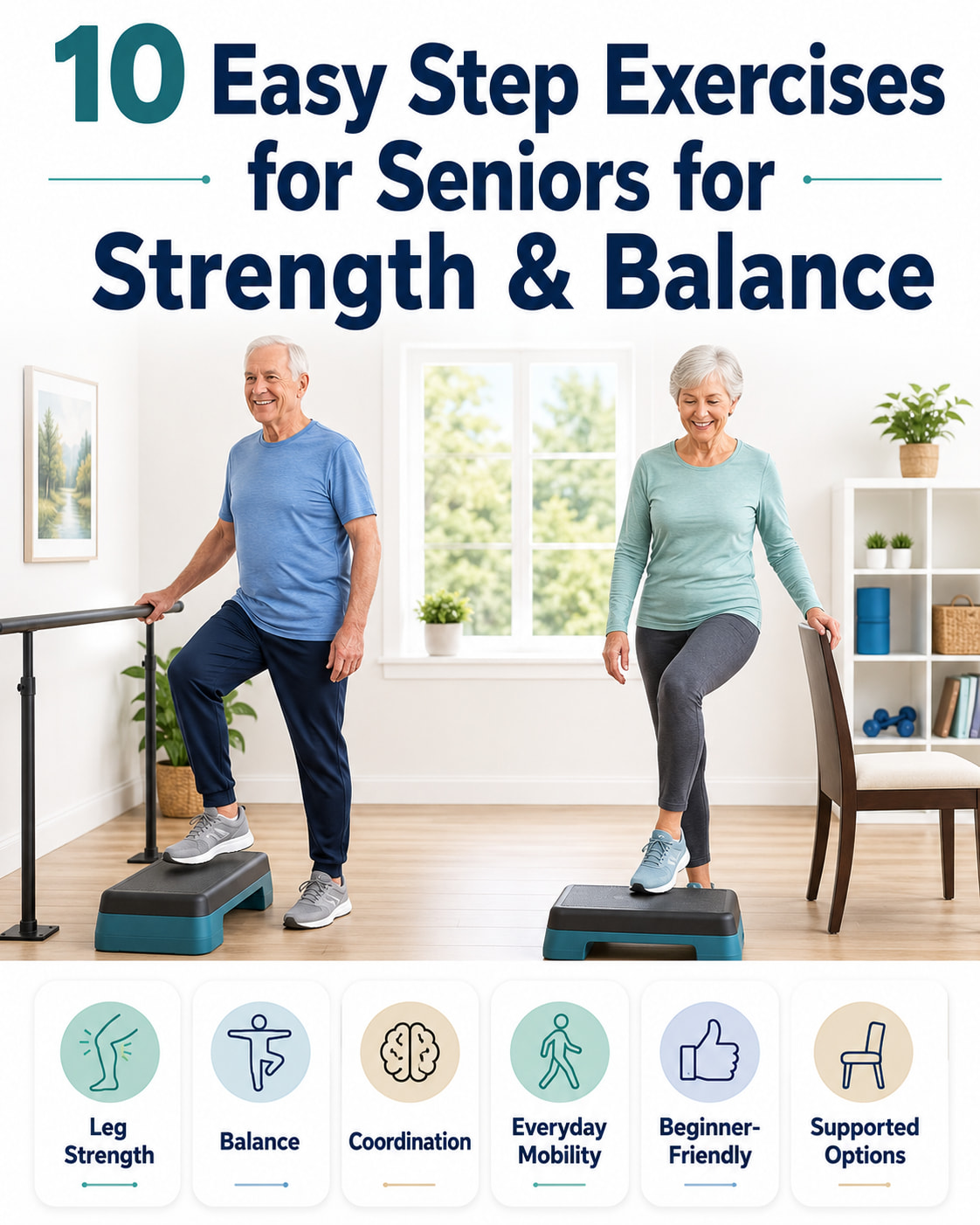
Step exercises for seniors can help strengthen the legs and provide practical balance practice when they are performed slowly with a low, stable step and dependable hand support. They can also make movements such as walking, changing direction, stepping over obstacles, and climbing stairs feel more familiar.
You do not need to complete fast step aerobics or use a high platform. This guide begins with supported floor-based steps and gradually progresses to low step-ups. Start with the easiest movements, use as much support as necessary, and increase the difficulty only when every repetition feels controlled.
Step Exercises for Seniors at a Glance
| Exercise | Best for | Equipment | Starting level |
|---|---|---|---|
| Supported Step Taps | Foot clearance and coordination | Low step and support | Beginner |
| Forward Step and Return | Forward weight shifting | Countertop or railing | Beginner |
| Side Step and Return | Side-to-side control | Countertop or railing | Beginner |
| Backward Step and Return | Controlled backward stepping | Countertop or railing | Beginner |
| Basic Low Step-Up | Leg strength and stair practice | Low step and railing | Beginner |
| Alternating Step-Up | Coordination and balanced leg use | Low step and railing | Beginner–intermediate |
| Step-Up to Balance Hold | Single-leg control | Low step and railing | Intermediate |
| Lateral Step-Up | Hip and thigh strength | Low step and railing | Beginner–intermediate |
| Step-Up With Knee Lift | Dynamic balance and hip control | Low step and railing | Intermediate |
| Clock Step | Multidirectional balance | Countertop or railing | Beginner–intermediate |
These difficulty levels are general. A floor-based exercise can still be challenging when balance is limited, while a low step-up may feel easy for someone who regularly climbs stairs.
Why Step Exercises Can Be Useful for Seniors
The Centers for Disease Control and Prevention recommends that adults aged 65 and older include aerobic activity, muscle-strengthening exercise, and balance activity each week. Its guidance, updated December, 2025, recommends muscle-strengthening activity on at least two days each week and regular activities that improve balance.
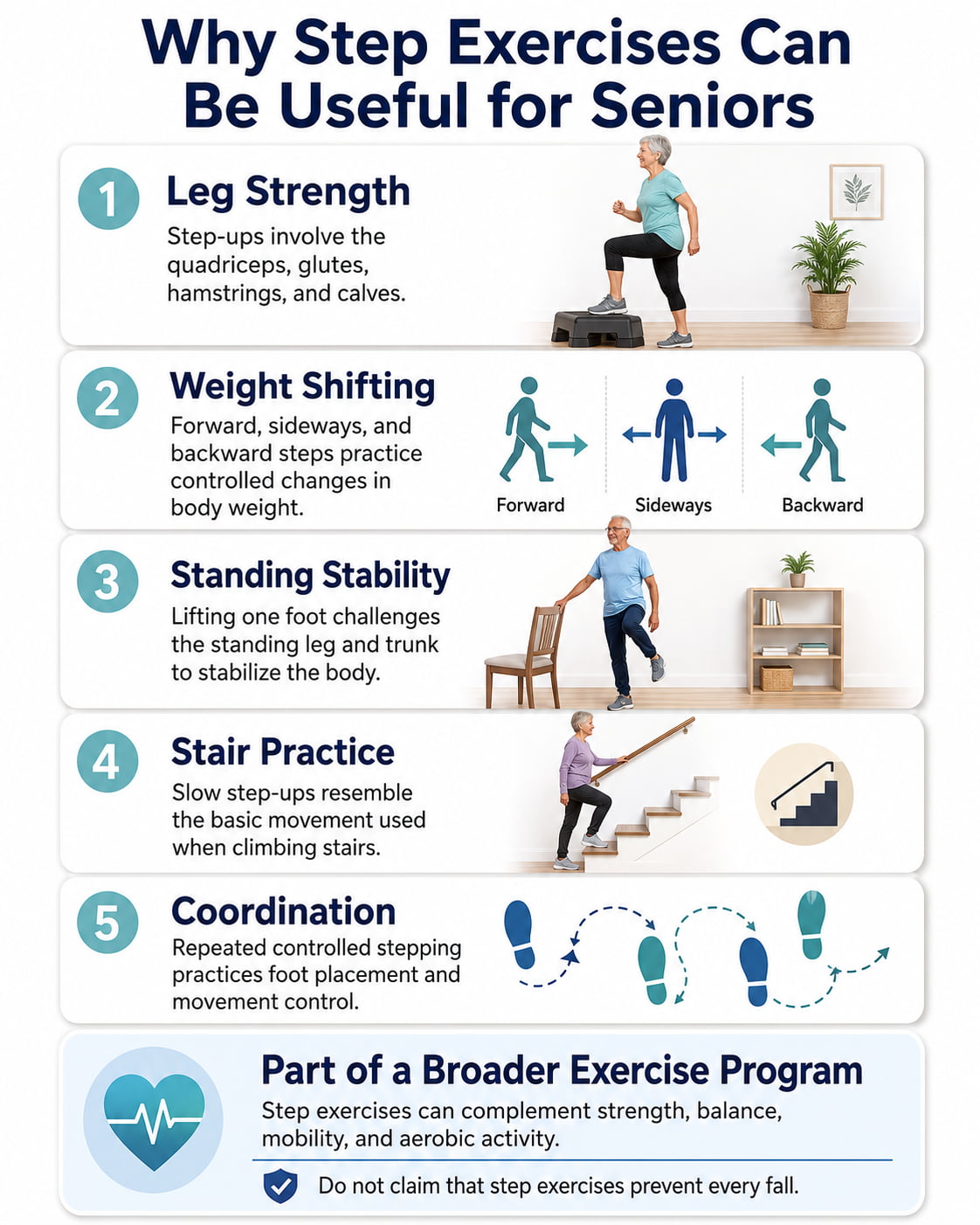
Step exercises can contribute to these goals in several ways:
- Stepping onto a platform challenges the quadriceps, glutes, hamstrings, and calves.
- Moving forward, sideways, and backward practices controlled weight shifting.
- Lifting one foot requires the standing leg and trunk to stabilize the body.
- Slow step-ups resemble the basic movement used when climbing stairs.
- Repeating a controlled stepping pattern can improve coordination and confidence with the movement.
According to Centers for Disease Control and Prevention older-adult fall data updated February, 2026, more than 14 million—or approximately one in four—U.S. adults aged 65 and older report falling each year. This does not mean falling is an unavoidable part of aging, but it supports including strength and balance activities in an older adult’s routine.
A large Cochrane review involving 108 randomized trials and 23,407 participants found that exercise programs reduced the overall rate of falls by approximately 23%. Programs emphasizing balance and functional exercise were particularly useful. These findings apply to complete, structured programs—not to one exercise or a brief home routine—so step-ups should be treated as one part of a broader activity plan.
A separate systematic review indexed by PubMed found improvements in stepping reaction time, gait, balance, and balance recovery among older adults participating in structured stepping interventions. However, the interventions varied and sometimes included supervised or specialized training. Their results should not be interpreted as proof that a basic home routine will prevent every fall.
What You Need Before Starting
Choose a Secure Step
Use one of the following:
- The bottom step of a staircase with a sturdy railing
- A low exercise platform designed to remain stable
- A wide, secure aerobic step with locked risers
- A low platform recommended by a physical therapist
Do not use:
- A folding step stool
- A loose box or stack of books
- A rolling chair
- A lightweight chair that can tip
- A platform that slides when you press against it
The surface should be wide enough for your entire foot unless you are only performing light step taps.
Keep Stable Support Nearby
The best support is usually a fixed handrail, sturdy countertop, or wall-mounted bar. A heavy chair may also work if it cannot slide, fold, swivel, or roll.
Place the support close enough that you can reach it without leaning. Use both hands when necessary. Reducing hand support is optional, not required.
Do not replace a prescribed cane, walker, or other mobility aid with furniture unless a healthcare professional has advised you to do so.
Prepare the Exercise Area
Before beginning:
- Remove loose rugs, cords, clutter, and other trip hazards.
- Keep children and pets away from the exercise area.
- Make sure the room is well lit.
- Wear secure, supportive shoes.
- Avoid exercising in socks on a slippery surface.
- Keep the step directly in front of or beside you as required.
Warm Up for Approximately Five Minutes
Begin with gentle activity that feels comfortable:
- Easy walking
- Supported marching
- Ankle pumps
- Heel and toe raises
- Gentle knee bends
- Slow side-to-side weight shifts
The American Academy of Orthopaedic Surgeons recommends warming up with approximately 5 to 10 minutes of low-impact activity before strengthening exercises.
Who Should Get Individual Guidance First?
Speak with a healthcare professional or physical therapist before trying step exercises when you have:
- Recently fallen or frequently feel as though you may fall
- Unexplained dizziness, fainting, or sudden weakness
- A recent operation, fracture, or significant injury
- New or worsening hip, knee, ankle, foot, or back pain
- Instructions to limit weight-bearing activity
- Significant heart, lung, neurological, or balance problems
- Difficulty standing safely even with support
- Uncertainty about safely climbing the bottom stair
A physical therapist can assess your current strength, mobility, balance, and need for assistance before selecting an appropriate exercise level.
Stop exercising if you experience chest pain or pressure, dizziness, faintness, nausea, unusual or extreme shortness of breath, sudden weakness, loss of balance, or new and worsening pain. The National Institute on Aging advises that exercise should not cause dizziness, chest pain or pressure, or nausea.
10 Easy Step Exercises for Seniors
The exercises below use the same slow, supported approach shown in the NHS balance exercise guidance, which recommends completing step-ups near a wall or railing and controlling both the upward and downward portions of the movement.
Start with three to five repetitions per side. You do not need to perform all ten exercises in one session.
1. Supported Step Taps
Why it works:
Supported step taps practice foot clearance, weight shifting, and coordination without requiring you to place your full body weight on the step. They are a good starting point before regular step-ups.
Muscles worked:
Hip flexors, quadriceps, calves, and standing-leg stabilizers.
How to do it:
- Stand facing a low step with a railing or countertop within easy reach.
- Shift your weight onto your left leg.
- Lift your right foot and gently tap the top of the step.
- Return the right foot to the floor slowly.
- Repeat with the left foot.
- Start with 3–5 taps per foot.
Trainer Tip:
Keep your torso tall and use enough hand support to remain steady. If the raised step feels difficult, practice tapping a floor marker first.
2. Forward Step and Return
Why it works:
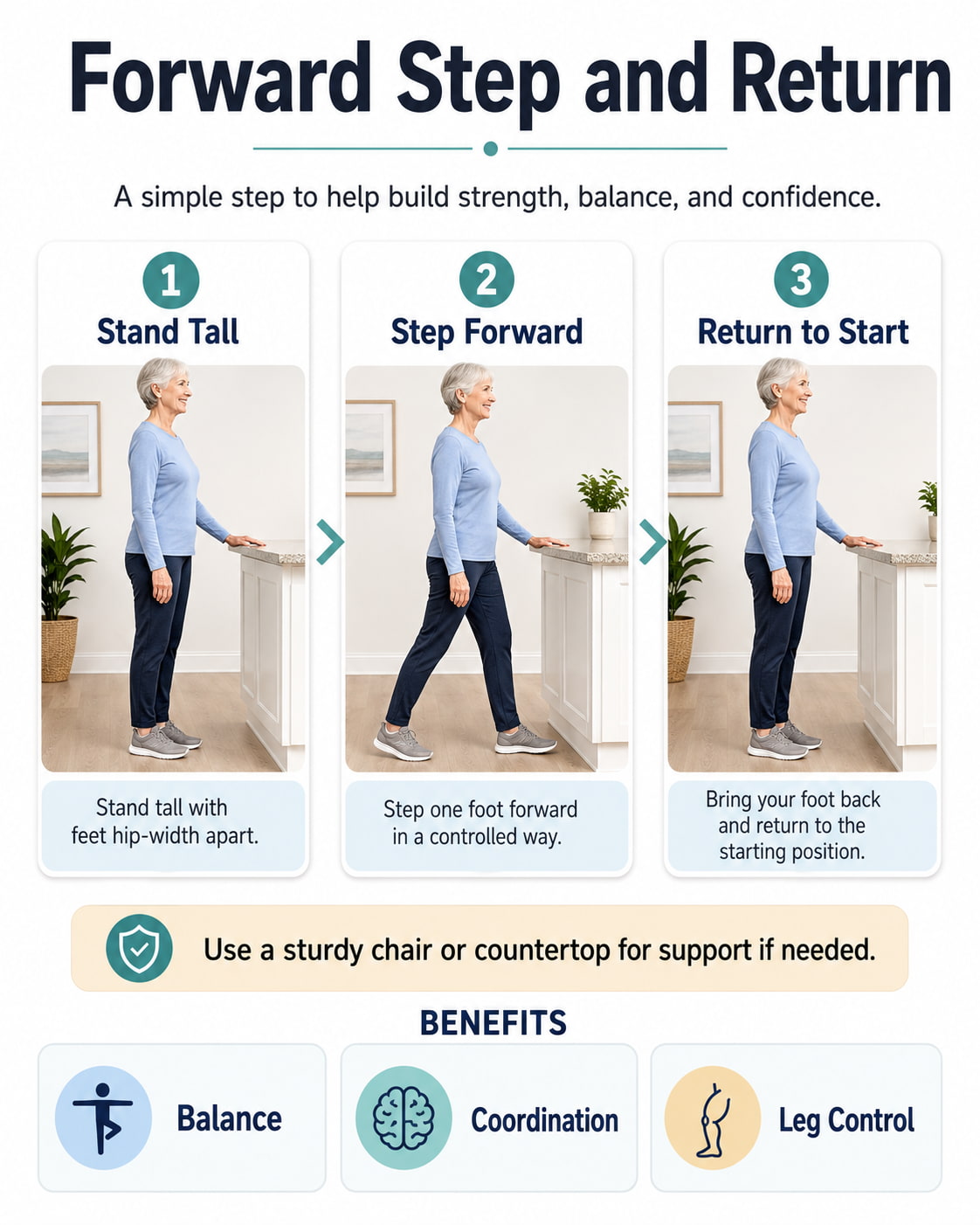
This exercise practices controlled forward weight shifting, which is commonly used during walking and other everyday movements.
Muscles worked:
Quadriceps, glutes, calves, and hip stabilizers.
How to do it:
- Stand tall facing a countertop or railing.
- Step forward a comfortable distance with your right foot.
- Gently shift some of your weight onto the right leg.
- Press through the right foot and return to the starting position.
- Complete 3–5 repetitions.
- Repeat with the left leg.
Trainer Tip:
Take a comfortable step rather than a deep lunge. Start with a small weight shift and increase the range only when you feel stable.
3. Side Step and Return
Why it works:
Side stepping practices lateral weight transfer and challenges the hip muscles that help stabilize the pelvis during standing and walking.
Muscles worked:
Gluteus medius, other hip stabilizers, quadriceps, and calves.
How to do it:
- Stand facing a countertop with both hands available for support.
- Step your right foot a comfortable distance to the side.
- Shift some of your body weight onto the right foot.
- Return the right foot to the starting position.
- Complete 3–5 repetitions.
- Repeat on the left side.
Trainer Tip:
Keep your toes generally pointing forward and lift the moving foot instead of dragging it across the floor.
4. Backward Step and Return
Why it works:
Backward stepping provides practice controlling your body when moving in a direction that can feel less familiar than forward walking.
Muscles worked:
Glutes, hamstrings, quadriceps, calves, and trunk stabilizers.
How to do it:
- Stand facing a sturdy countertop or railing.
- Make sure the area behind you is completely clear.
- Step your right foot a short distance backward.
- Place the foot down gently and shift only as much weight as feels comfortable.
- Return to the starting position.
- Complete 3–5 repetitions per side.
Trainer Tip:
Begin by lightly touching your toes behind you without transferring much weight. Never practice this exercise by stepping backward onto a raised platform.
5. Basic Low Step-Up
Why it works:
The basic step-up strengthens the legs while practicing a movement similar to climbing stairs.
Muscles worked:
Quadriceps, glutes, hamstrings, and calves.
How to do it:
- Stand close to a low step and hold a stable railing.
- Place your entire right foot securely on the step.
- Press through the right foot to raise your body.
- Bring your left foot onto the platform.
- Step down slowly, leading with the left foot.
- Complete 3–5 repetitions, then lead with the left leg.
Trainer Tip:
Choose a step low enough that you can place your whole foot on it and control the descent. Do not pull yourself forcefully upward with the railing.
6. Alternating Step-Up
Why it works:
Alternating the lead leg adds a coordination challenge while allowing both legs to practice producing and controlling force.
Muscles worked:
Quadriceps, glutes, hamstrings, calves, and core stabilizers.
How to do it:
- Stand facing a low step with a railing available.
- Step onto the platform with your right foot.
- Bring your left foot up beside it.
- Step back down carefully.
- Perform the next repetition by leading with your left foot.
- Continue alternating for 4–6 total repetitions.
Trainer Tip:
Pause after each repetition if necessary. Smooth, controlled steps are more important than maintaining a continuous rhythm.
7. Step-Up to Balance Hold
Why it works:
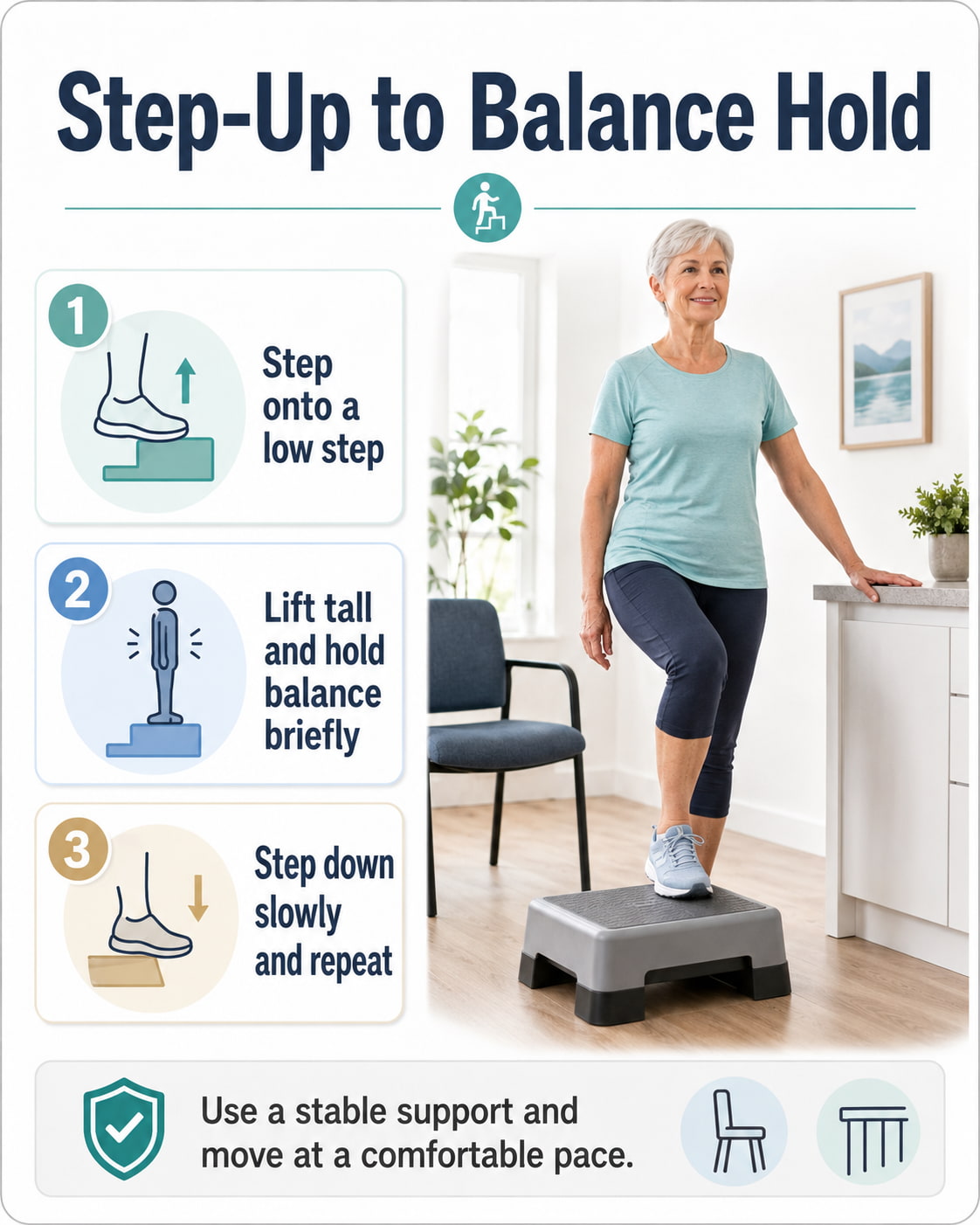
This variation combines leg strengthening with a brief period of single-leg balance, increasing the stability challenge.
Muscles worked:
Quadriceps, glutes, hamstrings, calves, hip stabilizers, and core.
How to do it:
- Place your right foot completely on a low step.
- Hold the railing and press through the right leg.
- Lift your left foot slightly from the floor without placing it on the platform.
- Hold for 1–3 seconds.
- Lower the left foot slowly, followed by the right.
- Complete 3 repetitions per side.
Trainer Tip:
Keep using the railing throughout the exercise. If lifting the second foot feels unstable, lightly keep its toes on the floor instead.
8. Lateral Step-Up
Why it works:
Lateral step-ups strengthen the thighs and hips while adding side-to-side movement that is different from a standard forward step-up.
Muscles worked:
Quadriceps, glutes, hip abductors, hamstrings, and calves.
How to do it:
- Stand sideways beside a low step.
- Hold a secure railing or countertop.
- Place the foot nearest the platform fully on the step.
- Press through that leg and bring the other foot onto the platform.
- Step down slowly in the same direction.
- Complete 3–5 repetitions, then carefully change sides.
Trainer Tip:
Keep your hips facing generally forward rather than twisting toward the platform. Use a lower step if you have difficulty controlling the descent.
9. Step-Up With Knee Lift
Why it works:
Adding a small knee lift increases the coordination and balance demands of a regular step-up while also involving the hip flexors.
Muscles worked:
Quadriceps, glutes, hip flexors, calves, and core stabilizers.
How to do it:
- Place your right foot securely on a low step.
- Hold the railing and press through your right leg.
- As you rise, lift your left knee a small, comfortable distance.
- Pause briefly without leaning backward.
- Lower the left foot to the floor, followed by the right.
- Complete 3 repetitions per side.
Trainer Tip:
The knee does not need to reach hip height. Keep the lift small and controlled. Skip this variation until a regular step-up feels comfortable and steady.
10. Clock Step
Why it works:
Clock steps practice controlled movement in several directions, helping challenge coordination, weight shifting, and dynamic balance.
Muscles worked:
Glutes, quadriceps, calves, hip stabilizers, and core.
How to do it:
- Stand in front of a countertop as though you are in the center of a clock.
- Step your right foot forward toward 12 o’clock and return to the center.
- Step the right foot sideways toward 3 o’clock and return.
- If comfortable, step slightly backward toward 6 o’clock and return.
- Repeat with the left foot using 12, 9, and 6 o’clock.
- Complete 1–2 controlled rounds per foot.
Trainer Tip:
Start with only forward and side steps. Add backward or diagonal directions only when you can return to the center without losing balance.
Common Step Exercise Mistakes
| Mistake | Why it matters | Practical correction |
|---|---|---|
| Using a step that is too high | Makes balance and leg control more difficult | Select a lower platform |
| Placing only the toes on the step | Reduces stability during weight transfer | Place the entire foot on the platform |
| Standing too far from support | Forces you to reach or lean | Move the support closer |
| Dropping quickly during the descent | Reduces control and increases impact | Lower slowly and quietly |
| Knee moving inward | Can make the leg feel unstable | Keep the knee aligned with the toes |
| Pushing mostly from the lower foot | Reduces work by the leg on the step | Press through the foot on the platform |
| Pulling hard with the arms | May hide insufficient leg strength | Use a lower step and lighter hand pressure |
| Looking down throughout the set | Can encourage a rounded posture | Check the step, then look forward when safe |
| Holding the breath | Can cause unnecessary strain | Exhale as you step up |
| Rushing repetitions | Makes balance errors more likely | Pause and reset after each repetition |
Some forward knee movement is normal during a step-up. The priority is controlled movement, a fully planted foot, and a knee that follows the direction of the toes without pain.
Beginner Step Exercise Routine
This routine takes approximately 12 to 15 minutes. Complete it near reliable support.
| Part | Activity |
|---|---|
| Warm-up | 5 minutes of easy walking, supported marching, and ankle movements |
| Exercise 1 | Supported Step Taps: 5 per side |
| Exercise 2 | Forward Step and Return: 5 per side |
| Exercise 3 | Side Step and Return: 5 per side |
| Exercise 4 | Basic Low Step-Up: 3–5 per side |
| Exercise 5 | Step-Up to Balance Hold: 3 per side |
| Cool-down | 2 minutes of easy walking and relaxed breathing |
Rest for approximately 30 to 90 seconds between exercises, or longer when needed. Your breathing should settle before the next exercise.
Skip the balance hold when the basic step-up already feels challenging.
How Many Step-Ups Should Seniors Do?
A cautious starting point is:
- Repetitions: 3–5 per side
- Sets: 1 set
- Rest: 30–90 seconds or as needed
- Frequency: 2 nonconsecutive days per week for the strength-focused exercises
The NHS balance routine suggests up to five step-ups with each leg, while general strength recommendations may eventually use higher repetition ranges. Beginning with fewer repetitions is reasonable when balance, confidence, or fatigue is the main limitation.
As the exercises become easier, gradually work toward:
- 6–10 repetitions per side
- 1–2 sets
- A longer balance hold
- Slightly less pressure through the hands
- A marginally higher step, when appropriate
You do not need to progress every exercise. Keeping hand support or continuing to use a low step can still provide useful practice.
How to Progress Step Exercises Safely
Change only one part of the routine at a time.
A practical progression order is:
- Improve the smoothness of each repetition.
- Add one or two repetitions.
- Add a second set.
- Increase the length of a balance hold.
- Use slightly lighter hand pressure.
- Increase the step height only when necessary.
Do not increase the height, speed, repetition count, and balance demand at the same time.
Progress is not only about making an exercise harder. Better foot placement, quieter step-downs, improved posture, and less fatigue are also signs of improvement.
Frequently Asked Questions
Are step exercises good for seniors?
Step exercises can be useful for seniors who can stand safely with appropriate support. They work the major leg muscles while practicing weight shifting, foot clearance, and balance. The safest exercise and difficulty level depend on the individual’s current mobility, health, and fall risk.
What is a safe step height for an older adult?
There is no universal safe height. Begin with the lowest secure platform that allows the whole foot to fit, the body to remain upright, and the movement to stay controlled. Some people should begin with floor-based steps instead of a platform.
Should seniors hold a railing during step exercises?
Yes, whenever it improves safety or confidence. A sturdy railing or countertop should be available even when you do not need to grip it continuously. Removing support is optional and should not be treated as the main goal.
Can seniors with knee arthritis perform step exercises?
Some people with knee arthritis may be able to perform modified step taps or low step-ups, while others may need a different exercise. Start with a low height, small range, slow pace, and hand support. Stop if joint pain becomes sharp, increases during the exercise, or remains worse afterward. Persistent pain or swelling should be discussed with a healthcare professional.
What can I do if I cannot step onto a platform?
Begin with supported floor-based exercises such as forward steps, side steps, backward toe taps, and clock steps. Supported marching and sit-to-stands can also help build some of the strength required for step-ups.
How often should seniors practice step exercises?
Strength-focused step-ups can generally be practiced two or three nonconsecutive days per week. Easier balance patterns may be practiced more frequently when they do not cause excessive fatigue or soreness. The appropriate schedule depends on the person’s overall exercise routine and recovery.
Are step exercises enough to prevent falls?
No single exercise can guarantee that someone will not fall. Fall risk can also be influenced by vision, medication, footwear, home hazards, blood pressure, neurological conditions, and other factors. Step exercises are best used as part of a broader program that includes strength, balance, mobility, appropriate medical care, and a safe environment.
Conclusion
Step exercises for seniors do not need to be fast, high, or complicated. Begin with supported floor steps and step taps, then introduce low step-ups when you can place the whole foot securely and control the descent.
Choose four to six exercises, complete a small number of steady repetitions, and progress one variable at a time. Consistent, well-controlled practice is more valuable than using a higher platform or completing a large number of repetitions.
Start with the easiest exercise today and focus on smooth, confident movement rather than speed.
References
- Centers for Disease Control and Prevention — Older Adult Activity: An Overview.
- Centers for Disease Control and Prevention — Older Adult Falls Data.
- Cochrane — Exercise for Preventing Falls in Older People Living in the Community .
- NHS — Balance Exercises.
- American Academy of Orthopaedic Surgeons — Knee Exercises.
- PubMed — Step Training Improves Reaction Time, Gait and Balance and Reduces Falls in Older People.