
A 12-week half marathon training plan can prepare many first-time runners who already run consistently and can comfortably complete about 5 miles. This beginner schedule uses three essential weekly runs, an optional fourth run, progressive long runs, strength training, cutback weeks, and a taper before race day.

A half marathon is exactly 13.1094 miles, or 21.0975 kilometers, according to World Athletics’ official half marathon overview. You do not need to run the full distance during training, but you do need enough time to build endurance gradually, test your fueling plan, and learn how to control your pace.
This is not a couch-to-half-marathon program. It is designed for healthy beginners who already have a basic running or run-walk foundation.
Is 12 Weeks Enough to Train for a Half Marathon?
Twelve weeks may be enough when you already:
- Run or run-walk at least three times per week.
- Can exercise continuously for 30–45 minutes.
- Can comfortably complete a 5-mile long run.
- Have trained consistently without worsening pain.
- Have enough time for three or four runs each week.
The Hospital for Special Surgery’s distance-training guidance recommends entering a formal plan with an existing aerobic base. Ideally, you would already be running three or four times per week and completing a comfortable long run of approximately 5–7 miles.
You may need more than 12 weeks if you are currently inactive, cannot yet run or run-walk for 30 minutes, or have not completed a 5-mile session recently. In that case, spend four to eight weeks gradually building your base before beginning Week 1.
Who Should Use This Half Marathon Training Plan?
This half marathon training plan is intended for beginners whose main goal is to complete their first 13.1-mile race comfortably rather than achieve an aggressive finishing time.
The plan may be appropriate if you:
- Have been running consistently for at least several weeks.
- Can complete 5 miles at an easy pace.
- Are comfortable using planned walking breaks when needed.
- Can train on three essential days each week.
- Are willing to slow down, repeat a week, or shorten a run when necessary.
- Are not experiencing an active injury or unexplained exercise-related symptoms.
Who Should Build More Fitness First?
Complete a separate base-building phase before starting this schedule if:
- Your longest recent run is under 4–5 miles.
- You cannot run or run-walk continuously for at least 30 minutes.
- You are returning after an extended break.
- You are recovering from an injury.
- You regularly experience pain that changes your stride.
- Your current weekly activity is limited to occasional walking.
During a base-building phase, focus on three easy run-walk sessions per week. Gradually extend one session until you can comfortably cover approximately 5 miles without feeling exhausted afterward.
Medical Safety Before Starting
Running is vigorous exercise for many people. Talk with a healthcare professional before beginning if you have a chronic condition, have been inactive, have a disability, are pregnant, are returning after surgery or a significant injury, or have concerns about whether vigorous exercise is appropriate for you.
The CDC specifically advises people with conditions such as heart disease, arthritis, or diabetes to discuss suitable activity with a healthcare professional. It also recommends medical consultation before beginning vigorous exercise for people who have been inactive, have a disability, or have overweight.
Stop exercising and seek urgent medical help for chest pressure or pain, fainting, severe breathing difficulty, or concerning symptoms such as chest discomfort accompanied by nausea, cold sweat, lightheadedness, or pain spreading into the arm, back, neck, jaw, or stomach.
How This 12-Week Half Marathon Training Plan Works
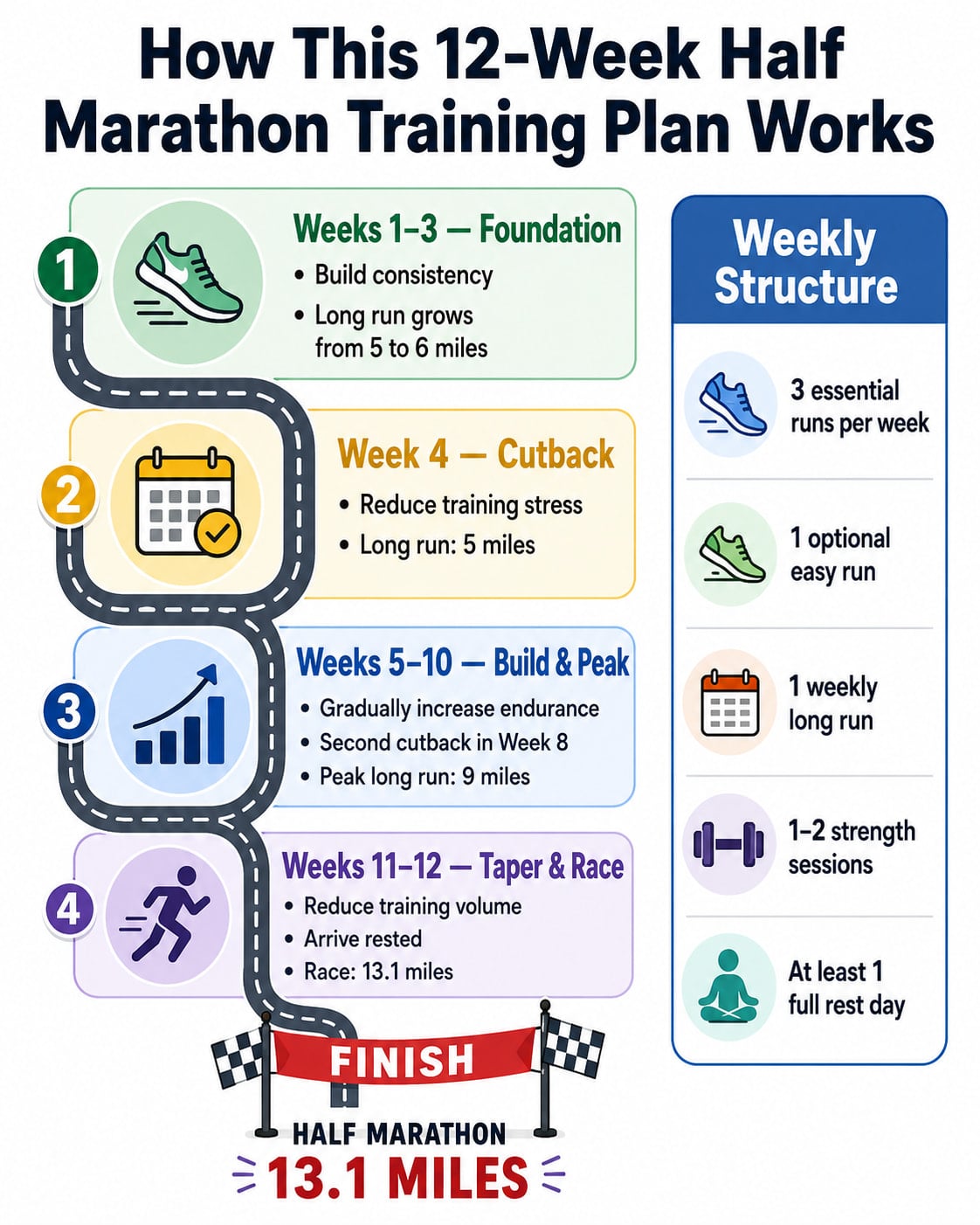
This schedule gradually develops endurance without filling every day with running.
It includes:
- Three essential runs per week
- One optional easy run
- One weekly long run
- One or two short strength sessions
- Two cutback weeks
- A peak 9-mile long run
- A reduced Week 11
- A light race week
The current B.A.A. first-time half-marathon plan also begins with a 5-mile long run, builds toward approximately 9–10 miles, and reduces training before race day. The schedule below is an original completion-focused plan rather than a reproduction of the B.A.A. program.
New York Road Runners notes that a runner’s longest half-marathon training run may fall between 9 and 11 miles. Therefore, this plan peaks at 9 miles, which is the lower end of that range and appropriate for many completion-focused beginners.
Suggested Weekly Layout
You can move sessions to different days, but avoid stacking all your training together.
| Day | Suggested activity |
|---|---|
| Monday | Complete rest |
| Tuesday | Run 1, followed by optional strength training |
| Wednesday | Rest or easy cross-training |
| Thursday | Run 2, followed by optional strength training |
| Friday | Optional easy run or rest |
| Saturday | Rest and prepare for the long run |
| Sunday | Long run |
Try to keep at least one complete rest day each week. During Weeks 9 and 10, reduce strength training or omit the optional run if your legs feel unusually tired.
Half Marathon Training Pace and Effort Guide
Most of your training should feel easy. Running every session hard does not necessarily prepare you faster and may make recovery more difficult.
The CDC talk test is a simple way to judge intensity. During moderate activity, you can usually talk but not sing. During vigorous activity, saying more than a few words may require a pause for breath.
Use the following effort guide throughout the plan:
| Workout | Effort | How it should feel |
|---|---|---|
| Easy run | 3–4 out of 10 | Relaxed; you can speak in full sentences |
| Long run | 3–4 out of 10 | Comfortable and controlled; slower than race effort |
| Steady running | 5–6 out of 10 | Focused but sustainable; you can speak in short sentences |
| Half-marathon effort | About 6 out of 10 | Purposeful and controlled, not an all-out effort |
| Strides | 7–8 out of 10 | Smooth, fast running for 20 seconds; never a maximum sprint |
| Easy cross-training | 3–4 out of 10 | Comfortable aerobic movement without heavy fatigue |
Your pace will change with weather, hills, sleep, stress, and fatigue. On hot, humid, windy, or hilly days, follow effort rather than forcing a particular pace.
12-Week Half Marathon Training Plan
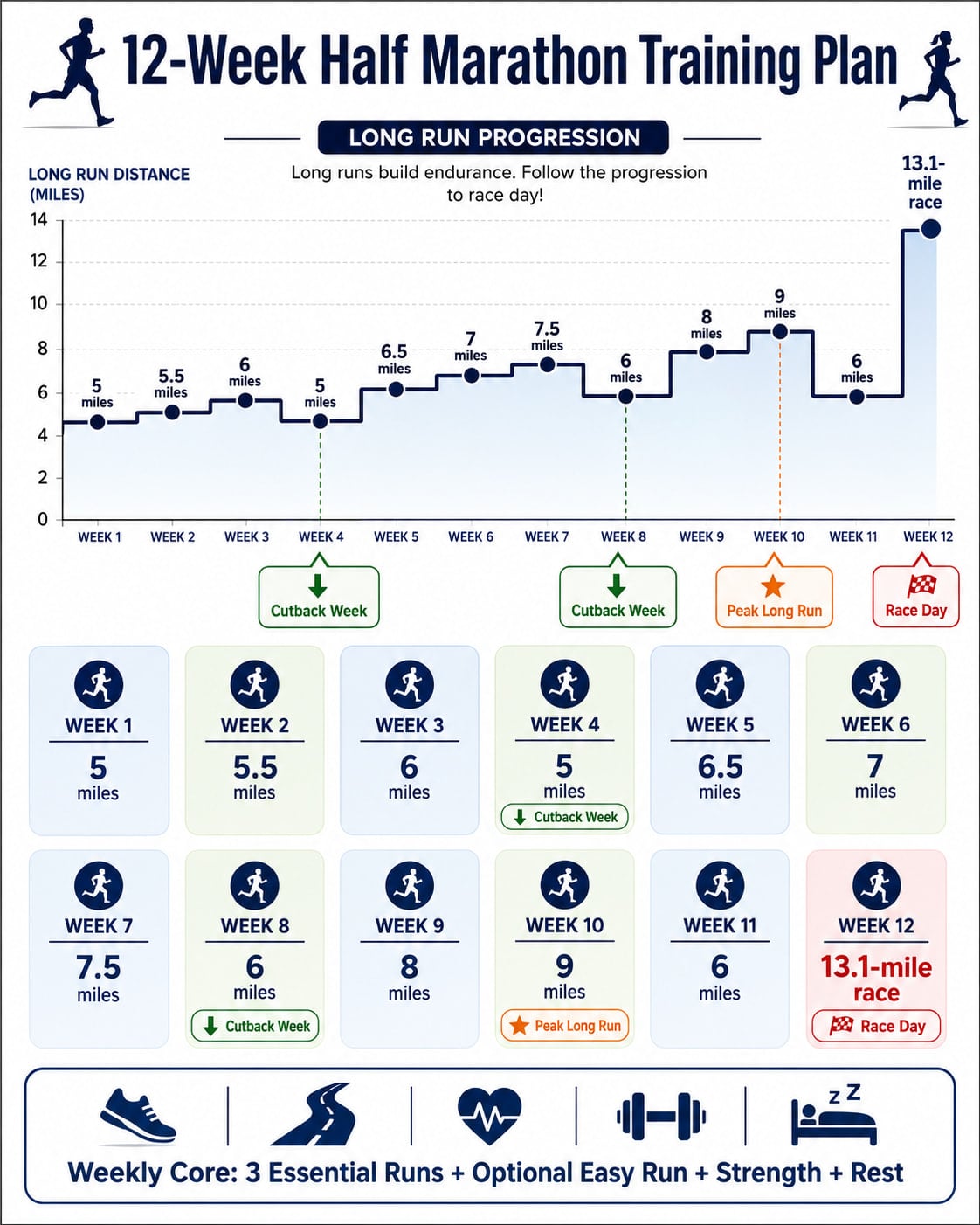
All distances include walking breaks. The optional run can be omitted without disrupting the core plan.
The steady and half-marathon-effort portions are included within the listed distance. Warm up with easy running before beginning them and finish the remaining distance easily.
| Week | Run 1 | Run 2 | Optional easy run | Long run |
|---|---|---|---|---|
| 1 | 3 miles easy (4.8 km) | 3 miles easy (4.8 km) | 2 miles easy (3.2 km) or cross-train | 5 miles easy (8 km) |
| 2 | 3 miles easy (4.8 km) | 3 miles easy plus 4 × 20-second strides | 2 miles easy (3.2 km) | 5.5 miles easy (8.9 km) |
| 3 | 3.5 miles easy (5.6 km) | 3.5 miles including 10 minutes steady | 2–2.5 miles easy (3.2–4 km) | 6 miles easy (9.7 km) |
| 4 | 3 miles easy (4.8 km) | 3 miles easy (4.8 km) | Rest or 2 miles easy | 5 miles easy (8 km) |
| 5 | 3.5 miles easy (5.6 km) | 4 miles including 2 × 5 minutes steady, with 3 minutes easy between | 2.5 miles easy (4 km) | 6.5 miles easy (10.5 km) |
| 6 | 4 miles easy (6.4 km) | 4 miles easy plus 4 × 20-second strides | 2.5 miles easy (4 km) | 7 miles easy (11.3 km) |
| 7 | 4 miles easy (6.4 km) | 4.5 miles including 2 × 8 minutes steady, with 3 minutes easy between | 2.5–3 miles easy (4–4.8 km) | 7.5 miles easy (12.1 km) |
| 8 | 3.5 miles easy (5.6 km) | 4 miles easy (6.4 km) | Rest or 2 miles easy | 6 miles easy (9.7 km) |
| 9 | 4 miles easy (6.4 km) | 5 miles including 2 × 10 minutes at controlled half-marathon effort, with 4 minutes easy between | 2.5–3 miles easy (4–4.8 km) | 8 miles easy (12.9 km) |
| 10 | 4 miles easy (6.4 km) | 5 miles including 3 × 8 minutes at controlled half-marathon effort, with 3 minutes easy between | 2–3 miles easy or rest | 9 miles easy (14.5 km) |
| 11 | 3.5 miles easy (5.6 km) | 4 miles including 10 minutes steady | Rest or 2 miles easy | 6 miles easy (9.7 km) |
| 12 | 3 miles easy (4.8 km) | 2 miles easy plus 4 × 20-second strides | Rest or a 10–15-minute shakeout | Race: 13.1 miles (21.1 km) |
Important Schedule Adjustments
This table is a guide, not a test you must pass exactly as written.
Adjust the schedule when necessary:
- Repeat a week if the current distance still feels difficult.
- Choose the lower distance when a range is provided.
- Omit the optional run when you need more recovery.
- Replace a steady workout with easy running after poor sleep, illness, or unusual fatigue.
- Shorten a run in extreme heat, poor air quality, or unsafe weather.
- Do not increase the long run and add a hard workout in the same week if you are struggling to recover.
A 2025 observational study of 5,205 runners associated single-session distance increases greater than 10% of the runner’s longest run during the previous 30 days with higher rates of overuse injury. This does not prove that 10% is a universal limit, but it supports avoiding abrupt jumps in one run.
How to Complete the Long Runs
The weekly long run is the most important endurance-building session in this plan. It should not become a weekly race.
Use these guidelines:
- Start slower than you think necessary. The first 10 minutes should feel especially easy.
- Maintain conversational effort. You should finish feeling as though you could continue for a little longer.
- Use walking breaks early. Do not wait until you are exhausted.
- Practice race equipment. Test your shoes, socks, shorts, anti-chafing product, fuel, and hydration system.
- Avoid a fast finish when tired. The goal is to accumulate controlled time on your feet.
- Recover afterward. Eat, drink, and allow adequate rest before your next demanding session.
You do not need to cover 13.1 miles before race day. The combination of weekly running, a 9-mile peak long run, appropriate pacing, and a taper can prepare a beginner to complete the remaining distance on race day.
How to Use Run-Walk Intervals
Run-walk training is a valid strategy for first-time half-marathon runners. HSS recommends considering run-walk intervals because they introduce the demands of running progressively and provide planned recovery opportunities.
Choose a repeatable ratio based on your current ability:
- Run 4 minutes, walk 1 minute.
- Run 3 minutes, walk 1 minute.
- Run 2 minutes, walk 1 minute.
- Run 1 minute, walk 1 minute.
Use the walking interval from the beginning instead of waiting until you are exhausted. Walking time counts toward the scheduled distance.
For example, a 6-mile long run may be completed using a 3-minute run and 1-minute walk pattern from start to finish. If that approach works well in training, use the same pattern on race day.
Planned walks can also be coordinated with aid stations, allowing you to drink without rushing.
Strength Training for Half Marathon Beginners
Strength training may support running performance, muscle capacity, and movement control. The CDC’s current adult activity guidance recommends muscle-strengthening exercise on at least two days per week.
A 2024 systematic review and meta-analysis found that high-load and combined strength-training methods may improve performance in middle- and long-distance runners. However, the certainty of the evidence ranged from very low to moderate, and the research does not mean strength training makes runners immune to injury.
Simple 20–30-Minute Strength Routine
Perform the routine once or twice per week during Weeks 1–8. Complete one session during Weeks 9–11, and avoid strenuous lower-body strength training during race week.
| Exercise | Beginner target | Easier option |
|---|---|---|
| Goblet squat | 2 sets of 8–12 | Sit-to-stand from a chair |
| Romanian deadlift or hip hinge | 2 sets of 8–12 | Unweighted hip hinge |
| Reverse lunge | 2 sets of 6–10 per leg | Supported split squat |
| Standing calf raise | 2 sets of 12–15 | Hold a chair for balance |
| Resistance-band or dumbbell row | 2 sets of 8–12 | Lighter resistance band |
| Push-up | 2 sets of 6–12 | Wall or incline push-up |
| Dead bug or side plank | 2 controlled sets | Shorter holds or fewer repetitions |
Use a load that allows controlled technique. Stop each set with approximately two or three good repetitions remaining rather than training to failure.
Strength work should support your running, not leave you too sore to complete the next session.
Cross-Training and Rest Days
Cross-training can provide additional aerobic exercise without adding another running session.
Beginner-friendly options include:
- Stationary cycling
- Elliptical exercise
- Swimming
- Pool running
- Brisk walking
- Easy rowing
Keep cross-training easy to moderate for approximately 20–45 minutes. It should not leave your legs exhausted before the next run.
Cross-training is optional. It does not replace the weekly long run, but it can replace the optional easy run when you want less repetitive impact.
At least one day each week should be a complete rest day. More rest may be necessary during peak training, after illness, or when work and sleep stress are unusually high.
How to Warm Up and Cool Down
Before an easy or long run:
- Walk or jog gently for 5–10 minutes.
- Gradually increase to your planned running pace.
- Add controlled movements such as leg swings, marching, ankle circles, or walking lunges when helpful.
Before strides or half-marathon-effort running, complete at least 10 minutes of easy running first.
HSS recommends approximately 5–10 minutes of low- to moderate-intensity aerobic movement before dynamic stretching. Mayo Clinic similarly recommends 5–10 minutes of brisk walking before running and a gradual walking cool-down afterward.
After a run, walk easily for several minutes until your breathing settles. Gentle stretching is optional, but do not force a painful range of motion.
Fueling During Half Marathon Training
Long runs are opportunities to practice your race-day nutrition strategy.
Before a Long Run
Eat a familiar carbohydrate-rich meal or snack at a time that has worked well during previous training.
Possible options include:
- Oatmeal with banana
- Toast with peanut butter
- A bagel
- Yogurt with fruit and cereal
- Rice with eggs
- A banana with crackers
The best choice depends on your digestion and dietary needs. Avoid experimenting with an unusually large, fatty, spicy, or high-fiber meal immediately before a long run.
During the Run
For sessions lasting longer than approximately 60–75 minutes, consider consuming carbohydrate during the run.
Sports nutrition guidance commonly recommends approximately 30–60 grams of carbohydrate per hour during prolonged endurance exercise. Individual needs and tolerance vary, so begin by practicing near the lower end rather than introducing a large amount on race day.
Fuel options include:
- Energy gels
- Sports chews
- Sports drinks
- Easily carried carbohydrate snacks
Read the product label because carbohydrate content varies. A gel, for example, may provide approximately 20–25 grams, but the exact amount depends on the product.
Practice the same product, timing, and approximate quantity during at least two or three long runs before the race.
After Training
After longer or harder sessions, eat a normal meal or snack containing carbohydrates, protein, and fluids. The goal is to replace energy, support recovery, and prepare for the next workout.
Avoid severely restricting food intake while training for a half marathon. Inadequate energy intake can make recovery and consistent training more difficult.
Hydration for Long Runs and Race Day
Fluid needs vary according to body size, sweat rate, pace, weather, humidity, and exercise duration. There is no single fluid amount that is correct for every runner.
The NYRR runner health and safety guidance recommends drinking according to thirst and cautions runners against trying an unfamiliar hydration strategy on race day.
Use these practical rules:
- Begin normally hydrated.
- Carry fluid or plan a route with water access when necessary.
- Drink according to thirst and conditions.
- Do not force excessive amounts of plain water.
- Consider a sports drink during longer sessions when you also need carbohydrate and sodium.
- Practice with the fluids available at your race when possible.
- Check the race’s official aid-station locations before race day.
Both inadequate fluid intake and excessive fluid intake can create problems. Sports medicine guidance emphasizes individualized hydration because sweat rate and electrolyte losses vary substantially between runners.
What to Do If You Miss a Workout
Do not double your mileage or combine multiple missed sessions.
HSS advises runners not to “make up” lost workouts. After a few missed days, resume with a lower-intensity session. After more than a week away, rebuild gradually instead of compressing two weeks into one.
| Time missed | Practical adjustment |
|---|---|
| One short run | Skip it and continue the schedule |
| Two or three days | Resume with an easy run |
| About one week | Repeat the previous completed week or step back one week |
| More than one week | Rebuild gradually from a manageable distance |
| Two or more weeks | Reassess whether the original race date remains realistic |
| Time missed because of injury | Follow professional return-to-running guidance |
Protect the long-term goal instead of trying to save one week of training.
Normal Soreness vs. Possible Injury
Mild muscle soreness can occur when training volume increases. It is generally less concerning when it:
- Feels muscular rather than sharp.
- Affects both sides similarly.
- Improves as you move gently.
- Does not change your walking or running form.
- Gradually improves with recovery.
Stop or shorten the run when pain is sharp, localized, worsening, or changing the way you move.
Arrange a medical or sports medicine assessment for symptoms such as:
- Pain that repeatedly worsens while running.
- Pain that causes limping or altered running form.
- Significant or increasing swelling.
- Pain directly over a bone.
- Recurring weakness or loss of sensation.
- Numbness or tingling.
- A joint that locks or gives way.
- Pain that persists despite reducing training.
- Inability to bear weight.
Medical sources advise prompt evaluation when an injury causes severe pain or swelling, numbness, an inability to move the joint, limping, or an inability to bear weight.
Do not rely on pain medicine to push through a run that would otherwise be too painful to complete.
Half Marathon Taper: Weeks 11 and 12
A taper reduces training fatigue while maintaining enough movement to keep your legs comfortable.
The plan lowers the long run from 9 miles in Week 10 to 6 miles in Week 11. Race-week running is then limited to two short sessions and an optional shakeout before the race.
A 2023 systematic review and meta-analysis found that tapering can improve endurance time-trial and time-to-exhaustion performance. Earlier meta-analysis findings also support reducing training volume while maintaining some training frequency and intensity rather than stopping completely.
During the taper:
- Do not add missed workouts.
- Do not test your fitness with another long run.
- Keep strength training light.
- Use familiar shoes and equipment.
- Maintain your usual eating habits.
- Prioritize regular sleep.
- Avoid trying a new workout class or sport.
- Expect to feel restless or uncertain as your mileage decreases.
Reduced training during race week does not mean you are losing all your fitness. The goal is to arrive at the starting line rested rather than exhausted.
Race-Week Checklist
Complete these tasks several days before the race:
- Confirm the start time and starting location.
- Review transportation, parking, or public transit.
- Check the course elevation and terrain.
- Find the aid-station locations.
- Verify the course time limit.
- Read the event’s weather and cancellation policies.
- Pick up your race number according to event instructions.
- Prepare your shoes, socks, clothing, fuel, and identification.
- Charge your watch if you plan to use one.
- Check the forecast and adjust clothing appropriately.
Do not wear brand-new shoes or untested clothing on race day.
Lay out everything the night before so you do not need to make unnecessary decisions in the morning.
Beginner Half Marathon Race-Day Strategy
Before the Start
Eat the same type of breakfast you successfully used before long runs. Begin normally hydrated and use the bathroom with enough time to enter your starting area.
Complete a brief warm-up appropriate for your pace. For many first-time runners, several minutes of walking and easy jogging are enough. Avoid a long, tiring warm-up.
Miles 1–3: Start Conservatively
The excitement of race day can make an ordinary pace feel unusually easy. Resist the urge to follow faster runners.
Your first few miles should feel controlled. If using run-walk intervals, take the first walking break exactly as planned rather than skipping it because you feel fresh.
Miles 4–10: Settle Into Your Routine
Focus on:
- Relaxed shoulders and hands
- Consistent effort
- Planned walking breaks
- Fueling at practiced times
- Drinking according to thirst
- Avoiding sudden pace changes
Run according to your own plan rather than another participant’s pace.
Final 3.1 Miles: Reassess
If you feel strong after 10 miles, gradually increase your effort. If you are struggling, maintain your run-walk pattern and focus on moving steadily toward the finish.
Walking late in a half marathon is not failure. It is often a practical way to manage fatigue and finish safely.
Frequently Asked Questions
Is 12 weeks enough to train for a half marathon?
Twelve weeks may be enough if you already run three or more times per week and can comfortably complete approximately 5 miles. Someone starting from little or no running will usually benefit from a separate base-building period first.
Can a complete beginner train for a half marathon in 12 weeks?
A complete beginner may be able to increase activity substantially in 12 weeks, but going directly from inactivity to 13.1 miles creates an unnecessarily aggressive progression. Build a walking and run-walk foundation first, then begin a formal half marathon schedule.
How many days per week should a beginner run?
This plan uses three essential running days and one optional easy run. Three days may be sufficient for a completion-focused beginner, while the optional fourth run can add easy aerobic volume when recovery is good.
What should the longest run be before a half marathon?
Approximately 9–11 miles is common in beginner half marathon training. This schedule peaks at 9 miles, which is appropriate for many first-time runners focused on finishing.
Should I run 13.1 miles before race day?
No. Most beginners do not need to complete the full distance during training. The race itself can be the first 13.1-mile effort after you have built adequate weekly consistency and long-run endurance.
Can I walk during a half marathon?
Yes. Planned walking breaks can be used throughout training and on race day. Start them early and follow a consistent ratio rather than waiting until you are exhausted.
What should I do if I miss a week of training?
Do not compress the missed training into the next week. Repeat the last successfully completed week or return with reduced mileage. After a longer interruption, reconsider whether you need additional time before the race.
Conclusion
A successful beginner half marathon training plan depends more on consistency than perfection. Complete the three essential weekly runs, keep most running conversational, build your long run gradually, practice fueling and hydration, and use the cutback and taper weeks as intended.
Adjust the schedule when illness, pain, weather, or life stress interferes. Repeating a week or skipping an optional run is usually more productive than forcing mileage your body is not ready to handle.
Choose your race, count back 12 weeks, and begin only after you can comfortably complete the Week 1 starting distance.
References
- World Athletics — Half Marathon Overview
- Boston Athletic Association — Boston Half Training Plans
- Hospital for Special Surgery — How to Start Training for a Marathon or Half Marathon
- New York Road Runners — Half Marathon Training FAQs
- CDC — How to Measure Physical Activity Intensity
- CDC — Adding Physical Activity as an Adult
- PubMed — Effects of Tapering on Performance in Endurance Athletes