
The most effective way to get rid of dandruff is to wash your scalp consistently and use a dandruff shampoo containing an active ingredient such as ketoconazole, pyrithione zinc, selenium sulfide, salicylic acid, or coal tar. Apply the shampoo directly to your scalp, leave it on for the label-directed contact time, and use it regularly for several weeks.

Most mild cases can be managed at home. However, dandruff commonly returns, so you may need occasional maintenance shampooing after the flakes and itching improve. The American Academy of Dermatology’s dandruff guidance recommends trying shampoos with different active ingredients when the first product does not provide enough relief.
A simple approach is to:
- Start with regular washing using a gentle shampoo.
- Choose a medicated shampoo based on your symptoms.
- Apply it to your scalp rather than only your hair.
- Follow the product’s frequency and contact-time directions.
- Give the treatment approximately two to four weeks to work.
- Seek medical advice if the condition is severe or does not improve.
What Causes Dandruff?
Dandruff does not have one single cause. Several factors may contribute, including:
- Irritated or oily skin
- Dry skin
- Malassezia, a type of yeast that naturally lives on most adult scalps
- Sensitivity to shampoo, hair dye, styling products, or other hair-care ingredients
- Skin conditions such as eczema or psoriasis
- Infrequent washing that allows oil, skin cells, and product residue to accumulate
Dandruff is not simply caused by poor hygiene. However, flakes may become more noticeable when the scalp is not washed regularly. Stress and cold weather can also make symptoms worse for some people. Mayo Clinic’s dandruff overview provides additional information about common causes and risk factors.
How to Get Rid of Dandruff: 7 Effective Treatments
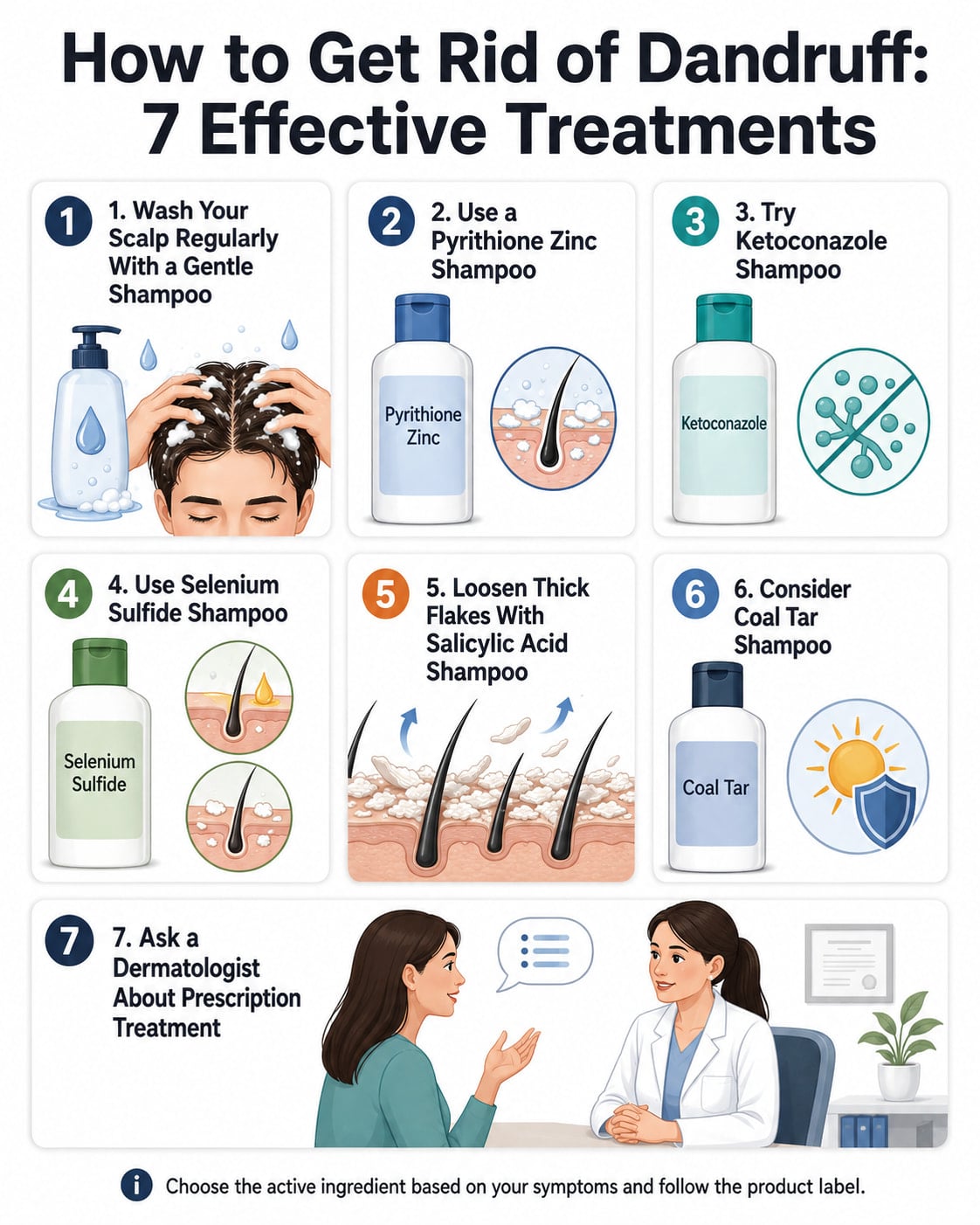
The right treatment depends on whether your main problem is oiliness, itching, loose flakes, thick scale, or repeated flare-ups. Look at the active ingredient on the Drug Facts label instead of choosing a product based only on its brand name.
1. Wash Your Scalp Regularly With a Gentle Shampoo
Regular shampooing may be enough for mild dandruff, especially when oil, dead skin, sweat, or styling-product residue has accumulated on the scalp.
Use a gentle shampoo and massage it into the scalp with your fingertips. Avoid digging into your skin with your fingernails because scratching can worsen irritation.
How often you wash depends on your scalp and hair type:
- Oily scalp or fine, straight hair: You may need to wash frequently, sometimes daily.
- Wavy or moderately dry hair: Wash often enough to prevent noticeable oil and buildup.
- Curly, coily, coarse, or textured hair: You may need to wash less frequently to avoid excessive dryness.
When medicated shampoo is unnecessary on a particular wash day, use a mild regular shampoo. You can apply conditioner mainly to the mid-lengths and ends if your hair becomes dry. The American Academy of Dermatology notes that people with straight or oily hair may use medicated shampoo about twice weekly, while those with curly or coily hair may tolerate it closer to once weekly.
Best for: Mild flakes, an oily scalp, or product buildup.
2. Use a Pyrithione Zinc Shampoo
Pyrithione zinc, also called zinc pyrithione, is a common anti-dandruff ingredient. It may help control yeast-related flaking while reducing itching and visible scale.
It is a practical first option for mild or moderate dandruff because many shampoos containing it are designed for regular use.
As of September, 2026, the current U.S. eCFR anti-dandruff ingredient rules list pyrithione zinc concentrations of:
- 0.3% to 2% for rinse-off products
- 0.1% to 0.25% for products left on the scalp
These are regulatory concentration ranges, not personalized usage instructions. Follow the directions on your specific product.
To use a pyrithione zinc shampoo:
- Wet your hair and scalp.
- Apply the product directly to the scalp.
- Massage gently until it lathers.
- Leave it on for the time listed on the bottle.
- Rinse thoroughly.
Best for: Mild-to-moderate flakes, itching, and ongoing maintenance.
3. Try Ketoconazole Shampoo
Ketoconazole is an antifungal ingredient that helps reduce the growth of fungi associated with dandruff. It can be particularly useful when ordinary shampoo or a general anti-dandruff product has not controlled persistent flakes and itching.
Usage instructions vary by product and country. MedlinePlus ketoconazole guidance notes that over-the-counter ketoconazole shampoo is commonly used every three to four days for up to eight weeks and then as needed. Other product labels may direct users to apply it twice weekly for two to four weeks. Always follow the directions supplied with your shampoo.
Some ketoconazole shampoos must remain on the scalp for three to five minutes before rinsing. Do not assume this contact time applies to every formulation; check your label.
MedlinePlus guidance indicates that you may notice improvement within two to four weeks. Stop using it and consult a healthcare professional if it causes significant irritation or your symptoms become worse.
Best for: Persistent, recurrent, or yeast-associated dandruff.
4. Use Selenium Sulfide Shampoo
Selenium sulfide is another ingredient that may reduce yeast-related flaking and help control an oily, scaly scalp.
The current U.S. eCFR lists the following OTC dandruff concentrations:
- Selenium sulfide 1%
- Micronized selenium sulfide 0.6%
Apply the product to the scalp and rinse it out thoroughly. Do not leave it on longer or use it more frequently than directed. If you have color-treated, bleached, gray, or chemically processed hair, read the product warnings carefully because instructions may differ between formulations.
Selenium sulfide can be useful when dandruff is accompanied by noticeable oiliness, but it may feel drying to some people. Applying conditioner to the hair lengths after rinsing may help protect dry hair.
Best for: Oily dandruff, recurrent flakes, and scalp scaling.
5. Loosen Thick Flakes With Salicylic Acid Shampoo
Salicylic acid is a scale-loosening ingredient. It helps remove accumulated dead skin when flakes are thick, attached to the scalp, or difficult to wash away.
The current U.S. eCFR permits 1.8% to 3% salicylic acid in OTC dandruff products. Some products combine salicylic acid with sulfur, another permitted anti-dandruff ingredient.
To use it effectively:
- Apply it directly to areas with noticeable scale.
- Massage gently instead of scraping the flakes.
- Leave it on only for the specified time.
- Rinse thoroughly.
- Use conditioner on the hair lengths if needed.
Salicylic acid may leave some scalps or hair feeling dry. If dryness or irritation increases, use it less often according to the label, alternate with a gentle shampoo, or ask a pharmacist or dermatologist about another ingredient.
Best for: Thick flakes, stubborn buildup, and attached scalp scale.
6. Consider Coal Tar Shampoo
Coal tar shampoo may help reduce itching, scaling, and flaking. It is sometimes used for stubborn dandruff and other scaly scalp conditions.
The current U.S. eCFR permits coal tar concentrations of 0.5% to 5% in OTC dandruff products.
Coal tar requires a few additional precautions:
- It may darken or stain blonde, gray, bleached, tinted, or other light-colored hair.
- It can make treated skin more sensitive to sunlight.
- U.S. labeling warns that increased sunburn sensitivity may continue for up to 24 hours after application.
- It should not be used for prolonged periods without consulting a healthcare professional.
- Avoid getting it in your eyes.
Wear a hat or otherwise protect your scalp from the sun after using a coal tar product. Follow the bottle directions carefully and stop if you develop significant irritation. Mayo Clinic guidance notes these precautions for dandruff shampoos containing coal tar.
Best for: Stubborn itching, flaking, and heavier scale.
7. Ask a Dermatologist About Prescription Treatment
Dandruff that does not respond to properly used OTC shampoo may be severe seborrheic dermatitis or another scalp condition.
A dermatologist can examine your scalp and may prescribe:
- A stronger antifungal shampoo
- Ciclopirox shampoo
- Prescription-strength ketoconazole
- A short course of topical corticosteroid for inflammation
- A nonsteroidal medication for seborrheic dermatitis
- A treatment specifically intended for psoriasis, eczema, or a fungal scalp infection
American Academy of Dermatology guidance explains that ciclopirox shampoo, for example, may be prescribed twice weekly for four weeks for scalp seborrheic dermatitis. A topical corticosteroid may be added briefly when inflammation and itching are pronounced, but it should be used only as directed because inappropriate or prolonged use can cause side effects. Newer nonsteroidal options, such as roflumilast foam, may be considered for diagnosed seborrheic dermatitis in appropriate patients.
Best for: Severe symptoms, persistent dandruff, inflamed skin, or suspected seborrheic dermatitis.
Which Dandruff Shampoo Ingredient Should You Choose?
There is no single best ingredient for everyone. Use your most noticeable symptom as a starting point.
| Main concern | Ingredient to consider | Important note |
|---|---|---|
| Mild, recurring flakes | Pyrithione zinc | Often suitable for regular or maintenance use |
| Persistent itching and flakes | Ketoconazole | Follow the exact product schedule |
| Oily, scaly scalp | Selenium sulfide | Rinse thoroughly |
| Thick, attached scale | Salicylic acid | Can feel drying |
| Stubborn itching and scaling | Coal tar | May stain light hair and increase sun sensitivity |
| Severe or inflamed symptoms | Prescription treatment | Requires professional diagnosis |
If one shampoo does not help after consistent use, check the active ingredient before purchasing a replacement. Two different brands may contain the same ingredient. The American Academy of Dermatology recommends switching to another active ingredient when one product does not provide enough relief.
How to Use Dandruff Shampoo Correctly
Even an appropriate shampoo may appear ineffective when it is applied mainly to the hair or rinsed out too quickly.
Follow These Steps
- Read the Drug Facts label. Check the active ingredient, frequency, contact time, warnings, and age restrictions.
- Wet your scalp and hair thoroughly. This helps the shampoo spread more evenly.
- Apply the shampoo to your scalp. Part thick hair in several places if needed so the product reaches the skin.
- Massage gently with your fingertips. Do not scratch with your nails or aggressively scrub away flakes.
- Allow the required contact time. Depending on the product, this may be several minutes and sometimes up to five or ten minutes.
- Rinse thoroughly. Residual shampoo can irritate sensitive skin.
- Condition the hair if needed. Apply conditioner primarily to the mid-lengths and ends unless its label says it is intended for the scalp.
- Wash your hands after application. Avoid contact with the eyes and mouth.
American Academy of Dermatology guidance notes that dandruff shampoos may need to remain on the scalp for several minutes before rinsing, depending on the product. The specific bottle directions should still take priority.
Mayo Clinic advises stopping a shampoo if it produces persistent burning, stinging, worsening redness, or a rash. Seek immediate medical help for hives, facial swelling, difficulty breathing, or another possible serious allergic reaction.
How Often Should You Use Dandruff Shampoo?
The appropriate frequency depends on the active ingredient, product strength, scalp condition, and hair texture.
A common starting pattern is:
- Straight, fine, or oily hair: Medicated shampoo about two times per week, with regular washing as needed.
- Wavy hair: Medicated shampoo two or three times per week if tolerated.
- Curly, coily, coarse, or textured hair: Medicated shampoo approximately once weekly, concentrating it on the scalp.
- Prescription shampoo: Use only according to the prescribed schedule.
These are general patterns, not universal instructions. The American Academy of Dermatology advises following the label or your dermatologist’s directions.
Once the dandruff is controlled, American Academy of Dermatology guidance notes that using an effective shampoo once weekly or once every one to two weeks may help prevent recurrence.
How Long Does It Take to Get Rid of Dandruff?
Some people notice less itching and fewer flakes after several washes, but a fair treatment trial usually takes approximately two to four weeks.
MedlinePlus ketoconazole guidance indicates that improvement often begins within this period. The NHS also recommends having persistent symptoms evaluated when an anti-dandruff shampoo has been used correctly for at least four weeks without improvement.
Do not increase the frequency or combine several strong shampoos in an attempt to get faster results. This may irritate your scalp and make the flaking more difficult to evaluate.
Dandruff vs. Dry Scalp
Dandruff and dry scalp can both cause itching and flakes, but they may respond to different products.
| Feature | Dandruff | Dry scalp |
|---|---|---|
| Typical flakes | White or yellowish; may be dry or greasy | Usually small and dry |
| Scalp | May be oily, itchy, or mildly irritated | Often feels dry, tight, or sensitive |
| Common contributors | Oil, yeast, skin conditions, product sensitivity | Low humidity, harsh products, excessive washing |
| Usual first step | Medicated dandruff shampoo | Gentle, nonmedicated shampoo |
| Recurrence | Common | Depends on the cause |
The American Academy of Dermatology notes that dandruff often improves with dandruff shampoo, while a dry scalp may improve after switching to a gentle, nonmedicated product. Because symptoms can overlap, persistent or inflamed flaking should be evaluated by a dermatologist.
Signs That It May Not Be Ordinary Dandruff
Arrange a medical evaluation if you notice:
- Thick silvery plaques
- Significant redness, swelling, pain, or oozing
- Cracked or bleeding areas
- Flaky patches on the face, ears, beard, chest, or elsewhere
- Patchy hair loss
- Numerous broken hairs or black dots on the scalp
- A rash after using hair dye or another product
- Symptoms spreading rapidly
The American Academy of Dermatology notes that patchy hair loss and broken hairs combined with scaling can indicate tinea capitis, also called scalp ringworm. This infection requires prescription oral antifungal medication; ordinary dandruff shampoo cannot eliminate it.
How to Help Prevent Dandruff From Coming Back
Dandruff often requires ongoing management. These habits may reduce repeated flare-ups:
Continue Maintenance Shampooing
Once your symptoms improve, use the shampoo that worked once weekly or according to its maintenance directions. American Academy of Dermatology guidance notes that stopping completely may allow the flakes to return.
Wash According to Your Scalp Type
Wash an oily scalp often enough to prevent heavy buildup. If your hair is curly, coily, or dry, concentrate medicated shampoo on the scalp and use moisturizing products on the hair lengths.
Rinse Hair Products Thoroughly
Shampoo, conditioner, gel, spray, dry shampoo, and other product residue may contribute to itching or buildup when it remains on the scalp.
Avoid Products That Trigger Irritation
The American Academy of Dermatology advises stopping a hair dye, fragrance, styling product, or shampoo if it repeatedly causes itching, burning, or a rash. Product sensitivity can look similar to dandruff.
Avoid Scratching
Scratching may further irritate the scalp. Massage gently with your fingertips when washing instead of trying to scrape off every flake.
Manage Known Triggers
Mayo Clinic notes that stress and cold weather may worsen dandruff in some people. A consistent scalp-care routine can be especially helpful during periods when symptoms usually return.
When to See a Dermatologist
According to the NHS guidance on dandruff, you should seek medical advice when symptoms remain after at least four weeks of appropriate shampoo use or when the condition is severe.
Schedule an evaluation when:
- You have used anti-dandruff shampoo correctly for four weeks without improvement.
- Your scalp is extremely itchy.
- The skin is red, swollen, painful, crusted, or oozing.
- Flaky or itchy patches have developed on your face or body.
- You have patchy hair loss or broken hairs.
- Symptoms repeatedly return despite maintenance treatment.
- You are unsure whether the problem is dandruff, psoriasis, eczema, contact dermatitis, or an infection.
Mayo Clinic advises getting urgent medical help if a shampoo causes hives, facial or throat swelling, breathing difficulty, or another serious allergic reaction.
Frequently Asked Questions
What Is the Fastest Way to Get Rid of Dandruff?
Start by washing your scalp and applying an appropriate medicated shampoo exactly as directed. Leave it on for the required contact time rather than rinsing it out immediately.
The American Academy of Dermatology notes that you may see early improvement after several washes, but meaningful control often takes consistent treatment. Avoid using the shampoo more frequently than directed because irritation can worsen scalp discomfort.
Which Shampoo Ingredient Is Best for Dandruff?
Ketoconazole, pyrithione zinc, selenium sulfide, salicylic acid, and coal tar are all established options, but they work differently.
Mayo Clinic guidance explains that ketoconazole may suit recurrent yeast-associated dandruff. Salicylic acid can help with thick scale. Selenium sulfide may be useful for oily flaking, while pyrithione zinc is a practical general-purpose option. Coal tar may help stubborn scaling but requires additional precautions.
Can I Use Dandruff Shampoo Every Day?
Some products may be suitable for frequent use, but many medicated shampoos are intended for only one to three uses per week. Daily use can be too drying or irritating for some hair and scalp types.
Follow the product label. On non-treatment days, use a gentle regular shampoo when needed.
How Long Should I Leave Dandruff Shampoo on My Scalp?
The required time varies. Some dandruff shampoos need several minutes, while others may require up to five or ten minutes.
The American Academy of Dermatology notes that some dandruff shampoos need time on the scalp before rinsing. Ketoconazole products commonly require approximately three to five minutes, but your product may have different directions. Always follow its label.
Why Does My Dandruff Keep Coming Back?
Mayo Clinic explains that dandruff is usually a recurring condition rather than a problem that disappears permanently. Your symptoms may return after you stop treatment or during stress and cold, dry weather.
Using an effective shampoo once weekly or once every one to two weeks may help maintain control.
Is Dandruff Contagious?
The NHS states that dandruff is not contagious. You cannot catch dandruff from another person or spread it by ordinary contact. However, some conditions that resemble dandruff—particularly scalp ringworm—are contagious and require medical treatment.
Can Dandruff Cause Hair Loss?
Ordinary dandruff does not usually explain distinct bald patches. Heavy scratching and inflammation may contribute to hair breakage or temporary shedding, but the American Academy of Dermatology notes that patchy hair loss, broken hairs, or black dots on the scalp may indicate another condition, such as scalp ringworm or psoriasis.
Arrange a medical evaluation rather than continuing to switch shampoos when hair loss accompanies the scaling.
Conclusion
Learning how to get rid of dandruff begins with choosing the right active ingredient and using it correctly. Start with consistent scalp cleansing, apply medicated shampoo directly to the scalp, and follow the contact time and frequency on the label.
Give the treatment approximately two to four weeks. Once your symptoms improve, continue occasional maintenance use to reduce recurrence. If your scalp remains severely itchy, inflamed, painful, or flaky after four weeks, schedule an evaluation with a healthcare professional or dermatologist.
This content is for informational purposes only and not medical advice.
References
- American Academy of Dermatology: How to Treat Dandruff
- American Academy of Dermatology: Seborrheic Dermatitis Diagnosis and Treatment
- Mayo Clinic: Dandruff Diagnosis and Treatment
- Mayo Clinic: Dandruff Symptoms and Causes
- Electronic Code of Federal Regulations: OTC Dandruff Active Ingredients
- MedlinePlus: Ketoconazole Topical
- NHS: Dandruff