
The safest way to extract blackheads at home is not to squeeze, pierce, or dig them out. Instead, use gentle cleansing and one pore-unclogging ingredient, moisturize your skin, wear sunscreen, and leave stubborn blackheads to a dermatologist.

This approach may take several weeks, but it is less likely to cause irritation, dark marks, or permanent scarring. The American Academy of Dermatology’s guidance on acne extraction explains that dermatologists use sterilized equipment and proper technique when removing blackheads.
At-home safety rule: Never use your fingernails, a needle, tweezers, a lancet, or a comedone extractor to force out a blackhead.
What Are Blackheads?
Blackheads are a type of acne called open comedones. They develop when excess oil and dead skin cells collect inside a pore while the opening remains exposed.
The dark color is not trapped dirt. The material at the surface darkens while exposed to air, so aggressive washing will not remove it. Scrubbing may instead increase irritation and make acne appear worse.
Blackheads commonly appear on the:
- Nose
- Chin
- Forehead
- Cheeks
- Chest
- Back
- Shoulders
They are usually small, dark, and not painful. A red, swollen, tender, deep, or pus-filled bump is more likely to be inflammatory acne rather than a simple blackhead.
Blackheads vs. Sebaceous Filaments
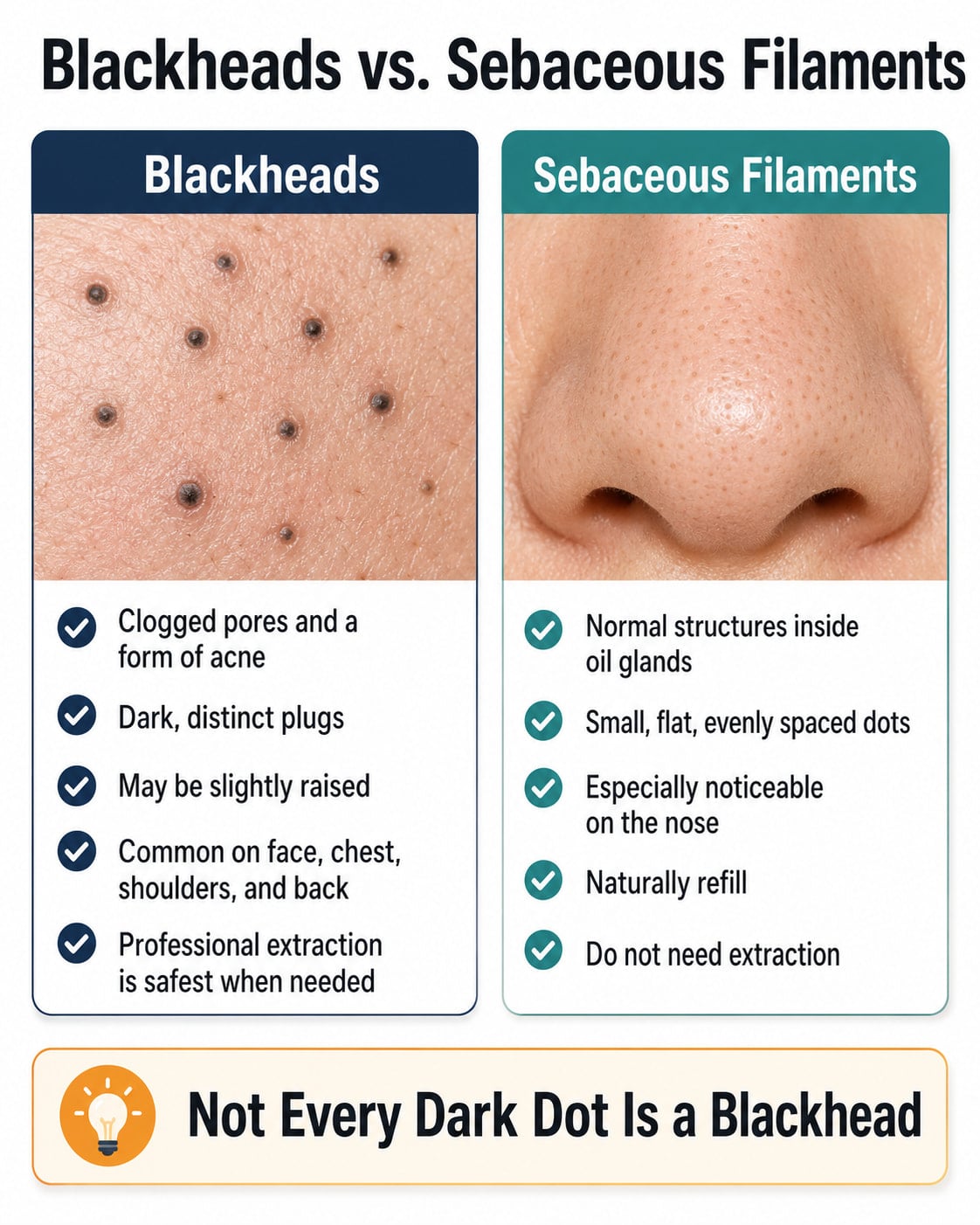
Many of the small dots on a person’s nose are actually sebaceous filaments, not blackheads. Sebaceous filaments are normal structures that help carry oil to the skin’s surface.
| Feature | Blackheads | Sebaceous filaments |
|---|---|---|
| What they are | Clogged pores and a form of acne | Normal structures inside oil glands |
| Appearance | Dark, distinct plugs that may be slightly raised | Small, flat, evenly spaced gray, yellow, or light-brown dots |
| Common locations | Face, chest, shoulders, and back | Especially noticeable on the nose, chin, forehead, and cheeks |
| Should they be extracted? | Manual extraction is best left to a dermatologist | No; they are normal and naturally refill |
| Helpful approach | Salicylic acid, adapalene, gentle skin care | Gentle cleansing and products that help control clogged pores |
Squeezing sebaceous filaments may temporarily remove some oil, but the filaments naturally refill. Repeated pressure can irritate or injure the surrounding skin.
Can You Safely Extract Blackheads at Home?
You can often clear and reduce blackheads at home, but manually forcing the plug out is not the safest method.
Professional extraction is different from squeezing in front of a mirror. A dermatologist can examine the spot, confirm that it is a blackhead, prepare the skin, and use sterilized equipment with controlled pressure. Blackheads can still return afterward, which is why an ongoing skin-care routine matters.
Cleveland Clinic’s October 2025 blackhead guidance also recommends keeping manual extraction in professional hands because attempting it incorrectly can scar the skin.
Therefore, the following step-by-step process focuses on gradually clearing the pore without puncturing or squeezing it.
How to Extract Blackheads Safely at Home: Step-by-Step
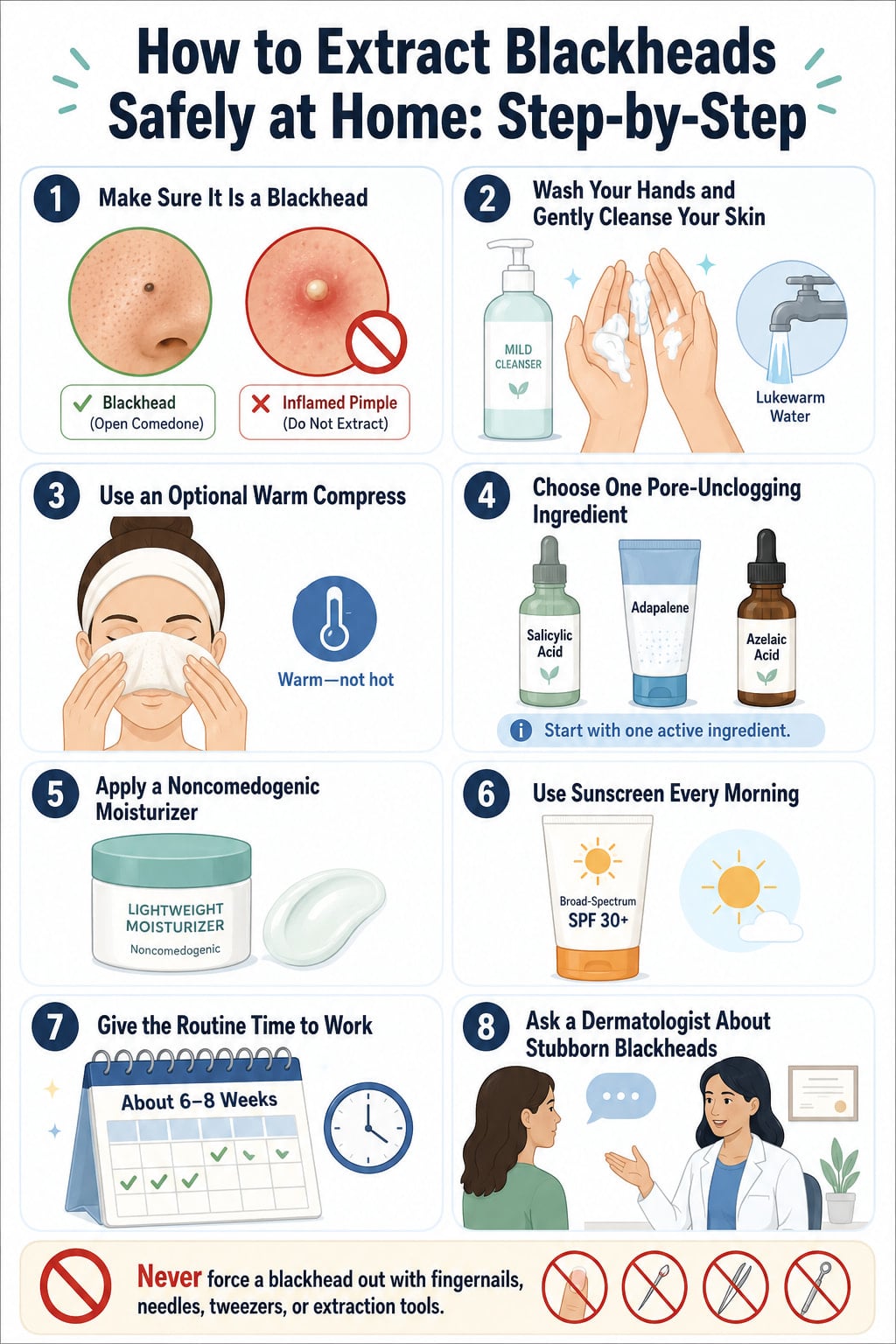
Step 1: Make Sure It Is a Blackhead
Look closely at the spot before applying anything.
A typical blackhead is:
- A small, clearly defined dark plug
- Open at the skin’s surface
- Usually not red, swollen, or painful
- Often found among other clogged pores
Do not attempt to extract a spot that is:
- Painful or tender
- Red or noticeably swollen
- Filled with pus
- Bleeding or crusted
- Deep under the skin
- Surrounded by a rash
- Located on sunburned, cut, or irritated skin
Painful, deep, or inflamed bumps may require a different approach. Pressing them can push material deeper into the skin and increase inflammation, discoloration, and scarring.
Step 2: Wash Your Hands and Gently Cleanse Your Skin
Wash your hands before touching your face. Remove makeup and sunscreen with a gentle cleanser.
Use lukewarm water rather than very hot water. Apply the cleanser with your fingertips, rinse thoroughly, and pat your face dry with a clean towel.
Avoid washcloths, cleansing brushes, rough sponges, and grainy scrubs. Dermatologists recommend gently washing acne-prone skin up to twice daily and after heavy sweating. Washing more frequently or scrubbing harder can irritate the skin.
Step 3: Use an Optional Warm Compress
A comfortably warm compress may soften surface buildup and make the skin feel more comfortable. However, it does not make squeezing risk-free, and pores do not permanently “open.”
To use a warm compress:
- Soak a clean, soft washcloth in warm—not boiling—water.
- Wring out the excess water.
- Check the temperature against your hand.
- Rest it gently over the affected area for a few minutes.
- Stop if the skin feels hot, itchy, or uncomfortable.
Do not place your face directly over boiling water. Excessive heat can cause burns or increase redness.
Skip steam and warm compresses if you have rosacea, visible broken capillaries, eczema, heat-sensitive skin, or active irritation. Cleveland Clinic advises stopping facial steaming if it feels too hot or causes irritation and notes that heat can worsen redness in people with rosacea.
Step 4: Choose One Pore-Unclogging Ingredient
After cleansing, apply one suitable product according to its label. Starting several strong products at the same time makes it difficult to identify what is helping or irritating your skin.
The 2024 American Academy of Dermatology acne-management guideline supports topical retinoids and conditionally recommends salicylic acid and azelaic acid as acne-management options.
Option A: Salicylic Acid
Salicylic acid exfoliates and helps unclog pores, making it particularly useful for blackheads and whiteheads.
For products sold as over-the-counter acne medications in the United States, the current federal OTC acne rule lists salicylic acid concentrations of 0.5% to 2%.
Salicylic acid is available in:
- Cleansers
- Gels
- Lotions
- Pads
- Leave-on liquids
Follow the product directions. If your skin becomes dry or uncomfortable, use the product less frequently and apply moisturizer. Do not assume that a higher concentration or more frequent application will produce faster results.
Option B: Adapalene
Adapalene is a topical retinoid available without a prescription in the United States. It helps unclog pores and may reduce the formation of new blackheads and whiteheads.
Apply a thin layer to the acne-prone area according to the package directions rather than placing a thick amount on one visible blackhead. Adapalene may cause dryness, peeling, or stinging when first introduced.
Do not apply adapalene to broken, sunburned, or severely irritated skin. People who are pregnant or planning a pregnancy should not use it unless specifically instructed by their healthcare professional.
Option C: Azelaic Acid
Azelaic acid may help keep pores clear and can also support a more even-looking skin tone after acne spots fade. It may be an option for someone who cannot tolerate salicylic acid or adapalene, although any active ingredient can cause irritation.
Choose a fragrance-free product when possible and introduce it gradually according to the label.
Step 5: Apply a Noncomedogenic Moisturizer
Even oily or acne-prone skin may need moisturizer. Salicylic acid and adapalene can cause dryness, peeling, or irritation, particularly during the first few weeks.
Choose a moisturizer labeled:
- Noncomedogenic
- Oil-free
- Won’t clog pores
- Fragrance-free, especially for sensitive skin
Apply it after your blackhead product or whenever your skin feels dry. Moisturizer can help the skin tolerate pore-unclogging products more comfortably.
Step 6: Use Sunscreen Every Morning
Apply a broad-spectrum, water-resistant sunscreen with SPF 30 or higher to exposed skin. Choose a product labeled noncomedogenic or “won’t clog pores.”
Sun protection is especially important when your skin is dry, peeling, or adjusting to an active ingredient. It may also help prevent acne-related dark marks from becoming more noticeable.
Step 7: Give the Routine Time to Work
A blackhead may not disappear after one application. Acne products work gradually by helping clear existing pore buildup and reducing the chance of new clogs.
Use your chosen product consistently for approximately six to eight weeks, unless it causes significant irritation. The AAD recommends giving one suitable nonprescription product time to work rather than continually switching products or adding several new ingredients.
Take a photograph once a week in similar lighting instead of inspecting and squeezing your pores every day. This makes gradual changes easier to notice.
Step 8: Ask a Dermatologist About Stubborn Blackheads
Schedule a dermatology appointment if a blackhead remains after six to eight weeks of consistent care or if you have many clogged pores.
A dermatologist may recommend:
- Professional comedone extraction
- A prescription-strength topical product
- A professionally performed chemical peel
- Another plan based on your skin type and acne pattern
During professional extraction, sterilized equipment and controlled technique are used to remove pore contents. A preventive routine is still needed because blackheads can return.
Best Ingredients for Removing and Preventing Blackheads
The most appropriate product depends on whether you mainly have blackheads, sensitive skin, inflammatory pimples, or post-acne discoloration.
| Ingredient | Most useful for | Important precautions |
|---|---|---|
| Salicylic acid | Blackheads, whiteheads, and oily clogged pores | May cause dryness or stinging; follow the product label |
| Adapalene | Existing blackheads and prevention of new clogged pores | May initially cause dryness or peeling; avoid during pregnancy |
| Azelaic acid | Clogged pores and lingering uneven tone | May sting or irritate sensitive skin |
| Benzoyl peroxide | Red or inflamed pimples occurring with blackheads | Does not directly target blackheads as well as salicylic acid or retinoids; may irritate skin and bleach fabrics |
Salicylic acid and adapalene are generally the most directly relevant options for blackheads. Benzoyl peroxide is more useful when blackheads occur alongside inflamed acne.
Should You Combine Salicylic Acid and Adapalene?
Some people eventually use salicylic acid at one time of day and adapalene at another. However, starting both together can increase dryness and make it difficult to determine which product is causing irritation.
A practical approach is to:
- Start with one active ingredient.
- Use it consistently according to the label.
- Add moisturizer and daily sunscreen.
- Allow six to eight weeks to evaluate the result.
- Ask a dermatologist before adding another strong product if your skin is sensitive.
Stop and seek medical advice if you develop marked swelling, blistering, severe burning, or a widespread rash.
Should You Use a Comedone Extractor at Home?
A comedone extractor is a metal tool with a loop designed to place pressure around a clogged pore. Although these tools are widely sold, using one correctly requires more than placing the loop over a blackhead and pressing.
Too much pressure, repeated attempts, poor positioning, or unclean equipment may injure the skin and increase the likelihood of irritation and scarring. Current guidance from both the AAD and Cleveland Clinic favors professional extraction for stubborn blackheads.
Do not use:
- Sewing needles
- Safety pins
- Lancets
- Tweezers
- Fingernails
- Sharp extractor attachments
- High-suction pore devices on irritated skin
If a plug does not clear with consistent skin care, increasing the pressure is not the solution.
Do Pore Strips Remove Blackheads?
Pore strips can remove some surface material and provide a temporary smoother appearance. However, they do not address the process that caused the pore to become clogged.
They may also remove normal sebaceous filaments rather than true blackheads. The effect is temporary because sebaceous filaments refill naturally.
Use extra caution with pore strips if your skin is:
- Sensitive or very dry
- Sunburned
- Peeling from adapalene or an exfoliating product
- Affected by eczema or rosacea
- Cut, scratched, or otherwise irritated
Cleveland Clinic notes that pore strips may temporarily clear visible congestion but can also cause dryness and irritation.
Blackhead-Removal Mistakes to Avoid
Squeezing With Your Fingernails
Fingernails apply uneven pressure and can damage the skin. Squeezing may push pore contents deeper, increase inflammation, and raise the risk of scars and dark marks.
Scrubbing Until the Dots Disappear
Blackheads are not dirt. Rough scrubbing will not wash away the dark plug and may weaken the skin barrier.
Use a mild cleanser and your fingertips instead of a stiff brush, rough washcloth, salt scrub, or sugar scrub.
Using Toothpaste
Toothpaste is designed for teeth, not facial skin. Its abrasives, whitening agents, flavorings, and other ingredients may irritate skin without addressing clogged pores.
Applying Rubbing Alcohol or Harsh Astringents
Drying the skin aggressively does not solve the underlying pore blockage. Alcohol-based products and harsh astringents may increase dryness and irritation.
Starting Several Acids and Scrubs Together
Using salicylic acid, glycolic acid, adapalene, a scrub, and a peel in the same routine may overwhelm the skin. Introduce one active ingredient at a time.
Using Very Hot Steam
Hot steam can irritate the skin or cause a burn. It may also aggravate rosacea, eczema, sensitivity, and visible facial redness.
Extracting the Same Spot Repeatedly
If a plug does not release, stop touching it. Repeated pressure is a sign that the spot needs more time or professional evaluation.
How to Prevent Blackheads From Returning
Removing a visible plug does not prevent another one from forming. A consistent routine is more useful than occasional aggressive extraction.
Helpful habits include:
- Wash gently up to twice daily and after sweating.
- Remove makeup before going to bed.
- Continue using one suitable pore-unclogging ingredient.
- Use noncomedogenic skin care, sunscreen, and makeup.
- Keep oily hair and heavy hair products away from the face.
- Avoid touching, picking, and squeezing your pores.
- Moisturize when your skin feels dry.
- Avoid switching products every few days.
The AAD’s acne skin-care recommendations emphasize gentle cleansing, consistent product use, noncomedogenic sunscreen, and keeping hands away from acne-prone skin.
Blackhead Products During Pregnancy or Breastfeeding
Skin-care safety may change during pregnancy.
Most experts recommend stopping adapalene during pregnancy. The AAD states that limited salicylic acid use is generally considered acceptable during pregnancy, but recommends discussing it with an obstetrician or dermatologist first. Azelaic acid is considered a possible option, but individual medical guidance remains important.
Review the AAD’s pregnancy and acne-product guidance before using an active ingredient while pregnant. Breastfeeding individuals should also ask a healthcare professional where and how a product can be applied.
When to See a Dermatologist
Consider professional care when:
- Blackheads do not improve after six to eight weeks.
- You have widespread clogged pores or frequent breakouts.
- The bumps are painful, deep, swollen, or pus-filled.
- Picking has caused bleeding, scars, or dark marks.
- Your skin burns or peels significantly after using a product.
- You have eczema, rosacea, or highly reactive skin.
- You cannot tell whether the spots are blackheads or sebaceous filaments.
- You are pregnant, breastfeeding, or planning a pregnancy.
- Acne is affecting your confidence or emotional well-being.
A dermatologist can confirm what type of acne you have and create a plan that fits your skin sensitivity, other health conditions, and current products.
Frequently Asked Questions
Is It Safe to Squeeze Blackheads With Your Fingers?
No manual squeezing method is completely risk-free. Fingernails can injure the skin, and pressure may increase inflammation, discoloration, and scarring. Use a pore-unclogging ingredient or ask a dermatologist about professional extraction.
How Long Does Salicylic Acid Take to Improve Blackheads?
Some people notice gradual changes within several weeks. Give one suitable product approximately six to eight weeks before deciding that it is not helping, unless it causes significant irritation.
Does Steaming Your Face Open Your Pores?
Steam may temporarily soften skin and surface buildup, but it does not permanently open pores or make squeezing safe. Avoid excessive heat, and skip steaming if you have rosacea, broken capillaries, eczema, or very sensitive skin.
Are Nose Pore Strips Good for Blackheads?
Cleveland Clinic notes that pore strips may temporarily remove surface material, but they do not prevent pores from becoming clogged again. They can also remove sebaceous filaments and may cause irritation or dryness.
Can I Use Salicylic Acid and Adapalene Together?
Some people can use both, but introducing them at the same time may cause dryness or irritation. Start with one product, follow its label, use moisturizer, and consider professional advice before combining strong active ingredients.
Why Do the Dots on My Nose Keep Coming Back?
They may be sebaceous filaments rather than blackheads. Sebaceous filaments are normal structures that transport oil to the skin’s surface, so they naturally refill after being squeezed or removed.
When Should a Blackhead Be Professionally Extracted?
Professional extraction may be appropriate when a confirmed blackhead remains after six to eight weeks of consistent care, when many clogged pores are present, or when home attempts have caused irritation. A dermatologist uses sterilized equipment and controlled technique.
Conclusion
Learning how to extract blackheads safely starts with resisting the urge to squeeze them. Cleanse gently, choose one pore-unclogging ingredient such as salicylic acid or adapalene, moisturize, apply sunscreen, and give the routine six to eight weeks.
Do not use needles, fingernails, or force when a blackhead remains in place. A dermatologist can safely evaluate and professionally extract stubborn plugs while helping you prevent them from returning.
Start with one simple, consistent routine today rather than trying to remove every visible pore in one session.
This content is for informational purposes only and not medical advice.
References
- American Academy of Dermatology: Acne extraction and the risks of squeezing
- American Academy of Dermatology: Updated acne-management guidelines
- American Academy of Dermatology: Nonprescription products for adult acne
- Electronic Code of Federal Regulations: OTC acne active ingredients
- Cleveland Clinic: How to get rid of blackheads
- Cleveland Clinic: Blackheads vs. sebaceous filaments