
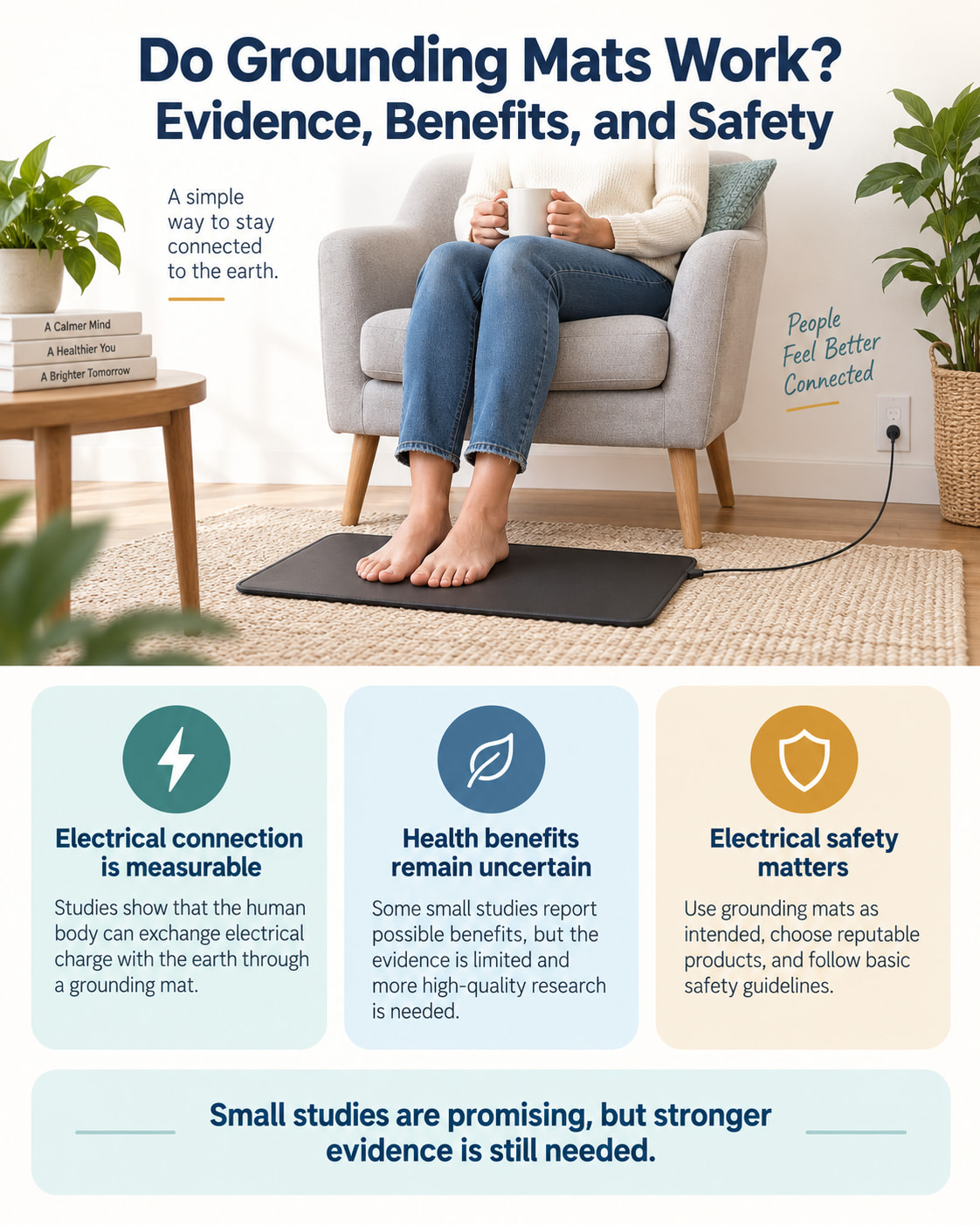
Do grounding mats work? Grounding mats can electrically connect your body to the earth, but reliable health benefits have not been established. Small studies suggest possible benefits, particularly for sleep, without providing enough evidence to promise results. Electrical activity and meaningful improvements in health are different outcomes.
Understanding that difference can help you evaluate the claims before spending money. The key is to look beyond testimonials, consider what researchers actually measured, and check electrical safety before using an outlet-connected product.
What Is a Grounding Mat?
A grounding mat, also called an earthing mat, is a conductive surface designed to connect your body to the earth through a grounding system. Indoor versions commonly use a cord connected to the grounding connection of a properly grounded electrical outlet. Related products include grounding sheets, mattress pads, and conductive patches.
Supporters propose that this connection allows electrons from the earth to influence processes involving oxidative stress and inflammation. However, this proposed biological mechanism remains a hypothesis—not a confirmed explanation for better health.
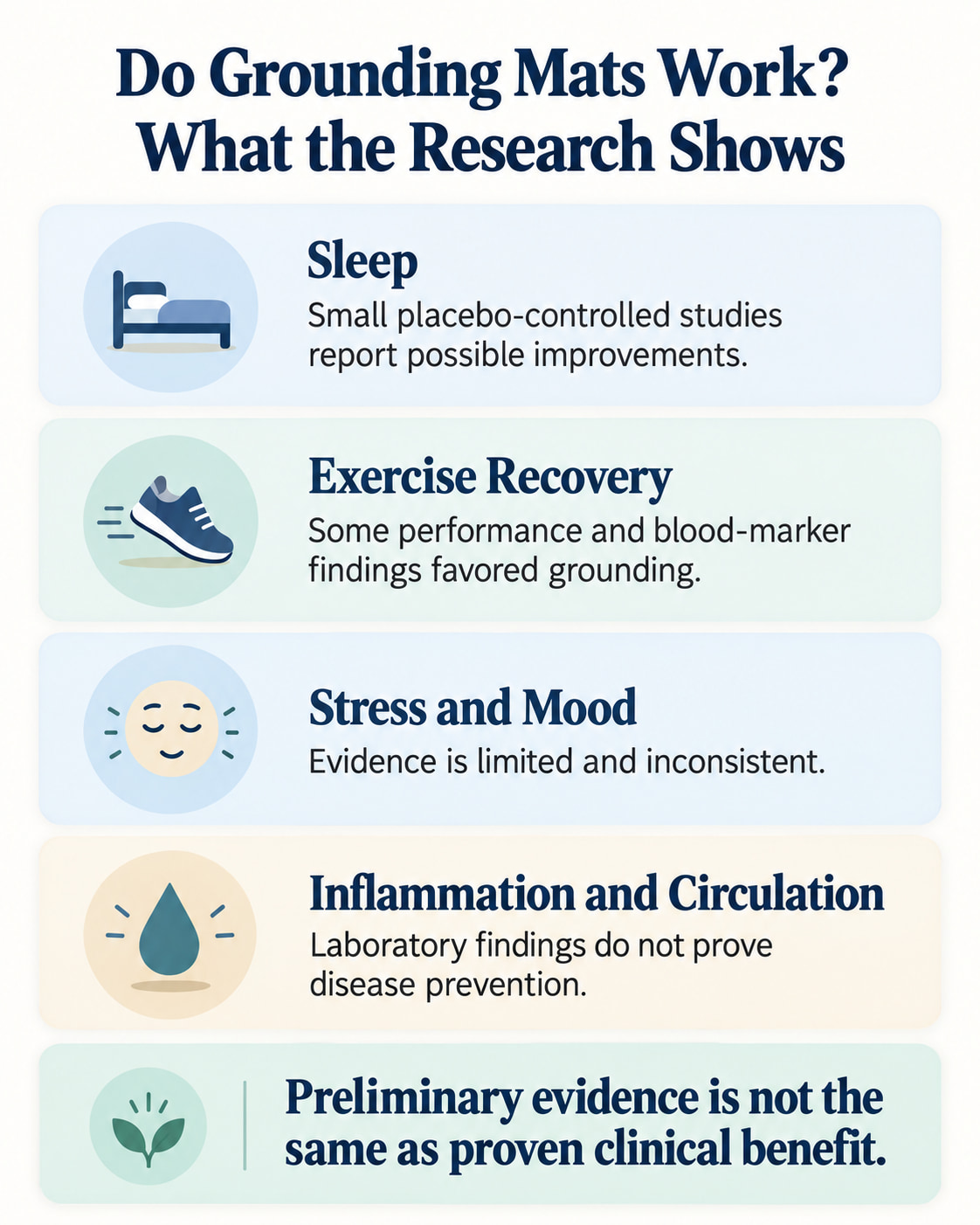
Do Grounding Mats Work? What the Research Shows
The answer depends on what you expect a mat to do.
An electrical study published in 2014 measured very small currents between grounded participants and the earth. That demonstrates an electrical phenomenon, but the experiment did not establish benefits for sleep, pain, or disease prevention.
Human health studies provide some preliminary findings, but their results need to be interpreted individually.
Sleep Quality and Insomnia
A 2025 randomized, double-blind, placebo-controlled study in Advances in Integrative Medicine assigned 60 participants to grounded or non-grounded mats for 6 hours daily over 31 days.
The published abstract reports longer sleep time, estimated using an activity-monitoring device, in the grounding group compared with the control group. It also reports a better insomnia-severity score at follow-up.
However, several other improvements were comparisons with participants’ own starting scores, not demonstrated advantages over placebo. The available abstract does not establish how meaningful the differences would be in everyday life.
A separate 2022 placebo-controlled pilot study enrolled 22 people with mild Alzheimer’s disease, but only 15 completed the 12-week intervention and assessment. Sleep-quality scores favored grounding. The small sample, dropout, and specialized population limit how broadly the findings apply. The study does not demonstrate improved memory or slower disease progression.
Takeaway: Sleep findings justify further investigation, but they do not establish grounding mats as a dependable solution for insomnia.
Pain and Exercise Recovery
A 2019 randomized study followed 22 healthy participants during 10 days of recovery after demanding downhill running. Participants used grounded or sham-grounded sleeping conditions.
Some performance measures and changes in creatine kinase, a blood marker associated with muscle damage, favored grounding. However, muscle-soreness ratings did not show a statistically significant advantage over sham grounding. Detailed inflammatory-marker testing involved only four participants.
These findings cannot establish that a desk mat relieves everyday back pain, joint pain, or nerve pain. They concern a particular exercise challenge and an overnight grounding setup—not every product or pain condition.
Stress, Anxiety, and Mood
The 2022 Alzheimer’s pilot did not find significant improvements in anxiety or depression scores compared with sham grounding. This matters because improved sleep scores should not be presented as proof of broader mental health benefits.
Likewise, the 2025 study’s abstract describes reduced stress compared with participants’ own baseline. That is not equivalent to showing that grounding clearly outperformed placebo for stress.
A person may feel calmer while using a mat. That experience does not, by itself, identify whether the electrical connection, expectations, or a change in routine caused the improvement.
Inflammation and Circulation
A 2013 study examined 10 healthy adults before and after a two-hour grounding session. Researchers reported changes in red-blood-cell electrical properties and reduced cell aggregation, or clumping. Participants used conductive patches rather than an ordinary desk mat.
These laboratory findings do not demonstrate fewer heart attacks, strokes, or blood clots. They also do not establish grounding as an alternative to prescribed anticoagulants.
Similarly, exploratory changes in inflammatory markers do not establish that grounding mats reliably reduce harmful inflammation throughout the body. The four-person blood-testing subgroup in the exercise-recovery study is far too limited to support that conclusion.
Why the Evidence Is Still Limited
The problem is not that grounding has never been studied. It is that promising observations have not yet become a strong, consistent body of clinical evidence.
Small Studies Leave Important Questions Unanswered
The trials discussed above involved small groups and relatively short observation periods. They provide limited information about long-term benefits, uncommon adverse effects, or which people might benefit most. Findings in people with mild Alzheimer’s disease also cannot automatically be applied to otherwise healthy adults.
A Better Score Does Not Always Mean a Proven Benefit
A study may find improvement after an intervention without showing that the intervention caused it.
For example, imagine that someone starts using a grounding mat while also keeping a more consistent bedtime. Better sleep afterward would not tell us which change mattered. This is an illustrative example, not a reported study result.
Comparisons with an inactive or sham product help address that uncertainty. That is why the difference between “better than before” and “better than placebo” matters when reading research.
Commercial Relationships Deserve Attention
The authors of a 2015 grounding hypothesis paper disclosed contractor relationships with EarthFx, a company sponsoring earthing research; two also disclosed share ownership. Such relationships do not automatically invalidate a paper, but they make independent confirmation particularly important.
Not every study reports those relationships. For example, the 2019 exercise-recovery paper declared no commercial or financial conflicts of interest. Research should be assessed study by study rather than dismissed—or accepted—as a group.
Are Grounding Mats Safe?
Do not assume an outlet-connected mat is risk-free because it is marketed as natural. Product condition, wiring, and the circumstances of use all matter.
Have the Electrical Setup Checked
Cleveland Clinic’s earthing guidance notes that faulty wiring can create shock risks and discusses having an electrician check the outlet intended for a grounding device.
Follow the product’s instructions, and leave electrical alterations to a qualified professional. Do not improvise connections or use damaged cords and plugs.
General electrical-safety guidance from the Canadian Centre for Occupational Health and Safety also recommends inspecting equipment for damage, keeping cords clear of walking routes, and avoiding outlets with exposed wiring. Unusually warm outlets or cords require attention from an electrician.
Avoid Use During Thunderstorms
Do not use an outlet-connected grounding mat during a thunderstorm.
The CDC’s lightning safety guidance explains that lightning can travel through electrical systems and advises against using anything connected to an electrical outlet during a storm. Being indoors does not eliminate risks from contact with wired equipment.
Stop if Use Causes Unpleasant Symptoms
Do not interpret feeling unwell or an unpleasant sensation as proof that the mat is working. Cleveland Clinic advises stopping when indoor earthing products feel unpleasant or use is associated with flu-like symptoms. Do not push through symptoms as a supposed “detox” response.
Use Extra Caution With Reduced Sensation
People with nerve damage or reduced sensation may not readily notice an electrical burn or shock from a faulty mat. Discuss this risk with a healthcare professional before use.
Small, short-term studies also cannot establish safety for every medical condition or every commercial product. A mat used in one research setting is not a blanket safety endorsement.
How Can You Tell Whether a Grounding Mat Is Working?
Separate electrical function from health effects.
An electrical measurement may provide information about a grounding connection. It does not measure whether inflammation has decreased, sleep has improved, or a medical condition has changed. Electrical research and clinical research answer different questions.
For personal observation, keep the question specific. Rather than asking, “Do I feel healthier?”, record something relevant to your goal, such as your sleep schedule, nighttime awakenings, or daytime sleepiness.
Also note other changes made at the same time. This can make your observations more useful, although a personal log cannot establish cause and effect or replace medical assessment.
Do not use a sensation, a meter reading, or a testimonial as proof of a health benefit.
Are Grounding Mats Worth Trying?
Grounding mats should be viewed as an unproven wellness accessory, not an essential health purchase. The small studies available do not justify expecting dependable results across different products and health concerns.
Before buying one, consider three questions:
- What problem are you trying to address? Persistent symptoms deserve an appropriate assessment rather than repeated product experiments.
- Would the purchase still feel worthwhile with no noticeable benefit? Make the decision around uncertainty, not a guaranteed outcome.
- Can you follow the electrical precautions? An uncertain benefit is not a reason to accept an unsafe setup.
For sleep concerns, prioritize established guidance. The NHLBI’s insomnia guidance recommends a sleep-friendly bedroom, consistent sleep and wake times, and avoiding caffeine near bedtime. It identifies cognitive behavioral therapy for insomnia, or CBT-I, as the usual first option for long-term insomnia.
Skipping a grounding mat is a reasonable choice. Buying one is not a necessary step toward better sleep.
When to Talk With a Healthcare Professional
Seek an assessment when sleep problems persist or interfere with daytime functioning. Loud snoring, gasping during sleep, witnessed breathing pauses, and excessive daytime sleepiness are symptoms that warrant discussion with a healthcare professional because they can occur with sleep apnea.
For long-term insomnia, ask about CBT-I and whether medications, habits, or other health conditions may be contributing. A clinician can help identify options appropriate to your situation.
Do not change prescribed medication based on grounding claims or laboratory findings from a small study. In particular, the blood-cell experiment did not test whether grounding could safely replace anticoagulant medication.
Frequently Asked Questions
Is There Scientific Evidence That Grounding Mats Work?
There are published studies, including placebo-controlled trials, but the evidence remains preliminary. Small positive studies are not the same as consistent proof that grounding mats produce meaningful benefits for most users.
How Long Does It Take for a Grounding Mat to Work?
There is no established timeframe for a health benefit. A study’s usage schedule does not tell us when an individual should expect results, nor does it establish an ideal daily duration. More use should not be assumed to produce better results.
Can You Sleep on a Grounding Mat All Night?
Overnight grounding has been studied, but that does not establish universal safety or an optimal exposure time. Only consider overnight use for a product specifically intended for it, follow its instructions, and apply the electrical and storm precautions described above.
Does Tingling Mean a Grounding Mat Is Working?
Tingling is not proof of a beneficial effect. Do not use an unpleasant sensation as a reason to continue. Stop using the product and have concerns about the mat or its electrical setup checked.
Does a Grounding-Mat Tester Prove Health Benefits?
No. An electrical test concerns the connection or electrical behavior of the setup. It cannot establish improved sleep, reduced pain, or disease prevention. Those claims require evidence from studies measuring the relevant health outcomes.
Are Grounding Mats the Same as Grounding Exercises for Anxiety?
No. Psychological grounding exercises use attention, the senses, or mental tasks to refocus on the present. They do not require an electrical connection or a grounding mat. The shared word can make two different practices sound interchangeable.
Conclusion
Grounding mats have an electrical basis and some preliminary clinical findings, but their health benefits remain uncertain. They should not be presented as a proven answer to insomnia, pain, inflammation, or circulation concerns.
Start with the problem you want to address—not the product. Review established options, seek help for persistent symptoms, and check electrical safety before considering an outlet-connected mat.
This content is for informational purposes only and not medical advice.
References
- Park, H. J., et al. (2025). A randomized, double-blind, placebo-controlled study on the improvement of sleep quality with Earthing mat. Advances in Integrative Medicine, 12(3), 100458. Published abstract and bibliographic record.
- Lin, C. H., et al. (2022). Grounding the Body Improves Sleep Quality in Patients with Mild Alzheimer’s Disease: A Pilot Study. Healthcare, 10(3), 581.
- Müller, E., et al. (2019). Effectiveness of Grounded Sleeping on Recovery After Intensive Eccentric Muscle Loading. Frontiers in Physiology, 10, 35.
- Chevalier, G., et al. (2013). Earthing (grounding) the human body reduces blood viscosity—a major factor in cardiovascular disease. Journal of Alternative and Complementary Medicine, 19(2), 102–110.
- Chamberlin, K., et al. (2014). Analysis of the charge exchange between the human body and ground: Evaluation of “earthing” from an electrical perspective. Journal of Chiropractic Medicine, 13(4), 239–246.
- Oschman, J. L., Chevalier, G., and Brown, R. (2015). Hypothesis paper on grounding, inflammation, and immune responses. Journal of Inflammation Research, 8, 83–96.
- Centers for Disease Control and Prevention. Safety Guidelines: Lightning.
- Canadian Centre for Occupational Health and Safety. (2025). Electrical Safety—Basic Information.