
Ashwagandha for sleep may help some adults sleep a little better in the short term, especially people with insomnia, but it is not a guaranteed fix and it is not risk-free.
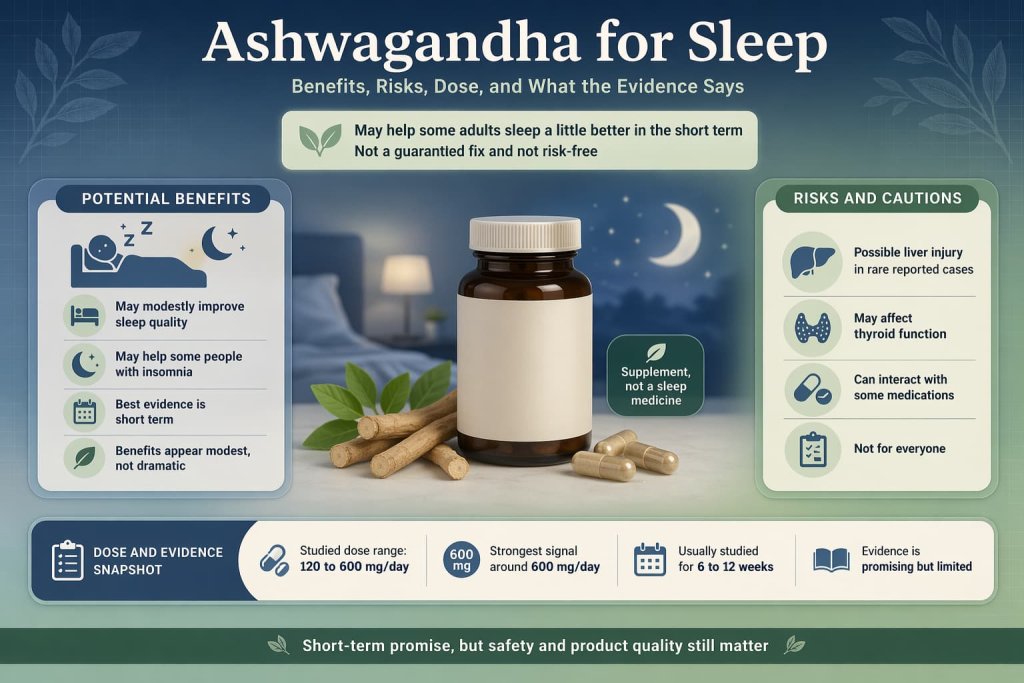
That matters because many people treat it like a simple natural sleep aid, even though the strongest official summaries say the evidence is still limited, products vary widely, and important safety concerns include liver injury, thyroid effects, and medication interactions.
The safest way to think about it is as a supplement with some promising but modest research behind it, not as a proven replacement for standard insomnia care. The NIH Office of Dietary Supplements provides one of the clearest official summaries of the current evidence.
Does Ashwagandha Help You Sleep?
The current research points to a possible benefit, but not a dramatic one. According to the NIH Office of Dietary Supplements, a 2021 systematic review and meta-analysis looked at five clinical trials involving 372 adults who took ashwagandha or placebo for 6 to 12 weeks.
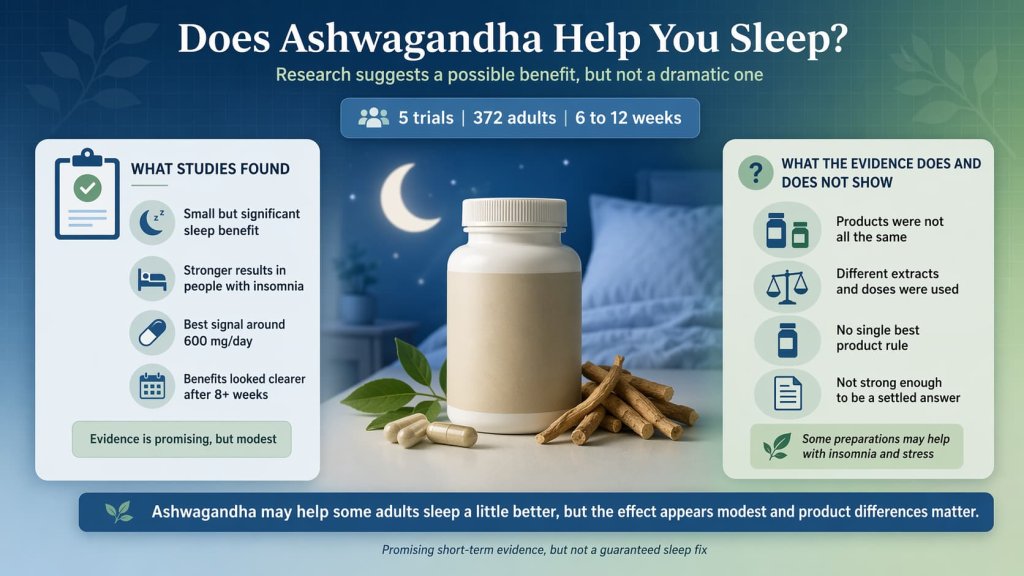
Overall, ashwagandha had a small but statistically significant effect on sleep, and the benefit looked stronger in people with insomnia, with doses around 600 mg per day, and with use for at least 8 weeks.
That does not mean every ashwagandha product works the same way. The same NIH summary points out that studies used different extracts, different standardization methods, and different doses, which makes it hard to turn the research into one simple best product or best dose rule.
The National Center for Complementary and Integrative Health reaches a similar conclusion, saying that some preparations may be effective for insomnia and stress, but the evidence is still not strong enough to treat ashwagandha like a settled answer for everyone.
What Sleep Changes Were Seen in Studies?
In the better-known trials summarized by NIH, people taking ashwagandha showed improvements in measures such as:
- sleep quality
- sleep efficiency
- total sleep time
- sleep onset latency, which means how long it takes to fall asleep
- mental alertness on rising in some groups
The strongest signals were seen in adults with insomnia rather than in people who already slept fairly well. That is a useful reality check because it suggests ashwagandha may be more relevant for people with actual sleep complaints than for someone expecting a strong sedating effect from a single bedtime dose.
Ashwagandha for Sleep Dose: What Studies Actually Used
The research does not support one universal dose for everyone. The NIH Office of Dietary Supplements reports that sleep studies used products ranging from about 120 mg to 600 mg per day for 6 to 12 weeks, including both root extract products and one root-and-leaf extract product.
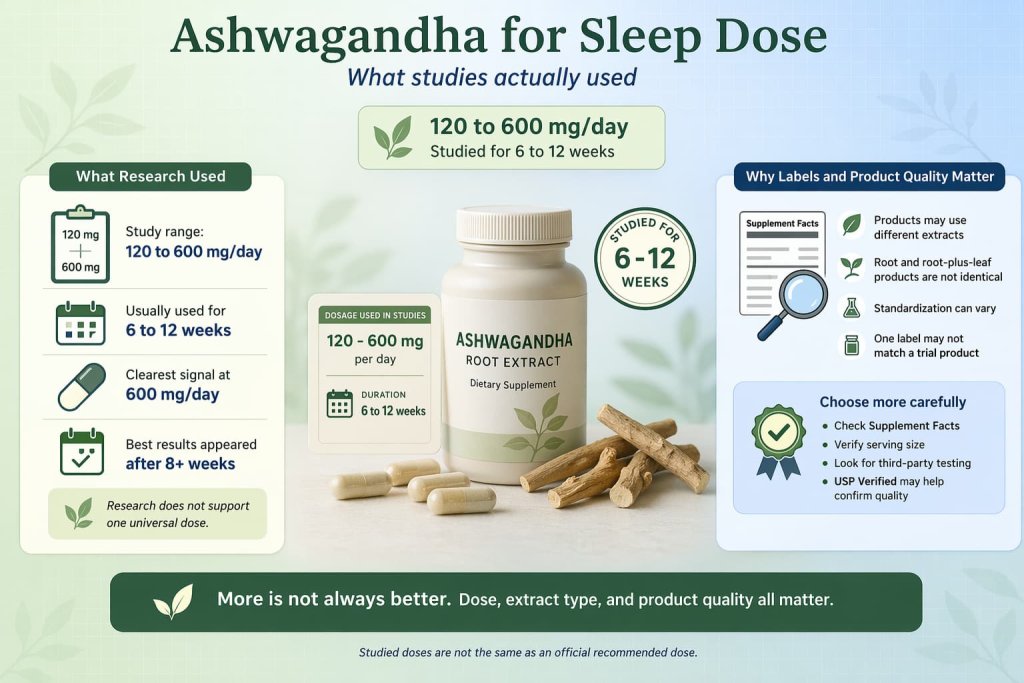
The same source says the clearest benefit signal appeared when the dose was 600 mg per day and the treatment period lasted at least 8 weeks.
That said, this is not the same as an official recommended dose. Because products can differ by extract type, plant part, and standardization, the amount on one label may not reflect the same product profile used in a clinical trial.
Because ashwagandha products vary so much, product quality matters almost as much as dose. When possible, choose a supplement with a clear Supplement Facts panel and independent third-party testing.
NIH resources on label reading and the National Institute on Aging’s guidance on dietary supplements note that seals such as USP Verified can help confirm identity, quality, strength, and purity, but they do not prove that a product will help you sleep.
A practical approach is to read the Supplement Facts panel carefully, verify the serving size, and avoid assuming that more means better, especially because FDA does not set a general legal maximum amount of an herbal ingredient per serving and does not approve supplements before they are marketed.
Who May Benefit Most From Ashwagandha for Sleep?
Based on the available trials, ashwagandha seems most promising for:
- adults with insomnia or ongoing sleep difficulty
- adults whose sleep problems overlap with stress
- people looking for a short-term supplement approach rather than a prescription sleep medicine
Even in those groups, the benefit appears modest, not dramatic. If you have chronic insomnia, the better-supported first step is still American College of Physicians guidance on CBT-I, which recommends cognitive behavioral therapy for insomnia as first-line treatment for adults with chronic insomnia.
Common Side Effects of Ashwagandha
Short-term use appears reasonably well tolerated for many adults, but mild side effects are not rare. According to NCCIH and NIH, the most commonly reported side effects include:
- drowsiness
- stomach upset
- loose stools or diarrhea
- nausea
- vomiting
These effects may be easy to dismiss, but they matter more when you are already taking other products that cause sleepiness or when digestive side effects disrupt sleep instead of helping it.
Serious Ashwagandha Risks to Know Before Using It for Sleep
The two most important safety concerns in official summaries are liver injury and thyroid effects.
The NIH LiverTox monograph on ashwagandha says ashwagandha has been linked to clinically apparent liver injury in case reports. The NIH supplement fact sheet adds that reported cases have included symptoms such as jaundice, itching, nausea, lethargy, abdominal discomfort, and high bilirubin. Most reported cases improved after the supplement was stopped, but this is still a real safety issue, not just a theoretical warning.
NIH also says ashwagandha might affect thyroid function. In the evidence summarized by NIH, some studies found changes in thyroid hormone levels, and case reports have described thyrotoxicosis in some users. That does not prove the same risk for every product or every person, but it is enough reason for people with thyroid disease or thyroid medication use to be cautious.
Another important limitation is time. NCCIH says ashwagandha may be safe in the short term, up to about 3 months, but there is not enough information to judge its long-term safety. So even if a product seems to help, that is not the same as having strong evidence that nightly use over many months or years is well studied.
Who Should Avoid Ashwagandha or Talk to a Clinician First?
According to NCCIH, ashwagandha should be avoided during pregnancy and should not be used while breastfeeding. NCCIH also says it is not recommended for people who are about to have surgery or for people with autoimmune or thyroid disorders.
In addition, it may interact with diabetes medicines, blood pressure medicines, immunosuppressants, sedatives, anticonvulsants, and thyroid hormone medications.
NCCIH also says people with hormone-sensitive prostate cancer should avoid ashwagandha because it may increase testosterone levels. This is worth mentioning clearly because ashwagandha is often marketed to men for stress, sleep, and performance, which can make that caution easy to overlook.
A more recent safety opinion from ANSES, France’s food safety agency, goes further. In its 2024 opinion, ANSES recommended that people with thyroid, liver, or heart disorders, pregnant women, people using sedative or other central nervous system depressant medicines, and people under 18 avoid ashwagandha supplements because of safety concerns and insufficient data to identify a safe intake level.
A Quick Safety Checklist
Get medical advice before using ashwagandha for sleep if you:
- are pregnant or breastfeeding
- are under 18
- have thyroid, liver, heart, autoimmune disease, or hormone-sensitive prostate cancer
- take sedatives, seizure medicines, thyroid medicine, diabetes medicine, blood pressure medicine, or immunosuppressants
- are preparing for surgery
- have had unexplained jaundice or other liver problems in the past
These cautions are much more important than the marketing language on the front of a supplement bottle.
How to Use Ashwagandha for Sleep More Carefully
If you are considering ashwagandha for sleep, a safer common-sense approach looks like this:
- read the Supplement Facts panel and serving size carefully
- compare the exact milligrams per serving, not just the front-label claims
- check whether the product specifies root extract or root-and-leaf extract
- do not combine it casually with sedatives or other sleep supplements
- tell your doctor or pharmacist what you are taking
- stop using it and seek medical advice if you develop yellowing of the skin or eyes, unusual itching, dark urine, severe nausea, or other concerning symptoms
FDA advises consumers to talk with a healthcare professional before using a dietary supplement and to read the label carefully. For sleep itself, the CDC’s sleep health guidance also notes that keeping a sleep diary that tracks bedtime, nighttime awakenings, naps, exercise, alcohol or caffeine intake, and medications can help you understand what is actually affecting your sleep.
Better-Proven Options if Your Insomnia Keeps Coming Back
If your sleep problem is chronic, ashwagandha should not be your main plan. The American College of Physicians recommends CBT-I as first-line treatment for adults with chronic insomnia. CBT-I focuses on sleep habits, stimulus control, sleep restriction, and thoughts around sleep, and it has much stronger clinical guideline support than most supplements.
If your sleep trouble happens at least 3 nights a week, lasts 3 months or longer, or is affecting your daytime function, it is a good idea to get evaluated instead of relying on supplements alone.
That pattern may fit chronic insomnia, and a clinician can also look for other sleep disorders or medical issues that a supplement will not address. The National Heart, Lung, and Blood Institute explains how chronic insomnia is evaluated and when a fuller workup may be needed.
Basic sleep tracking also matters. CDC encourages paying attention to factors such as caffeine, alcohol, medications, exercise, naps, and sleep timing because these often have a direct effect on sleep quality. That kind of simple pattern tracking can sometimes explain more than a supplement can.
FAQ About Ashwagandha for Sleep
How Long Does Ashwagandha Take to Work for Sleep?
In the studies summarized by NIH, people typically used ashwagandha for 6 to 12 weeks, and the benefits looked more noticeable at 8 weeks or longer. It is not well supported as a one-night, instant sleep fix.
Can You Take Ashwagandha Every Night?
Some official sources say short-term use, up to about 3 months, appears reasonably safe for many adults, but there is not enough evidence to know that long-term nightly use is safe. That is why ongoing use should be discussed with a healthcare professional, especially if you take medications or have a medical condition.
Is Ashwagandha a Sleeping Pill?
No. It is a dietary supplement, not an FDA-approved insomnia medication. The current evidence suggests it may offer modest support for sleep in some adults, but it should not be treated like a proven replacement for guideline-based insomnia care.
Final Thoughts on Ashwagandha for Sleep
Ashwagandha for sleep is promising enough to be worth a careful look, but not strong enough to be treated like a guaranteed answer. The best current summary is that it may modestly improve sleep in some adults, especially people with insomnia, when used consistently for several weeks.
At the same time, product variation, limited long-term safety data, and real concerns about liver injury, thyroid effects, and drug interactions mean it deserves more caution than most natural sleep aid marketing suggests. If you are thinking about trying it, start by checking the label, reviewing your medications, and talking with a healthcare professional if there is any reason you might be in a higher-risk group.
This content is for informational purposes only and not medical advice.
References
- National Library of Medicine, LiverTox — Ashwagandha
- U.S. Food and Drug Administration — Questions and Answers on Dietary Supplements
- American College of Physicians — ACP Recommends Cognitive Behavioral Therapy as Initial Treatment for Chronic Insomnia
- National Institute on Aging — Dietary Supplements for Older Adults
- National Heart, Lung, and Blood Institute — Insomnia Diagnosis
- ANSES — Opinion on the risks associated with the use of Withania somnifera preparations in food supplements