
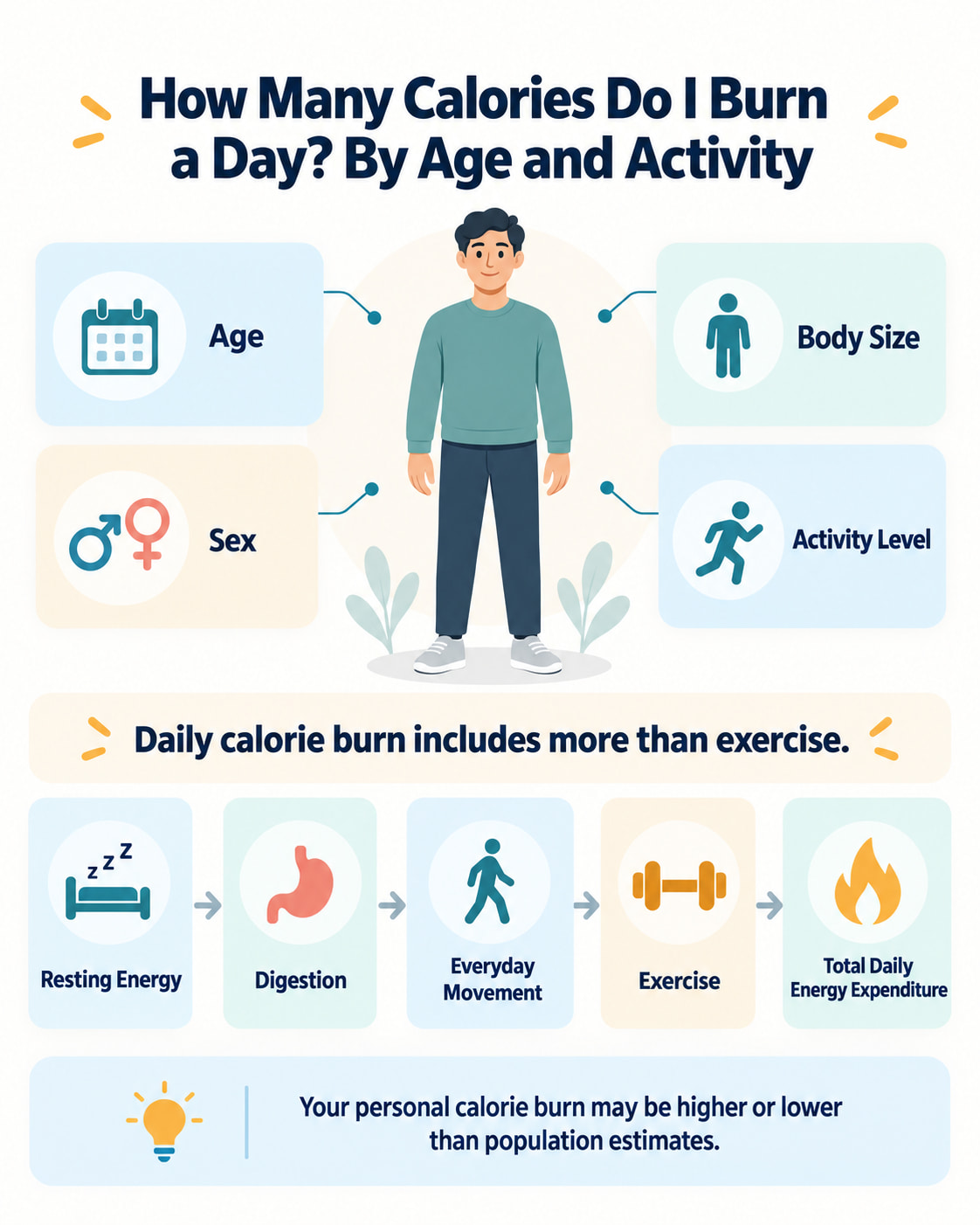
The adult reference estimates below range from about 1,700 to 3,500 calories burned per day, but your personal total depends on your age, body size, sex, and activity level—and may fall outside that range. Answering “how many calories do I burn a day” means estimating your whole-day energy use, not just the calories you burn during exercise.
Understanding that difference helps you interpret calorie calculators, fitness trackers, and maintenance estimates. Start with the age-and-activity tables, then use your own measurements and usual activity to get a more personalized estimate.
How Many Calories Do I Burn a Day by Age and Activity?
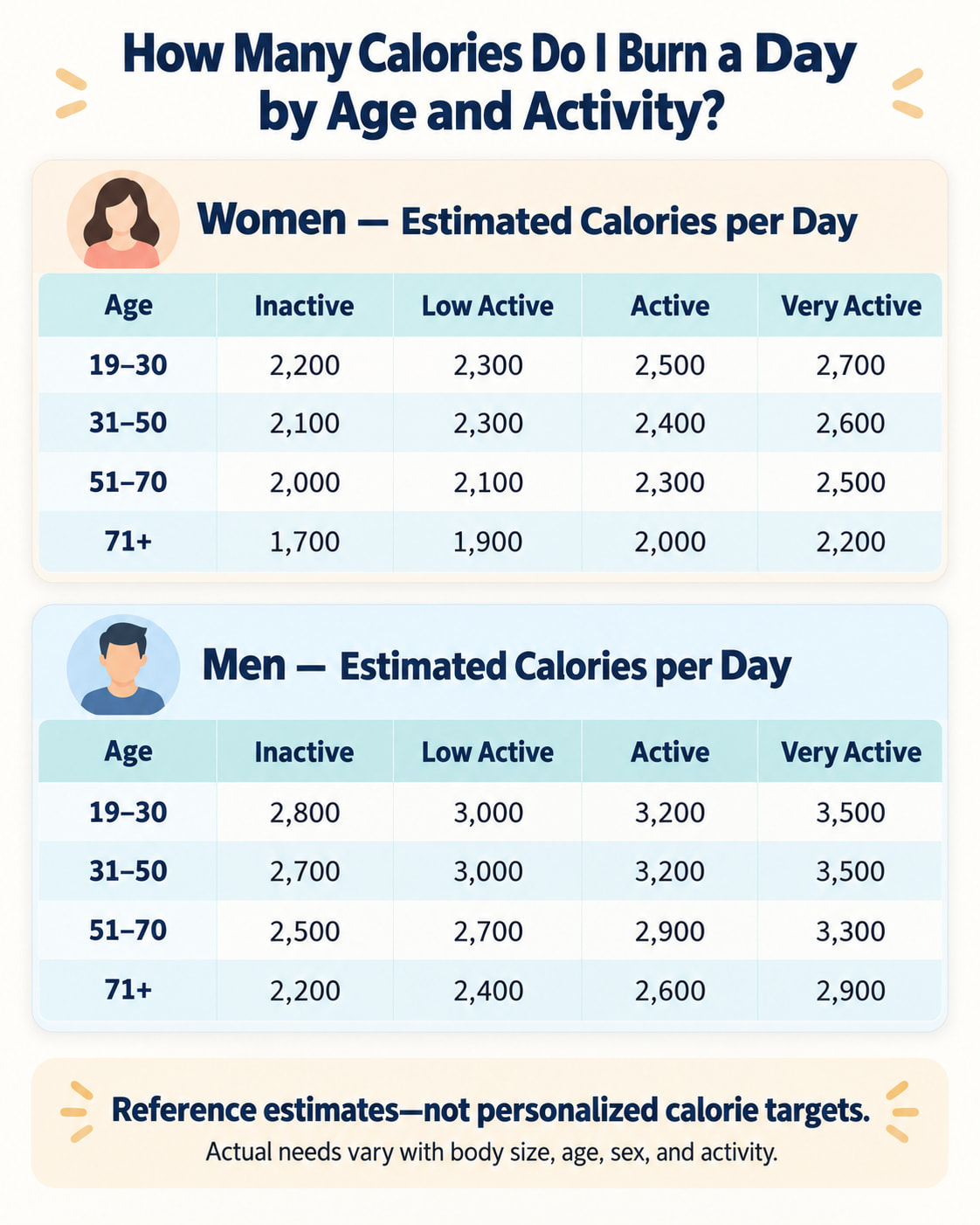
The following tables use reference estimates from the National Academies’ 2023 Dietary Reference Intakes for Energy. For weight-stable adults who are not pregnant or breastfeeding, estimated energy requirements can be used to estimate total daily energy expenditure.
All values are calories per day, rounded to the nearest 100. They include resting energy use, digestion, and activity—not exercise alone.
Estimated Daily Calories for Women
| Age | Inactive | Low active | Active | Very active |
|---|---|---|---|---|
| 19–30 | 2,200 | 2,300 | 2,500 | 2,700 |
| 31–50 | 2,100 | 2,300 | 2,400 | 2,600 |
| 51–70 | 2,000 | 2,100 | 2,300 | 2,500 |
| 71 and older | 1,700 | 1,900 | 2,000 | 2,200 |
Source: National Academies’ reference estimates for adult U.S. women.
Estimated Daily Calories for Men
| Age | Inactive | Low active | Active | Very active |
|---|---|---|---|---|
| 19–30 | 2,800 | 3,000 | 3,200 | 3,500 |
| 31–50 | 2,700 | 3,000 | 3,200 | 3,500 |
| 51–70 | 2,500 | 2,700 | 2,900 | 3,300 |
| 71 and older | 2,200 | 2,400 | 2,600 | 2,900 |
Source: National Academies’ reference estimates for adult U.S. men.
Important: These calculations use median U.S. heights and weights from 2015–2018 survey data. They use representative ages of 25, 40, 60, and 80 within the four age groups. Because body size also differs between rows, the differences do not show the effect of aging alone. These are reference profiles, not recommended body weights or personalized eating targets.
What the Activity Categories Mean
“Inactive” still includes basic daily living, along with resting metabolism and digestion. “Low active,” “active,” and “very active” represent progressively greater activity from work, recreation, and other movement. They are not fixed prescriptions for how often to exercise.
A few weekly workouts do not automatically place you in the active category. Consider your entire routine, and use the activity questions provided by your chosen calculator rather than classifying yourself from gym visits alone.
What Makes Up Your Daily Calorie Burn?
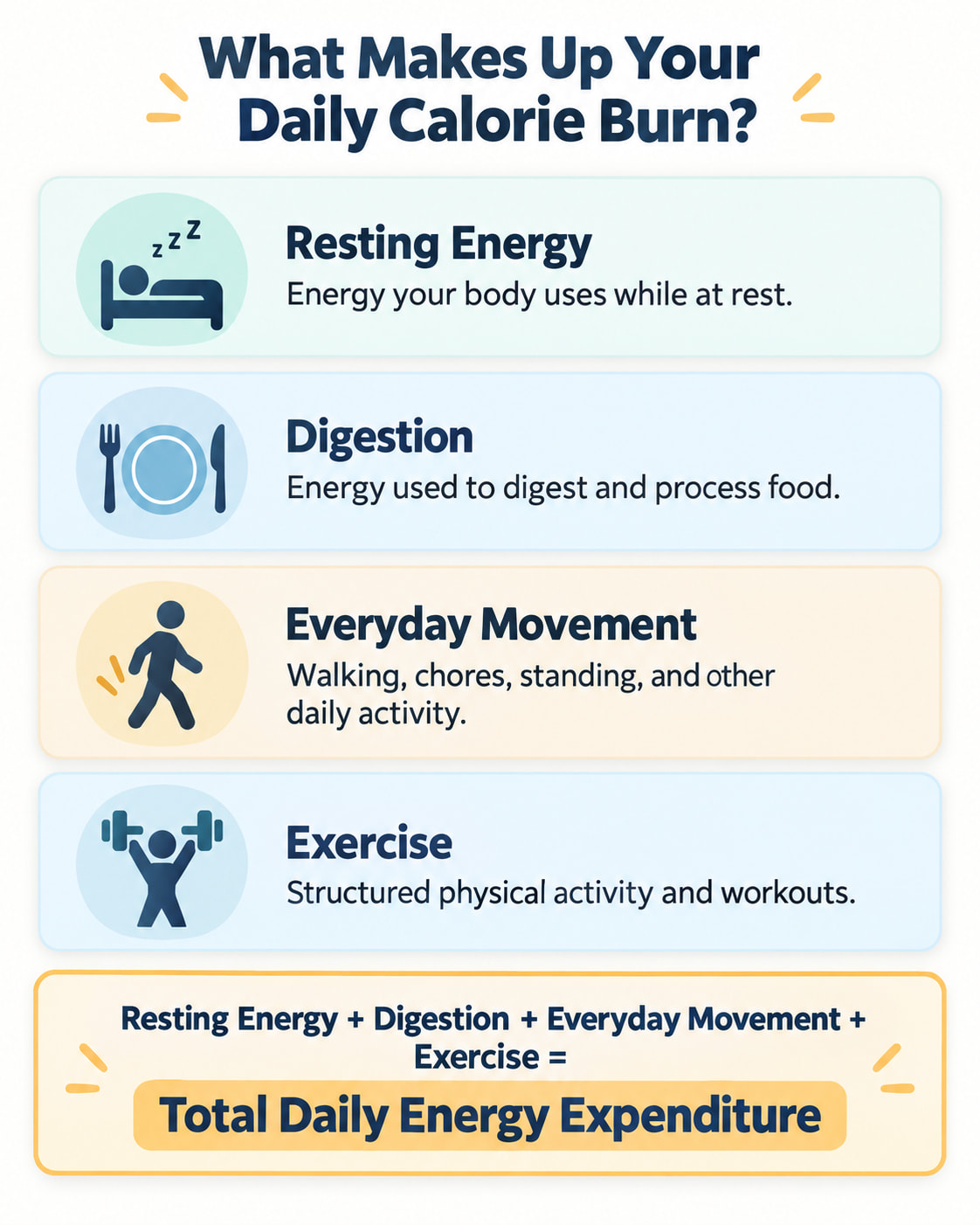
Your total daily energy expenditure, often shortened to TDEE, has several components:
Daily calorie burn = resting energy use + digestion + everyday movement + exercise.
Resting Metabolism
Your body needs energy even when you are still. Resting energy expenditure supports essential functions and is generally the largest part of your daily total.
Basal metabolic rate, or BMR, and resting metabolic rate, or RMR, describe energy use under somewhat different resting conditions. Neither represents a full day that includes eating and activity.
Digestion
Digesting, absorbing, and processing food also requires energy. This is called the thermic effect of food. It is already part of total daily expenditure, so you do not need to add a separate digestion allowance to a TDEE estimate.
Everyday Movement and Exercise
Walking around your home, doing chores, fidgeting, and exercising all contribute to activity-related expenditure. This explains why a workout’s calorie estimate is only one part of your day.
How to Estimate Your Daily Calorie Burn
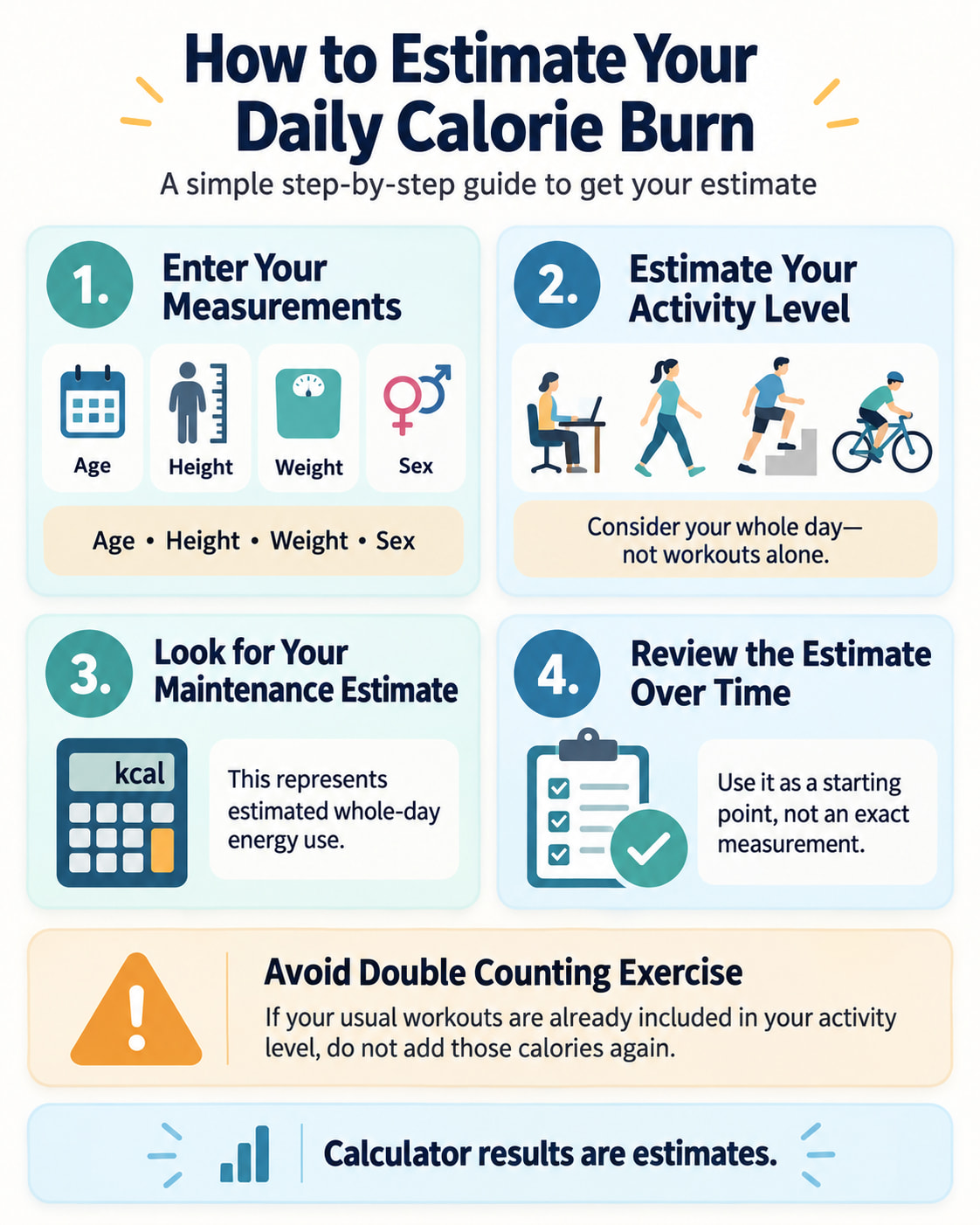
A useful estimate combines your own measurements with a realistic picture of your activity. An age chart alone cannot account for those differences.
Use a Calculator That Estimates the Full Day
The National Institute of Diabetes and Digestive and Kidney Diseases’ Body Weight Planner uses your weight, sex, age, height, and physical activity level. Its results distinguish calories needed to maintain your current weight from calories associated with a weight-change goal.
Enter your current measurements and check the units carefully. Then follow the tool’s activity-estimation questions.
For this question, look for the current-weight maintenance estimate. Do not confuse it with the calorie intake suggested for reaching a different weight.
Understand the Result With a Worked Example
Consider a 22-year-old woman who is approximately 5 feet 5 inches tall and weighs 139 pounds—165 centimeters and 63 kilograms—with a low-active activity level.
Using the National Academies’ adult equation for that category gives an estimate of approximately 2,275 calories per day, or about 2,300 calories when rounded. That is an estimate of whole-day expenditure at weight maintenance, not a workout goal.
Another calculator may produce a different result because it uses a different equation or activity assumption. Keep track of the method you use rather than treating every calculator result as directly interchangeable.
Avoid Counting Exercise Calories Twice
Suppose a calculator estimates 2,300 calories per day after accounting for your usual workouts. Adding another 300 calories for one of those same workouts would count that activity twice.
The same principle applies when combining an app, a watch, and a calculator: first check what each number includes. A whole-day total already contains an allowance for activity; a workout-only estimate does not represent the entire day.
How Does Age Affect Daily Calorie Burn?
Age matters, but the relationship is more complicated than a sudden metabolic slowdown at a particular birthday.
A 2021 study published in Science found that daily energy expenditure adjusted for body composition was broadly stable from approximately ages 20 to 60, then declined in older adulthood. This challenges the idea that everyone experiences a predictable metabolic “crash” at 30.
However, this was a population-level finding—not a promise that your calorie burn will remain unchanged for 40 years. Changes in body size, body composition, and activity can still affect your personal expenditure.
The practical takeaway is to update your estimate when your circumstances change, rather than assuming age alone explains every difference.
How Many Calories Do I Burn a Day Without Exercise?
You still burn calories on a day without a workout. Resting metabolism, food processing, and ordinary movement continue contributing to your total.
In the reference tables above, the inactive estimates range from approximately 1,700–2,200 calories for women and 2,200–2,800 calories for men, depending on the age-group profile. These are reference values, not guaranteed ranges for every individual.
A day without structured exercise is also not the same as complete bed rest. Use a whole-day estimate that reflects your actual routine rather than assuming your BMR equals everything you burn.
How Accurate Are Calorie Calculators and Fitness Trackers?
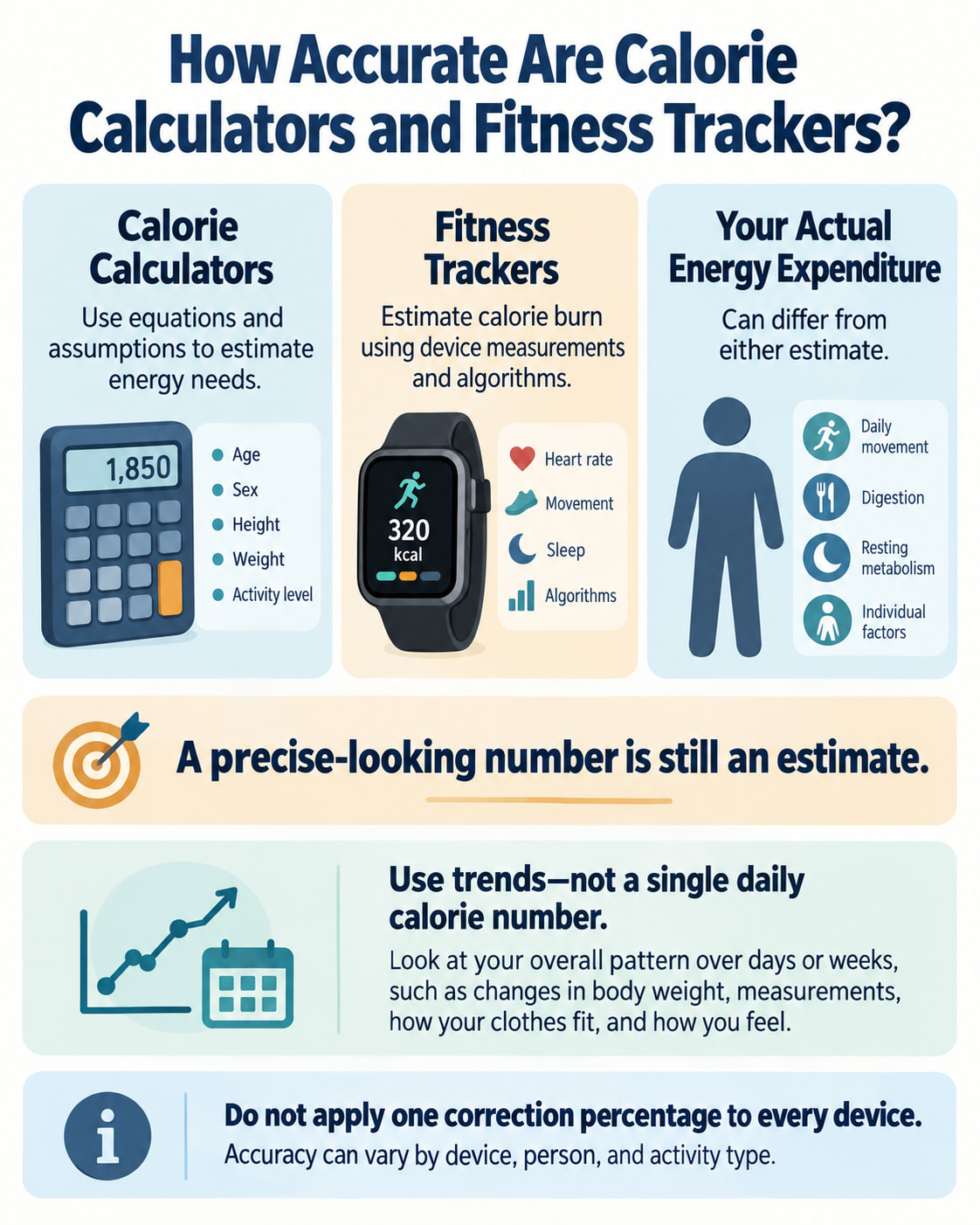
Calculators provide predictions, and people with the same age, height, weight, and activity category can still have different energy requirements. A result displayed to the nearest calorie should not be interpreted as that precise.
Fitness trackers have limitations, too. The National Academies’ 2023 assessment of energy-expenditure measurement methods reported substantial variation in device-based estimates, including large differences at the individual level.
That evidence does not justify applying one correction percentage to every watch. It also does not mean every device overestimates calories.
For everyday use, treat the displayed calorie number as an estimate—not an exact amount you must match with food or exercise.
How to Check Whether Your Estimate Is Reasonable
A calculator becomes more useful when you compare its estimate with what happens over time.
For weight-stable adults, usual energy intake should broadly match expenditure over the longer term. However, food records can contain errors, and a few logged days may not represent your normal intake.
A practical review involves three checks:
- Check the inputs. Confirm your measurements, units, and activity assumptions.
- Look at the longer-term pattern. Review weight and activity over several weeks rather than drawing conclusions from one measurement.
- Reassess when your routine changes. A new job, a different exercise schedule, or a change in body weight may justify a fresh estimate.
The National Academies recommends monitoring body weight over time rather than assuming an equation matches everyone’s requirements. A mismatch between your food log and calculator does not, by itself, establish a metabolic problem.
When to Get Personalized Advice
General adult estimates are not appropriate for every situation. The tables here begin at age 19. The NIDDK planner is intended for adults 18 and older and excludes pregnancy and breastfeeding.
A clinician or registered dietitian can help interpret your needs when medical conditions, medications, or recovery from illness make standard calculations less suitable.
Do not dismiss unexplained weight loss as simply “burning more calories.” MedlinePlus advises contacting a health care professional for unexplained loss of more than 10 pounds or 5% of your usual weight over 6–12 months or less, or when weight loss occurs with other symptoms.
Frequently Asked Questions
Is Burning 2,000 Calories a Day Normal?
A total of approximately 2,000 calories can be reasonable for some adults. Others expend considerably more or less. The number alone cannot tell you whether your metabolism is healthy; it needs to be interpreted alongside your body size, activity, and circumstances.
Do You Burn Calories While Sleeping?
Yes. Sleeping does not stop your body’s energy use. Those overnight calories are part of your whole-day expenditure, so they should not be added again to an estimate that already covers 24 hours.
Are Active Calories the Same as Total Calories?
No. Activity-related calories cover movement, while total daily expenditure also includes resting energy use and food processing. When reading a tracker, check whether the displayed number describes activity alone or a whole-day total.
Does a Higher Body Weight Mean You Burn More Calories?
Larger bodies generally require more energy, but body composition and activity also matter. Two people at the same weight can have different daily expenditure, so body weight alone is not enough for an individualized estimate.
Do I Need to Calculate My Calorie Burn Every Day?
No. A reasonable estimate based on your usual routine can be a starting point. The National Academies notes that people maintaining their weight and desired activity level may not need to identify a specific calorie intake to plan other aspects of their diet.
Should I Eat the Same Number of Calories I Burn?
For a weight-stable adult who is not pregnant or breastfeeding, average intake and expenditure should broadly balance over time. That does not mean matching them perfectly every day. A weight-change intake target is a separate question from estimating how much you currently burn.
The Bottom Line
Your daily calorie burn is more than the number shown after a workout. Age-and-activity tables offer a reference, but your own measurements, routine, and longer-term patterns make an estimate more useful.
Start with one reliable calculator, check what its result includes, and use the number as a starting estimate—not a daily score to beat.
References
- National Academies: Dietary Reference Intakes for Energy
- National Academies: Reference Energy Requirements for Adult U.S. Women
- National Academies: Reference Energy Requirements for Adult U.S. Men
- NIDDK: Body Weight Planner
- Science: Daily Energy Expenditure Through the Human Life Course
- MedlinePlus: Unintentional Weight Loss
This content is for informational purposes only and not medical advice.