
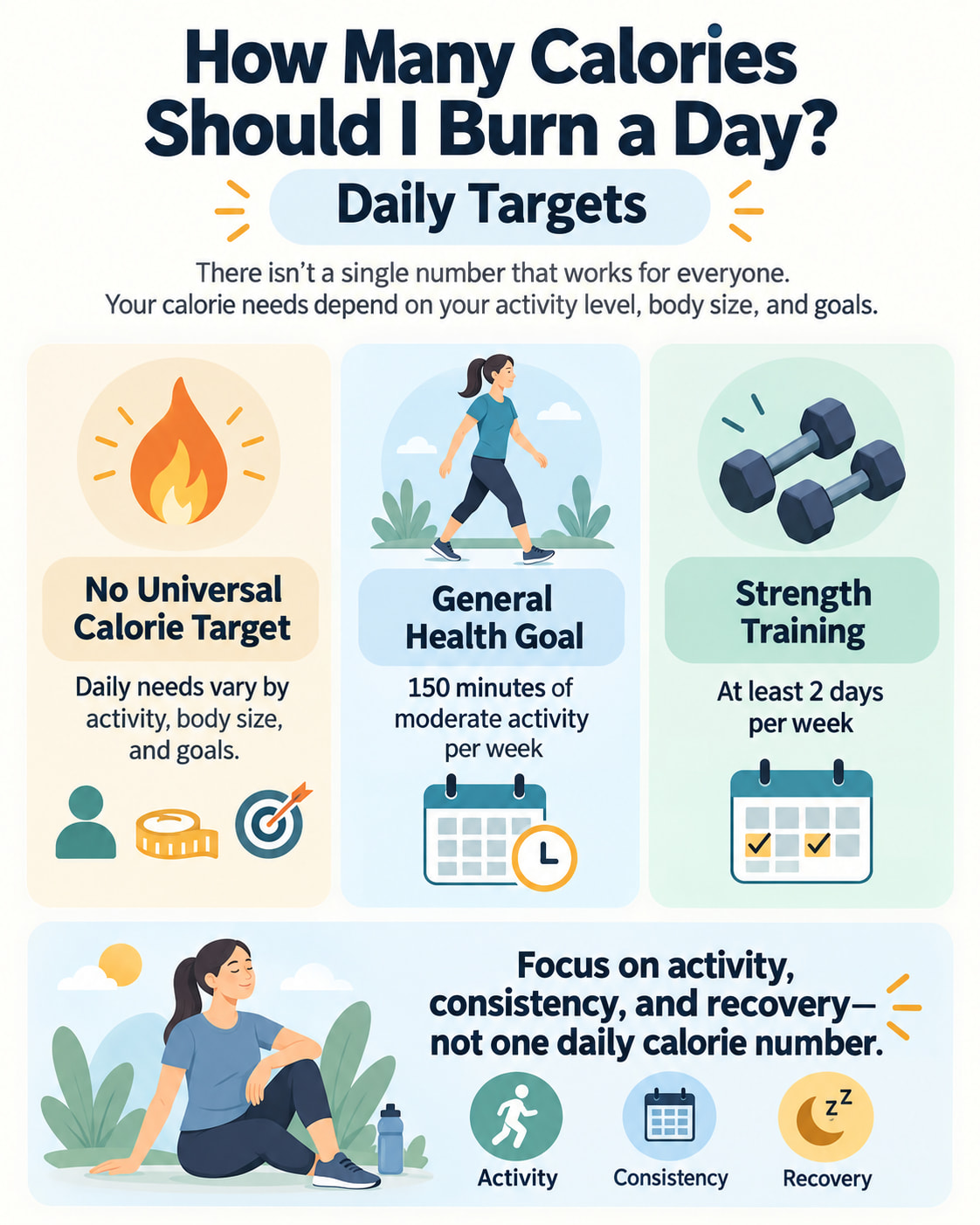
There is no universal daily calorie-burning target. For general health, aim for at least 150 minutes of moderate-intensity activity per week and muscle-strengthening activity on 2 days—not a fixed number of exercise calories. These are the basic recommendations in the CDC’s adult activity guidelines.
When asking “how many calories should I burn a day,” first clarify which number you are tracking: your total daily energy use, active calories, or calories from a workout. They are not interchangeable.
Understanding the difference helps you set realistic goals, avoid counting the same exercise twice, and make room for recovery.
Total Calories vs. Active Calories: What Is the Difference?
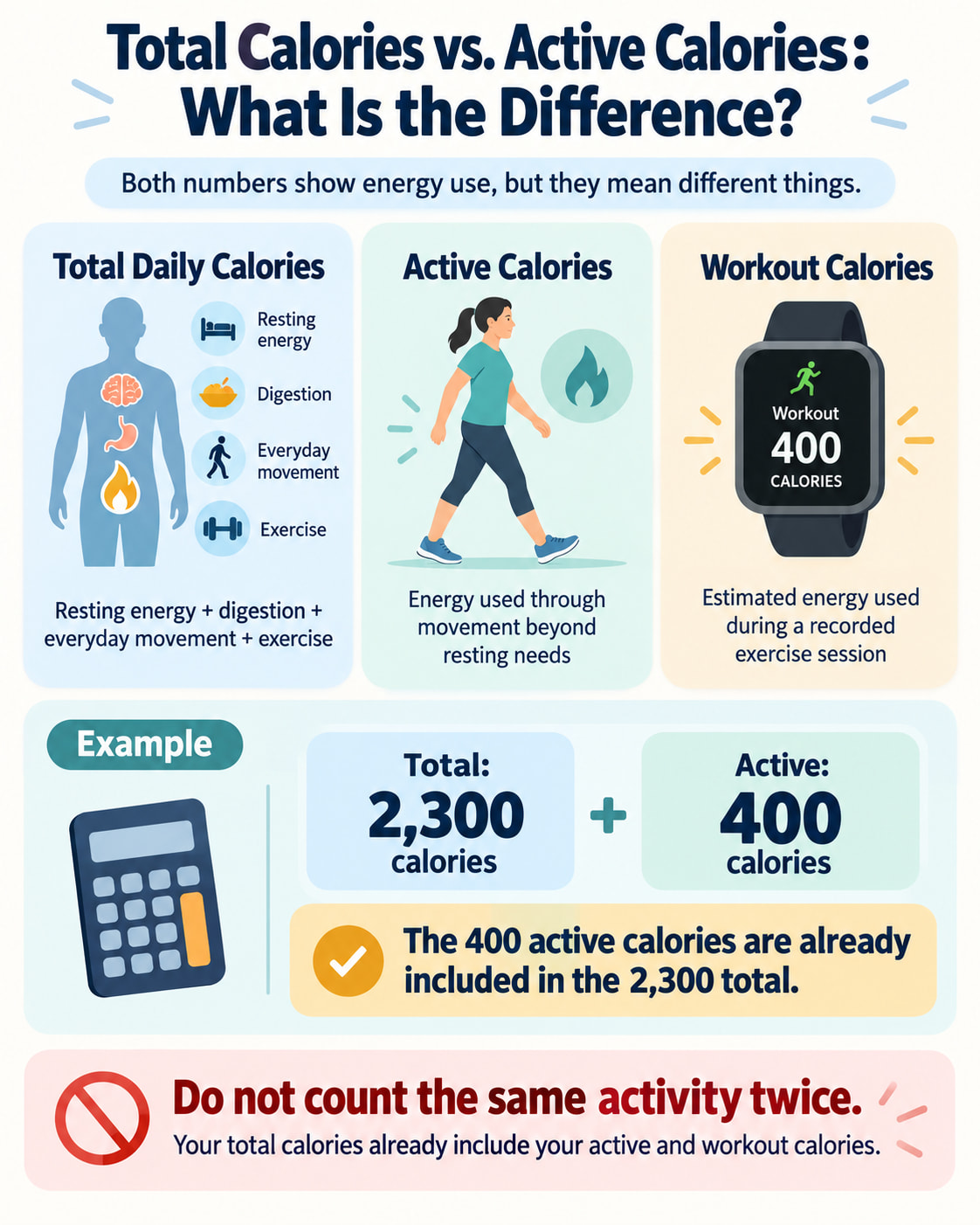
Total daily calories burned, also called total daily energy expenditure, include the energy your body uses for essential functions, processing food, everyday movement, and exercise. Your body uses energy even when you are resting or sleeping.
Active calories generally refer to energy used through movement beyond your resting needs. They can include both planned exercise and activity outside workouts.
Workout calories describe the energy attributed to a recorded exercise session. Check your device’s definition: some session totals include resting calories accumulated during that time. Garmin, for example, distinguishes these “activity calories” from active calories alone.
Consider this hypothetical tracker display:
- Total daily calories: 2,300
- Active calories: 400
The 400 active calories are already part of the 2,300 total. Adding them again would incorrectly produce 2,700.
Always check what a calorie number includes before using it to set a goal.
How Many Calories Should I Burn Through Exercise?
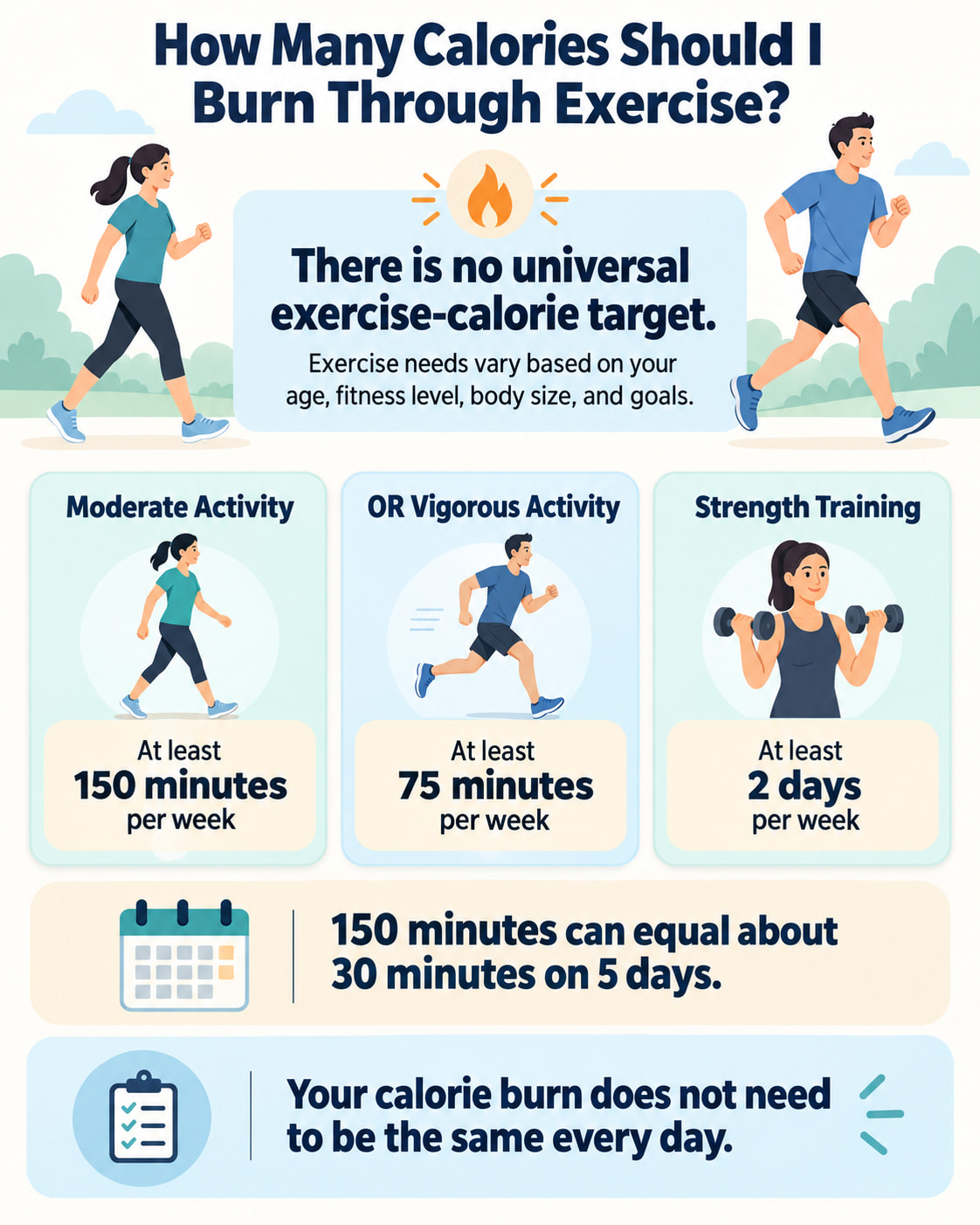
Rather than choosing a universal exercise-calorie target, use the recommended activity amounts as your starting framework.
Adults can meet the aerobic recommendation with 150 minutes of moderate-intensity activity, 75 minutes of vigorous-intensity activity, or an equivalent combination each week. Add muscle-strengthening activities that work the major muscle groups on at least 2 days, according to the CDC’s physical activity guidelines.
The broader federal guidelines recommend 150–300 minutes of moderate-intensity aerobic activity per week for substantial health benefits. Smaller amounts still offer benefits, and activity does not need to happen in minimum 10-minute blocks to count, according to the Physical Activity Guidelines for Americans.
What Does Moderate Intensity Feel Like?
Use the talk test. During moderate-intensity activity, you can usually talk but cannot comfortably sing. During vigorous activity, you generally need to pause for breath after a few words. The effort of the same activity can differ depending on your fitness.
What Common Activities May Burn in 30 Minutes?
The CDC’s physical activity and calorie information provides these approximate values for a 154-pound, or 70-kilogram, person. They are reference estimates—not personalized measurements.
| Activity | Approximate Calories in 30 Minutes |
|---|---|
| Walking at 3.5 mph | 140 |
| Bicycling below 10 mph | 145 |
| Hiking | 185 |
| Running or jogging at 5 mph | 295 |
People with different body weights may burn different amounts during these activities.
The numbers are not minimum requirements for a worthwhile workout.
Use the table to understand the scale of an activity—not to decide that every session must reach the highest number.
How Many Calories Should I Burn a Day to Lose Weight?
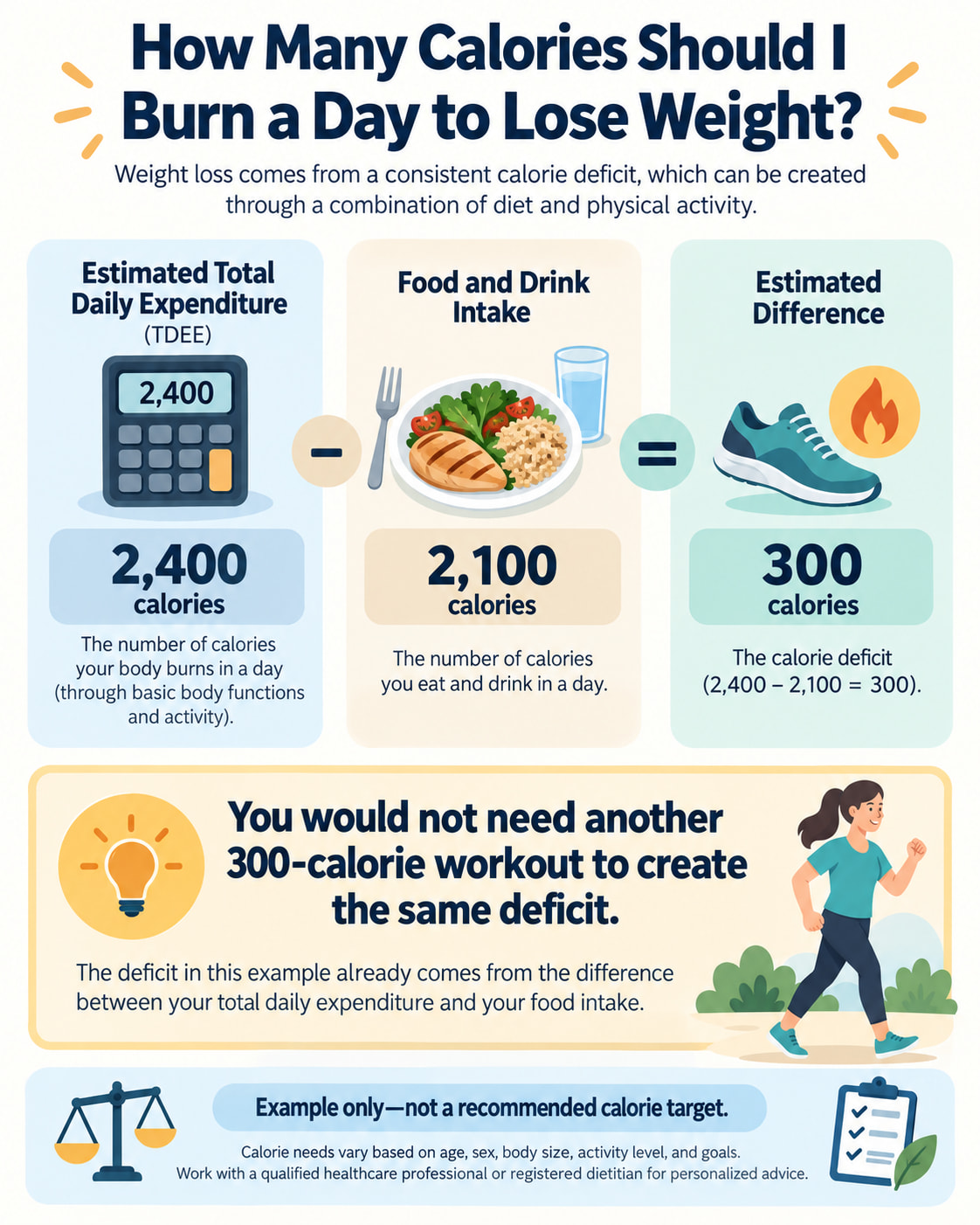
For weight loss, the relevant comparison is total daily energy expenditure versus calorie intake, not workout calories versus food calories. A calorie deficit occurs when you use more energy than you consume over time.
Here is a hypothetical example:
| Part of the Calculation | Calories per Day |
|---|---|
| Estimated total expenditure, including usual activity and workouts | 2,400 |
| Food and drink intake | 2,100 |
| Estimated calorie deficit | 300 |
In this example, the estimated deficit is already 300 calories. You would not need another 300-calorie workout to create that same deficit.
These numbers explain the calculation; they are not recommended targets for every reader.
Avoid Double Counting Exercise
Suppose a maintenance-calorie estimate already assumes that you exercise several times a week. Those usual workouts are included in the estimate.
Adding their calories again would count the same activity twice. Before adjusting food intake or exercise, check whether your calculator includes your usual workouts and whether an app automatically adds recorded activity.
For individualized planning, the NIDDK Body Weight Planner combines calorie and activity changes with a weight goal and timeline. It is intended for adults 18 and older, excluding pregnant or breastfeeding women. Its output is a planning estimate, not medical advice.
Why Burning 500 Calories Does Not Guarantee a Pound a Week
A fixed calorie calculation does not produce an identical weight change indefinitely.
Research on changes in body weight and energy expenditure has shown why predictions need to account for the body’s changing energy requirements rather than assume the same calorie reduction produces a constant rate of weight loss.
Treat calorie estimates as starting information. Do not interpret them as a guaranteed weekly result.
Is Burning 300, 500, or 1,000 Calories a Day a Good Goal?
First, determine whether the number represents exercise calories, active calories, or total daily calories. A workout goal and a whole-day expenditure estimate answer different questions.
Burning 300 or 500 Exercise Calories
Either number may describe a particular workout, but neither is a universal daily requirement. The activity and your body weight affect how much exercise produces that estimate.
Ask whether the session fits your overall plan. Do not automatically extend it because the display falls below a round number.
Burning 1,000 Exercise Calories
Burning 1,000 calories through exercise is not a general-health requirement. Adult activity guidelines are based on activity duration, intensity, and strength training—not reaching this calorie total.
Avoid adding exercise simply to reach the number when you are exhausted, sick, or injured. Recovery and adequate fueling matter alongside training.
A higher calorie total is not, by itself, evidence of a better exercise plan.
How to Set a Realistic Daily Activity Target
Start With Your Goal and Current Activity
Choose what you want the plan to accomplish. That might be building a walking habit, improving strength, preparing for an event, or supporting an appropriate weight-management goal.
Then review a typical week. Record your planned workouts, everyday movement, and the time you can realistically reserve for activity.
Make the first goal specific: “Walk after lunch on Monday, Wednesday, and Friday” is easier to act on than “burn more calories.” NIDDK guidance recommends setting concrete, trackable activity goals and scheduling them.
Build a Weekly Plan You Can Repeat
For someone already comfortable with 30-minute brisk walks, this example combines the basic aerobic and strength recommendations:
| Day | Example Activity |
|---|---|
| Monday | 30-minute brisk walk |
| Tuesday | 30-minute brisk walk and strength training |
| Wednesday | Rest from structured exercise |
| Thursday | 30-minute brisk walk |
| Friday | 30-minute brisk walk and strength training |
| Saturday | 30-minute brisk walk |
| Sunday | Rest from structured exercise |
This adds up to 150 minutes of moderate-intensity walking and 2 strength-training days, provided the walks reach moderate intensity and the strength sessions cover the major muscle groups.
It is one scheduling option, not a required routine.
Your calorie burn does not need to be identical each day.
Increase Activity Gradually
An inactive beginner does not need to start with the full schedule above.
The NIDDK’s guidance on starting physical activity suggests beginning with manageable amounts and gradually adding time.
Adjust the starting point to your abilities rather than forcing a predetermined calorie goal.
Make the next increase manageable enough that you can assess how you respond before adding more.
Allow for Rest and Recovery
Rest is part of training. It allows recovery between workouts, and inadequate recovery can contribute to declining performance and health problems.
Schedule recovery deliberately instead of treating it as something you have to earn by reaching a calorie target.
Review Progress Without Chasing a Daily Number
Choose a few useful questions for your weekly review:
- Are you completing the sessions you planned?
- Does the schedule fit your life?
- Are you recovering comfortably?
- Are you making progress toward the goal that matters to you?
Use those answers to decide whether to maintain, simplify, or gradually adjust the plan.
A missed numerical target does not automatically mean you need more exercise.
How Should You Use Fitness-Tracker Calorie Estimates?
Treat the calorie display as an estimate, not an exact measurement.
A 2026 study published in PLOS One compared four smartwatch models with laboratory energy-expenditure measurements in 58 Hispanic adults during a short cycling protocol. Researchers found substantial estimation errors that varied by device and body composition.
The study does not establish the accuracy of every current watch, every activity, or every user. It also does not justify subtracting one fixed percentage from all tracker readings.
For your own planning, keep calorie readings secondary to the activity you actually completed. Record workout duration, the type of exercise, and how the session felt rather than judging success by one displayed number.
When to Seek Professional Advice
According to MedlinePlus guidance on excessive exercise, ongoing fatigue, declining performance, sleep problems, and recurring overuse injuries can be signs that exercise and recovery are out of balance.
Contact a healthcare professional when symptoms persist despite reducing activity and resting.
Also seek support when you feel compelled to exercise, feel significant guilt about resting, or continue exercising while sick or injured.
For a chronic health condition, ask your healthcare professional about appropriate activity types and amounts. The CDC also recommends discussing vigorous exercise before starting it when you have been inactive or have certain health-related limitations.
Frequently Asked Questions
Do I Need to Burn Off Every Calorie I Eat Through Exercise?
No. Exercise is only part of your daily energy use. Your body also uses calories for essential functions, food processing, and movement outside workouts.
Comparing your entire food intake with workout calories alone leaves out these other needs.
Do Women and Men Need Different Exercise-Calorie Targets?
The basic adult activity guidelines do not prescribe separate exercise-calorie quotas for women and men.
Individual energy expenditure varies with factors such as body size and composition, so another person’s calorie goal is not automatically appropriate for you.
How Many Active Calories Should I Burn on Rest Days?
There is no required rest-day active-calorie number.
Allow the day to serve its recovery purpose instead of adding a workout solely to match a training-day total. Rest remains an important part of an exercise routine.
Is a Workout Still Useful if My Tracker Shows a Low Calorie Burn?
Yes. For example, strength training supports muscle and bone strength; its value is not determined solely by the estimated calories displayed afterward.
Assess whether the session served its intended purpose rather than whether it reached a calorie threshold.
Should I Eat Back All the Calories My Watch Says I Burned?
Do not automatically add them to a calorie plan that already includes your usual activity. That would count the same exercise twice.
At the same time, avoiding double counting should not mean ignoring fueling needs. Eating enough for your activity level is important; a healthcare professional or registered dietitian can help when your training and nutrition needs are difficult to balance.
The Bottom Line
The most useful answer to “how many calories should I burn a day” is not one number.
Separate total daily expenditure from exercise calories, build a repeatable activity schedule, and leave room for recovery.
Start this week by choosing an activity you can repeat and putting it on your calendar. Use calorie estimates for context—not as a daily pass-or-fail test.
References
- CDC — Adult Activity: An Overview
- CDC — Physical Activity and Your Weight and Health
- CDC — How to Measure Physical Activity Intensity
- CDC — Adding Physical Activity as an Adult
- HHS — Physical Activity Guidelines for Americans
- Mayo Clinic — Metabolism and Weight Loss: How You Burn Calories
- Garmin — Calories Burned
- NIDDK — About the Body Weight Planner
- NIDDK — Tips for Starting Physical Activity
- Hall and Colleagues — Quantification of the Effect of Energy Imbalance on Bodyweight
- PLOS One — Smartwatch Caloric Expenditure Accuracy Study
- MedlinePlus — Are You Getting Too Much Exercise?
This content is for informational purposes only and not medical advice.