
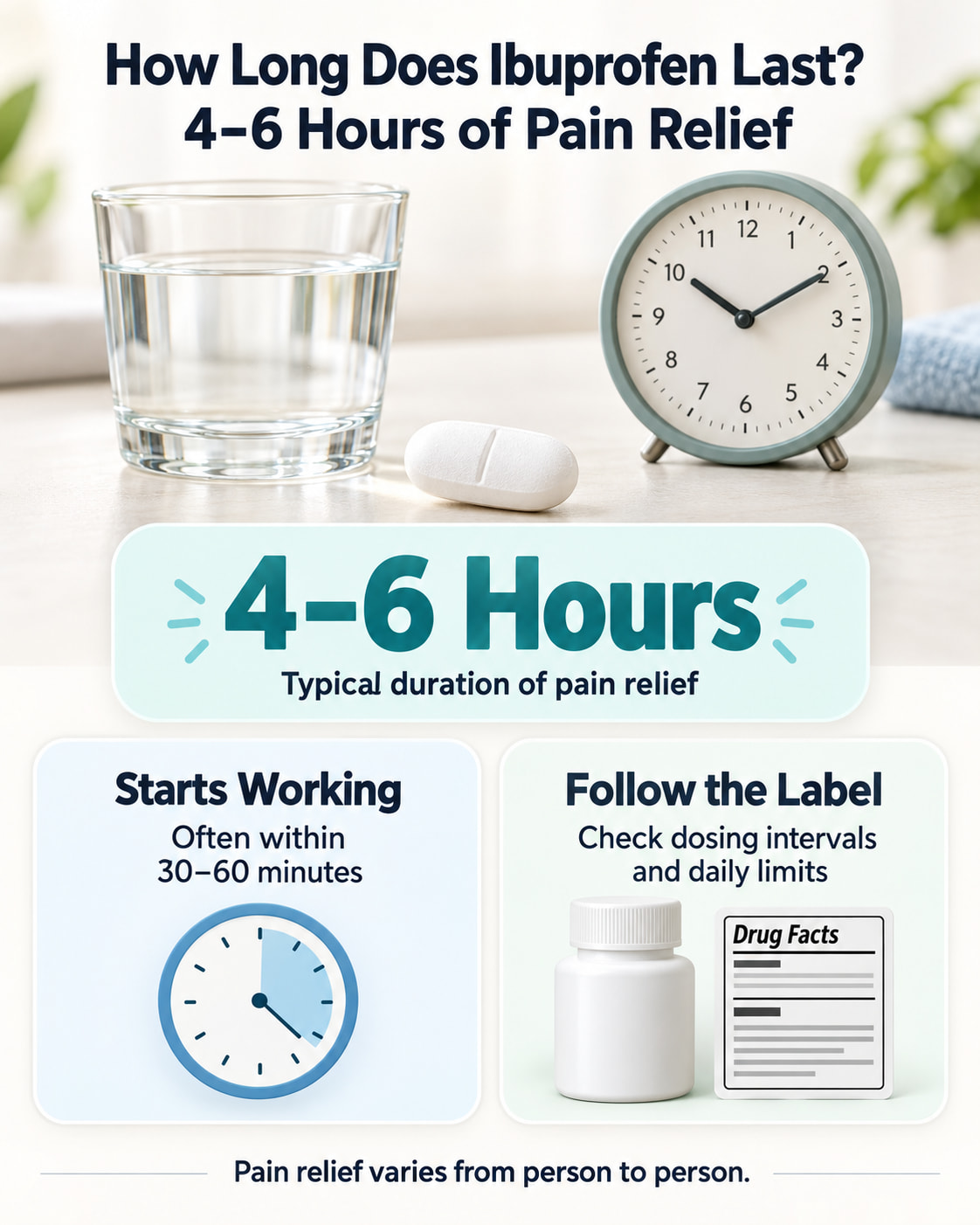
Standard, immediate-release oral ibuprofen usually provides about 4–6 hours of pain relief. It often starts working within 30–60 minutes, according to Tufts Medicine. Your response may vary.
Understanding how long ibuprofen lasts helps you plan around the label’s directions. Pain returning early does not automatically mean another dose is appropriate. Both the time between doses and the maximum amount allowed in 24 hours matter.
This guide focuses on standard oral ibuprofen taken on its own. Prescription medicines and products containing additional ingredients may have different instructions.
How Long Does Ibuprofen Last?
The usual pain-relief window is about 4–6 hours, but it is an estimate. Some people get less relief, and symptoms may return before the next dose is due.
These timing terms describe different things:
| Timing measure | Typical estimate | What it means |
|---|---|---|
| Onset of relief | About 30–60 minutes | When you may begin noticing improvement |
| Pain-relief duration | About 4–6 hours | How long the medicine may reduce pain |
| Elimination half-life | About 2 hours | How long the drug concentration takes to fall by roughly half |
The half-life does not determine when you should take another dose. Use the product’s directions rather than judging by how much medicine you think remains in your body.
How Long Does Ibuprofen Take to Work?
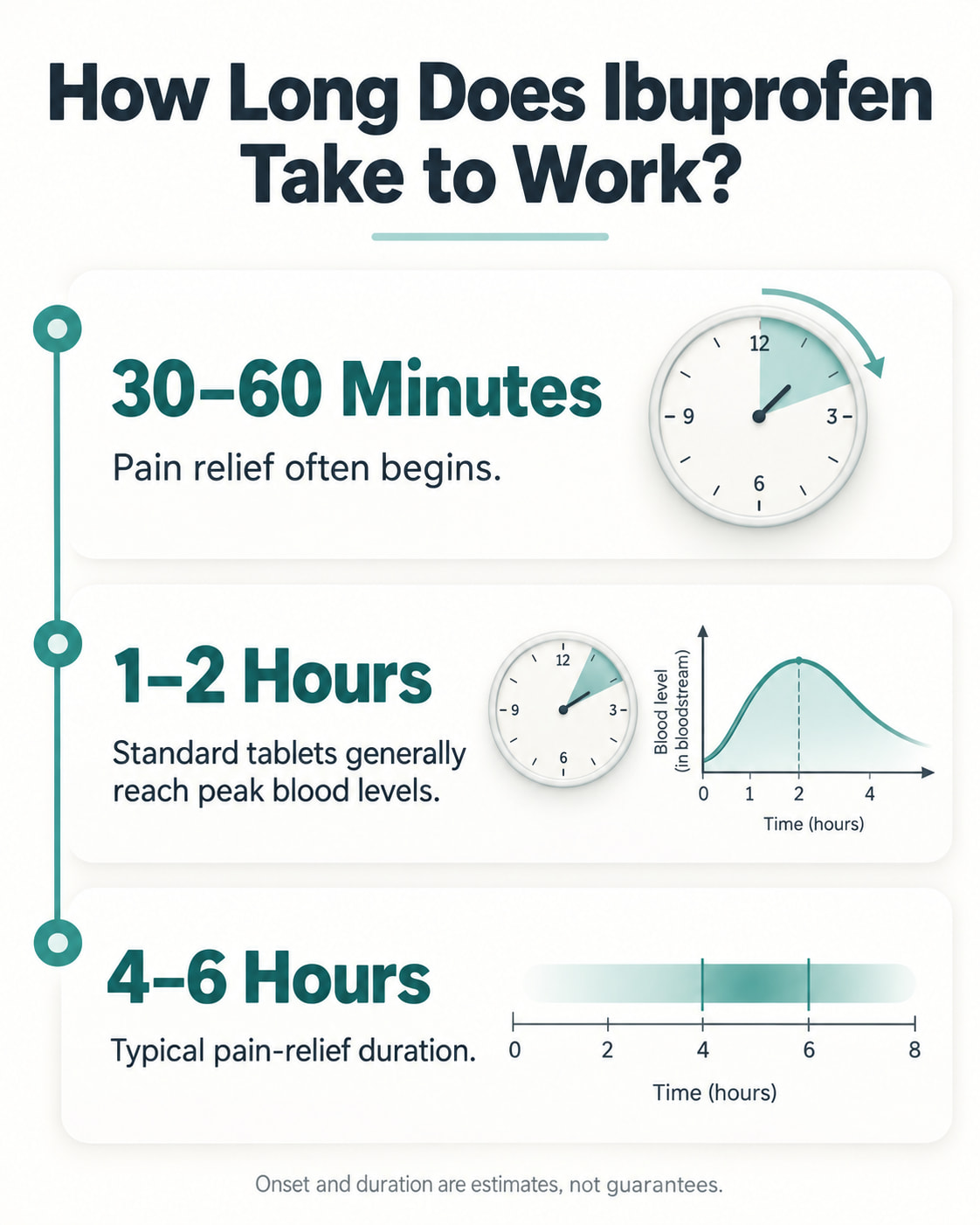
Ibuprofen often begins helping within 30–60 minutes. It does not necessarily provide its full benefit as soon as you swallow it.
Standard tablets generally reach their highest blood levels after 1–2 hours. Taking them immediately after a meal can slow absorption without substantially reducing the amount absorbed.
If stomach upset occurs, the OTC label suggests taking ibuprofen with food or milk. This advice does not guarantee protection against ulcers or stomach bleeding.
Avoid taking extra medicine simply because relief has not started yet.
How Long Does Ibuprofen Stay in Your System?
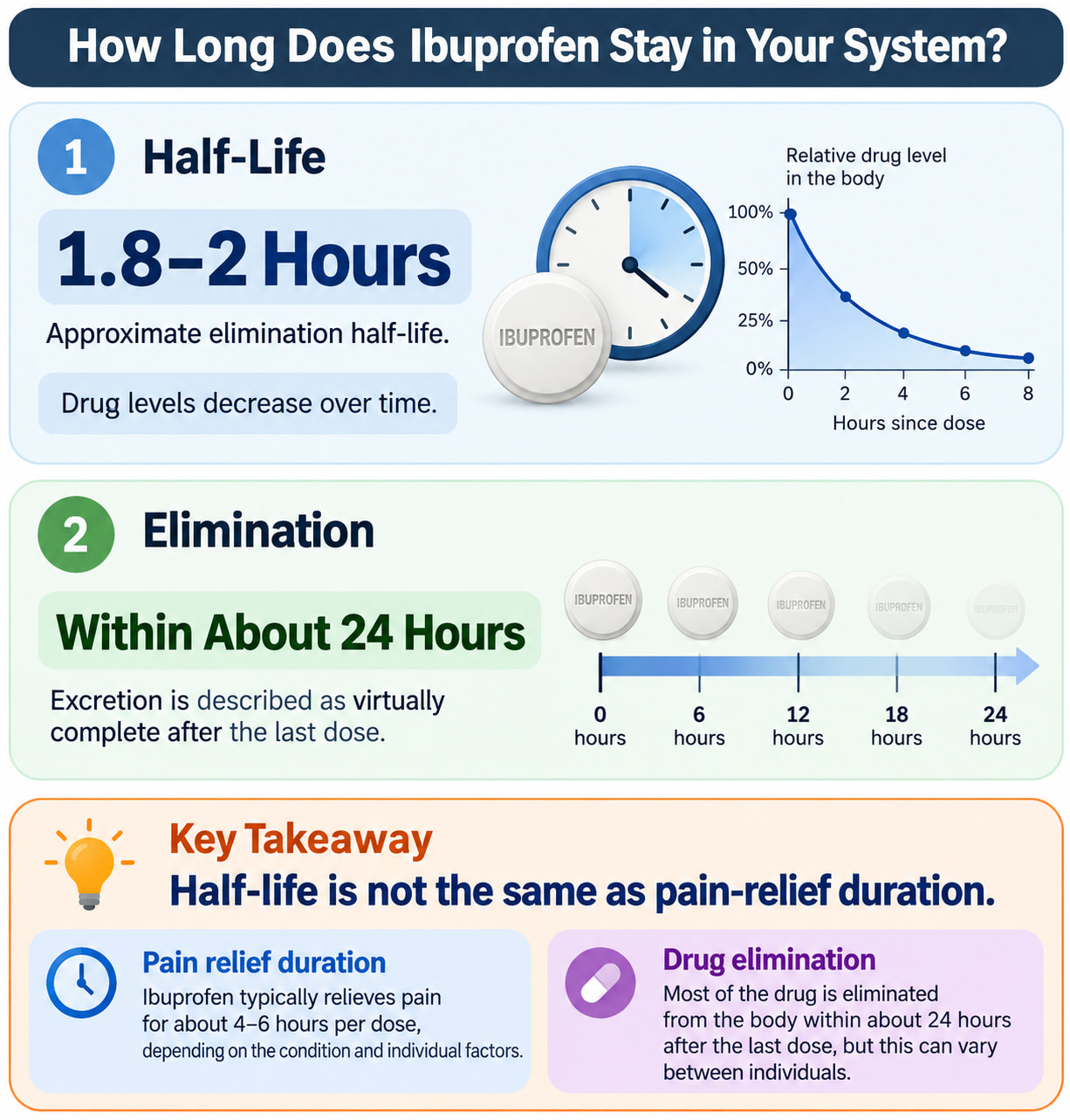
The prescribing information on DailyMed gives ibuprofen a half-life of approximately 1.8–2 hours. Drug levels decline over several half-lives, so some medicine remains after one half-life has passed.
The label describes excretion as virtually complete 24 hours after the last dose. This is a general estimate, not a precise clearance time for every person.
Neither figure means that pain relief lasts for 24 hours. They also should not be used to calculate when mixing ibuprofen with another medicine or alcohol becomes safe.
Does the Dose or Form Affect How Long Ibuprofen Lasts?
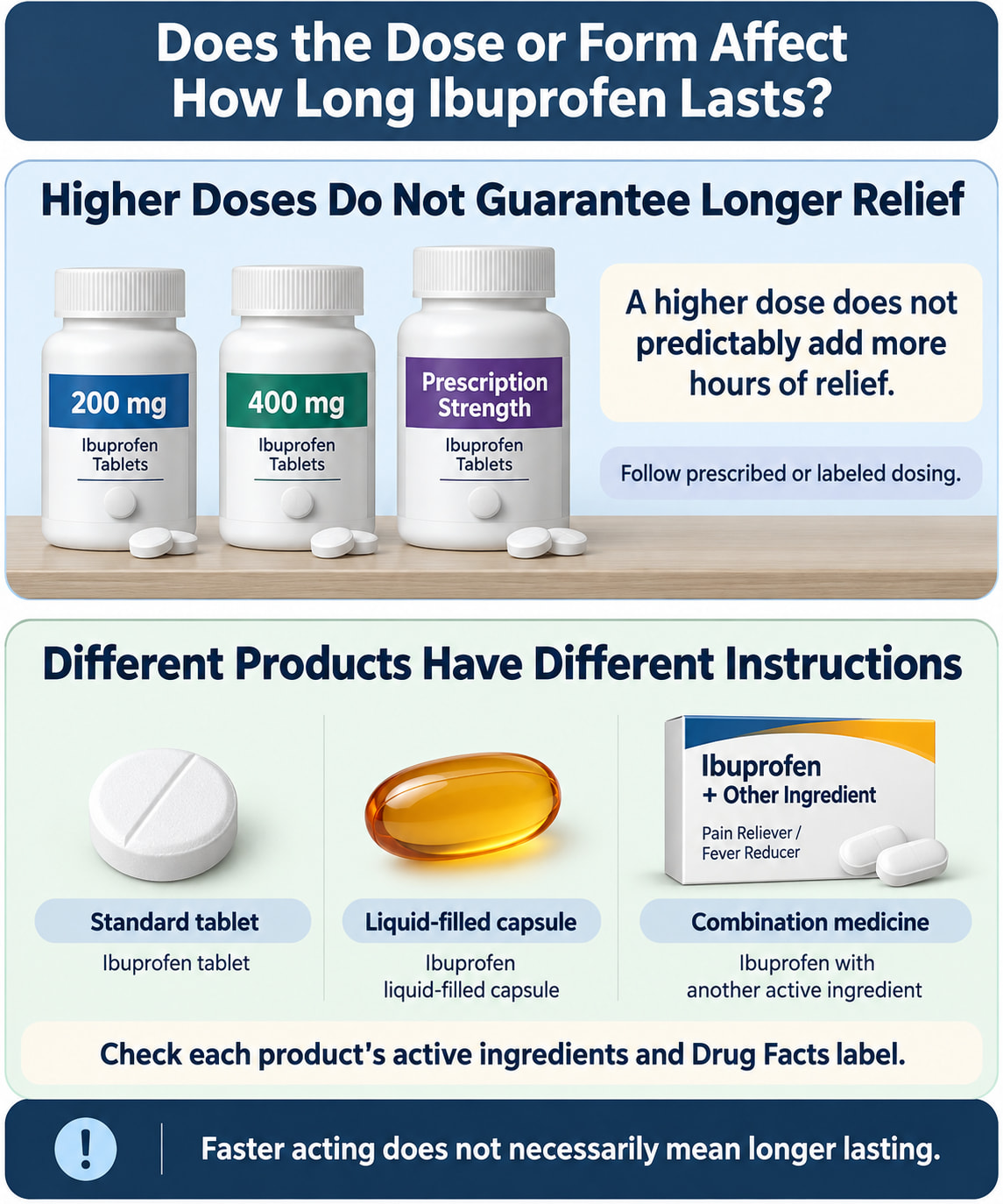
Higher Doses Do Not Guarantee Longer Relief
A larger dose does not translate into a predictable number of extra hours.
Prescription labeling reports that doses above 400 mg were no more effective than 400 mg in controlled pain-relief trials. That finding does not establish identical duration for every strength or every condition.
If you have been prescribed 600 mg or 800 mg tablets, follow your prescriber’s schedule. Do not increase an OTC dose to try to make it last longer.
Different Products Have Different Instructions
Advil’s product information lists both standard tablets and Liqui-Gels as providing relief for up to six hours. A fast-acting description does not automatically mean longer-lasting relief.
Combination products need separate attention. Some contain acetaminophen or a sleep aid in addition to ibuprofen. Their directions and warnings may differ, so check the active ingredients and Drug Facts panel rather than relying only on the brand name.
How Often Can You Take Ibuprofen?
For standard 200 mg OTC tablets, the Advil Drug Facts label, updated March, 2026, gives these directions:
| Label instruction | Adults and children 12 years and older |
|---|---|
| Starting amount | One 200 mg tablet |
| Time between doses | Every 4–6 hours while symptoms persist |
| If one tablet is insufficient | Two tablets, totaling 400 mg, may be used |
| Maximum without a doctor’s direction | Six 200 mg tablets, totaling 1,200 mg, in 24 hours |
The interval and daily maximum apply together. Taking 400 mg every four or six hours throughout a full day would exceed the OTC limit.
Use the smallest effective dose. For children under 12, the adult tablet label says to ask a doctor. Prescription dosing should follow the prescription rather than this OTC table.
What If Pain Returns Before the Next Dose?
Do not shorten the labeled interval or exceed the daily maximum because pain has returned.
Before taking more, check:
- The product: Confirm the active ingredients and strength.
- The time: Check when you took the last dose.
- The total: Count all ibuprofen taken during the past 24 hours, including combination products.
- Other medicines: Check for another NSAID, such as naproxen, or duplicate ibuprofen.
If the labeled amount is not providing enough relief, ask a pharmacist or healthcare professional about the next step. Persistent or worsening pain may need assessment rather than repeated dose increases.
Who Should Check Before Taking Ibuprofen?
Ibuprofen is not suitable for everyone. Its risks include stomach bleeding, kidney problems, and cardiovascular complications.
Check with a healthcare professional first if you have:
- A history of stomach ulcers or gastrointestinal bleeding.
- Kidney disease, heart disease, high blood pressure, or a previous stroke.
- Liver disease or asthma.
- A serious medical condition or medicines that may interact.
Do not take ibuprofen if you have previously had an allergic reaction to ibuprofen, aspirin, or another NSAID. Ask a healthcare professional about an appropriate alternative. Ibuprofen should also not be used immediately before or after heart bypass surgery.
Medicines That Need Extra Attention
MedlinePlus guidance highlights interactions with blood thinners, corticosteroids, other NSAIDs, and certain antidepressants.
Avoid combining ibuprofen with another NSAID unless a healthcare professional directs it. Check cold, flu, and combination pain products for duplicate ingredients.
If you take low-dose aspirin for heart protection, ask your clinician or pharmacist before adding ibuprofen. According to FDA guidance, ibuprofen can interfere with aspirin’s protective effect; do not change prescribed aspirin on your own.
Pregnancy
Ask a healthcare professional before using ibuprofen during pregnancy.
The FDA’s pregnancy safety guidance recommends avoiding NSAIDs at 20 weeks of pregnancy or later unless specifically directed by a healthcare professional. These medicines can cause fetal kidney problems and low amniotic fluid.
This warning does not mean ibuprofen is automatically appropriate earlier in pregnancy.
When Should You Seek Medical Advice?
The OTC ibuprofen label advises stopping use and contacting a healthcare professional if:
- Pain worsens or lasts more than 10 days.
- Fever worsens or lasts more than three days.
- New symptoms develop.
- The painful area becomes red or swollen.
These are label limits for self-directed use, not reasons to wait when symptoms are severe or worsening.
Get emergency help for chest pain, breathing difficulty, one-sided weakness, slurred speech, or signs of a severe allergic reaction.
Stop taking ibuprofen and seek urgent medical attention for bloody vomit, black or bloody stools, or severe stomach pain. If you may have taken too much, contact Poison Control or seek medical help promptly rather than waiting for it to wear off.
Frequently Asked Questions
How Long Does 200 mg of Ibuprofen Last?
A standard 200 mg oral dose generally fits the usual 4–6-hour pain-relief window, although it may not provide enough relief for everyone. Follow both the dosing interval and daily maximum on the package.
How Long Does 400 mg of Ibuprofen Last?
Standard oral ibuprofen is commonly used within the same 4–6-hour interval. A 400 mg dose does not guarantee six hours of relief. For OTC use, remember the 1,200 mg maximum in 24 hours unless a doctor directs otherwise.
Does 800 mg of Ibuprofen Last Longer?
There is no reliable rule that 800 mg lasts twice as long as 400 mg. Prescription strengths should follow the prescriber’s directions, and increasing the amount can increase risks.
Can You Take More Ibuprofen After Two Hours?
Two hours is earlier than the usual 4–6-hour interval for standard OTC tablets. Do not take an additional dose sooner than directed because pain remains. Ask a pharmacist or clinician if relief is inadequate.
Do Ibuprofen Liquid Gels Last Longer Than Tablets?
Not necessarily. Advil lists both its standard tablets and Liqui-Gels as lasting up to six hours. Differences in formulation do not remove the need to follow each product’s dose limits.
Can You Take Ibuprofen Every Day?
Daily use should be discussed with a healthcare professional if it is ongoing. Longer use can increase the chance of serious side effects. The OTC label advises medical review when pain worsens or lasts more than 10 days; that limit does not make daily use appropriate for everyone.
Conclusion
Ibuprofen typically provides 4–6 hours of pain relief, but the response varies. Its roughly two-hour half-life describes drug levels, not when another dose is appropriate.
Before taking more, check the product’s directions, your last dose, and your total for the past 24 hours. If relief is inadequate or you keep needing ibuprofen, ask a pharmacist or healthcare professional for guidance.
This content is for informational purposes only and not medical advice.
References
- Tufts Medicine: How Do I Know When to Take What Pain Reliever?
- DailyMed: Advil 200 mg Drug Facts
- DailyMed: Ibuprofen Prescribing Information
- DailyMed: Generic Ibuprofen 200 mg Label
- MedlinePlus: Ibuprofen
- FDA: NSAID Use at 20 Weeks of Pregnancy or Later
- FDA: Taking Ibuprofen and Aspirin Together
- Advil: Tablets and Product Comparison