
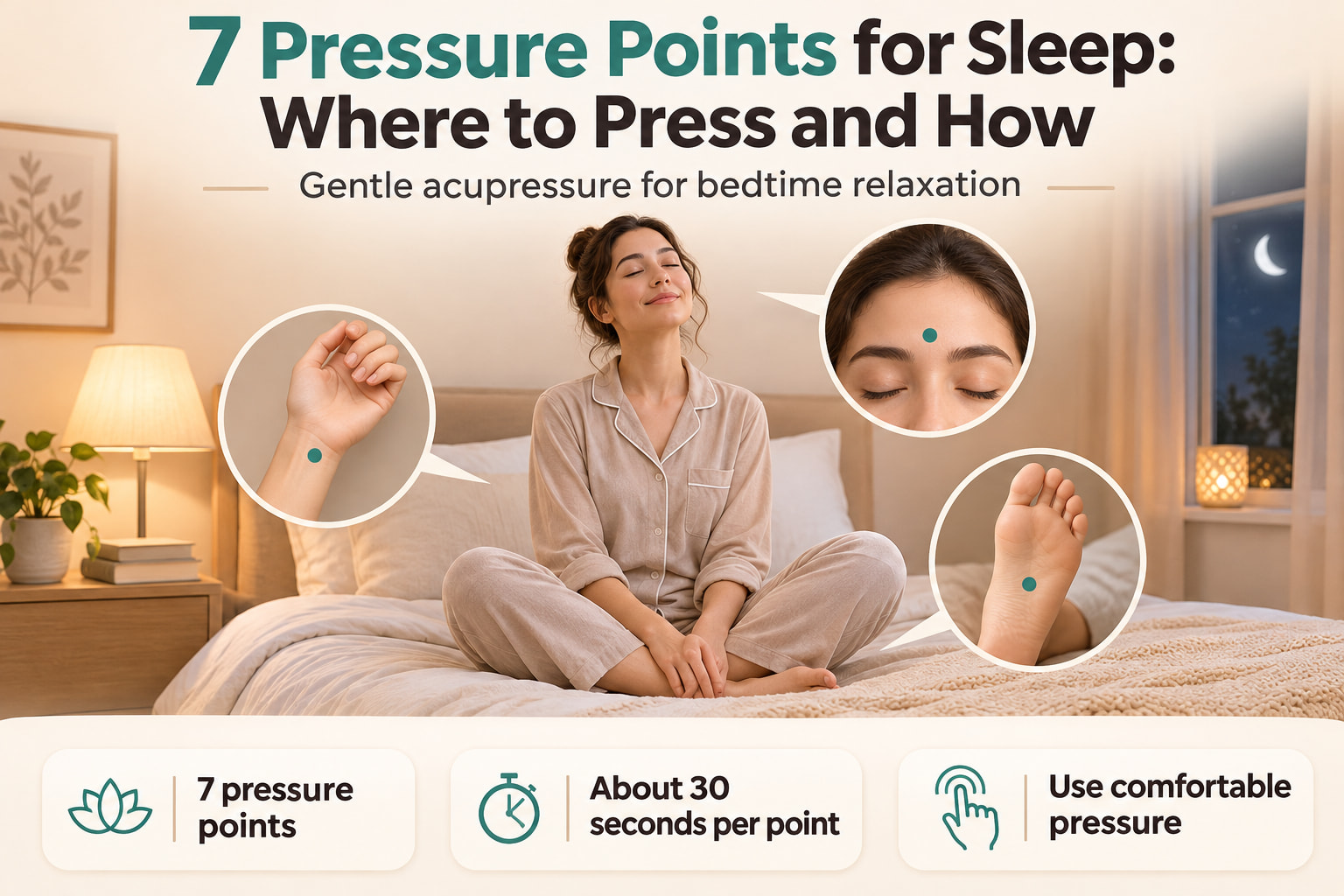
Pressure points for sleep are spots on the wrists, forehead, behind the ears, legs, and feet where gentle acupressure may help you relax before bed. Research suggests possible sleep benefits, but no point is guaranteed to make you fall asleep.
Knowing where to press and how much pressure to use can help keep the practice comfortable. Start with a short session, choose an accessible point, and avoid pressing through pain.
The seven points below are options for a calming bedtime routine. You do not need to use all of them. If you are pregnant or might be pregnant, speak with your healthcare professional before trying acupressure.
What Are Pressure Points for Sleep?
Pressure points, also called acupoints, are specific locations used in traditional Chinese medicine. Acupressure involves applying pressure with your fingers or thumbs. Acupuncture uses needles and requires a qualified practitioner.
For self-acupressure, the practical goal is gentle relaxation. Traditional explanations involving energy pathways are part of Chinese medicine theory; they should not be confused with established explanations of how sleep works.
The letters and numbers in point names identify their locations. They do not mean that pressing a point improves the function of a particular organ.
Do Pressure Points for Sleep Work?
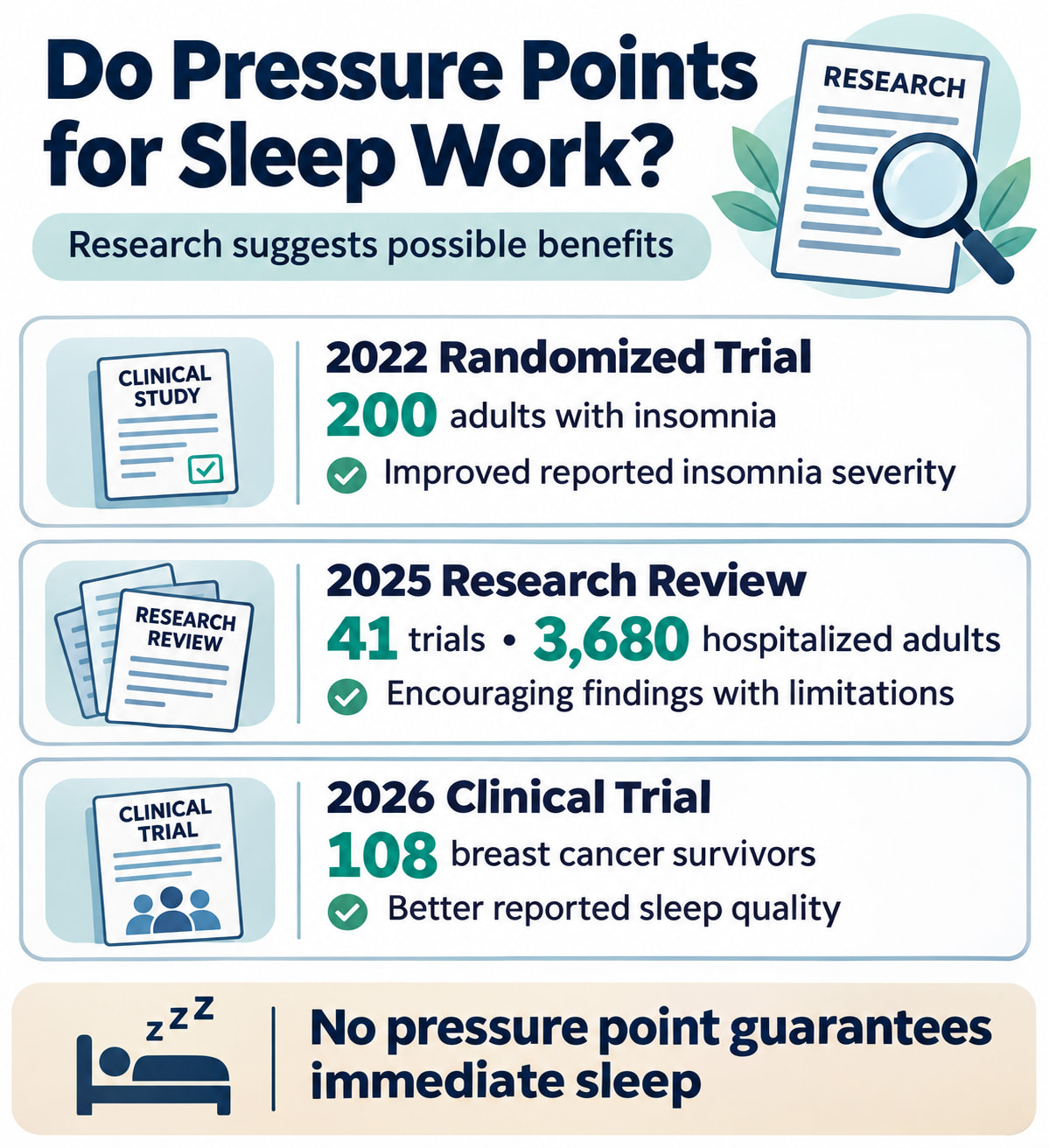
Some studies suggest that acupressure may improve reported sleep quality or insomnia symptoms. However, the results depend on the people studied, the routine used, and the comparison group.
A 2022 randomized trial in Phytomedicine included 200 adults with insomnia. Participants who learned self-acupressure reported greater improvements in insomnia severity over four to eight weeks than those who received sleep-hygiene education. The study did not compare acupressure with cognitive behavioral therapy for insomnia, or CBT-I.
A March 2025 review in Nursing & Health Sciences included 41 trials involving 3,680 hospitalized adults. It found encouraging results, but many studies used ear acupressure. Differences between studies, publication bias, and problems with blinding limited confidence in the findings.
More recently, a September 2026 trial involving 108 breast cancer survivors found better reported sleep quality with a multi-point self-acupressure routine than with sham acupressure or usual care. Its results may not apply to other adults.
These findings support cautious expectations. They do not establish a best pressure point, an ideal pressing duration, or a guaranteed way to fall asleep immediately.
7 Pressure Points for Sleep: Where to Press and How
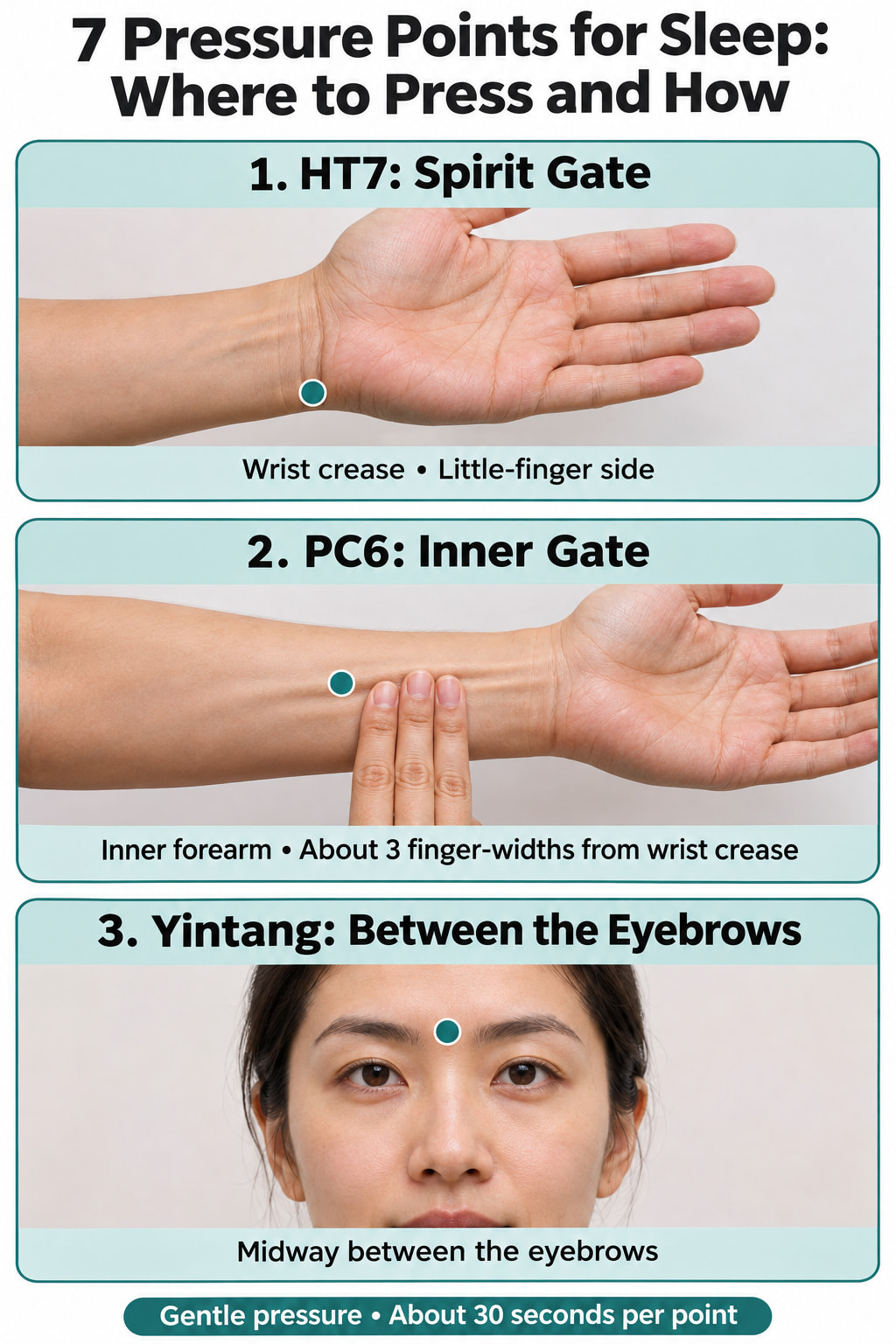
These points appear in institutional sleep and relaxation resources, including University of Minnesota guidance. This exact seven-point selection has not been established as a standard insomnia protocol.
For a simple starting duration, VA guidance recommends about 30 seconds per point, using comfortable pressure. Repeat on the other side for paired points. This is practical self-care guidance, not a proven sleep “dose.”
1. HT7: Spirit Gate
Where to press: On the palm side of your wrist, at the wrist crease near the little-finger edge.
How to find and press it:
- Rest your forearm on your lap or a pillow, with your palm facing upward.
- Find the crease where your wrist bends.
- Near the little-finger side, locate the small hollow beside the prominent tendon, toward the center of the wrist.
- Use your opposite thumb to apply gentle pressure or slow, small circles for about 30 seconds.
- Repeat on the other wrist.
Keep the hand relaxed. You should not need to bend your wrist forcefully to reach the point.
2. PC6: Inner Gate
Where to press: On your inner forearm, approximately three finger-widths from the wrist crease toward your elbow, between two tendons.
How to find and press it:
- Turn your palm upward.
- Place three fingers of your opposite hand across the inner forearm, starting at the wrist crease.
- At the edge farthest from your hand, find the space between the two tendons running along the forearm.
- Remove your measuring fingers and place your thumb over that space.
- Apply comfortable pressure for about 30 seconds, then switch arms.
Use your own finger-widths as an approximate guide. Avoid digging into the area if the tendons are difficult to identify.
3. Yintang: Between the Eyebrows
Where to press: At the midpoint between the inner ends of your eyebrows, above the bridge of your nose.
How to find and press it:
- Sit or lie in a comfortable position.
- Place one fingertip or your thumb between your eyebrows.
- Apply light pressure or make small, slow circles for about 30 seconds.
- Keep your jaw and forehead relaxed while breathing comfortably.
Keep your finger on the forehead between the eyebrows. Do not press on your eyes.
Yintang is easy to reach without changing position, which can make it a practical choice for a short evening routine.
4. Anmian: Behind the Ears
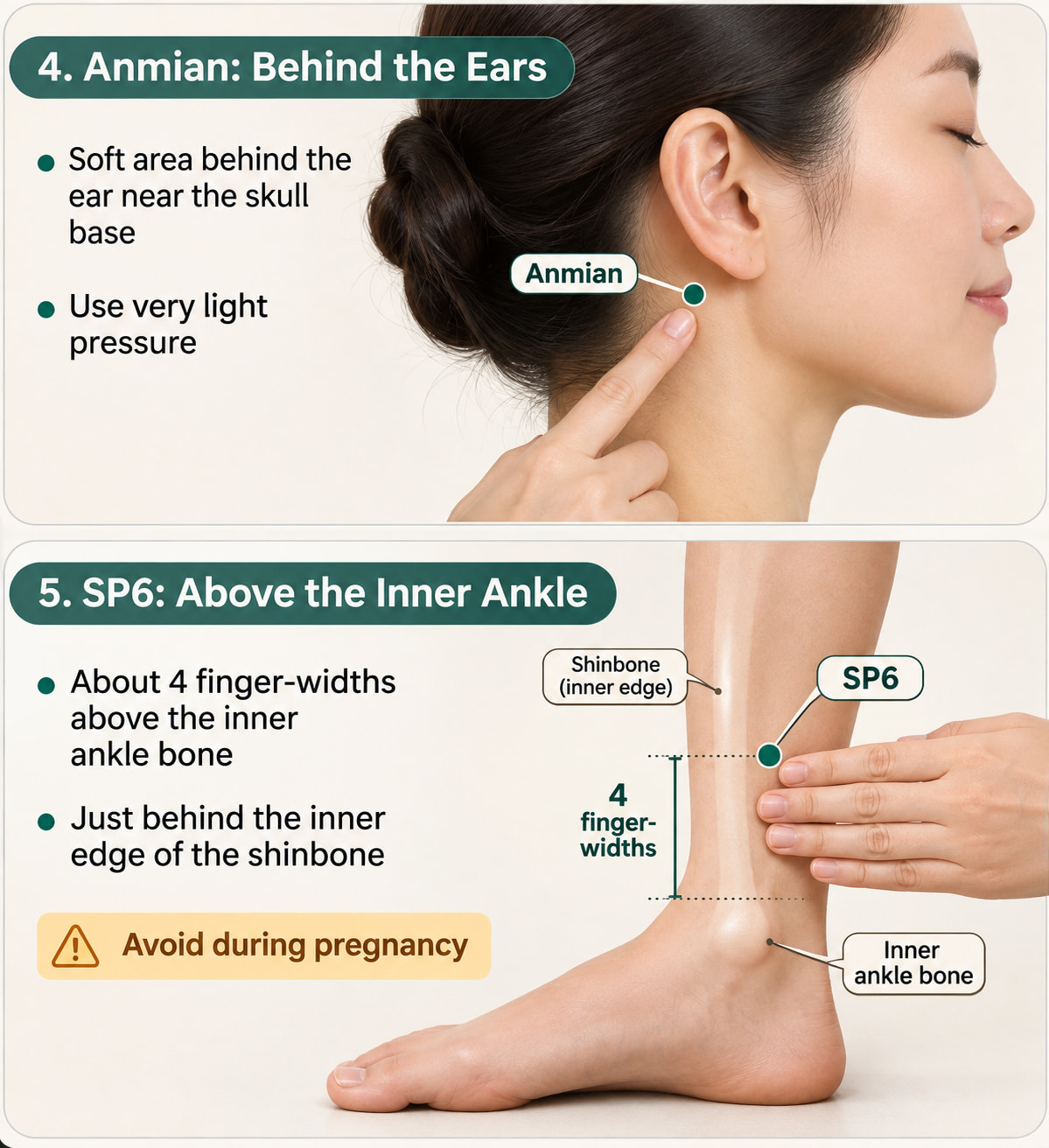
Where to press: In the soft area behind each ear near the base of the skull.
How to find and press it:
- Find the bony bump behind your ear.
- Move slightly backward toward the skull base to the nearby soft area.
- Use one fingertip to apply a very light touch for about 30 seconds.
- Repeat on the other side.
Avoid firm or deep pressure here. If you cannot confidently locate the area, skip this point and ask a trained practitioner to demonstrate it.
5. SP6: Above the Inner Ankle
Where to press: On the inner lower leg, approximately four finger-widths above the highest point of the inner ankle bone, just behind the inner edge of the shinbone.
How to find and press it:
- Sit with your lower leg supported.
- Locate the highest part of the ankle bone on the inside of your leg.
- Measure four of your own finger-widths upward.
- Move just behind the inner border of the shinbone.
- Apply gentle thumb pressure to the soft area for about 30 seconds, then switch legs.
Avoid pressing directly into the bone.
Pregnancy precaution: University of Minnesota guidance advises avoiding SP6 during pregnancy.
6. KI1: On the Sole of the Foot
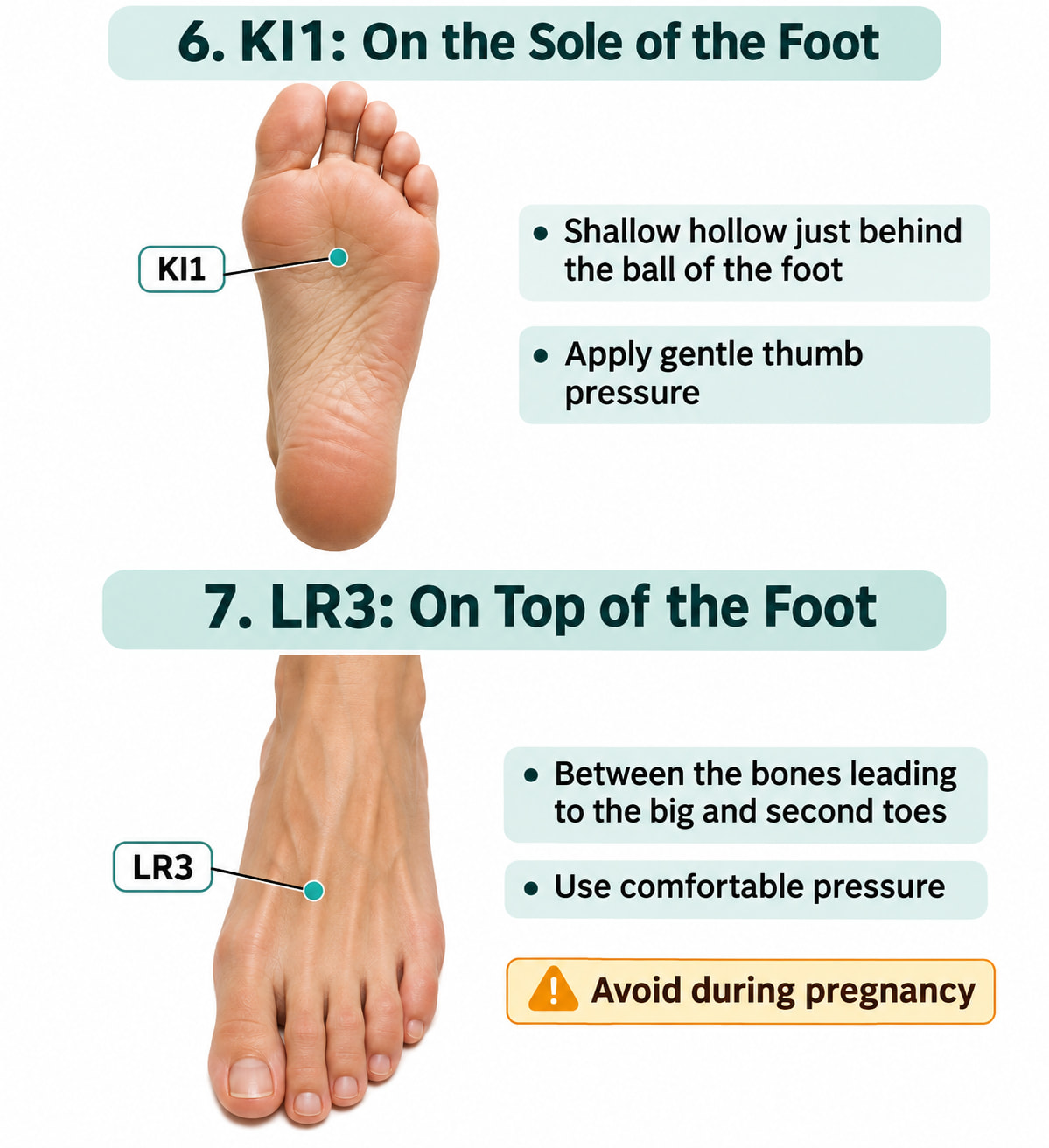
Where to press: In the shallow hollow on the sole, just behind the ball of the foot toward the heel. This point may also be labeled K1 or KD1.
How to find and press it:
- Sit with one foot comfortably supported where you can reach its sole.
- Locate the padded ball beneath the toes.
- Move slightly toward the heel to find the nearby hollow.
- Use your thumb to apply gentle pressure for about 30 seconds.
- Repeat on the other foot.
Keep the foot relaxed. Tenderness is not a sign that you need to press harder.
7. LR3: On Top of the Foot
Where to press: On top of the foot, in the space between the long bones leading to your big toe and second toe. It may also be called LV3.
How to find and press it:
- Place a fingertip between the bases of your big and second toes.
- Slide backward toward your ankle along the space between the two bones.
- Find the small hollow before that space narrows.
- Apply gentle pressure for about 30 seconds, then switch feet.
Pregnancy precaution: University of Minnesota guidance advises avoiding LR3 during pregnancy.
How to Use Acupressure Before Bed
Choose a comfortable position that lets you reach the point without straining. Support your arm or foot as needed, and use the pad of your finger or thumb.
A brief example could be:
- Yintang for about 30 seconds.
- HT7 on one wrist for about 30 seconds.
- HT7 on the other wrist for about 30 seconds.
That example simply organizes a short relaxation practice. No particular order has been established as best.
Breathe normally or slowly if that feels comfortable. Stop when you have finished the brief routine; you do not need to keep repeating it until you fall asleep.
Support your evening routine with a consistent wake-up time, a quiet and dark bedroom, and less caffeine close to bedtime. These habits can support sleep, but persistent insomnia may need more than changes to bedtime habits.
Safety Precautions Before Trying Pressure Points for Sleep
Acupressure should feel comfortable. Excessive pressure can cause bruising or lingering soreness.
Avoid pressing areas with:
- Broken skin, wounds, rashes, or infection.
- Bruising or recent tissue injury.
- Severe swelling.
- Numbness or reduced sensation.
- A recent blood clot.
Ask a healthcare professional before starting if you are pregnant, have a bleeding disorder, take blood-thinning medication, or are recovering from surgery near the area you want to press. The VA’s acupressure safety guidance recommends additional caution with bleeding disorders or blood-thinning medications.
Avoid SP6 and LR3 during pregnancy. Use especially light contact around Anmian, behind the ears.
Stop immediately if you develop pain, dizziness, or other unusual symptoms. Contact a healthcare professional if the symptoms continue.
When to Get Help for Sleep Problems
Speak with a healthcare professional if poor sleep affects your concentration, mood, work, or other daily activities.
According to NHLBI guidance, insomnia is considered chronic when it occurs at least three nights a week for three months or longer. You do not need to wait three months to ask for help.
Also arrange an assessment if you:
- Snore loudly and frequently.
- Wake up gasping for air.
- Have breathing pauses that someone else notices.
- Experience significant daytime sleepiness.
These can be signs of sleep apnea.
For chronic insomnia, CBT-I is a recommended clinical option. The 2025 VA/DoD guideline strongly recommends it. CBT-I helps people address sleep-related thoughts and behaviors; acupressure should not replace an existing care plan.
Frequently Asked Questions
Which Pressure Point Is Best for Sleep?
Research has not established one best point for everyone. Yintang and the wrist points are accessible options if you want a short routine. Choose a location you can reach comfortably rather than searching for a guaranteed “sleep switch.”
How Long Should You Press a Sleep Pressure Point?
About 30 seconds per point is a conservative starting instruction used in the VA sleep handout. The ideal duration for improving sleep has not been established. Pressure should stay comfortable, and you can stop sooner if needed.
Can Pressure Points Make You Fall Asleep Immediately?
There is no reliable basis for promising immediate sleep. The clinical studies discussed above assessed routines over several weeks. You may find the practice relaxing, but relaxation does not guarantee that you will fall asleep right away.
Where Are the Pressure Points for Sleep on Your Feet?
KI1 is on the sole, just behind the ball of the foot. LR3 is on top of the foot, between the bones leading to the big and second toes. SP6 is farther up the inner lower leg, above the ankle.
Can You Use Pressure Points for Sleep During Pregnancy?
Check with your prenatal care professional before trying acupressure. University of Minnesota guidance specifically advises avoiding SP6 and LR3 during pregnancy. Do not assume that a general bedtime routine is appropriate during pregnancy.
Can Acupressure Replace Care for Chronic Insomnia?
No. It may be an optional relaxation practice, but ongoing sleep difficulty deserves assessment. Continue your prescribed care plan and ask about options such as CBT-I if insomnia persists.
Conclusion
Pressure points for sleep offer a simple way to explore gentle relaxation before bed. Start with one accessible point, keep the pressure comfortable, and avoid expecting an immediate result.
If the practice feels pleasant and is appropriate for you, it can become part of your evening routine. If sleep problems continue or interfere with daily life, make an appointment to discuss what may be causing them.
This content is for informational purposes only and not medical advice.
References
- U.S. Department of Veterans Affairs. Acupressure for Sleep.
- University of Minnesota. Acupressure Sequences for Insomnia.
- Allina Health. How to Use Acupressure Points to Fall Asleep Naturally.
- Memorial Sloan Kettering Cancer Center. Acupressure for Stress and Anxiety and Acupressure for Nausea and Vomiting.
- Cleveland Clinic. What Is Acupressure and Does It Work?.
- Kaiser Permanente. Acupressure for Chronic Pain: Point Locations.
- Yeung and colleagues. Self-Administered Acupressure for Insomnia Disorder: A Randomized Controlled Trial.