
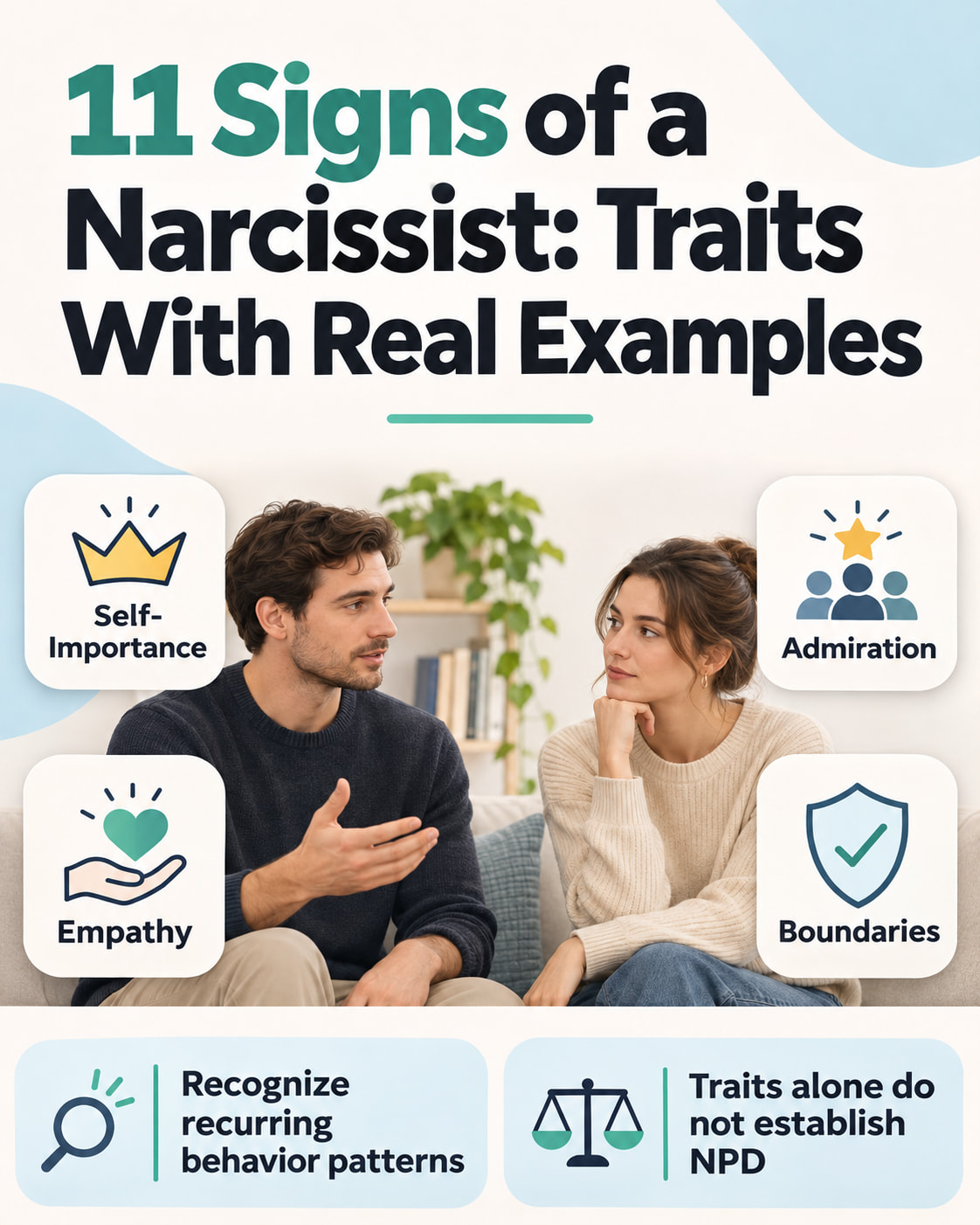
Common signs of a narcissist include exaggerated self-importance, an excessive need for admiration, entitlement, taking advantage of others, and difficulty recognizing other people’s feelings. These patterns can be associated with narcissism, but they do not establish that someone has narcissistic personality disorder (NPD).
Understanding the distinction can help you describe concerning behavior more clearly. The examples below explain recurring patterns, followed by practical guidance on boundaries and professional support.
What Does “Narcissist” Mean?
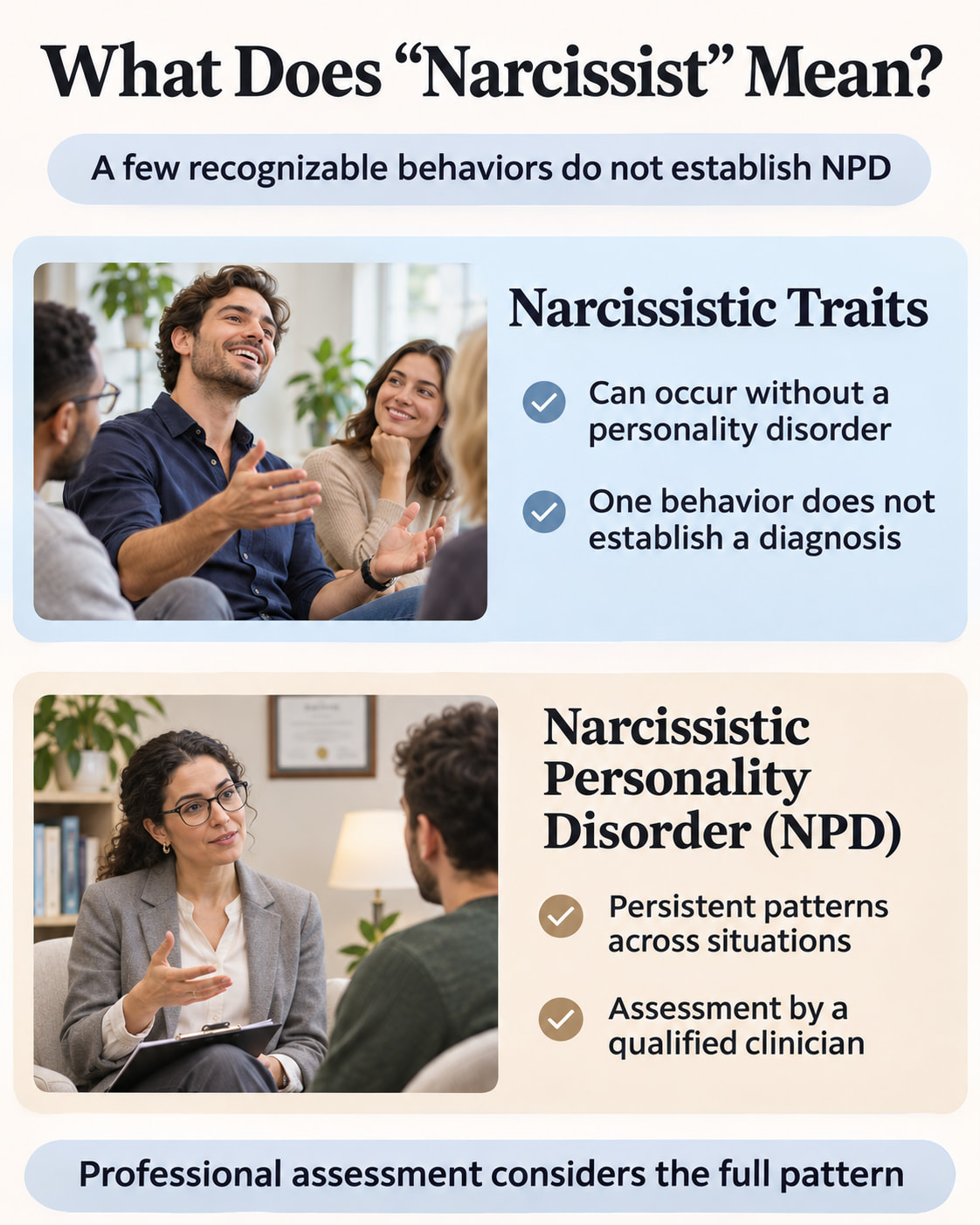
People often use “narcissist” to describe someone who seems unusually self-centered. NPD is a specific mental health condition involving persistent difficulties with self-image and relationships.
The American Psychiatric Association explains that narcissistic traits become a disorder when they are enduring, inflexible, and associated with significant distress or problems functioning. The pattern occurs across situations and generally begins by early adulthood.
A clinician considers the person’s history, the severity of their difficulties, and other possible explanations. One argument, an occasional selfish decision, or a confident personality cannot establish a diagnosis.
11 Signs of a Narcissist With Real Examples
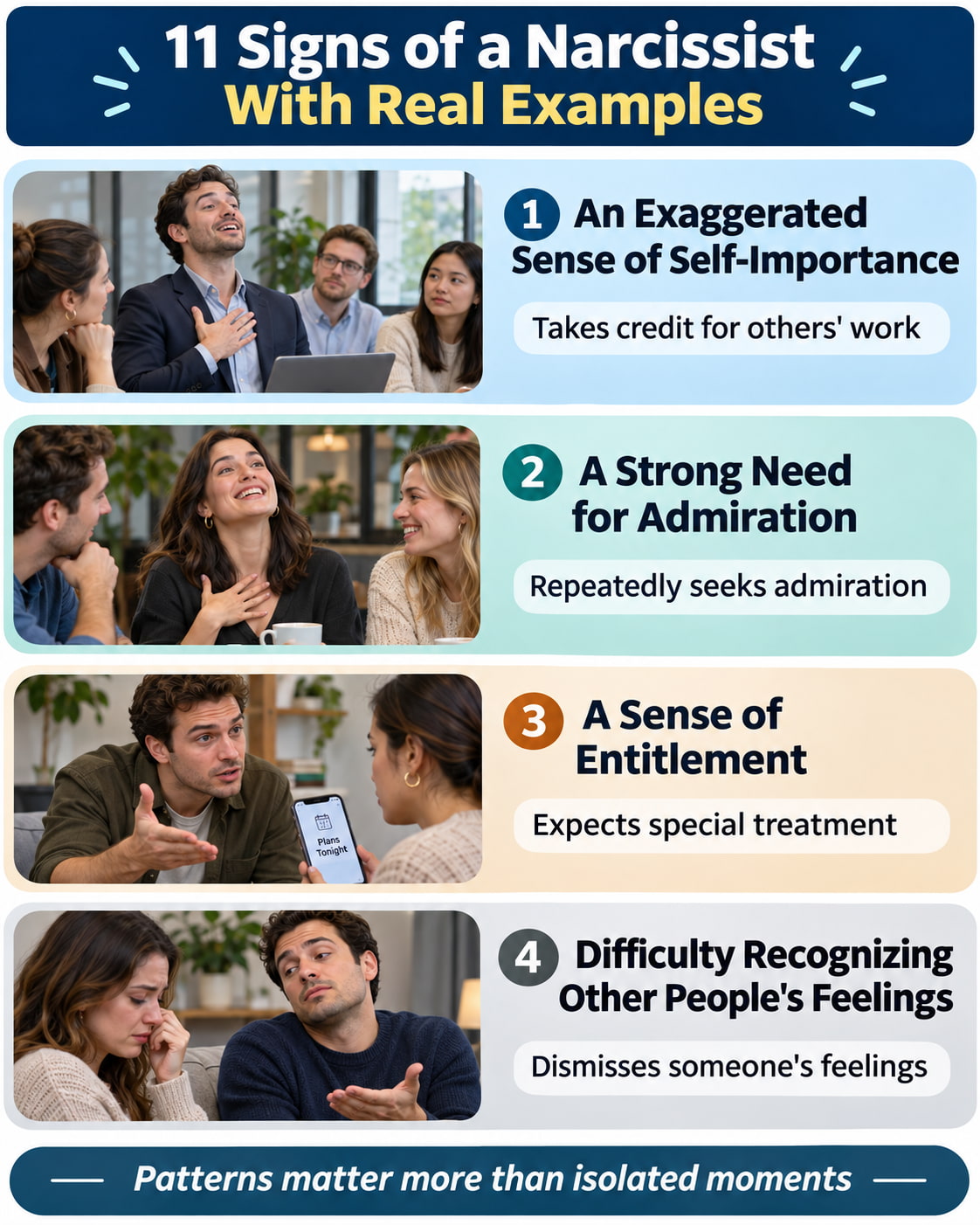
The first nine signs below reflect recognized clinical features of NPD. The final two describe associated patterns. Mayo Clinic’s overview describes these features and emphasizes that symptoms and severity vary.
The examples are hypothetical everyday situations, not actual patient histories. This list is educational and should not be used to score or diagnose someone.
1. An Exaggerated Sense of Self-Importance
This involves repeatedly overstating abilities, achievements, or personal importance. Someone may expect exceptional recognition even when their contribution does not support it.
Example: A coworker completes one part of a group project but repeatedly tells others that they were responsible for the entire result. When teammates describe their contributions, the coworker dismisses them as unimportant.
The concern is the recurring mismatch between the person’s claims and what happened. Taking pride in an accomplishment is different from routinely minimizing everyone else’s role.
2. A Strong Need for Admiration
Someone may depend heavily on praise and repeatedly seek acknowledgment. Conversations can become opportunities to secure reassurance about being exceptional, impressive, or superior.
Example: During a friend’s birthday dinner, a person repeatedly redirects the discussion toward their own promotion. Even after receiving congratulations, they keep pressing others to acknowledge how impressive it is.
Enjoying compliments is ordinary. The concerning pattern involves excessive demands for admiration that leave little space for other people’s experiences.
3. A Sense of Entitlement
Entitlement means expecting special treatment or assuming that other people should comply with one’s wishes. The person’s preferences may consistently take priority over others’ needs.
Example: A friend expects you to cancel plans whenever they want company. If you decline, they insist that your existing commitments should not matter.
Asking for help or accommodation is not inherently entitled. Pay attention to whether the person recognizes your right to say no and considers the effects of their demands.
4. Difficulty Recognizing Other People’s Feelings
A person may repeatedly overlook, dismiss, or struggle to respond to others’ emotional needs. This can become especially apparent when another person’s feelings conflict with what they want.
Example: You explain that a joke about a painful experience hurt you. The person repeatedly dismisses your concern and focuses only on how inconvenient it is to discuss it.
An awkward response does not establish an empathy problem. The broader concern is recurring disregard, including after someone has clearly explained how they feel.
5. Taking Advantage of Others

This pattern involves using other people to meet personal goals with little consideration for the costs to them. It may appear in friendships, families, or workplaces.
Example: A colleague regularly asks you to finish their responsibilities, accepts the recognition, and dismisses your concern when you explain that the extra work is affecting your own deadlines.
Asking for support is normal. A repeated arrangement in which one person benefits while disregarding the other’s needs deserves closer attention.
6. Preoccupation With Exceptional Success, Power, or Ideal Love
Someone may become absorbed in fantasies of extraordinary achievement, influence, beauty, or a flawless relationship. These expectations can make realistic goals and ordinary relationships seem inadequate.
Example: A person repeatedly insists that only a prestigious, widely admired partner would be suitable for them. They dismiss otherwise meaningful relationships because those relationships do not match that ideal.
Ambition and high standards are not signs of a disorder by themselves. The issue is rigid preoccupation that distorts expectations and devalues everyday achievements or connections.
7. Believing They Are Uniquely Special
A person may believe that only exceptional or high-status people can understand them. They may dismiss others because of perceived social standing rather than actual knowledge or character.
Example: Someone rejects a qualified professional’s explanation by insisting that only a famous expert could understand a person of their importance.
Seeking specialized expertise is reasonable. The concerning pattern is treating prestige as proof of another person’s worth while assuming ordinary people are inherently incapable of understanding them.
8. Envy or Believing Others Are Envious
This can involve repeatedly resenting others’ achievements or assuming that other people are jealous. It may make recognition and success feel like competitions.
Example: When a coworker earns a promotion, a person immediately minimizes the achievement. Later, they dismiss reasonable feedback about their own performance as jealousy.
Occasional envy is a common emotion. A more concerning pattern is habitually devaluing others’ accomplishments or using assumed jealousy to dismiss what they say.
9. Arrogant or Condescending Behavior
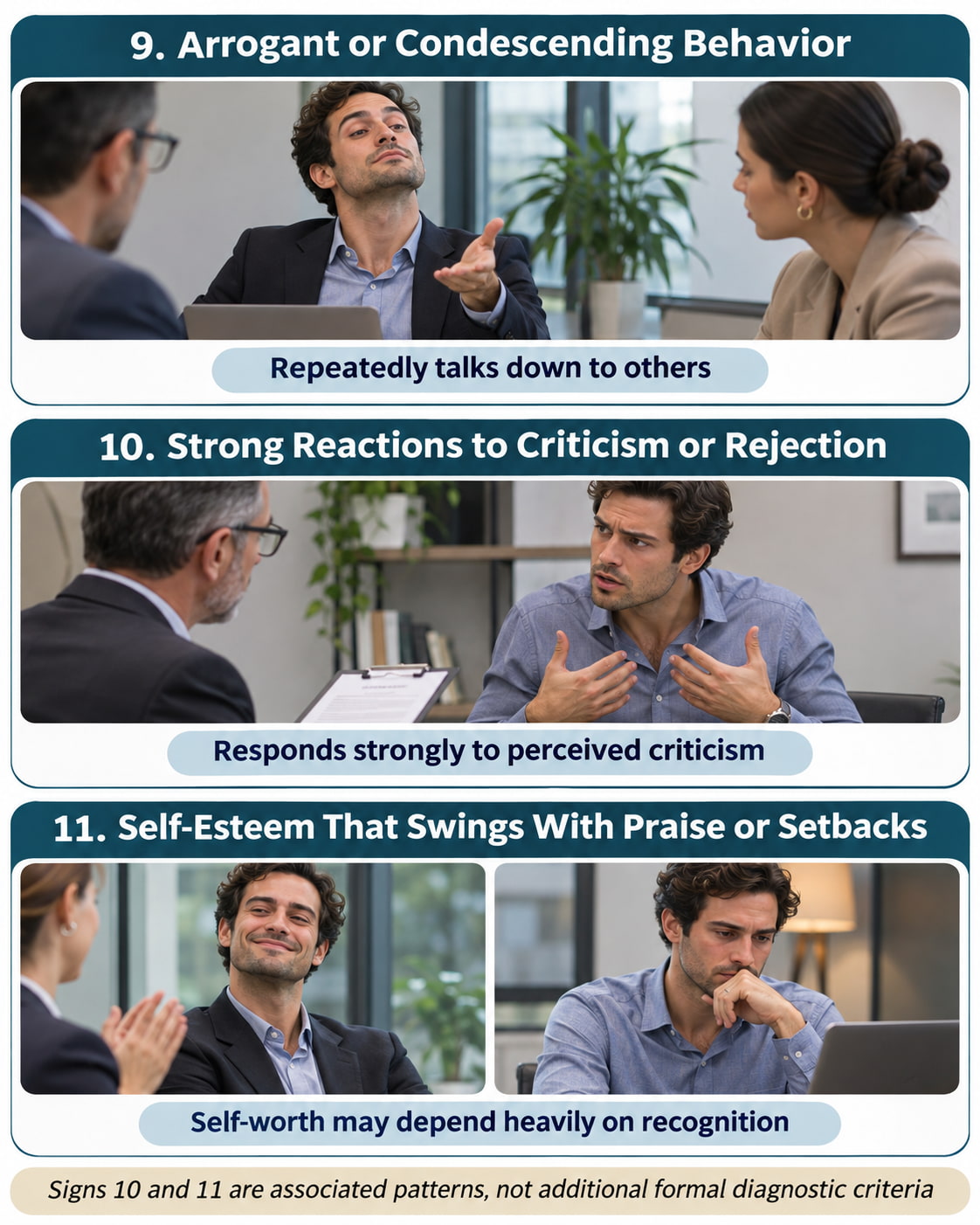
Arrogance may appear through habitual superiority, dismissiveness, or contempt. A person may treat those they consider less important as undeserving of respect.
Example: Someone regularly talks down to service staff, ignores coworkers they consider beneath them, and mocks people for asking questions.
Repeated disrespect is worth addressing regardless of its cause. It does not, on its own, identify a personality disorder.
10. Strong Reactions to Criticism or Rejection
Perceived criticism may trigger intense anger, contempt, shame, or withdrawal. Reactions vary; an outwardly angry response is not universal.
Example: A manager suggests a small revision to a report. The employee repeatedly responds by attacking the manager’s competence or describing the feedback as deeply humiliating.
Sensitivity to criticism occurs in many circumstances. In narcissistic patterns, clinicians consider how it connects with self-image, expectations of recognition, and broader relationship difficulties.
11. Self-Esteem That Swings With Praise or Setbacks
Some people experience self-worth that depends heavily on outside recognition. Their view of themselves may shift between feeling exceptional and feeling deeply inadequate.
Example: After receiving praise, someone describes themselves as far more capable than everyone else. Following a minor setback, they describe themselves as worthless and withdraw from colleagues.
These shifts cannot always be observed from the outside. Neither unstable self-esteem nor insecurity alone establishes NPD, and outward confidence does not prove hidden insecurity.
What to Do if You Notice These Patterns
You do not need to settle on a diagnosis before deciding what behavior you will accept. Start with the specific problem, its effect on you, and the support you need.
Describe the Behavior Clearly
Use concrete observations when it feels safe to discuss a concern.
For example: “You interrupted me several times during the meeting, and I could not finish explaining my work.”
This gives the conversation a specific focus. A statement such as “You’re a narcissist” is a diagnostic accusation and does not explain what needs to change.
Set Boundaries Around Your Own Actions
Cleveland Clinic’s guidance recommends clear boundaries and attention to your own well-being.
A boundary describes what you will do:
- “If you insult me, I will end the conversation.”
- “I can help for 20 minutes, but I cannot complete your assignment.”
- “I will discuss this when we can both speak respectfully.”
Choose limits you can realistically follow. A boundary cannot guarantee another person’s cooperation.
Seek Support for Yourself
Consider speaking with a trusted person or a mental health professional if the situation is affecting your well-being. You can discuss your experiences and options even if the other person has never received a diagnosis.
Focus on how the relationship affects you rather than making yourself responsible for persuading someone to change.
Take Abuse Seriously, Regardless of Diagnosis
NPD and abuse are not interchangeable. The National Domestic Violence Hotline explains that not everyone who abuses has NPD, and not everyone with NPD abuses a partner.
If there are threats, intimidation, coercion, or fear of retaliation, seek individualized support and safety planning. Do not assume confronting the person about narcissism is safe.
In the United States, call 800-799-SAFE (7233) or text START to 88788 for domestic violence support. If you are in immediate danger, contact local emergency services.
When to Seek Professional Support
Consider an assessment if you recognize persistent patterns in yourself that are harming relationships, work, or daily functioning. You can also seek support for the effects of someone else’s behavior.
According to Mayo Clinic’s guidance on assessment and care, evaluation considers symptoms, their impact, and a thorough psychological assessment. Psychotherapy may help people work on relationships, emotional regulation, self-esteem, and realistic goals.
If you are considering an appointment, bring a few specific examples: what happened, how you responded, and what difficulties keep recurring. You do not need to arrive with a diagnosis.
Frequently Asked Questions
Can Someone Have Narcissistic Traits Without Having NPD?
Yes. Narcissistic traits can occur without a personality disorder. Clinical assessment considers whether the pattern is persistent, inflexible, and associated with significant distress or difficulty functioning. A few recognizable behaviors do not establish NPD.
What Is the Difference Between Confidence and Narcissism?
Confidence can coexist with acknowledging limitations, accepting feedback, and respecting other people’s contributions. The patterns discussed here involve excessive self-importance, demands for admiration, entitlement, or disregard for others. Being confident or proud of your work is not enough to identify a disorder.
What Does Covert Narcissism Mean?
“Covert narcissism” is an informal description of narcissistic features that may be less outwardly obvious. Cleveland Clinic explains that overt and covert are not separate formal NPD diagnoses. Shyness, introversion, or insecurity alone should not be interpreted as covert narcissism.
Can an Online Narcissism Test Provide a Diagnosis?
No. A questionnaire may prompt reflection or contribute to a professional assessment, but an online result cannot establish NPD. A qualified clinician considers history, context, functioning, and other possible explanations.
Can Someone With Narcissistic Personality Disorder Change?
Improvement is possible, although outcomes vary. A 2026 randomized trial involving 114 participants reported reduced NPD symptom severity in both psychotherapy groups across a 12-month follow-up. That finding supports the possibility of improvement; it does not guarantee an individual’s outcome. You are not responsible for making another person change.
What if I Recognize These Signs in Myself?
Consider discussing recurring difficulties with a qualified mental health professional. Bring examples of conflicts, reactions to feedback, and problems with self-worth. Recognizing a pattern does not confirm NPD, and asking whether you have it does not rule it out. You can seek help with the difficulties themselves.
Conclusion
The signs of a narcissist are most useful as descriptions of recurring patterns, not as labels to assign after a difficult interaction. Look at the behavior, its context, and its effect on relationships and daily life.
If these patterns concern you, choose one practical next step: identify a boundary, talk with someone you trust, or arrange professional support. You can take your well-being seriously while leaving diagnosis to a qualified clinician.
This content is for informational purposes only and not medical advice.
References
- American Psychiatric Association: What Is Narcissistic Personality Disorder?
- Merck Manual: Narcissistic Personality Disorder.
- Mayo Clinic: Narcissistic Personality Disorder—Symptoms and Causes.
- Cleveland Clinic: Narcissistic Personality Disorder.
- NAMI: Help and Support for Narcissistic Personality Disorder.
- Mayo Clinic: Narcissistic Personality Disorder—Diagnosis and Treatment.