
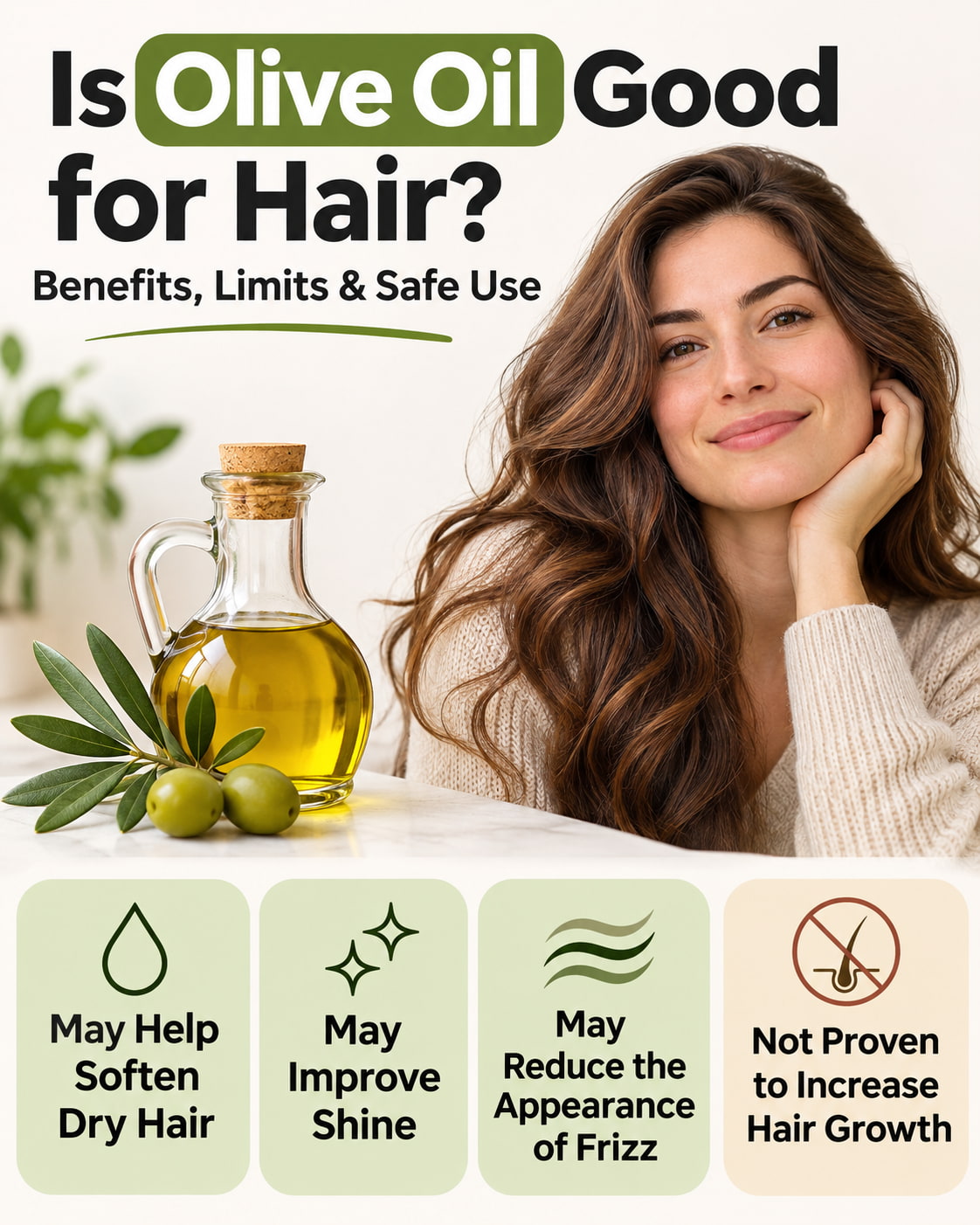
Olive oil may help dry hair feel softer, look shinier, and appear less frizzy, but it is not proven to increase human hair growth. Results depend on your hair and scalp.
The key is to separate conditioning your strands from addressing a scalp problem. You can assess an optional cosmetic product by how your hair feels and behaves. Persistent itching, scaling, or hair loss needs attention to its cause.
Potential Benefits of Olive Oil for Hair
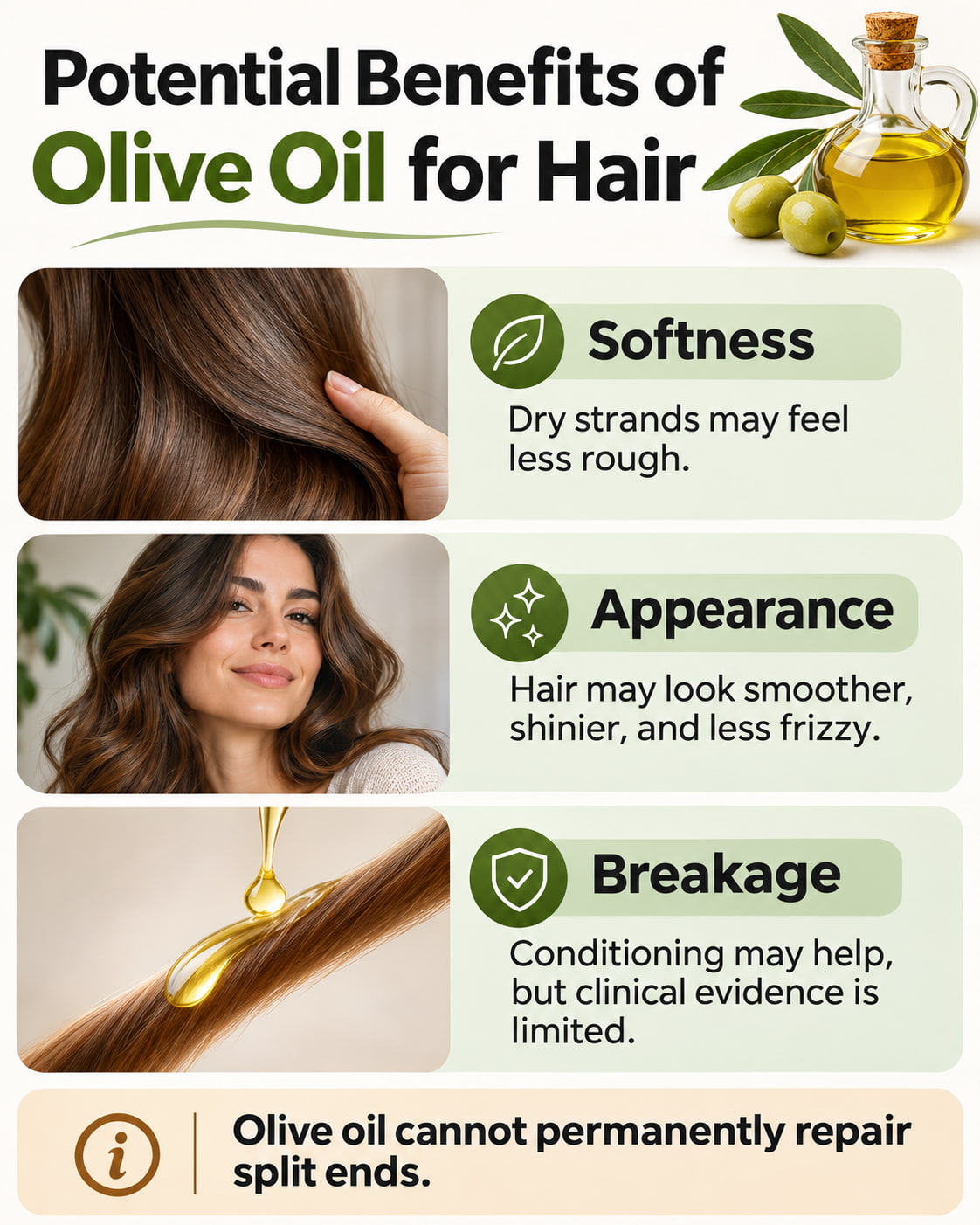
Cleveland Clinic guidance, published in August 2026, describes several possible benefits:
- Softness: Dry strands may feel less rough.
- Appearance: Hair may look smoother, shinier, and less frizzy.
- Breakage: Conditioning may help, although clinical evidence for olive oil is limited.
These are cosmetic effects. Olive oil cannot permanently repair split ends.
Research offers some support for how oils interact with hair. A 2005 laboratory study found changes consistent with olive oil entering human hair fibers and leaving a thinner surface film. However, this did not establish how much benefit someone would notice in everyday use.
Oil penetration alone does not prove faster growth, stronger hair, or a particular reduction in breakage.
Is Olive Oil Good for Hair Growth?
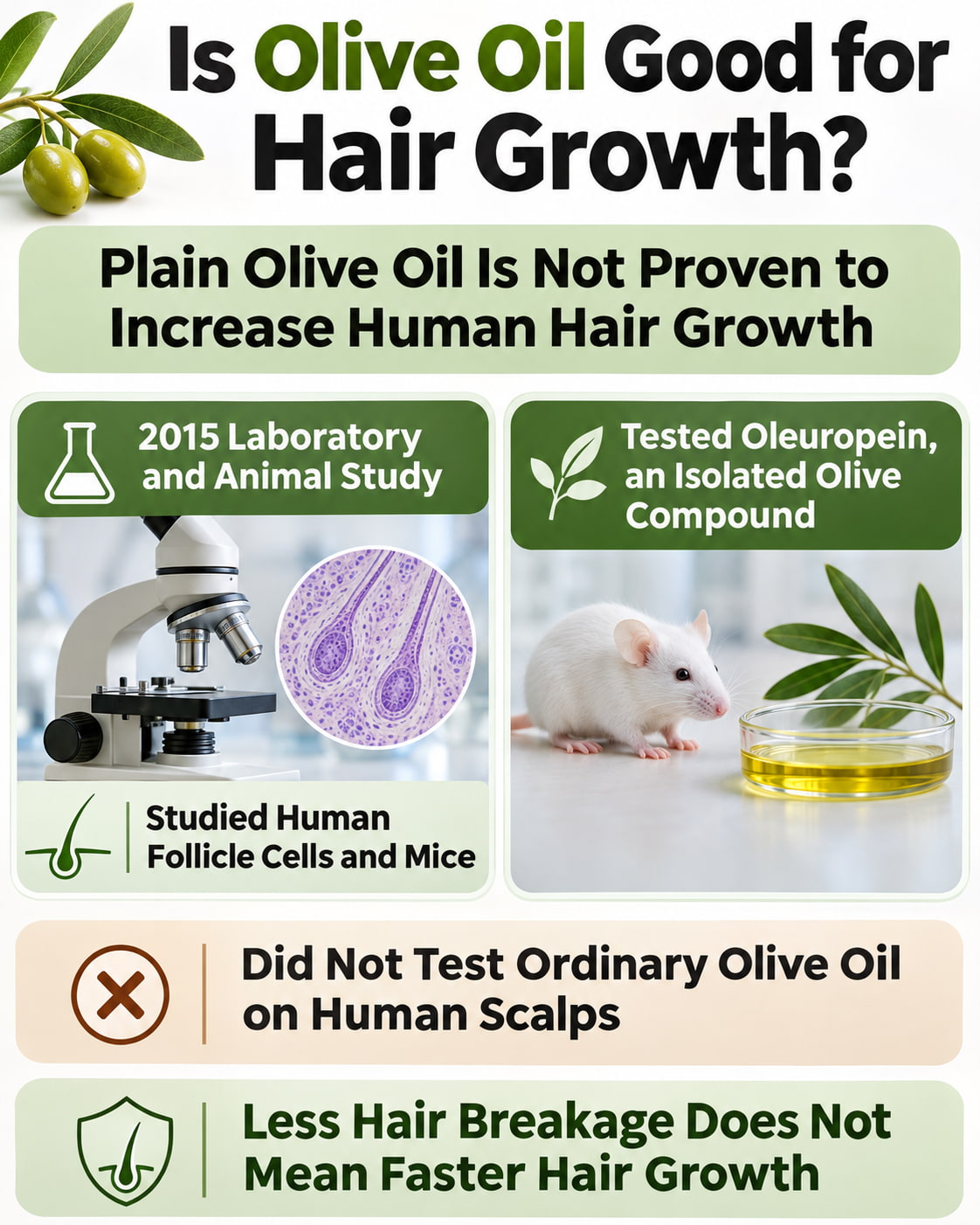
There is insufficient evidence that plain olive oil makes human hair grow faster or increases hair density.
A frequently cited 2015 laboratory and animal study tested oleuropein, an isolated olive compound. Researchers observed effects in cultured human follicle cells and growth-phase activity in mice.
That experiment did not test kitchen olive oil on people’s scalps. Results from isolated cells or mice cannot establish that applying olive oil will reverse thinning.
If fewer existing strands break, you may retain more length. That does not demonstrate a change in how quickly follicles produce hair.
Which Hair Types May Benefit From Olive Oil?
| Hair type | What to consider |
|---|---|
| Dry, thick, coarse, or curly hair | May tolerate an oil coating better. |
| Fine hair | Can look flat or weighed down. |
| Naturally oily hair | Added oil may feel greasy. |
Hair texture does not determine scalp health. For example, you can have dry ends and an oily, flaky scalp at the same time. Choose care for your strands and scalp separately rather than assuming one product suits both.
How to Use Olive Oil on Hair
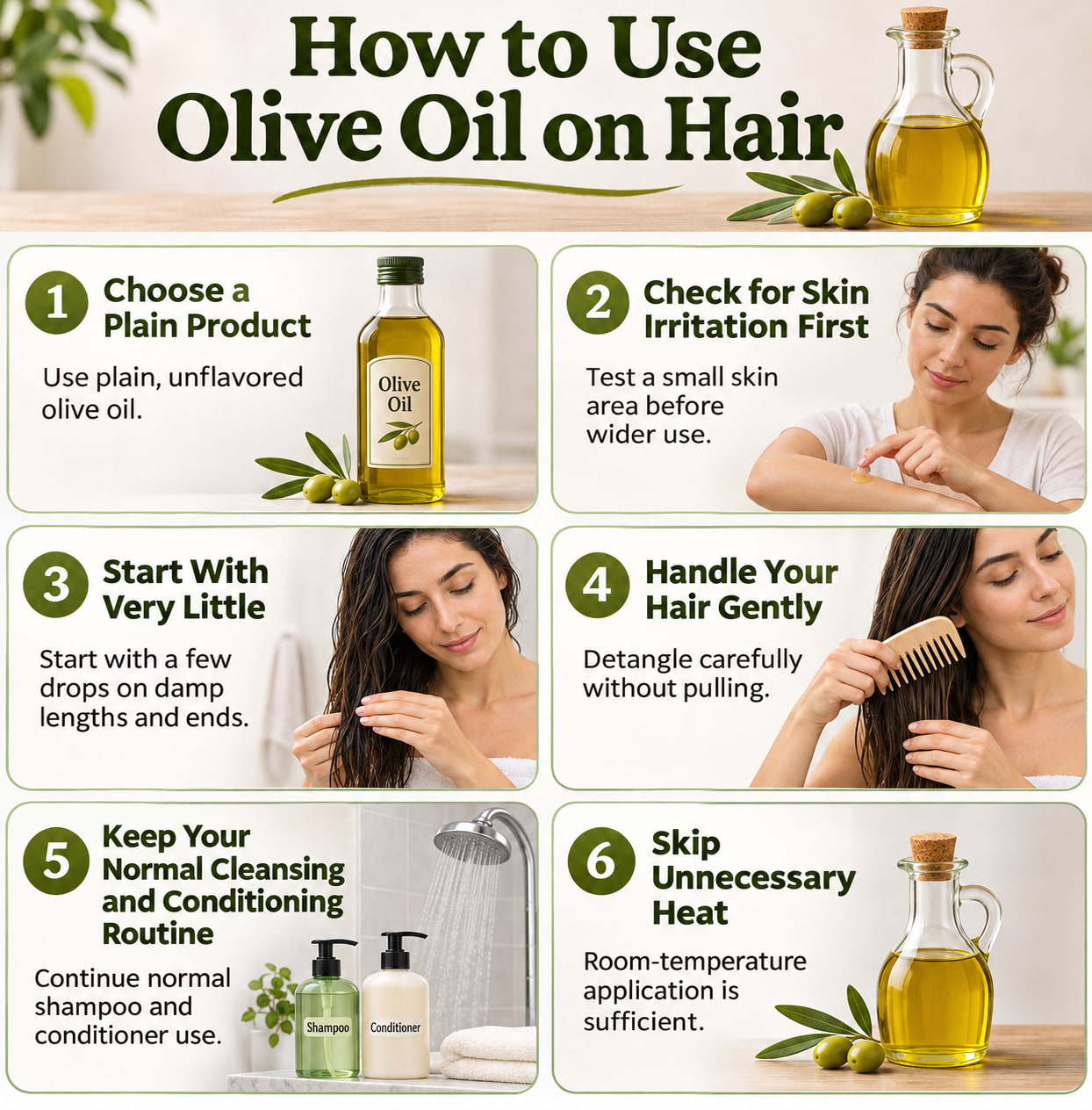
The following steps offer a cautious way to try it. They are practical guidance, not a clinically established regimen.
1. Choose a Plain Product
Choose plain, unflavored olive oil without added fragrance.
2. Check for Skin Irritation First
Follow the AAD’s product-testing guidance before wider use. It recommends trying a product on a small area of skin twice daily for seven to ten days, using it as you normally would.
For something you intend to rinse off, do not leave the test application on indefinitely. Wash it off and stop using it if redness, itching, or swelling develops.
This is a precaution, not a guarantee against future reactions. If you already have eczema or irritated skin, ask your clinician before experimenting.
3. Start With Very Little
Distribute a few drops through damp mid-lengths and ends. Avoid saturating your scalp.
Assess the result before adding more. If the trial does not improve how your hair feels or behaves, there is no reason to keep increasing the amount.
4. Handle Your Hair Gently
Avoid pulling oil through tangles with force. The AAD recommends gentle detangling with a wide-tooth comb, starting at the ends and working upward.
Detangling also depends on texture. Curly hair is often easier to detangle while conditioner is still in it; straight hair may benefit from drying slightly first.
Oil does not make rough brushing harmless.
5. Keep Your Normal Cleansing and Conditioning Routine
Wash according to your hair type, scalp oiliness, and product buildup. Focus shampoo on the scalp and continue using conditioner after washing.
Treat olive oil as an optional addition to that routine. You do not need to replace a conditioner that already works well.
6. Skip Unnecessary Heat
Room-temperature use is a straightforward choice. There is no need to heat the oil for this trial.
The AAD specifically advises people experiencing hair loss to avoid hot-oil applications because heat can further damage fragile hair. For styling, keep heat moderate and use a product intended for heat protection.
When to Avoid Olive Oil on Your Scalp
Persistent Dandruff or Seborrheic Dermatitis
Flakes do not automatically mean your scalp needs more oil.
MyHealth Alberta’s guidance advises people with seborrheic dermatitis to avoid olive-oil-containing products and keep oils off the scalp.
This advice applies to a particular condition; it does not mean every healthy scalp will react badly. However, persistent itching or scaling is a reason to seek guidance before starting scalp oiling.
The AAD recommends professional assessment when dandruff is severe or does not improve with appropriate care.
Sensitive or Eczema-Prone Skin
A small controlled skin study, published in the January–February 2013 issue of Pediatric Dermatology, involved 19 adults across two experiments. Repeated olive-oil application was associated with reduced skin-barrier integrity and mild redness.
The researchers studied forearms over several weeks, not occasional use on hair ends. The findings support caution with repeated skin application, especially when discussing sensitive skin, but do not prove that all hair use is harmful.
Breakouts Around the Hairline
Oily hair products can transfer onto the forehead, hairline, or neck and contribute to breakouts. Keep excess product away from those areas, particularly if you notice new bumps after changing your routine.
Babies’ Cradle Cap
Do not extend adult hair-conditioning advice to babies. NHS guidance, reviewed in October 2025, specifically advises against olive oil for cradle cap.
Symptoms That Need Assessment
Stop using the product if irritation develops. Arrange professional advice for persistent scalp symptoms or new or worsening hair loss.
Increasing pain, swelling, warmth, or pus around a scalp rash warrants prompt medical attention. Adding more oil will not identify the underlying problem.
Olive Oil vs. Coconut Oil for Hair
Coconut oil has direct published evidence for reducing hair-protein loss under certain experimental conditions.
In a 2003 study, researchers compared coconut, sunflower, and mineral oils. Coconut oil reduced protein loss from damaged and undamaged hair when used before or after washing.
Olive oil was not included in that comparison. The results cannot prove that coconut oil is better than olive oil in a direct contest.
The useful distinction is the evidence for a specific outcome. Neither that experiment nor personal preference establishes that an oil will increase human hair growth.
Frequently Asked Questions
Can You Leave Olive Oil in Your Hair Overnight?
Overnight use has not been shown to provide extra benefit. A cautious first trial does not need an overnight application. Avoid prolonged scalp contact if you have irritation, dandruff, or a condition for which your clinician advises against oiling.
Should You Put Olive Oil on Wet or Dry Hair?
Damp lengths and ends are a reasonable starting point. Keep handling gentle, particularly when your hair is wet.
How Often Should You Use Olive Oil on Your Hair?
There is no clinically established frequency for healthy adult hair. Avoid automatically adding it every day. Judge whether it is useful after washing and styling, and stop if it causes discomfort or makes your routine harder to manage.
How Long Should You Leave Olive Oil in Your Hair?
Research does not establish an ideal contact time. Wash it out if it feels uncomfortable or leaves unwanted residue.
Is Extra Virgin Olive Oil Better for Hair?
There is no convincing clinical evidence that extra virgin olive oil produces better hair outcomes than other plain olive oils. Labels such as organic or cold-pressed should not be interpreted as proof of superior growth benefits.
Can Olive Oil Make Dandruff Worse?
It may be unsuitable for some people with dandruff or seborrheic dermatitis. If flaking or itching increases after use, stop applying it and seek advice about your scalp care.
Can Olive Oil Replace Conditioner?
It is better viewed as optional. Conditioner is a standard part of the AAD’s recommended hair-care routine and helps with detangling and manageability. If your conditioner already works, you do not need olive oil to complete the routine.
Conclusion
Olive oil is an optional cosmetic experiment, and your response matters more than a trend or a promised timeline.
If you want to try it, start cautiously, change one part of your routine at a time, and judge the result after your next wash. Continue only if it makes your hair easier to manage without causing problems. For persistent scalp symptoms or hair loss, prioritize finding the cause with a qualified clinician.
This content is for informational purposes only and not medical advice.
References
- Cleveland Clinic. Olive oil for hair: Benefits and precautions.
- Keis K, et al. Oil penetration into human hair fibers.
- Tong T, et al. Oleuropein and hair growth in mouse skin.
- American Academy of Dermatology. Tips for healthy hair.
- American Academy of Dermatology. Testing skin care products.
- American Academy of Dermatology. Hair-loss care tips.
- MyHealth Alberta. Seborrheic dermatitis care instructions.
- American Academy of Dermatology. Dandruff guidance.