
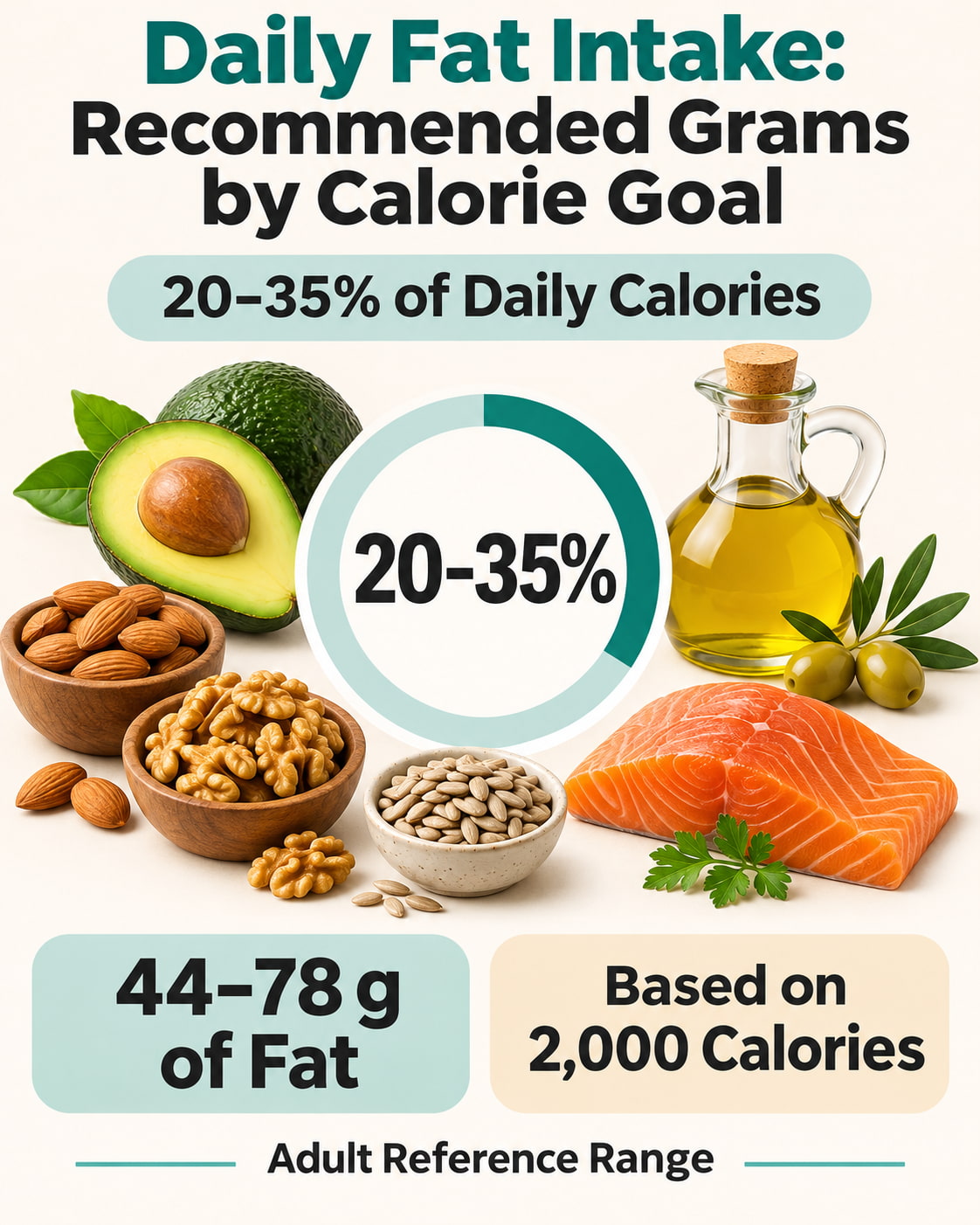
For most adults, daily fat intake can be planned around 20–35% of total calories, which equals about 44–78 grams on a 2,000-calorie diet. Your gram range changes with your calorie needs, and the types of fat you eat matter alongside the amount.
Understanding that difference makes food labels and meal planning easier. Use the chart below to estimate a range, learn how saturated fat fits within it, and choose foods that support a balanced eating pattern.
What Is the Recommended Daily Fat Intake?
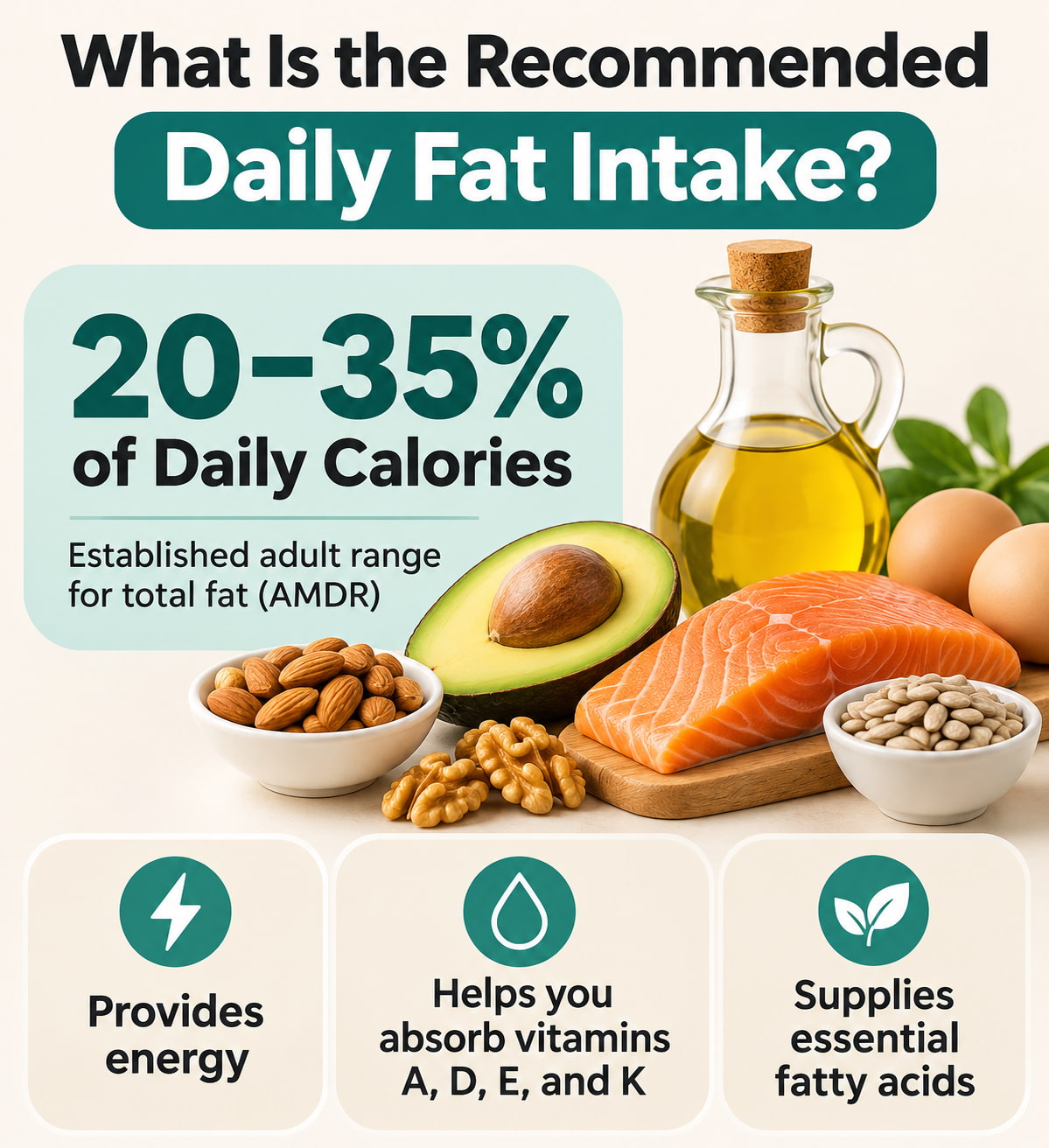
The National Academies identify 20–35% of calories as the established adult Acceptable Macronutrient Distribution Range, or AMDR, for total fat. This is a general planning range. There is no single adult Recommended Dietary Allowance, or RDA, for total fat in grams.
Dietary fat supplies energy and helps your body absorb vitamins A, D, E, and K. Your diet also needs to supply essential fatty acids.
Your total includes fat already present in foods as well as fat added during cooking. Oils, dressings, nuts, seeds, dairy products, eggs, meat, and fish can all contribute.
Daily Fat Intake Chart by Calorie Goal
Find your daily calorie level in the table to see the corresponding adult fat range.
| Daily calories | Total fat at 20–35% of calories | Example at 30% of calories |
|---|---|---|
| 1,200 | 27–47 g | 40 g |
| 1,500 | 33–58 g | 50 g |
| 1,600 | 36–62 g | 53 g |
| 1,800 | 40–70 g | 60 g |
| 2,000 | 44–78 g | 67 g |
| 2,200 | 49–86 g | 73 g |
| 2,400 | 53–93 g | 80 g |
| 2,500 | 56–97 g | 83 g |
| 2,800 | 62–109 g | 93 g |
| 3,000 | 67–117 g | 100 g |
Values are calculated using 9 calories per gram of fat and rounded to the nearest gram. Calorie levels are examples; the chart does not determine how many calories you should eat.
The 30% column shows one option within the reference range. It is not a separate requirement or the ideal target for everyone.
For example, if your appropriate calorie intake is 1,800 calories, the reference range is approximately 40–70 grams of fat. You do not need to aim for the highest number simply because it appears in the range.
How to Calculate Your Daily Fat Intake
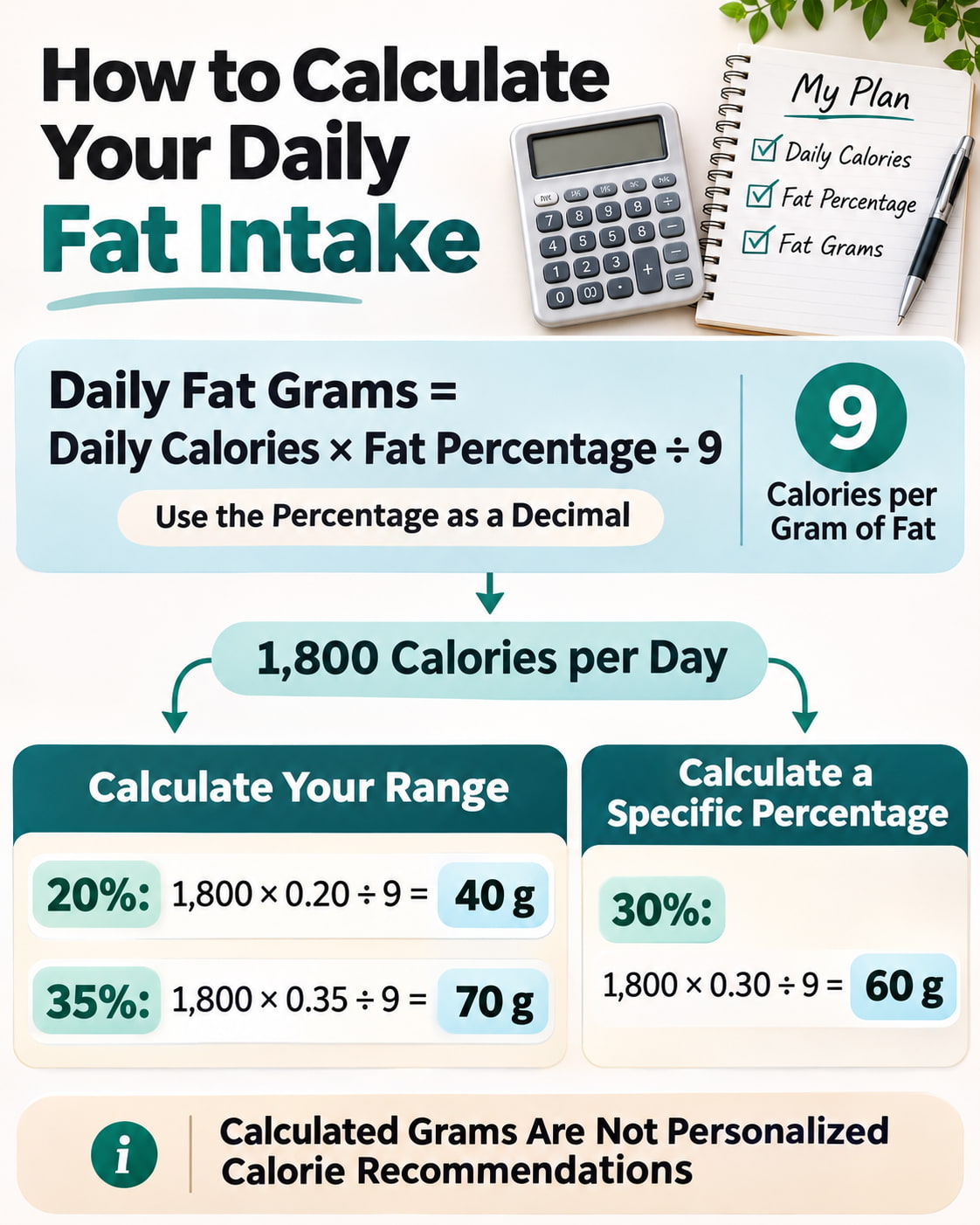
Each gram of fat provides 9 calories.
Use this formula:
Daily fat grams = daily calories × fat percentage as a decimal ÷ 9
Calculate Your Range
To find the lower and upper ends of the adult reference range:
- Multiply your daily calories by 0.20, then divide by 9.
- Multiply your daily calories by 0.35, then divide by 9.
For a 1,800-calorie intake:
- Lower end: 1,800 × 0.20 ÷ 9 = 40 grams
- Upper end: 1,800 × 0.35 ÷ 9 = 70 grams
Calculate a Specific Percentage
If you are planning for 30% of calories from fat:
1,800 × 0.30 ÷ 9 = 60 grams of fat per day
These calculations convert a calorie goal into grams. They do not establish an appropriate calorie goal by themselves.
How Much Saturated Fat Should You Eat Per Day?
The Dietary Guidelines for Americans, 2025–2030, published in January 2026, state that saturated fat generally should not exceed 10% of total daily calories.
To convert that percentage into grams, multiply daily calories by 0.10 and divide by 9.
| Daily calories | Saturated fat equivalent to 10% of calories |
|---|---|
| 1,500 | About 16.7 g |
| 1,800 | 20 g |
| 2,000 | About 22.2 g |
| 2,500 | About 27.8 g |
| 3,000 | About 33.3 g |
These figures represent approximate upper limits under the federal guidance. They are not amounts you need to reach.
Saturated fat is included in total fat. If your total-fat target is 60 grams, saturated fat counts toward those 60 grams.
If a health professional has recommended a lower saturated-fat limit for you, use that individualized guidance.
Which Types of Fat Should You Choose?
WHO guidance, updated in January 2026, favors unsaturated fats over saturated and trans fats.
Unsaturated Fats
Sources include:
- Olive, canola, soybean, and sunflower oils
- Nuts and seeds
- Avocados
- Fish
Use these foods to replace some sources of saturated fat while keeping portions appropriate for your calorie needs.
For example, you could use olive oil in place of butter for a suitable dish or choose a portion of nuts instead of a snack high in saturated fat.
Saturated Fats
Foods that can contribute substantial saturated fat include butter, ghee, cream, cheese, fatty cuts of meat, and coconut or palm oil.
Plant-based does not automatically mean low in saturated fat. Check the label, especially on foods made with coconut or palm oil.
Trans Fats
WHO recommends that trans fat provide no more than 1% of total calories and advises avoiding industrially produced trans fats.
Treat that percentage as a ceiling, not a target to reach.
Daily Fat Intake for Weight Loss
There is no single fat-gram target that guarantees weight loss.
NIDDK guidance emphasizes choosing a healthy eating plan you can maintain and reducing calorie intake when weight loss is appropriate. Foods containing unsaturated fats can fit within that plan.
A useful approach is to:
- Establish an appropriate calorie goal.
- Calculate a fat range that fits that goal.
- Include foods that provide protein, fiber, and other nutrients.
- Pay attention to portions of oils, dressings, spreads, and snacks.
For example, reducing cooking oil from 20 grams to 10 grams reduces its contribution by about 90 calories. That may help adjust a meal’s calories, but it does not guarantee weight loss or establish the right portion for everyone.
Avoid assuming that a food labeled “low fat” is automatically the best choice. Consider its calories, serving size, and overall nutritional value.
How to Track Fat Using Nutrition Labels
Start With the Serving Size
Nutrition information usually describes one serving. Multiply the listed amounts by the number of servings you actually eat.
For example, if a food contains 8 grams of fat per serving and you eat two servings, count 16 grams of fat.
For a homemade dish, add the fat from its ingredients and divide by the number of portions. Include cooking oils, dressings, and toppings in the calculation.
Count Total Fat Once
The saturated-fat and trans-fat lines describe parts of the total.
If a label lists:
- Total fat: 10 grams
- Saturated fat: 3 grams
You consumed 10 grams of total fat, including those 3 grams of saturated fat. The total is not 13 grams.
Understand the FDA Daily Values
The FDA Daily Values used on standard labels are:
| Nutrient | Daily Value |
|---|---|
| Total fat | 78 g |
| Saturated fat | 20 g |
These are labeling reference amounts. Your own calculated fat range may differ.
The FDA’s 20-gram saturated-fat Daily Value is also different from the mathematical equivalent of 10% of a 2,000-calorie intake, which is approximately 22.2 grams.
Use Percent Daily Value for Comparisons
As a general label-reading guide:
- 5% Daily Value or less per serving is low.
- 20% Daily Value or more per serving is high.
Percent Daily Value is not the percentage of calories supplied by fat.
For example, a food with 20% Daily Value for total fat does not necessarily get 20% of its calories from fat. Use the gram amount when tracking your intake and compare saturated fat between similar foods with similar serving sizes.
When Daily Fat Intake Needs Individual Guidance
The adult chart is a starting reference. It cannot account for every person’s age, activity level, health needs, or existing eating plan.
Children and teenagers have different reference ranges and growth needs. They should not use an adult calorie chart to set their own calorie targets.
During pregnancy or breastfeeding, or when following a medically prescribed diet, get help choosing appropriate calorie and nutrient goals. A registered dietitian can also help if you are unsure how to balance fat with the rest of your diet.
Frequently Asked Questions
How Many Grams of Fat Should I Eat on a 2,000-Calorie Diet?
The established adult range of 20–35% of calories equals approximately 44–78 grams of total fat. A 30% example would provide about 67 grams. Choose within an appropriate overall eating plan.
How Much Fat Should I Eat on a 1,500-Calorie Diet?
At 1,500 calories, 20–35% of calories equals approximately 33–58 grams of fat. This calculation does not mean that 1,500 calories is an appropriate intake for everyone.
Is 60 Grams of Fat a Day Too Much?
It depends on your calorie intake. Sixty grams provides 540 calories, or 27% of a 2,000-calorie diet, which falls within the adult reference range. Fat sources and your saturated-fat intake still matter.
Is 100 Grams of Fat a Day Too Much?
One hundred grams provides 900 calories. That equals 45% of a 2,000-calorie diet, above the adult reference range, but 30% of a 3,000-calorie diet, within it. The gram amount needs calorie context.
Does Saturated Fat Count Toward Total Fat?
Yes. Saturated fat is one component of total fat. Track it separately when checking your saturated-fat limit, but do not add it to the total-fat number again.
Do Men and Women Need Different Amounts of Fat?
The adult percentage range is the same for men and women. Gram amounts can differ because calorie needs vary with factors such as age, body size, and activity level.
Can I Lose Weight Without Following a Low-Fat Diet?
Yes. A sustainable eating plan that provides fewer calories than your body uses can support weight loss without eliminating dietary fat. Portions, total calories, nutritional quality, and consistency all matter.
Conclusion
Use your calorie needs to estimate daily fat intake, then consider both the amount and the sources. The adult 20–35% reference range provides a useful starting point, while saturated fat needs its own limit within that total.
Start with the chart, check a few labels on foods you eat regularly, and look for practical ways to include unsaturated fats within your calorie goal.
This content is for informational purposes only and not medical advice.
References
- National Academies of Sciences, Engineering, and Medicine. Description of the Acceptable Macronutrient Distribution Range. 2024; discusses the established 2002/2005 reference ranges.
- US Department of Agriculture and US Department of Health and Human Services. Dietary Guidelines for Americans, 2025–2030. January 2026.
- US Food and Drug Administration. Interactive Nutrition Facts Label: Total Fat.
- US Food and Drug Administration. Daily Value on the Nutrition and Supplement Facts Labels.
- US Food and Drug Administration. How to Understand and Use the Nutrition Facts Label.
- World Health Organization. Healthy Diet.
- National Institute of Diabetes and Digestive and Kidney Diseases. Eating and Physical Activity to Lose or Maintain Weight.
- National Institute of Diabetes and Digestive and Kidney Diseases. Some Myths About Nutrition and Physical Activity.