
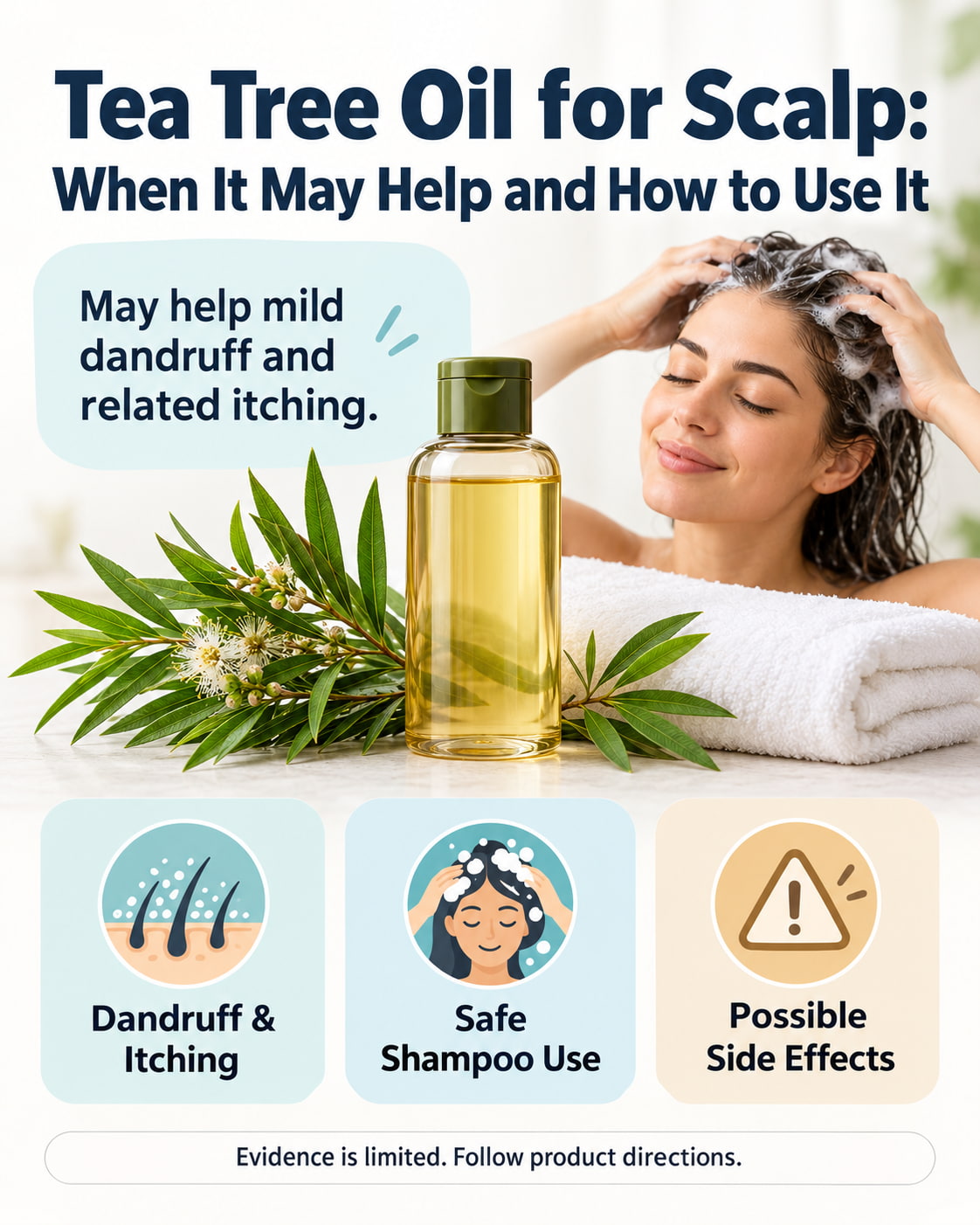
Tea tree oil for scalp care may help reduce mild dandruff and related itching when used in a formulated shampoo, but the evidence is limited. It can also cause irritation or allergic reactions, so the product you choose and the cause of your symptoms matter.
An itchy, flaky scalp does not always mean dandruff. Before trying tea tree oil, understand what it may help with, follow the product’s directions, and recognize symptoms that need professional attention.
What Is Tea Tree Oil?
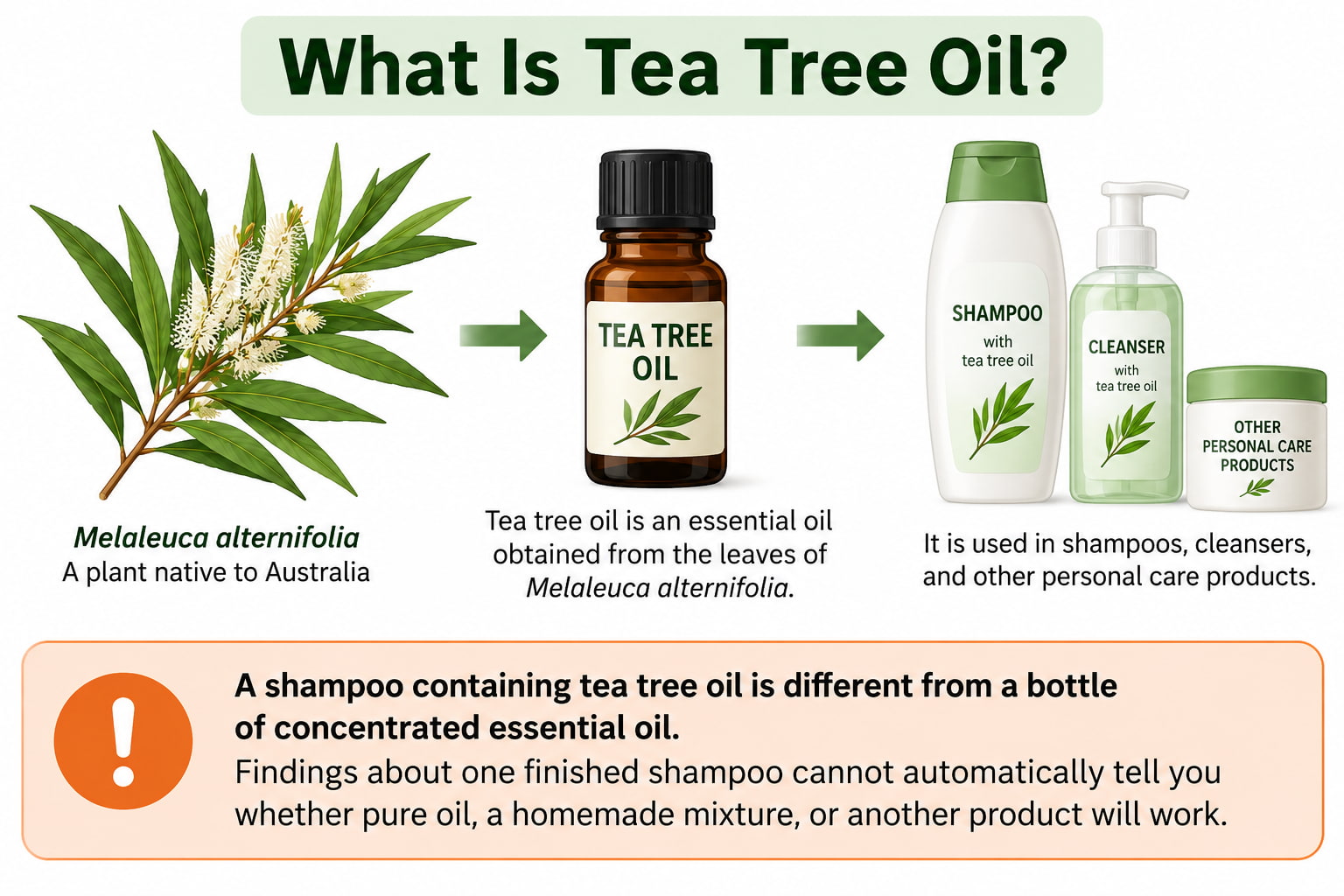
Tea tree oil is an essential oil obtained from the leaves of Melaleuca alternifolia, a plant native to Australia. It is used in shampoos, cleansers, and other personal care products.
A shampoo containing tea tree oil is different from a bottle of concentrated essential oil. Findings about one finished shampoo cannot automatically tell you whether pure oil, a homemade mixture, or another product will work.
When Tea Tree Oil for Scalp May Help
Mild Dandruff and Related Itching
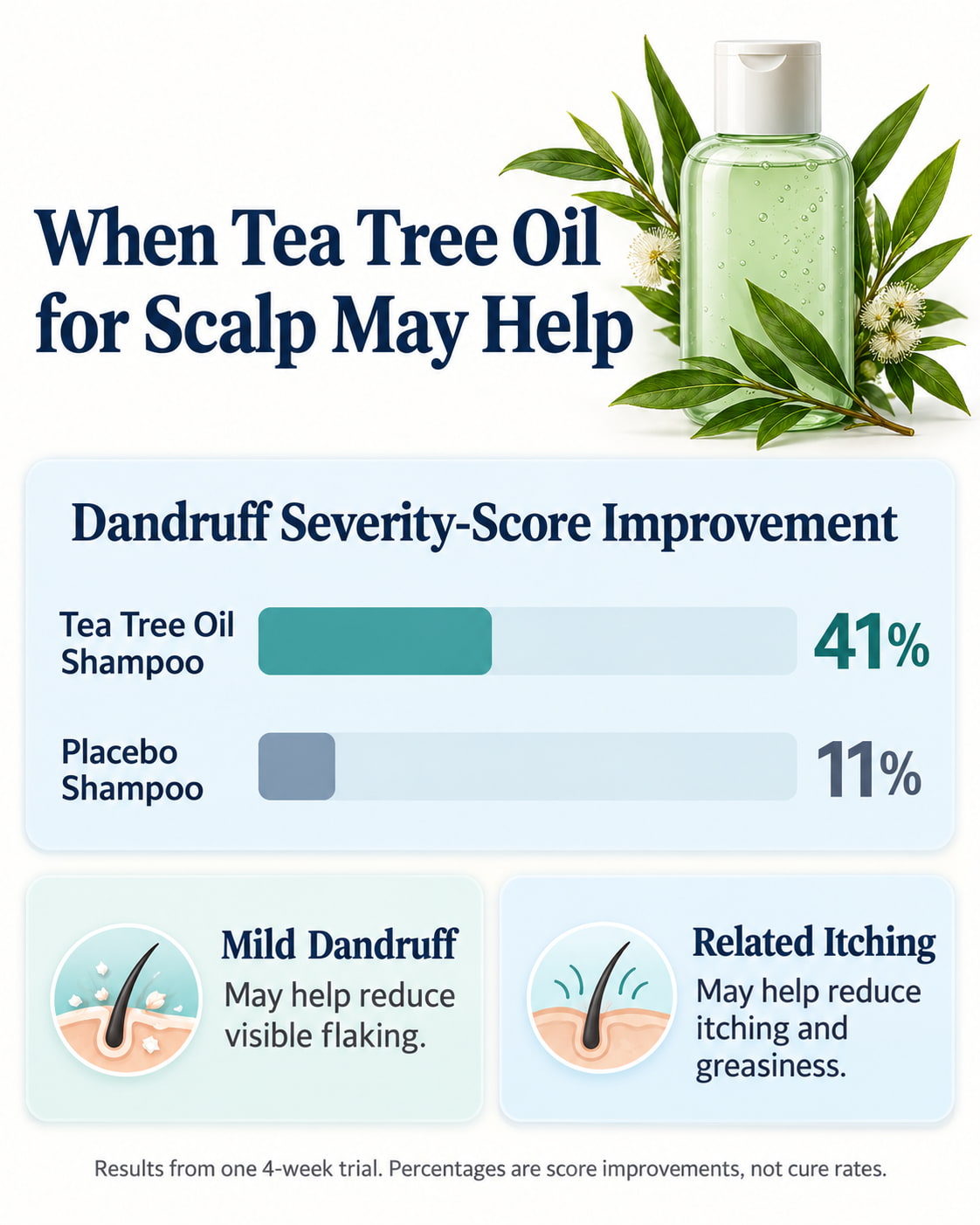
The clearest scalp-specific evidence comes from a 2002 randomized trial involving 126 people with mild to moderate dandruff. Participants used either a 5% tea tree oil shampoo or a placebo shampoo daily for four weeks.
Dandruff severity scores improved by 41% with tea tree oil shampoo, compared with 11% with placebo. Itching and greasiness also improved.
The 41% figure describes improvement in a severity score. It does not mean that 41% of participants became dandruff-free.
The study was short, single-blind, and did not compare tea tree oil with standard medicated dandruff shampoos. It therefore cannot establish long-term effectiveness or show that tea tree oil is the better option.
What About a Sensitive Scalp?
A small study published in 2025 reported improvements in redness and inflammation after tea tree oil shampoo use. However, it involved only nine adults and lacked a randomized comparison group.
That is not enough evidence to recommend tea tree oil broadly for sensitive scalps. If your scalp already burns or reacts easily to products, adding an essential oil may make choosing suitable care more complicated.
What Tea Tree Oil Has Not Been Proven to Do
Regrow Hair
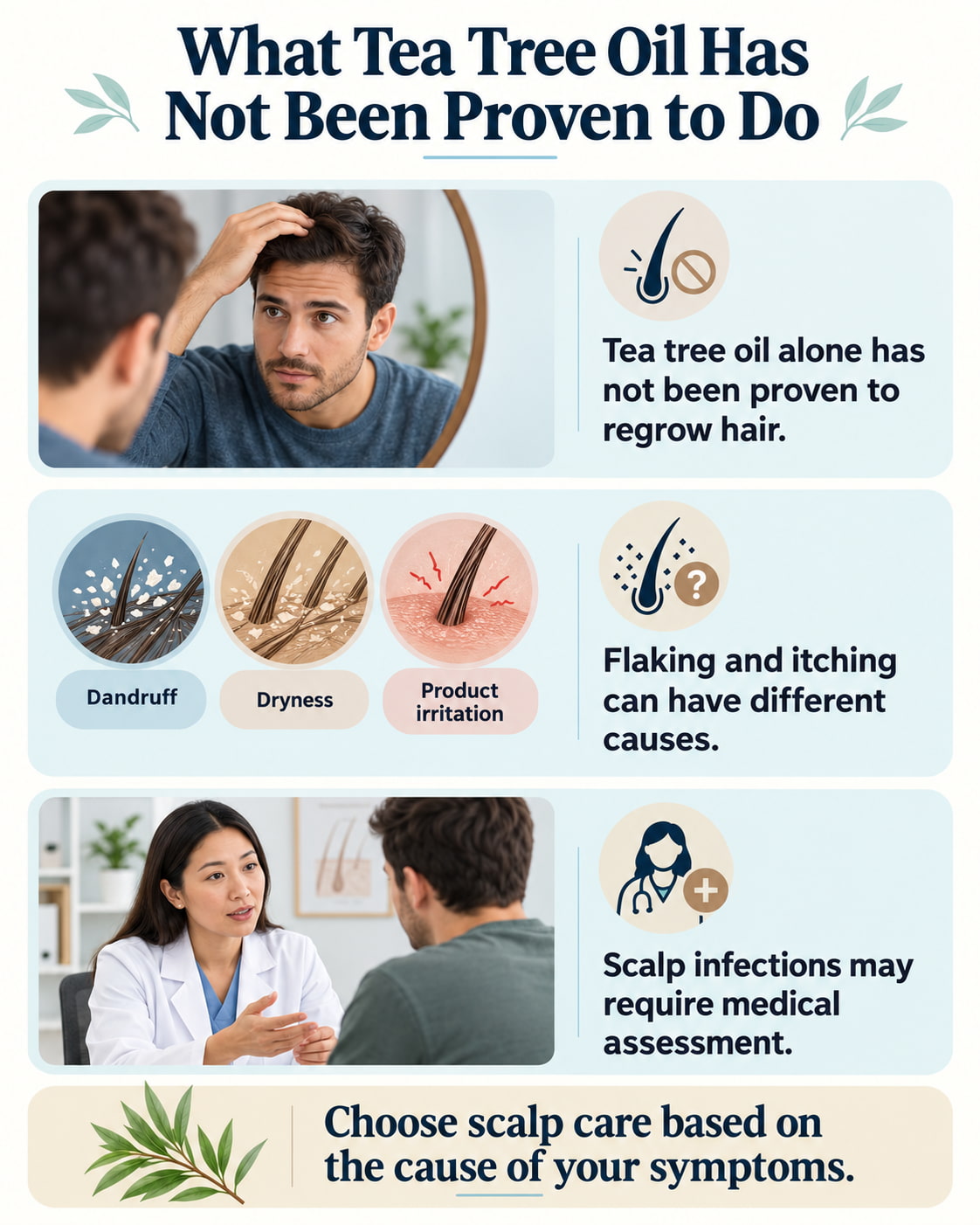
Tea tree oil alone has not been shown to reliably regrow hair.
A small 2013 study examined a formulation containing tea tree oil alongside minoxidil and diclofenac. Because several ingredients were combined, the results cannot establish tea tree oil’s independent effect.
Less itching or flaking should not be presented as proof of new hair growth.
Address Every Cause of Scalp Flaking
Several conditions can resemble ordinary dandruff. The American Academy of Dermatology identifies product reactions, eczema, psoriasis, and scalp ringworm among the causes of an itchy scalp.
| Scalp concern | What to keep in mind |
|---|---|
| Itching or a rash after a new hair product | Irritation or allergy may be involved. Stop using a product that appears to trigger a reaction. |
| Persistent, inflamed, or thickly scaly patches | Eczema, psoriasis, or another condition may need an individualized care plan. |
| Patchy hair loss or pus-filled bumps | Seek medical assessment. Scalp ringworm is one possible cause and requires prescription care. |
Laboratory evidence of antifungal activity does not establish tea tree oil as an adequate remedy for a scalp infection.
How to Use Tea Tree Oil for Scalp
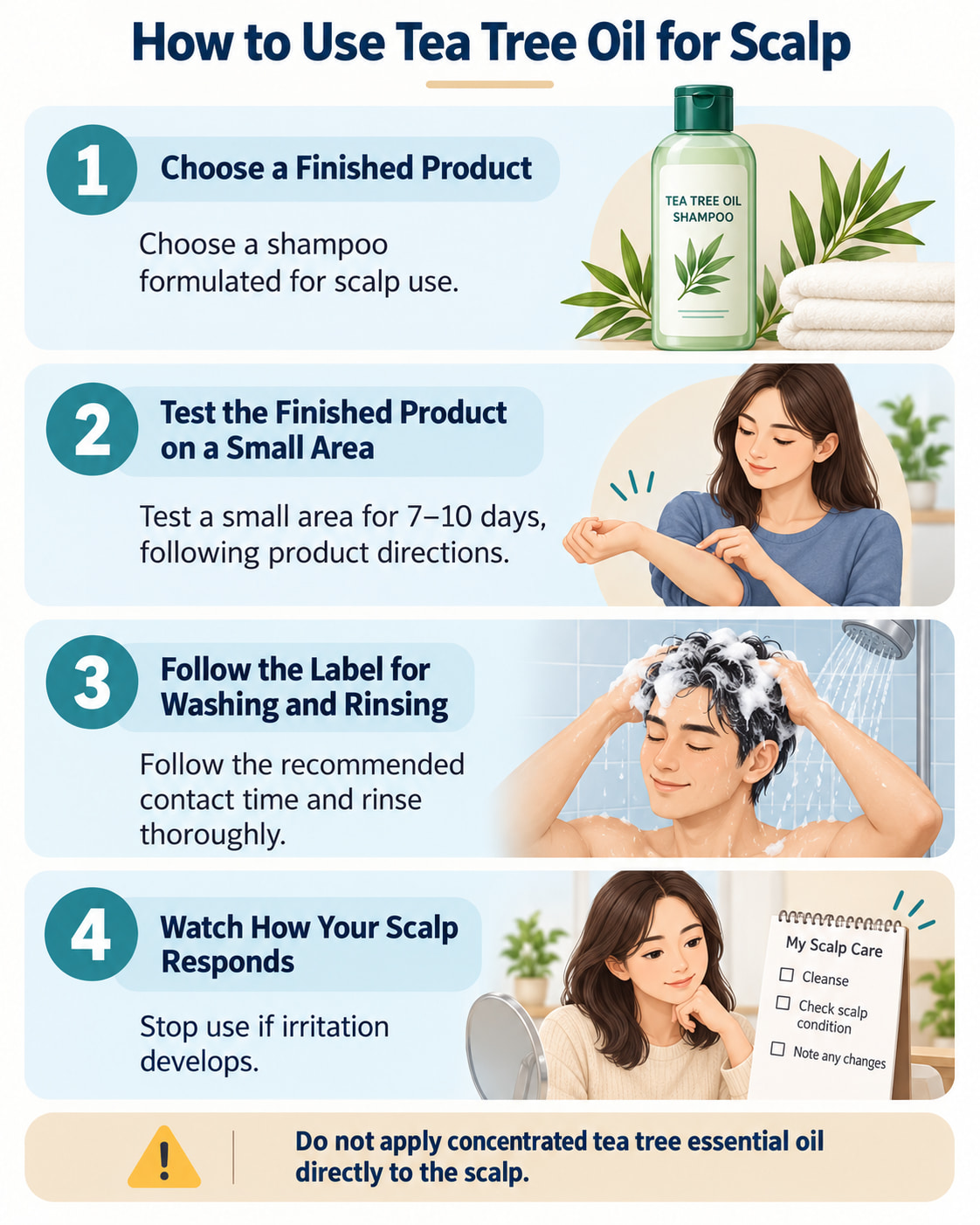
1. Choose a Finished Product Intended for the Scalp
If you decide to try tea tree oil, choose a shampoo specifically labeled for scalp use with clear directions and warnings.
Avoid applying concentrated essential oil directly to your scalp. There is no well-established home dilution recipe for dandruff supported by the research reviewed here. Adding drops to an existing shampoo bottle also does not reproduce the formulation used in a clinical trial.
The 5% research concentration is not a mixing instruction. A European safety opinion published in 2025 assessed tea tree oil as safe at up to 2% in specified adult shampoo formulations under its stated conditions. It also identified a skin allergy risk.
That assessment does not establish a US dosing rule or the safety of a homemade leave-on oil. The practical takeaway is to follow a finished product’s directions rather than choose a concentration yourself.
2. Test the Finished Product on a Small Area
The American Academy of Dermatology’s product-testing guidance recommends trying a new product on a small area before using it more widely.
For this small-area check:
- Choose a spot such as the underside of your arm or the bend of your elbow.
- Apply the normal amount of the finished product twice daily for seven to 10 days.
- For a rinse-off product, follow its normal contact time and wash it off.
- Stop if you develop redness, itching, or swelling.
Do not test concentrated tea tree oil on your skin. If you already know you are allergic to it, avoid it.
A small-area check cannot guarantee that you will never react. It is also different from medical patch testing used to investigate an allergy.
3. Follow the Label for Washing and Rinsing
Use the amount, frequency, and contact time stated on the bottle. Apply the product where directed and rinse thoroughly.
Do not assume that longer contact means better results. A rinse-off shampoo should not be left on overnight.
Your hair type also matters. The AAD notes that dandruff shampoos can dry curly or coily hair, so concentrating application on the scalp may help limit unnecessary exposure of the hair lengths. A pharmacist or dermatologist can help you choose an appropriate washing schedule.
4. Watch How Your Scalp Responds
Pay attention to whether flaking and itching improve without new discomfort. Introducing one new scalp product at a time can make it easier to identify what helps or irritates your skin.
Stop using the product and wash it off if burning, worsening itching, redness, or swelling develops. Seek advice for a substantial or persistent reaction.
Tea Tree Oil Side Effects and Precautions
Irritation and Allergic Reactions
Tea tree oil can cause skin irritation and allergic reactions, especially at higher concentrations. A botanical ingredient can still be unsuitable for your skin.
The NIH’s tea tree oil safety guidance also notes that irritation may be more likely with older products or those exposed to heat, light, or air.
Follow storage instructions, keep containers closed, and observe the manufacturer’s shelf-life guidance. Do not interpret burning as evidence that a product is working.
Eyes and Accidental Swallowing
Keep tea tree oil away from your eyes and never swallow it. Eye exposure can cause injury, and ingestion can cause serious poisoning.
Store concentrated oils and scalp products out of children’s reach. If someone swallows tea tree oil in the United States, contact Poison Control at 1-800-222-1222 promptly.
Pregnancy, Breastfeeding, and Children
NCCIH states that topical tea tree products may be safe during pregnancy and breastfeeding. That does not establish safety for every formula or homemade mixture.
Ask a clinician or pharmacist to check the particular product if you are pregnant, breastfeeding, or choosing it for a child. Do not turn adult scalp-care advice into a homemade remedy for an infant’s cradle cap.
Tea Tree Oil Shampoo vs. Other Dandruff Shampoos
Tea tree oil is one option readers may encounter, but established dandruff shampoos contain ingredients such as:
- Ketoconazole
- Selenium sulfide
- Zinc pyrithione
- Salicylic acid
The AAD includes these among its recommended dandruff shampoo ingredients. They do not all work in the same way, and their directions vary.
Check the active ingredient and the Drug Facts panel when present. A product’s tea tree branding alone does not tell you which ingredient is intended to address dandruff.
If a shampoo does not help, a pharmacist or dermatologist can guide your next choice. Increasing the strength of an essential oil mixture is not an evidence-based substitute for reassessing the cause of the symptoms.
When to See a Dermatologist
According to NHS guidance on dandruff, seek professional advice if:
- Symptoms continue after at least four weeks of appropriate anti-dandruff shampoo use.
- Your scalp is very itchy, red, swollen, or painful.
- Flaky, itchy patches also affect your face or other areas.
- Symptoms are severe or persistent.
Arrange an assessment for patchy hair loss, pus-filled bumps, or a strongly inflamed scalp.
The four-week timeframe is for evaluating dandruff care. Do not continue an irritating product for four weeks to see whether your skin adjusts.
Frequently Asked Questions
Can You Put Tea Tree Oil Directly on Your Scalp?
Avoid applying concentrated essential oil directly. Choose a finished product intended for scalp use and follow its directions. Dilution does not eliminate the possibility of irritation or allergy.
Can You Add Tea Tree Oil to Your Regular Shampoo?
The research does not establish a reliable home mixing recipe. Adding drops changes the formulation and makes the final concentration uncertain. A product formulated with tea tree oil is a more predictable choice.
Can You Leave Tea Tree Oil on Your Scalp Overnight?
Do not leave a rinse-off shampoo on overnight. The available scalp research does not establish the safety or benefit of homemade overnight tea tree oil mixtures.
How Often Should You Use Tea Tree Oil Shampoo?
Follow the product label and adjust your routine with professional guidance if needed. The right schedule depends on the formulation, your scalp’s tolerance, and your hair type.
How Long Does Tea Tree Oil Shampoo Take to Work?
There is no reliable timeline that applies to every product and person. Seek advice if appropriate dandruff care has not helped after about a month, or sooner if symptoms worsen.
Can Tea Tree Oil Make Scalp Itching Worse?
Yes. Irritation or an allergic reaction can cause new or worsening symptoms. Wash the product off, stop using it, and seek advice if the reaction is significant or does not settle.
Is Tea Tree Oil Good for Dry Scalp?
Not necessarily. Dryness and flaking can reflect product irritation, eczema, or other causes. Evidence for dandruff shampoo does not establish tea tree oil as a moisturizer or a suitable choice for every dry scalp.
Conclusion
Tea tree oil shampoo may help some people with mild dandruff, but the evidence remains limited and the formulation matters. Choose a product intended for the scalp, follow its label, and stop if irritation develops.
Start by identifying your main concern and checking your current products. If symptoms persist, become painful, or include patchy hair loss, seek a professional assessment so your next step addresses the actual cause.
This content is for informational purposes only and not medical advice.
References
- National Center for Complementary and Integrative Health: Tea Tree Oil
- Journal of the American Academy of Dermatology: Treatment of dandruff with 5% tea tree oil shampoo
- European Commission, Scientific Committee on Consumer Safety: Scientific Opinion on Tea Tree Oil
- American Academy of Dermatology: How to test skin care products
- NHS: Dandruff
- National Capital Poison Center: Tea tree oil: Remedy and poison
- Journal of Wellbeing Management and Applied Psychology: Study of tea tree oil shampoo for sensitive scalps
- Drug Design, Development and Therapy: Pilot study of a formulation containing minoxidil, diclofenac, and tea tree oil