
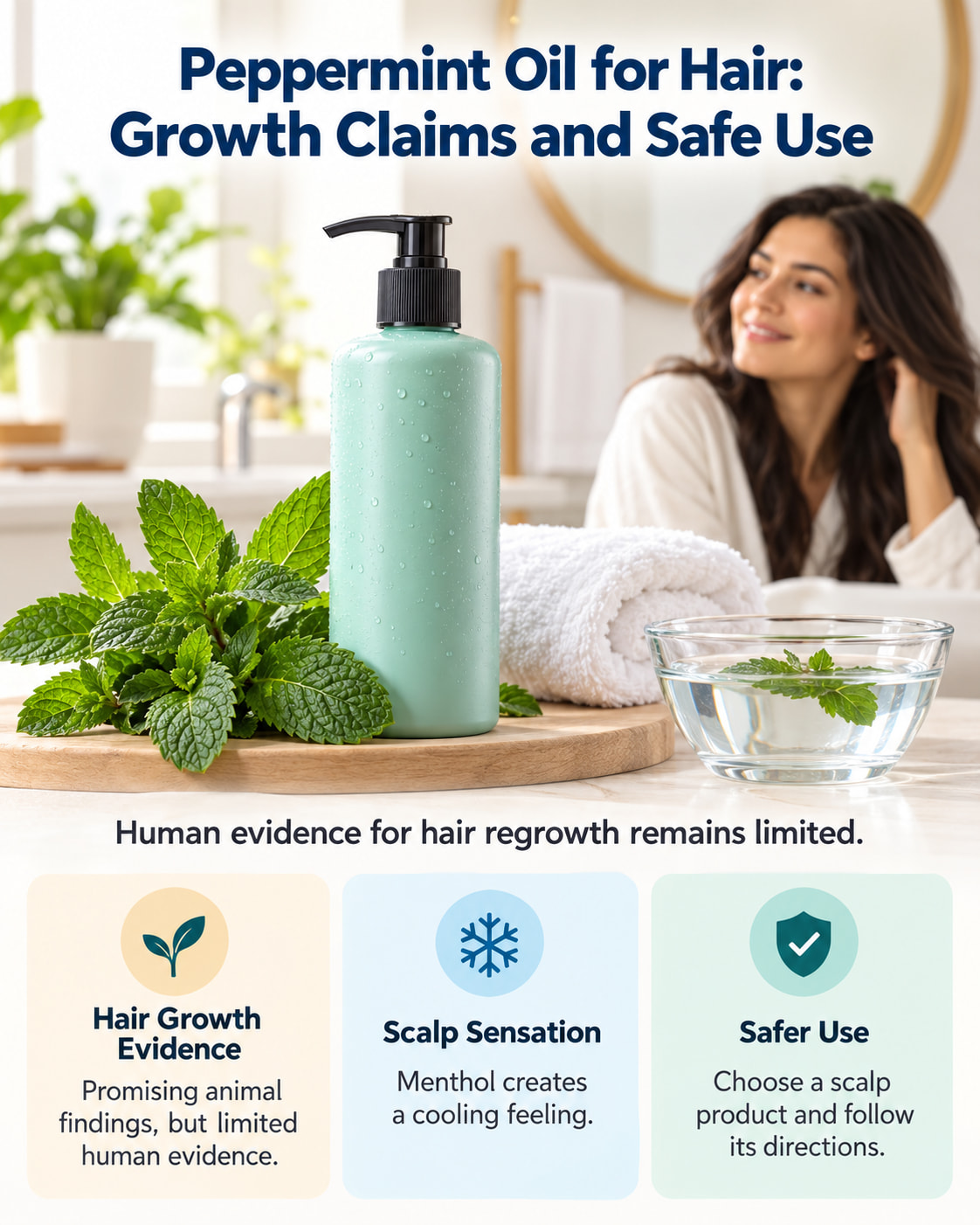
Peppermint oil for hair has not been established as a reliable way to regrow human scalp hair. Animal research has produced encouraging findings, but human evidence remains limited. There is also no convincing clinical evidence that it works better than minoxidil.
A peppermint product may feel cooling, but that sensation does not show that hair follicles are producing new hair. If you choose to try one, use a finished product intended for the scalp, follow its directions, and stop if irritation develops.
Understanding the evidence can help you set realistic expectations and avoid delaying care for unexplained hair loss.
What Is Peppermint Oil?
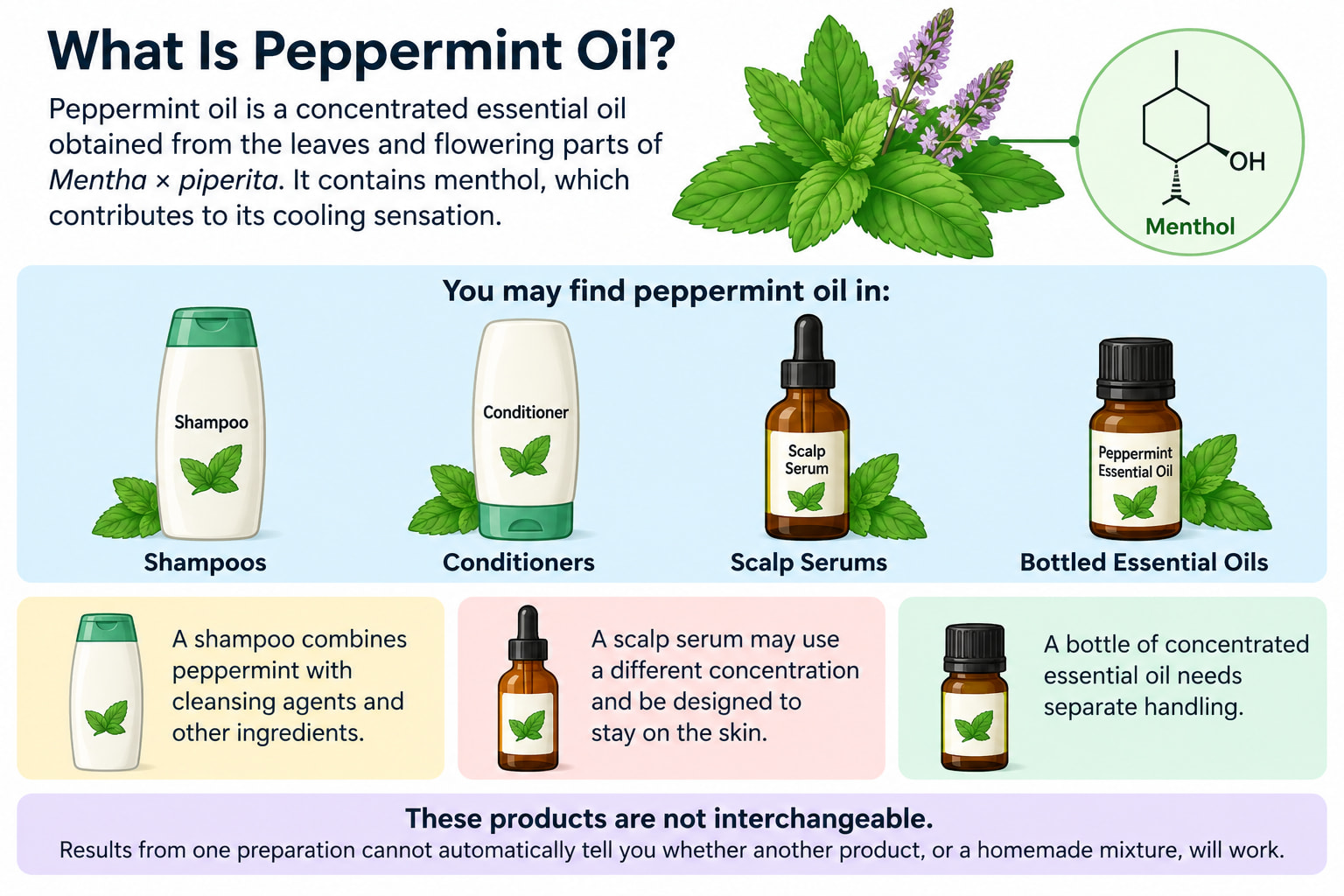
Peppermint oil is a concentrated essential oil obtained from the leaves and flowering parts of Mentha × piperita. It contains menthol, which contributes to its cooling sensation.
You may find peppermint oil in shampoos, conditioners, scalp serums, and bottled essential oils. These products are not interchangeable.
A shampoo combines peppermint with cleansing agents and other ingredients. A scalp serum may use a different concentration and be designed to stay on the skin. A bottle of concentrated essential oil needs separate handling.
Results from one preparation cannot automatically tell you whether another product, or a homemade mixture, will work.
Does Peppermint Oil for Hair Growth Work?
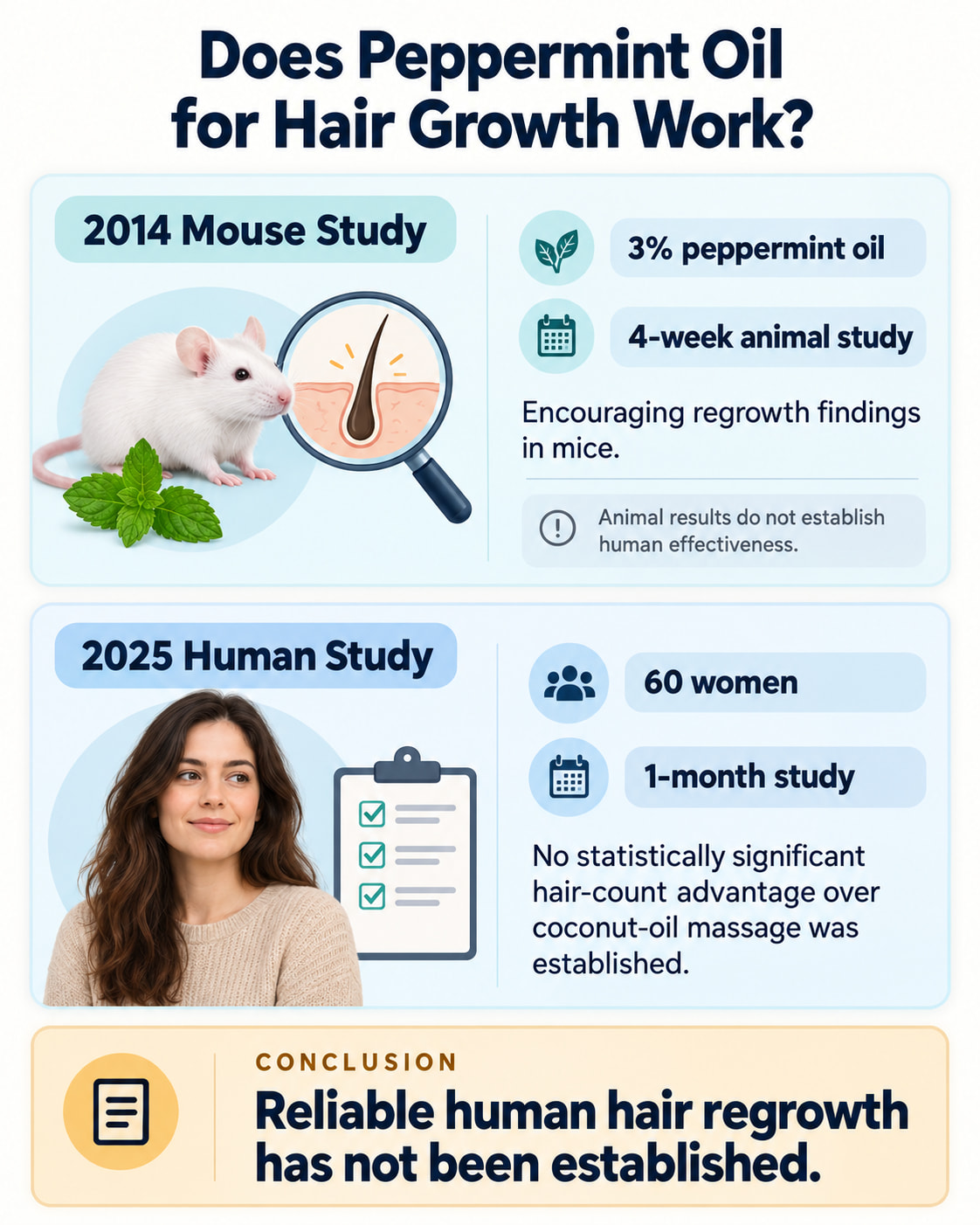
The research leaves important questions unanswered, including whether peppermint provides meaningful regrowth, which types of hair loss might respond, and what formulation would be appropriate.
What the Human Study Found
A small randomized study published in the Indian Journal of Integrative Medicine in 2025 included 60 women with diffuse hair loss. Their average age was about 20.5 years.
For one month, participants received scalp massage with either peppermint oil mixed with coconut oil or coconut oil alone.
Some measurements improved within the peppermint group. However, the reported hair-count comparisons did not establish a statistically significant advantage over the control group.
Improvement from a starting measurement does not, by itself, show that peppermint added a benefit. The small sample, short follow-up, and narrow participant group also limit how broadly the findings apply.
What the Animal Research Shows
The frequently cited 2014 mouse study compared 3% peppermint oil diluted in jojoba oil with saline, jojoba oil, and 3% minoxidil.
After four weeks, the peppermint group showed greater regrowth scores and changes in several follicle measurements and growth-related markers.
Those findings came from shaved mouse backs. They do not establish that peppermint oil regrows human scalp hair or outperforms minoxidil in people.
The study’s title also refers to an absence of toxic signs. Its limited observations, including body-weight changes and food intake, do not establish long-term safety for people.
Newer research, including a 2025 study of an experimental peppermint formulation in rats, remains preclinical. It cannot validate ordinary peppermint shampoos or homemade scalp mixtures.
What This Means for Your Expectations
There is no established peppermint-oil routine that reliably produces thicker hair. Claims promising regrowth within a particular number of weeks go beyond the available evidence.
You can judge a cosmetic product by whether it cleans your hair comfortably and suits your scalp. A pleasant sensation or softer-feeling hair does not demonstrate follicular regrowth.
What Peppermint Oil May Do for the Scalp
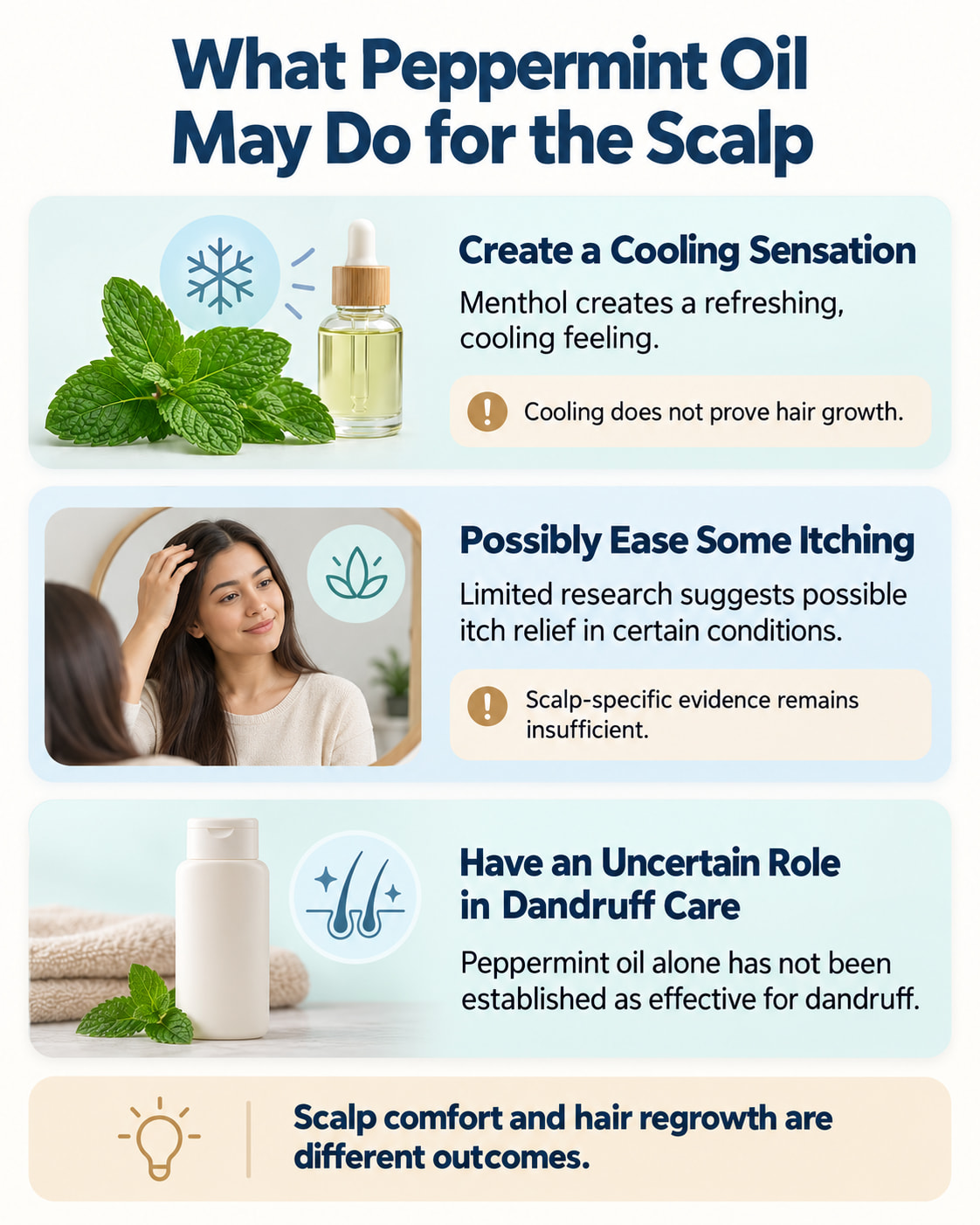
Create a Cooling Sensation
Menthol activates receptors involved in sensing cold. This explains why a peppermint-containing product can feel refreshing.
Researchers have also studied menthol’s effects on skin blood flow. However, measurements of circulation in skin do not establish that peppermint oil increases scalp hair growth.
A stronger tingling sensation is not a reason to use more product. Burning or persistent discomfort should prompt you to stop.
Possibly Ease Some Itching
A 2016 study examined topical peppermint oil in 50 people with chronic itching associated with liver disease, kidney disease, or diabetes. It reported improvement, but it was not a scalp or hair-growth study. Four participants reported burning when applying the preparation to skin folds.
These findings do not show that a peppermint shampoo will help every itchy scalp. Persistent itching deserves attention to its cause.
Have an Uncertain Role in Dandruff Care
Evidence for peppermint oil alone in dandruff care is insufficient.
One study evaluated a shampoo containing peppermint alongside other essential oils, climbazole, and triclosan. Because it tested a combination formula without a control group, it could not establish peppermint’s individual contribution.
If flaking continues, especially with redness or discomfort, seek advice about appropriate scalp care instead of repeatedly adding more essential oil.
How to Use Peppermint Oil for Hair More Safely
If you want to try a peppermint-containing product, focus on its intended use and your skin’s tolerance. There is no need to recreate an experimental study mixture.
1. Choose a Finished Product Intended for the Scalp
Look for a product with clear directions, a complete ingredient list, and instructions for whether it should be rinsed off.
| Product type | What to check |
|---|---|
| Shampoo or conditioner | Follow washing, contact-time, and rinsing directions. |
| Leave-on scalp serum or oil | Check the recommended amount, frequency, and application area. |
| Concentrated peppermint essential oil | Do not apply it undiluted. If clear scalp-use guidance is absent, choose a formulated product instead. |
Dilution can reduce direct-contact irritation, but it does not remove the possibility of allergy. A finished product can also cause a reaction, so the next step still matters.
2. Test the Finished Product on a Small Area
The AAD’s product-testing guidance recommends applying a new skin-care product to a small test area twice daily for seven to 10 days.
For a finished cosmetic product:
- Choose a small area on the underside of your arm or inside your elbow.
- Use the amount and thickness you would normally apply.
- Follow the usual contact time. Rinse-off products should be rinsed according to their directions.
- Stop and wash it off if redness, itching, swelling, or another reaction appears.
Do not test undiluted essential oil on your skin.
This home check may help identify a problem before broader use. It does not guarantee that a future reaction cannot occur or replace diagnostic patch testing by a dermatologist.
3. Follow the Label for Amount, Frequency, and Rinsing
Use the product only as directed. Avoid adding extra peppermint oil to a finished shampoo or combining several peppermint products in an attempt to speed up results.
A rinse-off shampoo should not become an overnight scalp mask. A leave-on product should be used only where and as often as its label recommends.
Keep the product away from your eyes, and wash your hands after applying it. Avoid applying peppermint oil to broken or irritated skin.
4. Stop if Your Scalp Reacts
Stop using the product and gently wash it off if you develop burning, a rash, swelling, or worsening itching.
Do not interpret discomfort as evidence that the product is stimulating growth. If the reaction is severe, persists, or keeps returning, contact a healthcare professional.
Difficulty breathing after exposure requires emergency medical care.
Peppermint Oil Side Effects and Who Should Be Cautious
According to NCCIH, topical peppermint oil can cause skin rashes and irritation. Contact allergy is also possible, and a reaction may come from peppermint or another ingredient in the product.
Extra caution is appropriate in the following situations:
- Known peppermint or menthol allergy: Avoid products containing the ingredient that caused your reaction.
- An irritated or damaged scalp: Avoid application until you have appropriate guidance.
- Pregnancy or breastfeeding: Safety data for medicinal peppermint-oil preparations are insufficient. Discuss concentrated oil use with your prenatal clinician.
- Infants and young children: Do not adapt an adult scalp routine for a child. Peppermint oil should not be applied to their faces, and inhaled menthol can cause serious breathing-related effects.
Keep concentrated oils and hair products out of children’s reach. Do not swallow them for hair growth.
If someone swallows an essential oil, contact a poison center for guidance. In the United States, Poison Control is available at 1-800-222-1222.
When to See a Dermatologist for Hair Loss
Arrange an assessment if your hair loss is sudden, rapid, patchy, or continuing without a clear explanation.
Seek advice promptly if it occurs with:
- Scalp pain or significant itching.
- Redness, scaling, sores, or signs of infection.
- Unusual hair-loss patterns.
- Bald patches involving your eyebrows or beard.
The AAD explains that appropriate hair-loss care begins with finding the cause. Different causes can require different approaches.
For some forms of hair loss, established options such as topical minoxidil may help. A clinician can explain whether an option fits your diagnosis and circumstances.
Avoid postponing an assessment while waiting for an essential oil to work.
Frequently Asked Questions
Does Peppermint Oil Help Hair Grow?
It has not been established as a reliable way to regrow human scalp hair. Animal findings are encouraging, but the small human trial did not demonstrate a significant hair-count advantage over coconut-oil massage.
Is Peppermint Oil Better Than Minoxidil?
There is no convincing human clinical evidence showing that it is. The frequently cited comparison involved mice. It cannot establish that peppermint is an equivalent substitute for minoxidil in people.
Can You Apply Peppermint Oil Directly to Your Scalp?
Do not apply concentrated peppermint essential oil undiluted. A finished product intended for scalp use can be applied according to its label, after checking your skin’s tolerance.
How Should Peppermint Oil Be Diluted for Hair?
There is no clinically established dilution for reliable hair regrowth. A universal drop-count recipe cannot account for the product, application method, or your skin’s sensitivity. Choose a formulated scalp product or ask a dermatologist about a specific preparation.
Can You Use Peppermint Oil Every Day or Leave It on Overnight?
Follow the finished product’s directions. Daily or overnight use has not been established as a necessary hair-growth routine. Rinse-off products should be washed off as directed, and more frequent application may increase exposure to irritating ingredients.
How Long Does Peppermint Oil Take to Work?
There is no reliable human hair-regrowth timeline because its effectiveness has not been established. Cooling can occur during use, but that sensation does not indicate that new hair is growing.
Can Peppermint Oil Help Dandruff?
Evidence for peppermint oil alone is insufficient. Studies of shampoos containing several ingredients cannot establish peppermint’s contribution. Persistent flaking, redness, or itching may need a different approach based on the cause.
Conclusion
Peppermint oil’s cooling sensation and preliminary research do not establish dependable hair regrowth. If you enjoy a peppermint-containing hair product, choose one designed for your scalp, follow its directions, and stop if it causes irritation.
For ongoing or unexplained hair loss, make identifying the cause your next step. That gives you a clearer basis for choosing care with realistic expectations.
This content is for informational purposes only and not medical advice.