
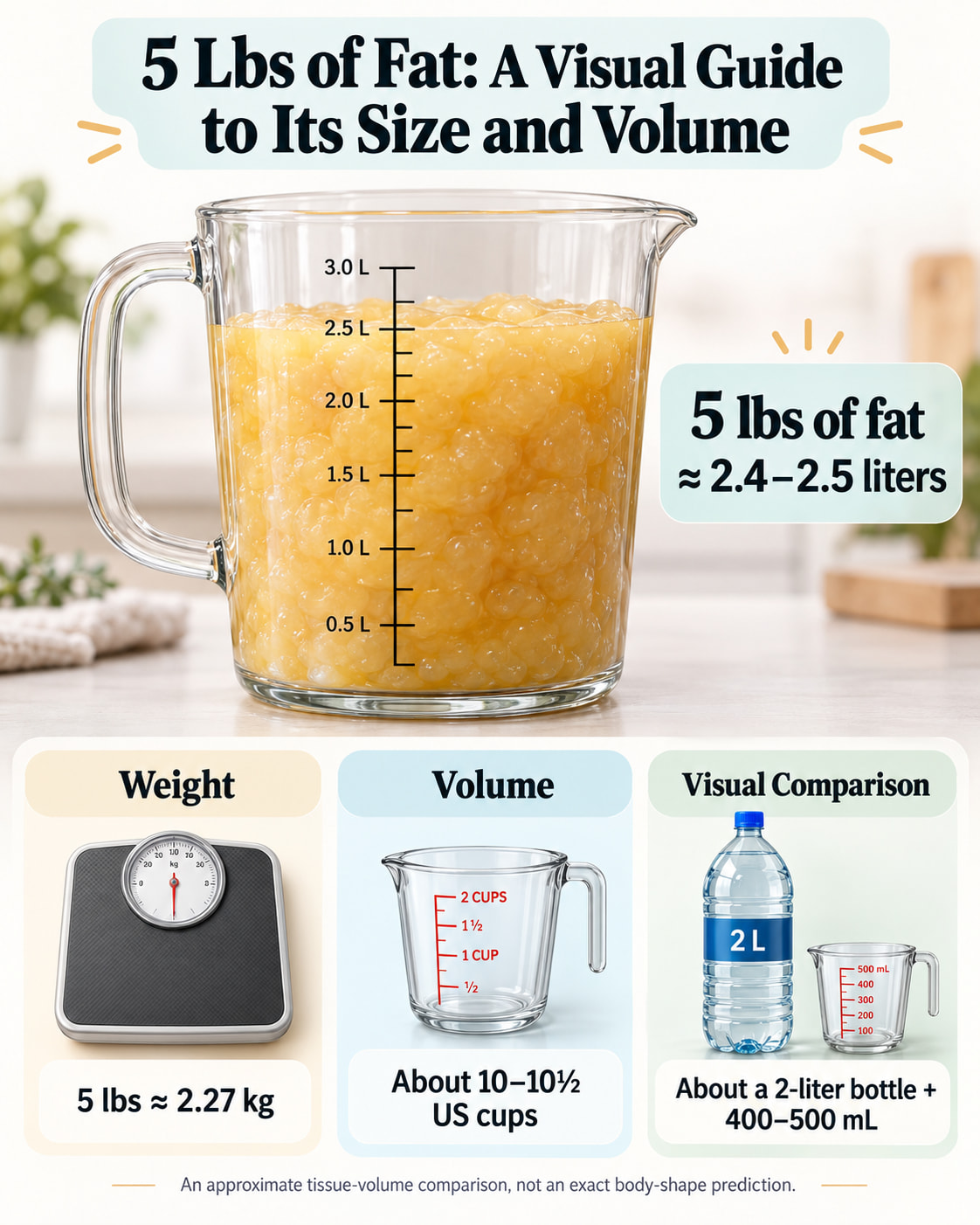
5 lbs of fat occupies approximately 2.4–2.5 liters when estimated as body fat tissue—about 10–10½ US cups. That is roughly the combined capacity of a 2-liter bottle and another 400–500 milliliters.
This comparison helps you picture the amount of tissue involved. However, it cannot predict exactly how losing five pounds will change your appearance. A five-pound change on the scale also does not automatically mean you have lost five pounds of fat.
Here is how the volume estimate works, how fat compares with muscle, and what these numbers can tell you.
What Does 5 Lbs of Fat Look Like?
Imagine a container holding a little less than two and a half liters. That gives you a useful sense of the space five pounds of adipose tissue could occupy.
Adipose tissue is the body’s fat-storing tissue. Throughout this guide, “fat” refers to that tissue when discussing size and volume.
Everyday Comparisons for 5 Lbs of Fat
| Comparison | Approximate amount |
|---|---|
| US measuring cups | 10–10½ cups |
| Bottle capacity | A 2-liter bottle plus another 400–500 mL |
| US liquid quarts | About 2.5–2.6 quarts |
| A hypothetical cube | About 5.3 inches on each side |
| A hypothetical sphere | About 6.5–6.6 inches in diameter |
The cube and sphere are mathematical comparisons. They show how much space the estimated volume would occupy if arranged into those shapes.
You can make the container comparison at home:
- Use a large container with volume markings.
- Measure 2 liters of water into it.
- Add another 400–500 milliliters.
- Look at the total amount of space the water occupies.
The water demonstrates volume only; its weight differs from the weight of the same volume of fat tissue.
A measured container is more useful than comparing fat with a “large grapefruit” or “small melon,” because those objects do not have a consistent size.
How Much Volume Does 5 Lbs of Fat Take Up?
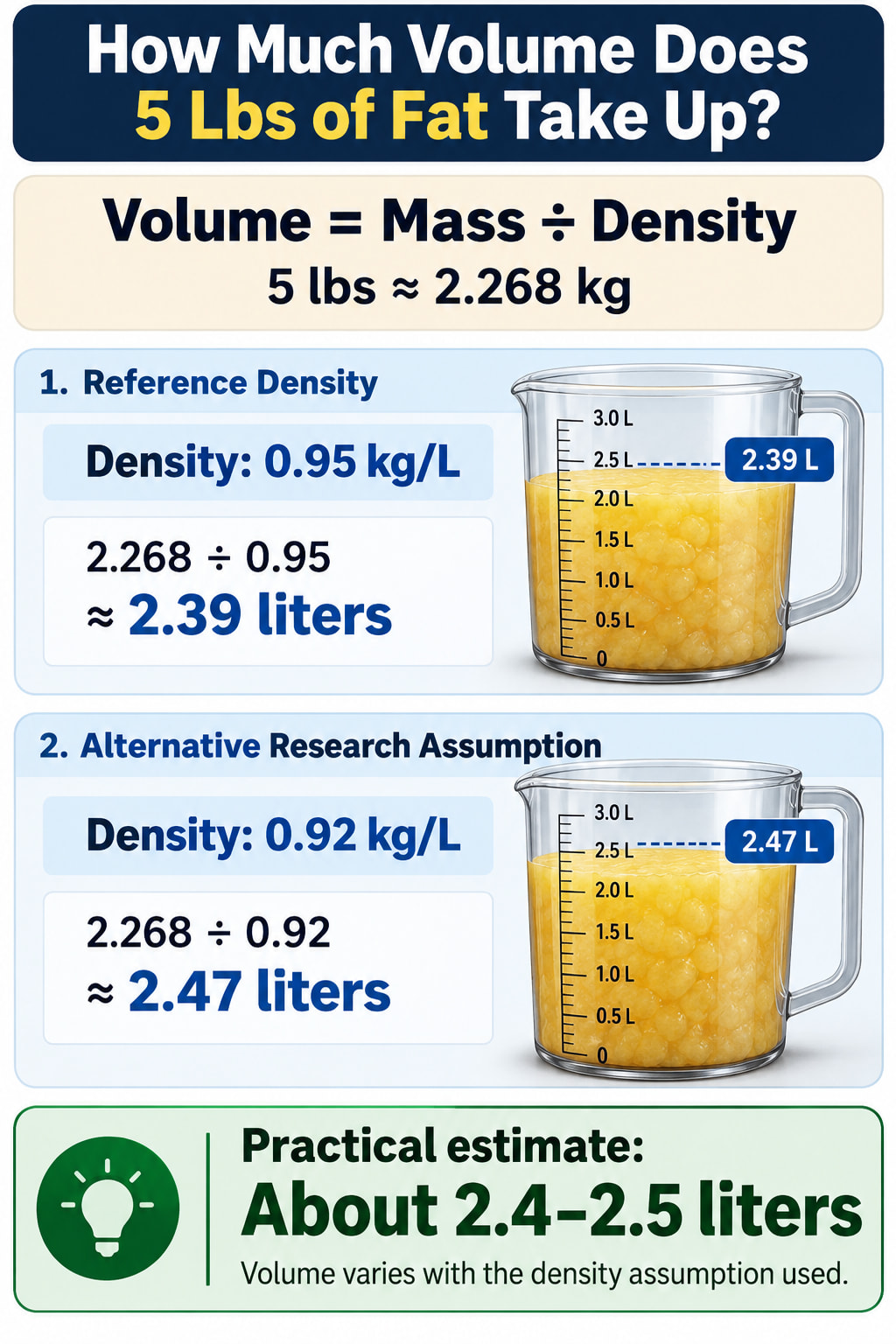
Five pounds equals approximately 2.27 kilograms. To estimate its volume, divide that mass by the tissue’s density:
Volume = mass ÷ density
The NIST tissue reference table lists an adipose tissue density of 0.95 kilograms per liter. Using that value:
2.268 kg ÷ 0.95 kg/L ≈ 2.39 liters
A 2026 body composition study used an assumed adipose tissue density of 0.92 kilograms per liter when converting MRI measurements from volume to mass. That assumption gives:
2.268 kg ÷ 0.92 kg/L ≈ 2.47 liters
Rounded for everyday use, those calculations produce the 2.4–2.5-liter estimate.
Why Is the Volume an Estimate?
Adipose tissue contains stored fat along with water and other tissue components. Differences in composition affect its density.
The figures above come from reference assumptions used in calculations. They are not measurements of your own tissue or the minimum and maximum volumes possible in everyone.
For a practical visual guide, “about 10 US cups” communicates the size without suggesting that the amount is exact.
5 Lbs of Fat vs. 5 Lbs of Muscle
Five pounds of fat and five pounds of muscle weigh the same. Muscle is denser, so the same weight occupies less space.
Using the adipose tissue and skeletal muscle densities from the NIST reference table:
| Tissue | Weight | Reference density | Estimated volume |
|---|---|---|---|
| Adipose tissue | 5 lbs | 0.95 kg/L | 2.39 liters |
| Skeletal muscle | 5 lbs | 1.05 kg/L | 2.16 liters |
Under these assumptions, five pounds of fat occupies approximately 11% more volume than five pounds of muscle.
That difference is meaningful, but it is much smaller than a comparison showing fat as twice the size of muscle. An accurate illustration should keep the two volumes relatively close.
The helpful phrase is “muscle is denser than fat.” Equal weights of the two tissues differ in volume, not in how much they weigh.
Why 5 Lbs of Fat Loss Looks Different for Everyone
You may notice a change after losing five pounds of fat, but the amount alone cannot tell you how noticeable it will be.
A model gathers all the tissue into one object. Your body carries tissue across different areas. If a change is spread across several areas, its appearance will differ from the same amount concentrated in a smaller area.
Your starting body proportions also provide the context for that change. There is no single silhouette that can represent what losing five pounds will look like for every reader.
How Many Inches Will You Lose?
There is no universal conversion from five pounds of fat to a specific number of waist inches or a clothing size.
A waist measurement describes one circumference. It cannot reveal exactly how much fat has changed throughout your body.
You might notice differences in clothing fit or measurements, but neither can confirm that you have lost exactly five pounds of fat. Use these observations as context rather than a precise tissue measurement.
5 Lbs of Fat Loss vs. 5 Lbs of Weight Loss
A bathroom scale measures your total weight. It does not separate fat from water, muscle, or other components.
A five-pound change can therefore include changes in:
- Body fat.
- Body water.
- Stored carbohydrate, called glycogen, and its associated water.
- Other lean tissue.
In a 2017 study of short-term weight changes, researchers followed 46 adults living normally without a prescribed weight-loss program. Weight fluctuations over two weeks were strongly associated with changes in fat-free mass, particularly body water.
That finding helps explain why short-term scale changes should not automatically be interpreted as fat changes. It does not provide a formula for calculating how much of an individual’s weight loss is water.
For example, if your weight changes from 180 to 175 pounds, the scale confirms a five-pound difference. It cannot establish the composition of that difference.
A volume model illustrates a quantity of tissue. A scale reading measures total weight. Keeping those purposes clear makes both easier to interpret.
How Long Does It Take to Lose 5 Lbs of Fat?
There is no exact timeline that applies to everyone.
The CDC’s weight-loss guidance, dated January, 2025, describes gradual weight loss of about 1–2 pounds per week as associated with a greater likelihood of keeping the weight off.
At that pace, losing five pounds of total body weight would mathematically take about 2½–5 weeks. However, that calculation does not establish how long it will take to lose five pounds specifically from fat.
The CDC’s guidance concerns overall weight change. The amount coming from fat, water, and other tissue can vary.
Does Losing 5 Lbs of Fat Require a 17,500-Calorie Deficit?
You may have seen the traditional calculation:
5 pounds × 3,500 calories = 17,500 calories
That arithmetic does not provide an exact personal weight-loss formula.
An NIDDK explanation of the 3,500-calorie rule describes how the body adjusts energy expenditure as weight changes. A simple fixed calculation can therefore overpredict weight loss over time.
It also cannot establish that every pound lost will come from fat. Avoid using 17,500 calories as a precise countdown or a reason to pursue a large, rapid calorie deficit.
Frequently Asked Questions
How Many Cups Is 5 Lbs of Fat?
Using the reference density estimates in this guide, five pounds of adipose tissue occupies about 10–10½ US cups. This is an approximate volume calculation, not a direct measurement of an individual’s body fat.
Does Five Pounds of Fat Weigh More Than Five Pounds of Muscle?
No. Both weigh five pounds. Muscle is denser, so it takes up less space at the same weight.
Is Losing Five Pounds Noticeable?
It can be, but the visible difference varies. Where the change occurs and your starting body proportions affect how noticeable it looks.
How Many Inches Will I Lose After Losing Five Pounds?
You cannot reliably convert five pounds into a fixed number of inches. Waist size and clothing fit may change, but they do not directly measure total fat loss.
Can a Five-Pound Scale Change Include Water Weight?
Yes. Body-water changes can contribute to weight fluctuations. A scale alone cannot determine how much of a five-pound change comes from water, fat, or other tissue.
Does a 17,500-Calorie Deficit Guarantee Five Pounds of Fat Loss?
No. That number comes from a traditional rule of thumb. Changes in energy expenditure and the composition of weight loss prevent it from being an exact guarantee.
Conclusion
5 lbs of fat is roughly 2.4–2.5 liters of adipose tissue under commonly used reference assumptions. About ten US cups provides a useful everyday picture.
To see the volume for yourself, measure roughly 2.4 liters of water into a marked container. Use that comparison to understand the amount of space involved, while keeping your own appearance and scale changes in individual context.
This content is for informational purposes only and not medical advice.