
Net carbs are an informal estimate of digestible carbohydrates, usually calculated by subtracting dietary fiber—and sometimes certain sweeteners—from total carbohydrates. The calculation is not standardized, so different methods can produce different results.
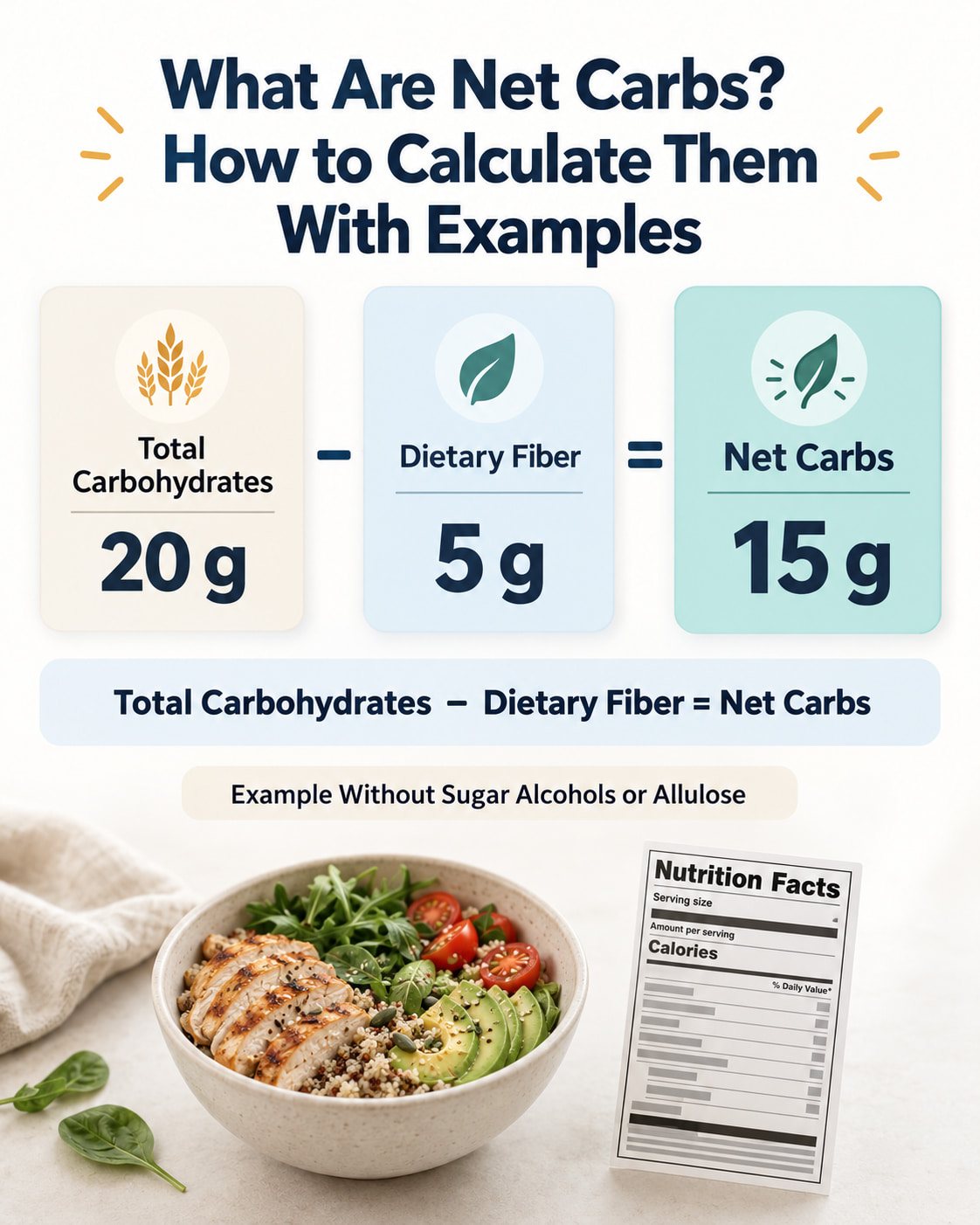
For a food without sugar alcohols or allulose, the usual formula is:
Net carbs = Total carbohydrates − Dietary fiber
For example, a food with 20 grams of total carbohydrates and 5 grams of fiber has 15 grams of net carbs using this method. Fiber is already included in the total carbohydrate number on U.S. Nutrition Facts labels.
The basic math is straightforward. Products containing sugar alcohols or allulose need a closer look.
Net Carbs vs. Total Carbs
Total carbohydrates include the different forms of carbohydrate in a food, such as starches, sugars, and fiber. Sugar alcohols are also included when present. Net carbs are a calculated amount after certain deductions—not a separate nutrient measured on the label.
Here is how the main label terms fit together:
| Label term | What it means for your calculation |
|---|---|
| Total Carbohydrate | Your starting number |
| Dietary Fiber | Already included in total carbohydrates; subtracted in the usual net-carb formula |
| Total Sugars | Already included in total carbohydrates; not an additional deduction |
| Includes Added Sugars | Part of total sugars, not an extra amount to add |
| Sugar Alcohol | Requires attention to the ingredient and calculation method |
The FDA explains that added sugars are included within total sugars. For example, “10 g Total Sugars, Includes 4 g Added Sugars” means 10 grams of sugar altogether, not 14 grams.
Another important distinction: the American Diabetes Association notes that “net carbs” has no standardized legal definition in the United States. A net-carb number also cannot precisely predict a food’s blood sugar effect.
The calculations below use U.S. Nutrition Facts labels.
How to Calculate Net Carbs
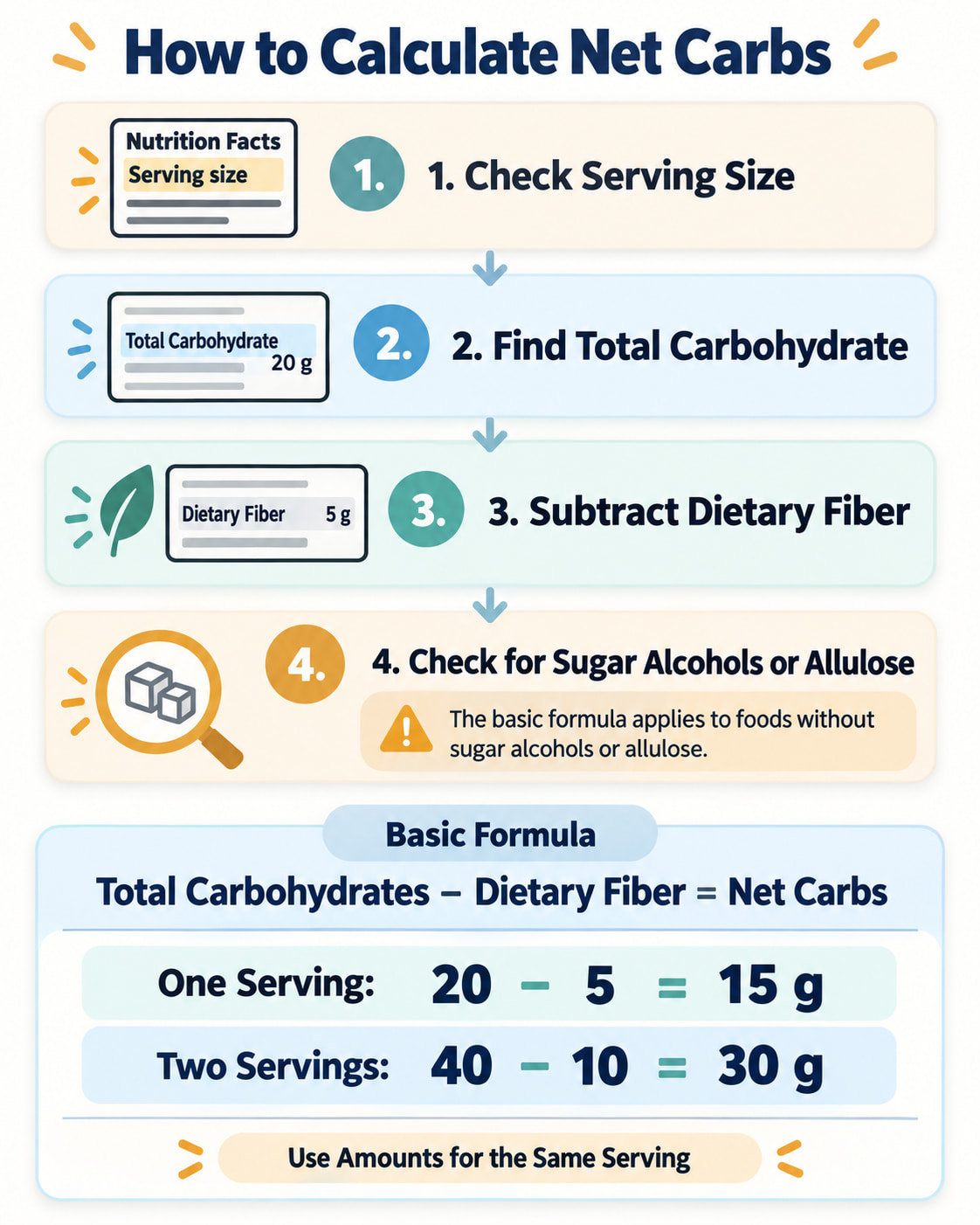
Start by checking the serving size, servings per container, and grams of total carbohydrate. Use nutrient amounts for the same portion throughout the calculation. A package may contain more than one serving.
Use the amounts in grams, not the percentages in the Daily Value column.
Foods Without Sugar Alcohols or Allulose
Subtract the listed dietary fiber from total carbohydrates:
Total carbohydrates − Dietary fiber = Net carbs
Using a hypothetical label:
| Nutrient | Amount per serving |
|---|---|
| Total carbohydrates | 20 g |
| Dietary fiber | 5 g |
| Total sugars | 6 g |
| Includes added sugars | 2 g |
The calculation is:
20 − 5 = 15 grams of net carbs
Do not subtract the 6 grams of total sugars or the 2 grams of added sugars. Those sugars remain part of the carbohydrate amount after fiber subtraction.
For fiber, use the amount listed under Dietary Fiber rather than guessing from ingredient names. The FDA’s definition includes naturally occurring fiber and certain qualifying added fibers; added fiber is not automatically invalid.
Foods With Sugar Alcohols
Sugar alcohols include ingredients such as maltitol, sorbitol, and xylitol. They are not handled exactly like ordinary sugar, but they can still affect blood glucose. A rule that subtracts every gram of every sugar alcohol can therefore be misleading.
One approach taught by the UCSF Diabetes Teaching Center subtracts half the listed sugar-alcohol grams when counting carbohydrates. This is a diabetes education method, not a universal definition of net carbs.
The practical point is to identify the method being used rather than assume every package or calculator follows the same rule.
Sugar alcohols can also cause gas, cramping, or diarrhea when consumed in amounts that exceed your tolerance. A low net-carb number does not tell you how well a product will agree with your digestion.
What About Erythritol?
Erythritol is a sugar alcohol that some commercial net-carb formulas subtract in full.
It is inaccurate to describe erythritol simply as “not absorbed.” Much of it is absorbed and then excreted unchanged in urine. An EFSA assessment found that the available, limited human evidence consistently showed no short-term effect on post-meal glucose regulation. That finding does not make an erythritol-containing food automatically healthy or appropriate for everyone.
Foods With Allulose
Allulose is a sugar, not a sugar alcohol. Under FDA guidance on allulose labeling, manufacturers may exclude it from Total Sugars and Added Sugars, but it must still be included in Total Carbohydrate.
Some commercial net-carb formulas subtract allulose separately. For a food containing fiber and allulose, but no sugar alcohols, that convention looks like this:
Net carbs = Total carbohydrates − Dietary fiber − Allulose
This explains why a product’s advertised net carbs might be lower than the number you get by subtracting fiber alone.
To reproduce the calculation, you need the allulose amount in grams. Seeing “allulose” in the ingredient list tells you it is present, but not how many grams to subtract.
Net Carb Calculation Examples
The examples below show different situations. All values are hypothetical except the FDA sample lasagna label. The sweetener examples illustrate specified calculation methods, not individualized medical advice.
| Example | Information used | Calculation |
|---|---|---|
| Basic food label, one serving | 20 g total carbs; 5 g fiber | 20 − 5 = 15 g net carbs |
| Two servings of the same food | 40 g total carbs; 10 g fiber | 40 − 10 = 30 g net carbs |
| FDA sample lasagna label, one cup | 34 g total carbs; 4 g fiber | 34 − 4 = 30 g using fiber-only subtraction |
| Product using full erythritol subtraction | 24 g total carbs; 8 g fiber; 6 g erythritol | 24 − 8 − 6 = 10 g under this method |
| Product using allulose subtraction | 20 g total carbs; 5 g fiber; 3 g allulose | 20 − 5 − 3 = 12 g under this method |
The lasagna numbers come from the FDA’s educational sample label, not a universal value for all lasagna. Full erythritol and allulose deductions are examples of commercial net-carb conventions.
Why Sugar-Alcohol Methods Can Give Different Answers
Consider a hypothetical product with:
- 29 grams of total carbohydrate
- 18 grams of sugar alcohol
- 0 grams of dietary fiber
A full sugar-alcohol deduction would give:
29 − 18 = 11 grams
Using the half-subtraction approach taught by UCSF would give:
29 − (18 ÷ 2) = 20 grams of counted carbohydrate
Both calculations use the same starting values, but the answers differ by 9 grams. That difference comes from the method—not an arithmetic error.
For diabetes management, do not choose whichever calculation produces the lowest number. Follow the counting method agreed with your diabetes care team.
Common Net Carb Calculation Mistakes
A few checks can prevent most calculation errors.
- Mixing serving sizes. Do not combine total carbohydrates for the whole package with fiber for one serving. When your portion changes, adjust all relevant amounts together.
- Subtracting ordinary sugars. Total sugars and added sugars are not extra deductions in the usual net-carb formula.
- Subtracting the same ingredient twice. Erythritol may already be included in the sugar-alcohol amount. Deducting both the full sugar-alcohol total and erythritol again would double-count that deduction.
- Starting with an already calculated net-carb number. If an app or package says “net carbs,” do not subtract fiber from that number again.
- Guessing missing quantities. An ingredient name alone does not provide the grams needed for a calculation. Check the manufacturer’s information rather than inventing an amount.
If your result is negative, recheck the serving sizes, inputs, and deductions. Do not interpret it as a food providing “negative carbs.”
Should You Count Net Carbs or Total Carbs?
For Understanding Food Labels
Net-carb calculations can help explain how a manufacturer arrived at a package claim. Keep the total carbohydrate number alongside the calculation so you can see exactly what was deducted.
However, net carbs do not describe the whole food. When comparing products, also look at calories, fiber, protein, saturated fat, sodium, and added sugars. The FDA’s label guidance emphasizes evaluating nutrients in the context of your overall dietary needs.
A lower net-carb number alone is not enough to establish that one product is the better choice.
For Diabetes Management
The ADA recommends using total carbohydrate grams and monitoring your blood glucose response to foods high in fiber or sugar alcohols. If you use insulin, do not replace your established carbohydrate-counting method with a package’s net-carb claim or change dosing based on this article’s examples.
A registered dietitian or diabetes care professional can help resolve differences between a product label, a tracking app, and your existing meal plan.
Frequently Asked Questions
Does Sugar-Free Mean Zero Net Carbs?
No. A sugar-free food can still contain other carbohydrates, including starches or sugar alcohols. Read Total Carbohydrate and the rest of the Nutrition Facts label rather than relying on the front-of-package claim.
How Do You Calculate Net Carbs in a Homemade Recipe?
For a recipe without sugar alcohols or allulose, add the total carbohydrate amounts for all ingredients, then separately add their fiber amounts. Subtract total fiber from total carbohydrates and divide by the number of equal servings.
For example, a hypothetical recipe containing 80 grams of total carbohydrates and 24 grams of fiber provides:
80 − 24 = 56 grams of net carbs for the recipe
Divided into eight equal portions:
56 ÷ 8 = 7 grams of net carbs per portion
Use ingredient amounts that match what actually went into the recipe.
Do You Subtract Protein or Fat When Calculating Net Carbs?
No. Protein and fat are separate nutrients, not components of the total carbohydrate grams. Neither belongs in the net-carb subtraction.
How Many Net Carbs Should You Eat Per Day?
There is no single net-carb target that suits everyone. Carbohydrate needs depend on factors such as activity, calorie needs, and personal health circumstances. If you have a prescribed carbohydrate goal, confirm whether it refers to total carbs or an adjusted counting method before tracking it.
The Bottom Line
For foods without sugar alcohols or allulose, the usual net-carb calculation is total carbohydrates minus dietary fiber. Products containing special sweeteners require a clearly identified method, and the result is not an exact prediction of blood sugar response.
Start with the serving size, keep every number on the same portion basis, and check what has already been subtracted.
This article provides general nutrition information and does not replace individualized advice from your healthcare professional.
References
- American Diabetes Association: Get to Know Carbs
- U.S. Food and Drug Administration: How to Understand and Use the Nutrition Facts Label
- U.S. Food and Drug Administration: Questions and Answers on Dietary Fiber
- U.S. Food and Drug Administration: Nutrition Labeling Guidance for Allulose
- UCSF Diabetes Teaching Center: Understanding Fiber, Learning to Read Labels, Counting Sugar Alcohols, and Counting Carbohydrates
- European Food Safety Authority: Re-evaluation of Erythritol as a Food Additive
- HighKey: Commercial Net-Carb Calculation Examples