
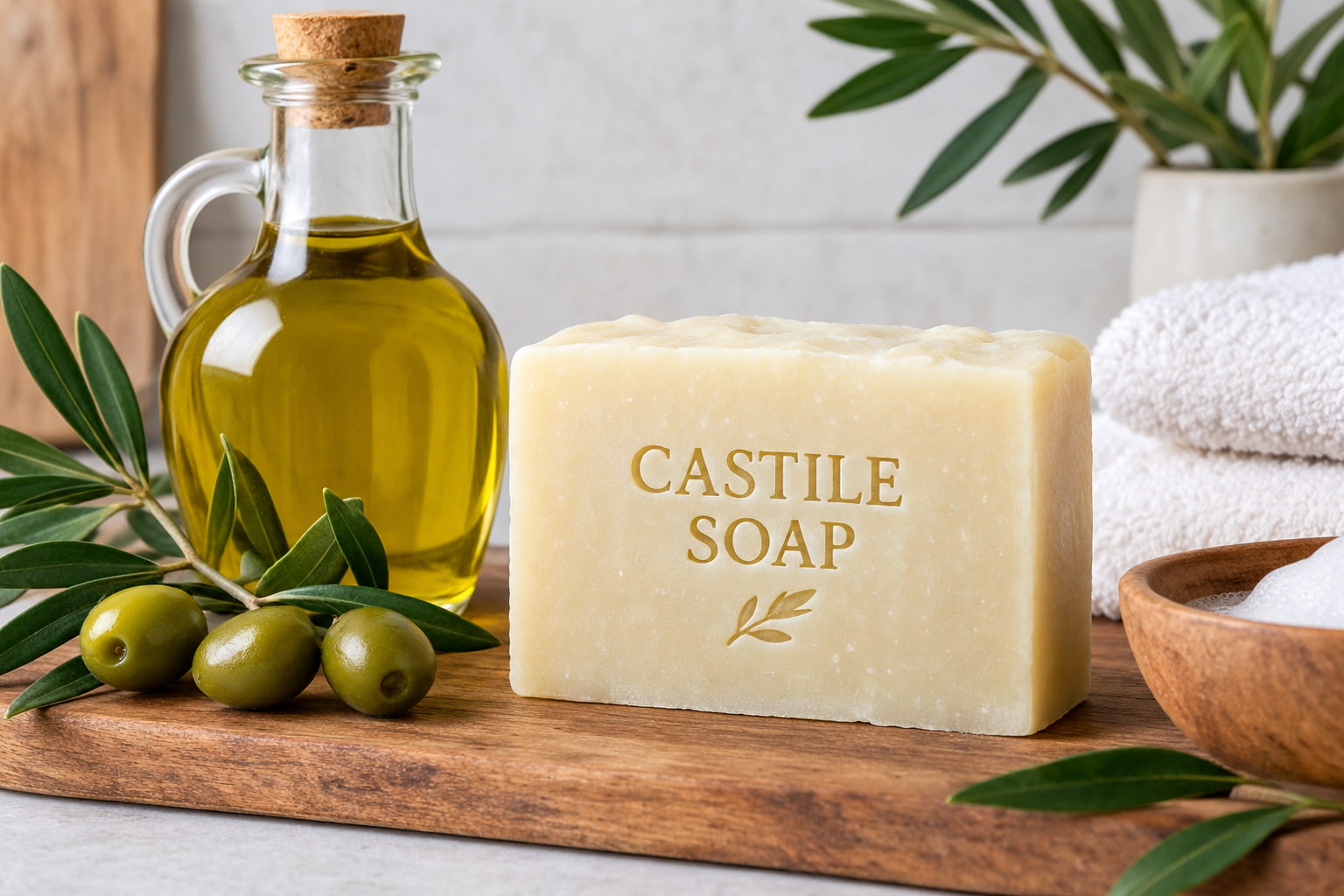
Castile soap is a plant-oil-based soap traditionally made with olive oil, although modern versions often contain a blend of vegetable oils. It comes in liquid and bar forms and can be used for personal cleansing and certain household cleaning tasks.
Its versatility makes it useful, but “natural” does not automatically mean suitable for every skin type or surface. The key is to choose an appropriate formula, follow its dilution instructions, and understand its limits—especially around sensitive skin, food preparation, and disinfecting.
What Is Castile Soap Made Of?
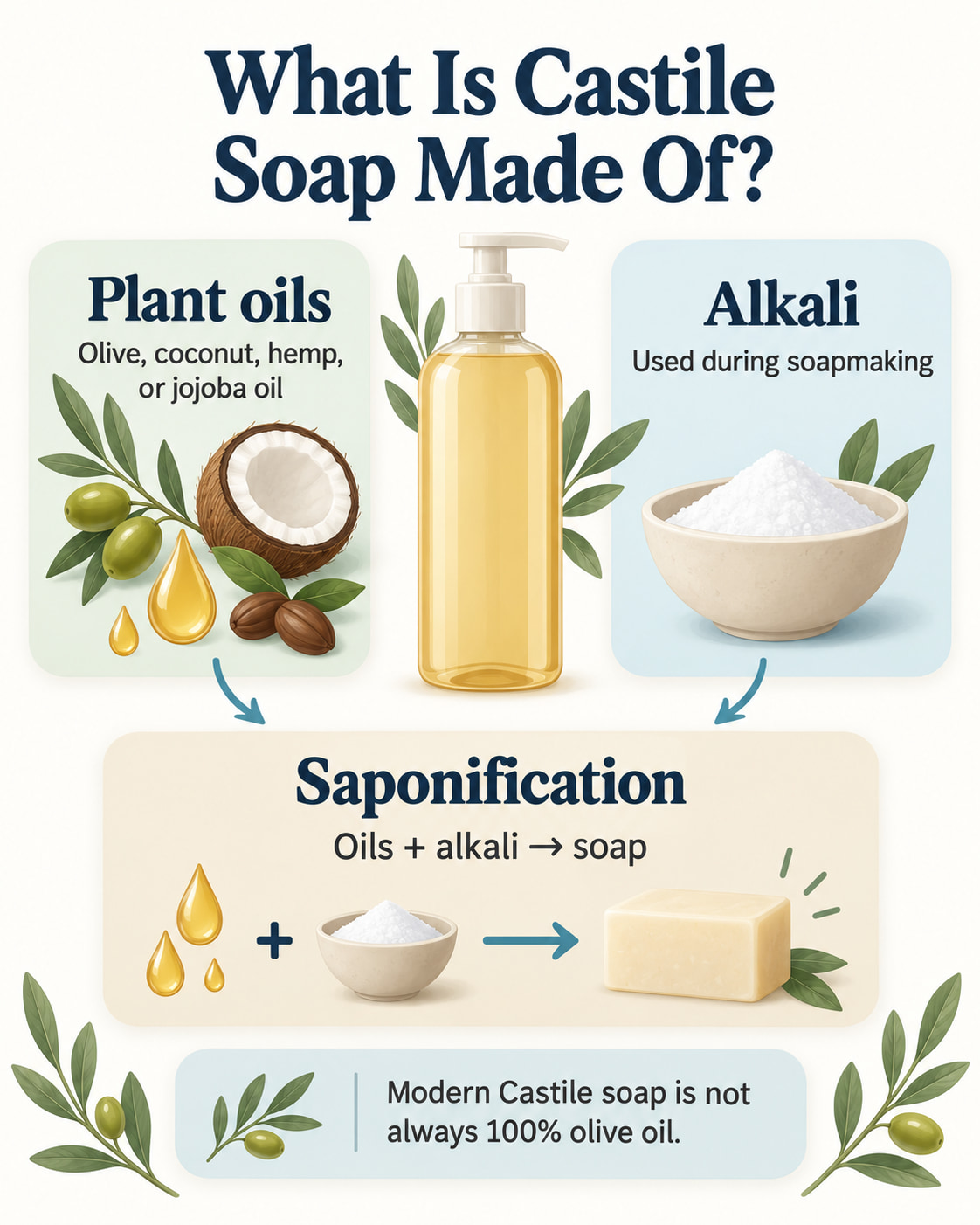
Castile soap uses plant oils instead of animal fats as its soapmaking base. Depending on the formula, those oils may include olive, coconut, palm, hemp, or jojoba oil. A product labeled “Castile” is not necessarily made from 100% olive oil.
Soap forms through saponification, a reaction between fats or oils and an alkali, such as sodium hydroxide or potassium hydroxide. The FDA’s explanation of soapmaking notes that properly made finished soap does not contain leftover lye.
However, that does not mean the finished soap has a neutral pH. True soaps are alkaline, while the skin’s surface is naturally slightly acidic. This difference can matter for people whose skin becomes dry or irritated after washing.
Check the full ingredient list rather than relying on the product name. Some formulas contain essential oils or other fragrance ingredients; others do not.
What Are the Benefits of Castile Soap?
A Plant-Based Soapmaking Base
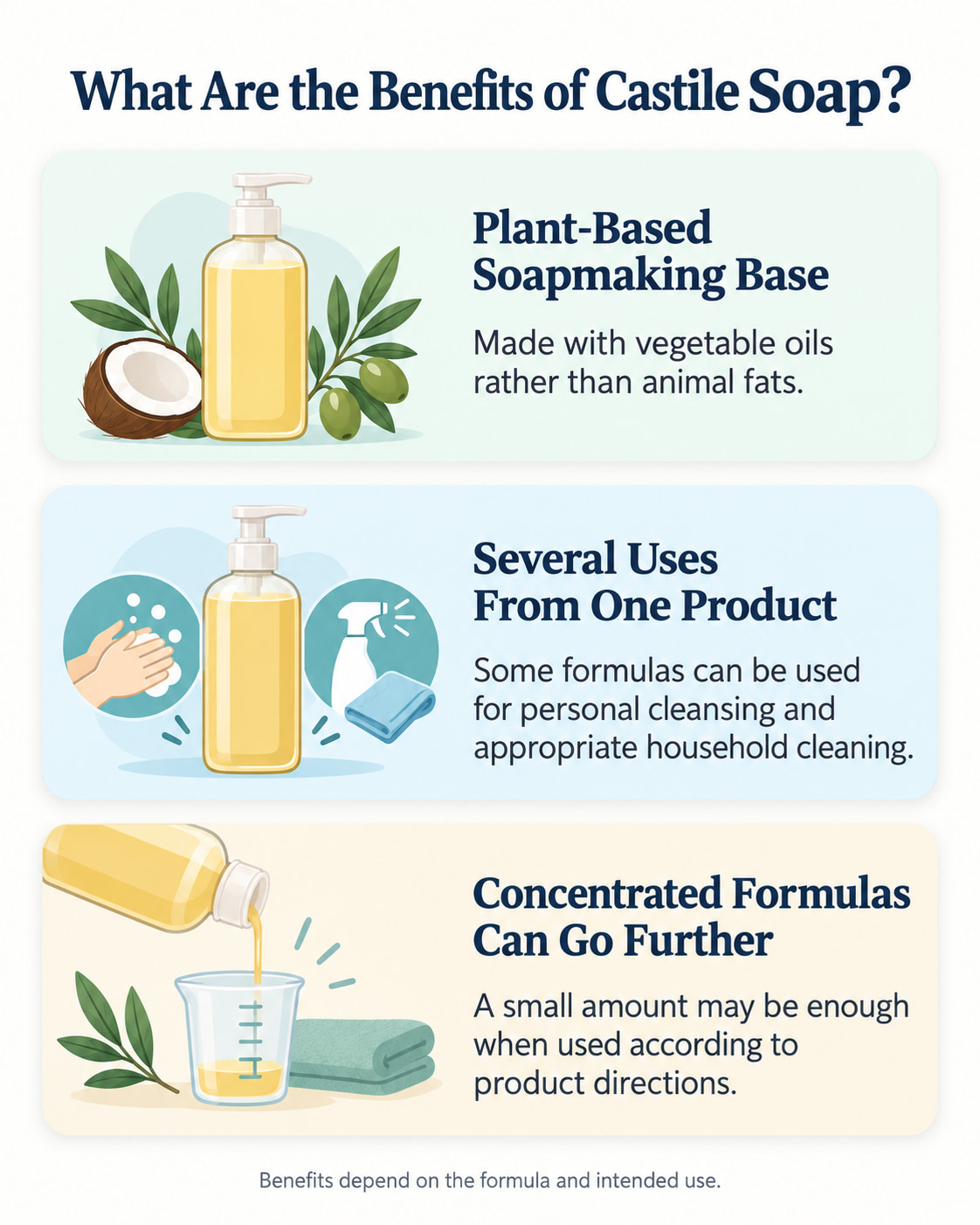
Castile soap can appeal to people who prefer cleansers made from vegetable oils rather than animal fats. That ingredient preference is separate from a safety claim: a plant-based formula is not automatically gentler or less likely to cause a reaction.
Several Uses From One Product
Certain formulations work for both body cleansing and household jobs, such as handwashing dishes or cleaning washable surfaces. This may simplify your supplies, provided the product is appropriate for each task.
Concentrated Formulas Can Go Further
Many liquid Castile soaps are concentrated, so a small amount may be enough when used as directed. Using more is not necessarily better; the manufacturer’s recommended amount is a more useful starting point than trying to create the biggest lather.
These are practical benefits—not reasons to replace medical care or assume Castile soap outperforms every other cleanser.
Common Uses for Castile Soap
The right use depends on the formulation, the surface, and your skin’s tolerance.
| Use | Practical guidance |
|---|---|
| Hand and body washing | Use a formula labeled for personal care. Apply with water as directed and rinse thoroughly. |
| Handwashing dishes | Follow the product’s dishwashing directions, rinse well, and watch for residue in hard water. |
| Washable household surfaces | Check the surface-care instructions before cleaning. Remove remaining soap with a damp cloth or rinse where appropriate. |
| Mopping suitable floors | Use the recommended amount and avoid excess water on moisture-sensitive flooring. |
| Laundry | Some manufacturers provide directions, but soap may leave mineral residue in hard water. Check both product and appliance instructions. |
These uses appear in manufacturer guidance, but they are not interchangeable recipes. In particular, hand-dishwashing directions are not dishwasher directions; Dr. Bronner’s specifically advises against putting its Castile soap in a dishwasher.
Is Castile Soap Good for Your Skin?
It can work for some people, but it is not automatically the best choice for dry, sensitive, or easily irritated skin. Its alkalinity, fragrance ingredients, concentration, and frequency of use can all affect how your skin responds.
The American Academy of Dermatology’s dry-skin recommendations, updated January, 2026, favor gentle, fragrance-free cleansers. They also recommend applying moisturizer while the skin is still damp after washing.
Choose Fragrance-Free Products When Sensitivity Is a Concern
Do not assume that “unscented” means the same thing as “fragrance-free.” Some unscented products contain ingredients that mask odors and may irritate sensitive skin. Read the label, particularly when fragrance has caused problems before.
Try a Small Area First
Before using a new Castile soap over your whole body, try it on a small area using the label-directed amount and rinse it off. Stop if you notice irritation. This is especially important when you already have a condition such as eczema or rosacea.
For dry skin, use warm rather than hot water, cleanse gently, and avoid scrubbing. A tight or uncomfortable feeling after washing is a reason to reassess your routine—not a goal to aim for.
How to Dilute Castile Soap
There is no universal Castile soap dilution ratio. Instructions vary by brand and purpose. Some uses involve mixing soap with water in a separate container; others involve applying a small amount to wet hands or a wet washcloth.
For illustration, Dr. Bronner’s liquid-soap dilution guide, checked September, 2026, gives these starting amounts:
| Task | Manufacturer’s directions for its liquid Castile soap |
|---|---|
| Body washing | A small squirt on a wet washcloth, applied to wet skin |
| Foaming hand-soap dispenser | One part soap to three parts water |
| Handwashing dishes | One part soap to 10 parts water |
These are brand-specific examples, not recommendations for every Castile soap. A dishwashing mixture should not be treated as a face-washing recipe.
To understand the measurements, one part soap to 10 parts water could mean one tablespoon of soap plus 10 tablespoons of water. Use the same measuring unit for both.
Store Diluted Mixtures Carefully
Adding water changes a product’s storage conditions. FDA guidance explains that water can introduce microorganisms and dilute a cosmetic product’s preservative system. Keep containers clean and follow the manufacturer’s storage instructions.
Dr. Bronner’s advises making small batches of prediluted soap and using them within a couple of weeks. Do not assume a homemade mixture will remain suitable for as long as the original concentrate.
Castile Soap Safety Tips and Uses to Avoid
Do Not Mix It Directly With Vinegar or Lemon Juice
Acids can interfere with soap’s cleaning action. Mixing Castile soap with vinegar in the same bottle can break down the soap and leave an oily or filmy residue instead of producing a better cleaner.
This is primarily a cleaning-performance problem. It is different from dangerous chemical combinations such as mixing bleach with incompatible cleaners.
When a separate acidic rinse is appropriate, rinse away the soap first and follow the surface manufacturer’s instructions. Do not use vinegar on acid-sensitive stone, such as marble.
Account for Hard-Water Residue
Calcium and magnesium in hard water react with soap and can form soap scum. You may notice cloudy mixtures, spotted dishes, or a film on surfaces. Rinsing and drying can reduce visible residue; persistent buildup may make a different cleanser more practical.
Do Not Use It as a Disinfectant
Cleaning removes dirt and many germs. Disinfecting uses a product or process intended to kill remaining germs. A homemade Castile soap spray should not be assumed to disinfect a surface.
The CDC’s home cleaning and disinfecting guidance recommends cleaning first and using an appropriate disinfectant when needed, such as when someone at home is sick or has a weakened immune system. Follow the disinfectant’s label, including its required wet contact time. Never mix cleaning products together.
Do Not Wash Fruits and Vegetables With Soap
Even though some Castile soap use lists suggest a produce rinse, the FDA’s produce-safety guidance recommends washing fruits and vegetables under running water—not with soap or detergent. Produce can absorb soap residues despite rinsing.
For ordinary, unwashed produce, rinse under running water and gently rub the surface. Follow package directions for produce labeled prewashed or ready to eat.
Keep It Away From Eyes and Avoid Swallowing It
If soap gets into your eyes, begin rinsing immediately with plenty of room-temperature water for 15–20 minutes. Remove contact lenses, then contact Poison Control for guidance. Severe or persistent pain or vision problems need urgent assessment.
If someone swallows soap, do not induce vomiting. In the United States, call Poison Control at 1-800-222-1222 for product-specific advice. Call 911 for trouble breathing, collapse, or inability to wake the person.
Castile Soap vs. Regular Soap and Body Wash
Castile soap is one type of true soap. Other true soaps may use different plant oils, animal fats, or a combination. Many products sold as body washes or cleansing bars instead use synthetic detergent ingredients. The FDA explains that a product can be marketed as “soap” without meeting the regulatory definition of true soap.
Synthetic does not automatically mean harsh. Soap-free cleansers can be formulated closer to the skin’s natural pH and may be better tolerated by people with sensitive skin. Choose based on the complete formulation, intended use, and your response—not simply whether the label says “natural.”
When to Stop Using Castile Soap
Stop using it if you develop dryness, scaling, itching, redness, or burning. Seek advice from a healthcare professional if the reaction persists or worsens after you stop. Do not keep using an irritating product because you expect your skin to “get used to it.”
A cleanser that works well for household cleaning does not also have to become your face or body cleanser.
Frequently Asked Questions
Is Castile Soap Always Made From 100% Olive Oil?
No. Traditional Castile soap is associated with olive oil, but modern formulas may blend several vegetable oils. Check the ingredient list when the specific oil source matters to you.
Can You Use Castile Soap Every Day?
Some people tolerate regular use, while others develop dryness or irritation. There is no single schedule that suits everyone. Use the label-directed amount and reconsider the product or frequency if your skin becomes uncomfortable.
Can Castile Soap Replace Shampoo?
Some products are marketed for hair washing, but they may be harder to rinse out than shampoo. Cleveland Clinic also notes that Castile soap can strip hair color. People with color-treated hair should be particularly cautious about switching.
Is Castile Soap Antibacterial?
Plain Castile soap is not the same as a formulated antibacterial wash. However, the FDA says there is insufficient evidence that over-the-counter antibacterial soaps prevent illness better than washing with plain soap and water. Proper washing matters more than an antibacterial claim.
Does Castile Soap Expire?
Shelf life depends on the product and storage conditions. Follow the manufacturer’s directions for the original soap, and remember that adding water can shorten the usable life of a mixture. A concentrate’s storage guidance does not automatically apply after dilution.
Is Liquid Castile Soap Better Than a Bar?
Neither form is universally better. Liquid soap is convenient for measuring and dilution, while a bar is compact and spill-resistant. Formulas can differ, so the liquid and bar versions of a product may not feel identical on your skin.
The Bottom Line
Castile soap can be a useful plant-based cleanser, but its value depends on matching the product to the task. Follow dilution directions, pay attention to skin irritation, and keep cleaning separate from disinfecting.
Start with one appropriate use rather than replacing your entire routine. Check the label, measure carefully, and judge the results before expanding how you use it.
This content is for informational purposes only and not medical advice.
References
- American Academy of Dermatology: Dermatologists’ tips for relieving dry skin.
- Centers for Disease Control and Prevention: When and how to clean and disinfect your home.
- Cleveland Clinic: Castile soap uses and skin-safety guidance.
- DermNet: Soaps and cleansers.
- National Capital Poison Center: First-aid guidance for poison exposures.