
Four plain large eggs have about 280 calories. A practical range is about 280 to 288 calories, depending on whether you use the common label-style value of 70 calories per egg or a USDA-style estimate closer to 72 calories per egg. According to MedlinePlus nutrition information for one egg, one large egg provides 70 calories, so 4 eggs come to about 280 calories.
That makes eggs a simple, high-protein option for breakfast, lunch, or dinner. But the final calorie total depends on egg size and especially on how you cook them. Butter, oil, cheese, and meat add calories quickly.
How Many Calories Are in 4 Eggs by Serving Style?
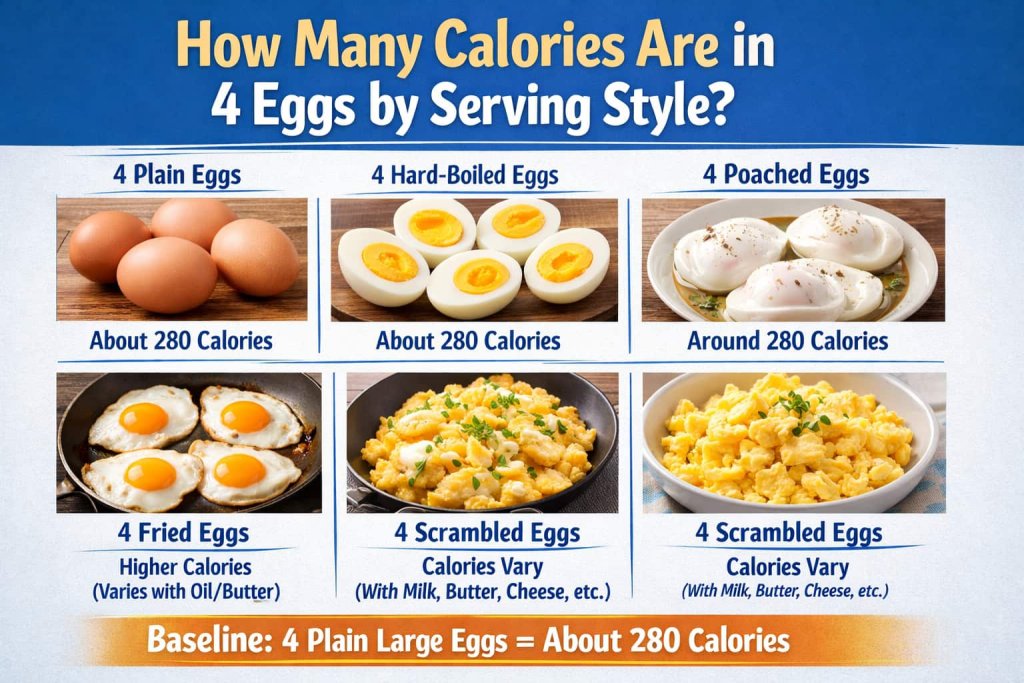
For most readers, this is the most useful everyday guide:
- 4 plain large eggs: about 280 calories
- 4 large hard-boiled eggs: about 280 calories
- 4 large poached eggs: usually close to 280 calories
- 4 large fried eggs: often higher, depending on how much oil or butter is used
- 4 scrambled eggs: can stay close to the plain total, but calories rise if you add milk, butter, cheese, or cream
The most practical baseline is still 4 plain large eggs = about 280 calories, based on MedlinePlus.
How Many Calories in 4 Eggs by Egg Size?
If you are not using large eggs, the calorie total changes a little. A practical guide is:
- 4 small eggs: about 216 calories
- 4 medium eggs: about 252 calories
- 4 large eggs: about 280 to 288 calories
- 4 extra-large eggs: about 320 calories
- 4 jumbo eggs: about 360 calories
This is helpful because many people count “4 eggs” without checking carton size. In everyday use, 4 large eggs is still the best default estimate unless the package says otherwise.
Why the Calories in 4 Eggs Can Vary
The number is not always exactly the same because of two main things:
Egg size
Small, medium, large, extra-large, and jumbo eggs do not weigh the same. Larger eggs contain more calories than smaller ones.
Cooking method
Plain boiled or poached eggs stay close to the natural calorie count. Fried and scrambled eggs can be much higher if cooked with added fat or mixed with other ingredients.
That is why “4 eggs” can mean very different calorie totals in real life. Four plain eggs are one thing. Four eggs cooked in butter with cheese are something else.
Nutrition Profile of 4 Eggs
Based on the MedlinePlus nutrition panel for one large egg, 4 large eggs provide about:
- Calories: 280
- Protein: 24 grams
- Total fat: 20 grams
- Saturated fat: 6 grams
- Carbohydrates: 0 grams
- Cholesterol: 740 milligrams
- Sodium: 280 milligrams
This is why eggs are often considered nutrient-dense. You get a lot of protein and several important nutrients for a relatively moderate calorie amount.
Key Nutrients in 4 Eggs
Eggs are more than just calories and protein.
Protein
Four eggs provide about 24 grams of protein, which can help support fullness and muscle maintenance. The Dietary Guidelines for Americans include eggs in the protein foods group.
Choline
Eggs are one of the best-known food sources of choline. The NIH Office of Dietary Supplements lists eggs among foods naturally rich in choline, and the Dietary Guidelines note that eggs provide notable amounts of it. Choline is important for cell structure, brain function, and normal metabolism.
Vitamin D, Vitamin A, and Vitamin B12
The MedlinePlus egg nutrition panel shows that eggs also provide vitamin D and vitamin A, and eggs are commonly recognized as a source of vitamin B12 as part of their nutrient density.
Selenium
Federal nutrition resources also recognize eggs as a useful source of selenium, another important nutrient that supports normal body function.
Is 4 Eggs Good for Weight Management?
It can be, depending on the rest of your meal and your daily calorie needs.
Four eggs give you a solid amount of protein for around 280 calories when eaten plain. For many people, a high-protein meal may feel more filling than a lower-protein meal with the same calories. That can make eggs a practical choice in a weight-management plan.
Still, whether 4 eggs fit your goals depends on the full meal:
More weight-management-friendly choices
- 4 boiled or poached eggs
- 4 eggs with vegetables
- 4 eggs with fruit or a fiber-rich side
- 4 eggs cooked with minimal added fat
Less weight-management-friendly choices
- 4 eggs fried in a lot of butter or oil
- 4 eggs with sausage, bacon, cheese, and hash browns
- 4 eggs in a large restaurant breakfast with toast, spreads, and sugary drinks
One practical reason restaurant egg meals can be much higher in calories is that they are often cooked with extra butter or oil, then served with calorie-dense sides. Even when the eggs themselves are modest in calories, the full plate may be much heavier than it looks.
The eggs themselves are not usually the problem. The extras often make the meal much more calorie-dense.
How to Make 4 Eggs More Balanced
If you are eating 4 eggs as a meal, what you pair with them matters just as much as the eggs themselves.
Better-balanced options include:
- eggs with sautéed or fresh vegetables
- eggs with fruit on the side
- eggs with whole-grain toast instead of buttery refined sides
- eggs cooked with a small amount of oil instead of a heavy amount of butter
This approach can help make the meal more filling and more balanced without pushing calories up as quickly as a large restaurant-style breakfast.
Are 4 Eggs Too Much?
For some people, 4 eggs in one sitting may feel perfectly reasonable. For others, it may be more than needed.
The main point is this: 4 eggs are high in protein, but they are also high in dietary cholesterol. The American Heart Association says eggs can fit into a healthy diet, but overall eating pattern matters most. That includes the balance of saturated fat, fiber, vegetables, whole grains, and other protein sources across the day.
So, 4 eggs are not automatically “too much,” but portion size should match your health needs, appetite, and the rest of your diet.
It is also worth thinking about how often you eat this amount. Having 4 eggs once in a while is different from building your breakfast around 4 eggs every day. If eggs are a frequent staple in your diet, it makes sense to look at your overall pattern of saturated fat, fiber, fruits, vegetables, legumes, whole grains, and other protein choices rather than judging the eggs alone.
Who Should Be a Little More Careful With 4 Eggs?
People watching cholesterol as part of a heart-health plan
Four eggs provide a large amount of dietary cholesterol. The American Heart Association notes that foods high in cholesterol should be viewed within the context of the overall diet, especially when meals are also high in saturated fat. If you are managing LDL cholesterol or have been told to follow a heart-healthy eating plan, portion size and meal balance matter. See the American Heart Association guidance on dietary cholesterol.
People with an egg allergy
Egg is one of the FDA’s major food allergens. The FDA food allergy guidance explains that eggs must be clearly identified on labels when present in regulated packaged foods.
People at higher risk from foodborne illness
Older adults, young children, pregnant women, and people with weakened immune systems should be especially careful with undercooked eggs. The CDC safer food guidance recommends cooking eggs until the yolks and whites are firm and using pasteurized eggs for foods that may stay raw or undercooked.
Safety Box
- Cook eggs until both the yolk and white are firm
- Cook egg dishes without meat or poultry to 160°F
- Use pasteurized eggs for foods that will not be fully cooked
These food safety recommendations come from the CDC safer food choices page.
4 Eggs Calories Compared With Common Variations
Here is the most practical way to think about it:
| Egg serving | Approximate calories |
|---|---|
| 4 plain large eggs | 280 |
| 4 eggs + 1 teaspoon butter | higher than 280 |
| 4 eggs + cheese | higher than 280 |
| 4 eggs + oil for frying | higher than 280 |
| 4 egg whites only | much lower than 4 whole eggs |
A useful comparison is whole eggs versus egg whites. Most of the calories in an egg come from the yolk, but the yolk is also where many of the egg’s vitamins, minerals, and choline are found. Egg whites are lower in calories and still provide protein, while whole eggs provide a broader nutrient package. For readers trying to lower calories without giving up volume, a mix such as 2 whole eggs plus 2 to 4 egg whites can be a practical middle ground.
This is why plain eggs and loaded egg dishes should not be treated as the same food nutritionally.
Common Questions About How Many Calories in 4 Eggs
How many calories are in 4 scrambled eggs?
If they are scrambled without much added fat, they are still close to the plain total of about 280 calories. If butter, milk, cream, or cheese is added, the total goes up.
How many calories are in 4 boiled eggs?
About 280 calories using the common 70-calorie-per-egg estimate from MedlinePlus.
How much protein is in 4 eggs?
About 24 grams of protein, based on 6 grams per egg from MedlinePlus.
Are 4 eggs a high-protein meal?
Yes. Four eggs provide enough protein to count as a protein-rich meal for many people.
Bottom Line on How Many Calories in 4 Eggs
4 plain large eggs contain about 280 calories and about 24 grams of protein. They can be a filling, nutrient-dense food that fits well into many eating patterns. The most important things to watch are portion size, cooking method, and what you eat with them.
If you want the best balance for calories and nutrition, keep the eggs simple and pair them with vegetables, fruit, or other minimally processed sides.
Sources/References
- MedlinePlus — Perfect Hard-Cooked Eggs
- U.S. Department of Agriculture and U.S. Department of Health and Human Services — Dietary Guidelines for Americans, 2020–2025
- NIH Office of Dietary Supplements — Choline Fact Sheet for Health Professionals
- American Heart Association — Here’s the latest on dietary cholesterol and how it fits in with a healthy diet
- FDA — Food Allergies
- CDC — Safer Food Choices