
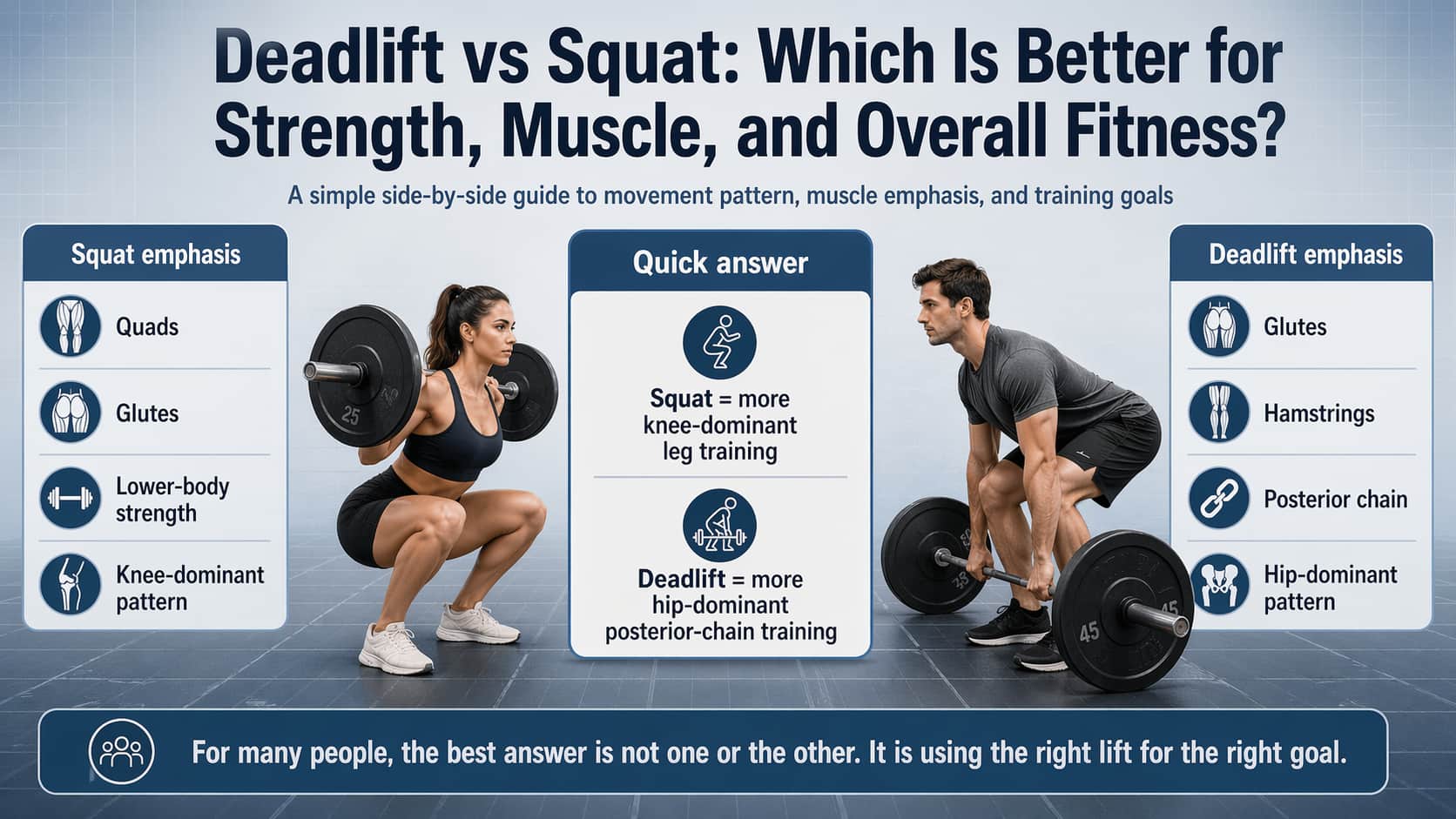
Deadlift vs squat is not really about picking one “winner.” For most people, the squat is the better knee-dominant lower-body lift, while the deadlift is the better hip-dominant posterior-chain lift. Understanding that difference matters because it helps you choose the right exercise for your goal, your body, and your training experience. The best answer for many lifters is simple: use the squat when you want more quad-focused leg work, use the deadlift when you want more hip-hinge and back-side strength, and use both when your program allows it.
A good starting point is to compare what each lift actually does, not just how much weight you can move. Official guidance from the American Council on Exercise back squat guide and ACE deadlift guide shows that the squat is mainly organized around sitting down and standing up under load, while the deadlift is built around a hip hinge with the bar starting from the floor. That difference changes which joints, muscles, and movement demands matter most.
Deadlift vs squat at a glance
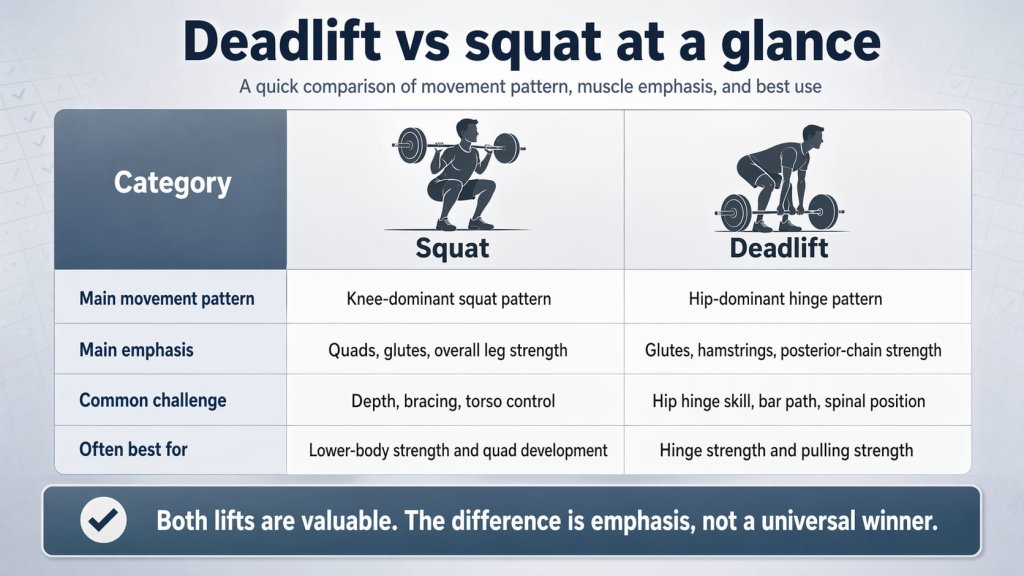
| Category | Squat | Deadlift |
|---|---|---|
| Main movement pattern | Knee-dominant squat pattern | Hip-dominant hinge pattern |
| Main emphasis | Quads, glutes, overall leg strength | Glutes, hamstrings, back-side strength |
| Bar position | On the back or front of body, depending on variation | In the hands, starting from the floor or blocks |
| Common challenge | Depth, bracing, knee and torso control | Hip hinge skill, bar path, spinal position |
| Often best for | Lower-body strength, quad development, athletic leg training | Posterior-chain strength, hinge mechanics, pulling strength |
| Good in the same program? | Yes | Yes |
This quick comparison fits both official exercise descriptions and current research. ACE lists the back squat under butt/hips and thighs, while it lists the deadlift as a full-body integrated exercise and notes that, when done correctly, the glutes and back of the thighs should feel the work rather than the low back.
Why body proportions and mobility matter
One reason the deadlift vs squat debate never has one universal answer is that body structure changes how each lift feels. People with longer femurs or limited ankle mobility often find squats harder to keep upright, while people with longer arms or stronger hip-hinge mechanics may feel more natural in deadlifts.
That does not mean one lift is better. It means your build can change which lift feels smoother, which one you can load more comfortably, and which variation fits you best. In practice, that is why some people do better with front squats, box squats, heeled shoes, trap-bar deadlifts, or Romanian deadlifts instead of forcing one exact setup.
If one pattern consistently feels awkward even after good coaching, the smarter move is usually to adjust the variation before giving up on the whole movement family.
What the squat trains better
The squat usually has a bigger training payoff for people who want strong legs, better quad development, and more practice producing force through both knees and hips together. ACE’s squat setup cues emphasize sitting back into the hips, keeping the chest up, and driving back up from the bottom position, which makes it a classic lower-body strength exercise.
A 2024 biomechanical review of the squat explained that the demands of the movement change based on depth, bar placement, stance, and other setup choices. That matters because “squat” is not just one fixed thing. A high-bar squat, low-bar squat, front squat, and goblet squat can all feel different even though they belong to the same family.
For many programs, the squat is the better pick when your main goal is:
- Building general lower-body strength
- Getting more quad stimulus
- Training a movement that carries over well to jumping, standing up, and many sports
- Using a lift that can be scaled from bodyweight to heavy barbell work
A 2024 narrative review on free-weight squats also noted that squat training can support sports performance and may help with injury prevention and injury-severity reduction when programmed well.
What the deadlift trains better
The deadlift usually has the edge when your goal is posterior-chain strength, especially through the glutes, hamstrings, and hip extensors. ACE’s 2024 deadlift teaching article describes proper deadlifting as a hip hinge powered by the hip extensor complex, and it notes that the greatest muscle forces in a traditional barbell deadlift are generated at the hip, lumbar spine, ankle, and knee, in that order.
ACE’s exercise library also says that a well-executed deadlift should feel like work in the glutes and back of the thighs, not the back itself. That is one reason deadlifts are often programmed for lifters who want stronger hips, better hinge mechanics, and more total-body pulling strength.
The deadlift is often the better choice when your main goal is:
- Building the posterior chain
- Learning or strengthening the hip hinge
- Improving pulling strength from the floor
- Training with an exercise that can load the whole body heavily
That does not mean the deadlift ignores the quads or that the squat ignores the glutes. Both lifts train several muscle groups at once. The difference is emphasis.
How variations change the deadlift vs squat comparison
Not every deadlift or squat creates the same training demand. A trap-bar deadlift usually keeps the load closer to the body and often feels more accessible than a straight-bar conventional deadlift. A front squat usually keeps the torso more upright than a back squat and often feels more quad-focused.
That is why two people can both say they prefer “deadlifts” or “squats” while actually talking about very different versions of the lift. For general fitness, the more useful comparison is often goblet squat vs trap-bar deadlift, not heavy back squat vs heavy conventional deadlift.
This matters because the best choice is often not a whole movement category. It is the variation that fits your goal, mobility, skill level, and tolerance best.
What research says about deadlift vs squat
The most useful direct comparison comes from a 2020 study in the Journal of Human Kinetics. It found that both squat-focused and deadlift-focused training improved lower-body maximal strength and jump performance in trained men. In practical terms, that means either lift can help build strength and power when used well.
That same study also reported that three participants in the deadlift group developed low back pain and were excluded, which is important context rather than a reason to fear the lift. It suggests that deadlift programming may place a higher technical and loading demand on the low back in some settings, especially when fatigue, mobility, or form are not managed well. A 2022 narrative review focused specifically on low-back biomechanics during repetitive deadlifts, which supports the idea that technique and progression matter a lot.
Related comparison research helps explain the muscle emphasis too. A 2019 study comparing the back squat, Romanian deadlift, and barbell hip thrust found that the squat simultaneously activated the hip and knee extensors, while the Romanian deadlift was more effective for isolating the hip extensors. That does not make the RDL identical to a conventional deadlift, but it reinforces the bigger point: squat patterns are usually more balanced across hips and knees, while deadlift patterns are generally more hip dominant.
There is also reassuring evidence on squat safety. A 2024 review concluded that the deep squat appears safe for knee joint health and can be included in resistance training without added knee-joint risk in healthy populations. That matters because “squats are bad for your knees” is still one of the most common myths around this topic.
Deadlift vs squat for muscle growth
For muscle growth, neither lift automatically beats the other in every body part. The better choice depends on what you want to emphasize.
Squat is often better for:
- Quads
- Overall thigh development
- Lower-body strength through a larger bend at the knees
Deadlift is often better for:
- Glutes
- Hamstrings
- Posterior-chain development
- Hinge strength and pulling strength
For many lifters, the smartest hypertrophy plan is not deadlift or squat. It is deadlift and squat, with one used as the primary lift and the other supported by accessory work. For example, a squat-focused day might use squats first, then Romanian deadlifts later. A hinge-focused day might use deadlifts first, then split squats or leg presses later.
Deadlift vs squat for beginners
Beginners usually do better when they learn the squat pattern first in a simpler form, such as a bodyweight squat, goblet squat, or box squat. The squat is often easier to coach early because it does not require pulling a bar from the floor and can be scaled with very light loads. ACE’s bodyweight squat guidance emphasizes core bracing, chest position, and shifting weight back into the heels, which are useful beginner-friendly cues.
That said, beginners can still learn deadlifts safely. The key is to start with a variation that matches current mobility and skill, such as a kettlebell deadlift, trap-bar deadlift, or rack pull, before jumping into heavy conventional pulls from the floor. ACE’s deadlift guidance specifically notes the need for hip mobility and spinal stability before loading the movement heavily.
Which is better for strength?
For raw lower-body strength, both lifts work. The better question is what kind of strength you want.
Choose the squat first when you want:
- More direct leg-strength emphasis
- More knee-extension demand
- A lift that supports many athletic lower-body qualities
Choose the deadlift first when you want:
- More hip-extension strength
- More posterior-chain loading
- A lift that challenges grip and total-body tension more heavily
A 2020 head-to-head comparison found similar improvements in lower-body maximal strength and jump performance from both lifts, so your result is likely to depend more on good programming than on arguing about which exercise is universally superior.
Can you do both in the same workout?
Yes. Many well-built lower-body programs include both a squat and a deadlift pattern, just not always at maximal intensity on the same day.
A practical structure could look like this:
Option 1: Squat first, deadlift variation second
- Back squat: 3 to 5 sets
- Romanian deadlift: 2 to 4 sets
- Split squat or leg curl: 2 to 3 sets
Option 2: Deadlift first, squat variation second
- Conventional deadlift: 3 to 5 sets
- Front squat or goblet squat: 2 to 4 sets
- Glute bridge or calf work: 2 to 3 sets
Option 3: Split them across the week
- Day 1: squat-focused lower-body session
- Day 2: deadlift-focused lower-body session
For general health, the CDC physical activity guidance says adults need muscle-strengthening activity at least 2 days per week, and AAOS bone health guidance notes that weight-bearing strength exercises such as squats and deadlifting can positively affect the hips and spine. AAOS also advises training major muscle groups at least twice weekly with a full day of rest between strength sessions.
Which lift is usually harder to recover from?
Both lifts are demanding, but many lifters find heavy deadlifts harder to recover from than squats when intensity and volume rise. Deadlifts can create a bigger recovery cost through the low back, grip, and total-body tension demands, especially when they are trained hard from the floor.
That does not mean squats are easy. It means deadlifts often need more care with weekly volume. If heavy deadlifts leave you drained for several days, it may make more sense to do fewer hard deadlift sets, use a lower-fatigue variation such as Romanian deadlifts, or place your deadlift work on a separate day.
A practical rule is to put your heaviest, highest-skill lift first, then use the other movement pattern in a lighter or less fatiguing variation.
How to decide between deadlift vs squat
Use this simple rule:
Pick the squat first if:
- You want more quad-focused lower-body work
- You want a more obvious “leg day” main lift
- You are building around front squats, back squats, or goblet squats
- You tolerate knee-dominant patterns well
Pick the deadlift first if:
- You want more glute and hamstring emphasis
- You need more hinge practice
- You want a strong posterior-chain anchor in your program
- You tolerate pulling from the floor well
Use both if:
- You want a more complete lower-body strength program
- You can recover well
- Your technique is solid enough to train both patterns regularly
This is the most useful real-world answer to the deadlift vs squat question. For long-term progress, the best lift is usually the one that matches your goal, your structure, your skill level, and your recovery capacity.
Common mistakes when comparing deadlift vs squat
Many articles oversimplify this topic. Here are the biggest mistakes to avoid:
- Assuming one lift is “better” for everyone
- Treating all deadlifts or all squats as identical
- Ignoring goal-specific differences between quad emphasis and posterior-chain emphasis
- Judging an exercise only by the amount of weight lifted
- Copying advanced barbell variations before learning the pattern well
A squat and a deadlift can both be excellent or poor choices depending on your current ability, setup, and program. That is why recent squat biomechanics work emphasizes modifiable parameters such as stance, depth, and bar position instead of treating the lift as one fixed template.
Deadlift vs squat: the best choice for most people
For most people, the best long-term answer is this:
- Squat for leg strength and knee-dominant lower-body development
- Deadlift for hip-dominant posterior-chain strength
- Keep both in your toolbox
- Prioritize the one that matches your goal
- Progress load and complexity slowly
That balanced approach is more useful than trying to crown one lift the permanent winner. It also fits what current exercise guidance and comparison research actually show.
Who should be more cautious with deadlifts or squats?
Both lifts can be useful, but some people should modify the exercise or get individualized guidance first. That includes people with recent surgery, a current back, hip, knee, or ankle injury, pain that becomes sharper during the lift, pain that lingers after training, or balance problems that make setup unsafe.
The goal is not to avoid strength training. The goal is to choose the version and loading level you can control well. In many cases, a supported or lighter variation is the better starting point. Box squats, goblet squats, trap-bar deadlifts, kettlebell deadlifts, split squats, and machine-based lower-body work can all help you train around limitations while still building strength.
Frequently Asked Questions
Is deadlift better than squat for glutes?
Usually, the deadlift has the stronger reputation for posterior-chain loading, especially through the glutes and hamstrings. But squats also train the glutes well. Deadlift patterns generally have a stronger hip-dominant emphasis, while squats distribute more work across the hips and knees.
Is squat better than deadlift for quads?
In most programs, yes. Squats usually provide a stronger quad-focused training effect because of the larger knee-extension demand.
Which burns more calories, deadlift or squat?
There is no reliable universal winner because calorie burn depends on load, volume, body size, rest periods, and effort. Both are large compound lifts that can contribute meaningfully to energy expenditure during resistance training.
Are squats bad for your knees?
Not automatically. A 2024 review reported that deep squats appear safe for knee joint health in healthy populations. Technique, load selection, individual history, and symptom response matter more than the exercise name alone.
Are deadlifts bad for your back?
Not automatically. Deadlifts do place meaningful demands on the hips and spine, which is why bracing, bar path, hip mobility, and sensible progression matter. Poor form, fatigue, and load mismanagement can make problems more likely.
Should beginners do deadlifts or squats first?
Many beginners start more easily with squat variations such as bodyweight or goblet squats, then learn beginner-friendly deadlift variations. But the right order depends on coaching, mobility, and equipment.
Can you replace squats with deadlifts?
You can, but you will not get exactly the same training effect. Deadlifts can replace some lower-body strength work, but they do not fully replace the more knee-dominant stimulus that squats provide.
Conclusion
Deadlift vs squat is best answered by your goal, not by gym arguments. Use the squat when you want more quad-focused leg strength, use the deadlift when you want more hip-dominant posterior-chain strength, and use both when you want a stronger, more complete lower-body program. Start with the variation you can control well, build technique first, and progress with patience. That approach is more effective and more sustainable than chasing a one-lift answer.
References
- CDC Physical Activity Basics: Adding Physical Activity as an Adult
- AAOS OrthoInfo: Exercise and Bone Health
- ACE Exercise Library: Back Squat
- ACE Exercise Library: Deadlift
- ACE Do It Better Series: The Deadlift
- A Comparison Between the Squat and the Deadlift for Lower Body Strength and Power Training
- A Biomechanical Review of the Squat Exercise
- Electromyographic Activity in Deadlift Exercise and Its Variants