
The close grip bench press is a bench press variation that places more emphasis on the triceps while still training the chest and front shoulders. It matters because a well-executed close grip bench press can help you build arm size, improve lockout strength, and add a useful pressing variation to your upper-body program without needing complicated equipment. The key is using a controlled bar path, a grip that is close but not extreme, and load you can manage with clean form.
What Is the Close Grip Bench Press?
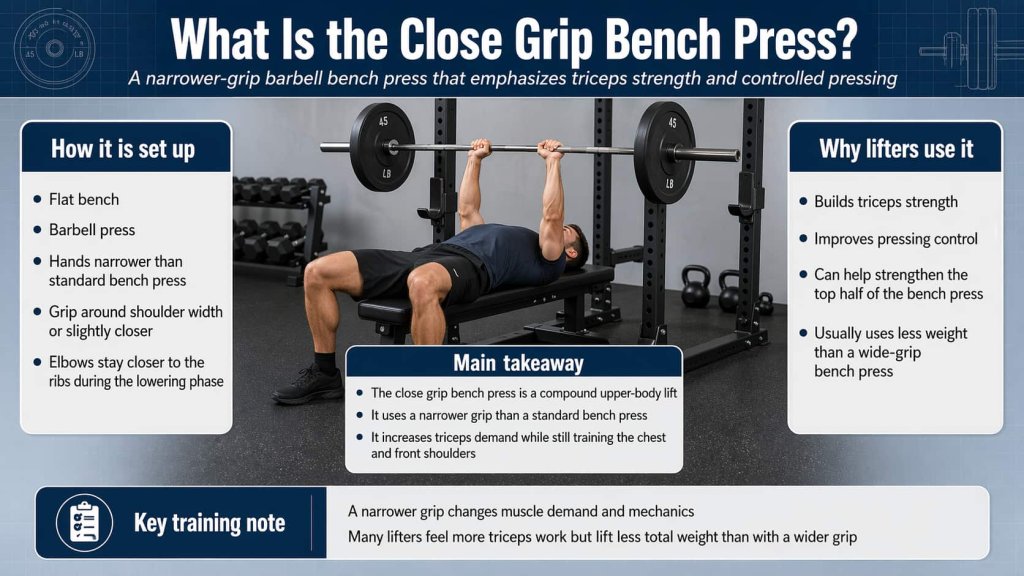
The close grip bench press is a compound barbell exercise done on a flat bench with your hands set narrower than a standard bench press. In the ACE exercise library, the setup is described with the hands directly in line with the shoulders and the elbows kept close to the ribs as the bar lowers. NASM also describes it as a narrower-than-shoulder-width press that shifts more mechanical demand toward the triceps and anterior deltoids.
Unlike a very wide bench press, the close grip version usually uses less weight, but it can be more useful when your goal is triceps strength, pressing control, and a stronger top half of the press. A 2021 study indexed in PubMed found that narrow-grip bench pressing changed muscle activity and reduced 6-rep-max performance compared with wider grips, which fits what many lifters notice in practice: more triceps demand, but usually less total load than a wider competition-style press.
Why the Close Grip Bench Press Works
The close grip bench press works because your narrower hand position changes leverage and typically asks the elbows to do more of the work. That tends to increase the training demand on the triceps while still involving the pectoralis major and front delts. Research on grip width has repeatedly shown that changing grip width changes muscle activity and bench press mechanics, so the exercise is not just a “regular bench with hands closer together.”
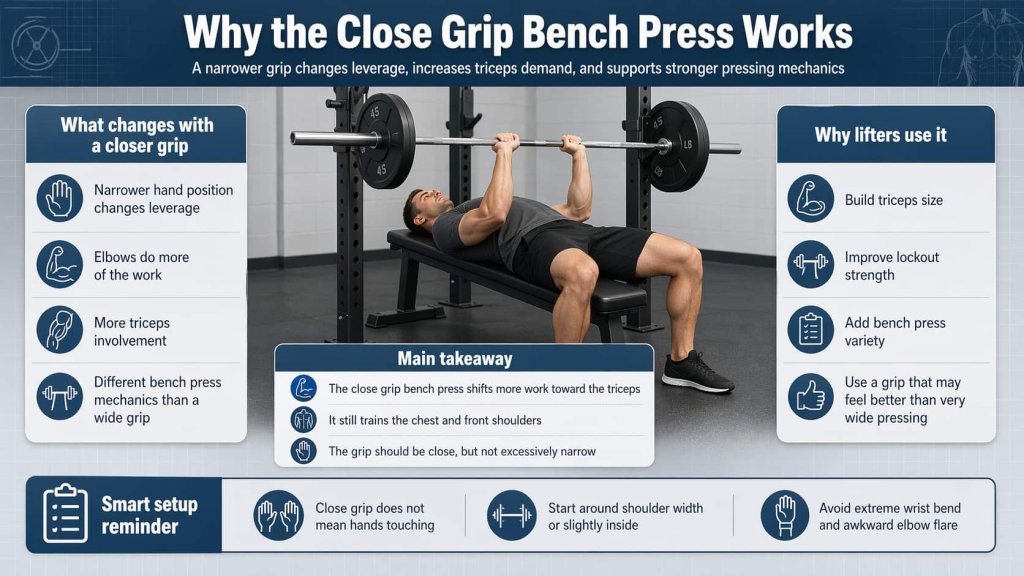
For many lifters, this makes the close grip bench press a smart choice when they want to:
- Build triceps size
- Improve pressing lockout strength
- Add bench press variety without changing the movement pattern too much
- Use a grip that may feel better than an extra-wide bench press
That said, “close grip” does not mean putting your hands so close together that your wrists fold over or your elbows flare awkwardly. In most cases, shoulder-width or slightly inside shoulder-width is a better starting point than an extreme narrow grip.
How to Do the Close Grip Bench Press
How to do it:
- Lie flat on a bench with your feet planted firmly on the floor.
- Set your hands about shoulder-width apart or slightly closer, not extremely narrow.
- Unrack the bar with straight wrists and shoulders set down and back.
- Lower the bar under control toward your lower chest or sternum area while keeping the elbows closer to the body.
- Lightly touch the chest or stop just above it if needed for control.
- Press the bar back up in a smooth line until your elbows are extended.
- Keep your glutes on the bench and your feet grounded throughout the set.
- Repeat for the planned number of reps.
Trainer Tip: Think “close and controlled,” not “as narrow as possible.” A grip that is too narrow often creates unnecessary wrist stress and usually does not improve the exercise.
Close Grip Bench Press Muscles Worked
The close grip bench press is still a compound upper-body press, so it does not isolate just one muscle.
Primary muscles worked:
- Triceps brachii
- Pectoralis major
- Anterior deltoid
Supporting muscles:
- Serratus anterior
- Upper back muscles that help stabilize the shoulder blades
- Forearms and grip muscles that help control the bar
Both ACE and NASM describe the movement as a pressing exercise that strongly involves the triceps while still training the chest and shoulders.
Close Grip Bench Press Benefits
Bigger Triceps Stimulus
One of the main reasons people use the close grip bench press is to put more training stress on the triceps than they would get from a wider bench press. A 2021 grip-width study available through PubMed found greater triceps involvement with narrow grips than with wider grips, which supports the common coaching use of this variation for triceps-focused pressing work.
Better Lockout Strength
Because the triceps play a major role in elbow extension, the close grip bench press can help lifters who struggle to finish the top half of a press. It is not magic, but it can be a practical accessory lift for improving the final portion of pressing strength. That is one reason strength coaches often keep some form of close-grip pressing in bench-focused training blocks, as also reflected in guidance from NASM.
Useful Bench Press Variety
The exercise keeps the familiar bench press setup while changing the emphasis enough to challenge the upper body in a different way. That makes it easier to rotate into a program than a completely unrelated press variation. Grip-width research also shows that changing hand placement changes the mechanics of the lift, which helps explain why this variation feels different even when it looks similar to standard benching, as shown in a biomechanical analysis available through PMC.
Strong Upper-Body Training With Simple Equipment
If you have a barbell, bench, rack, and a safe setup, you can train the close grip bench press without special machines. It fits well into general strength programs, and the CDC recommends muscle-strengthening work at least 2 days per week for adults, which gives this kind of compound exercise a clear place in a balanced routine.
Form Tips That Make a Big Difference
A few small setup details can make the close grip bench press feel much stronger and safer.
1. Use a true close grip, not an extreme grip
A lot of lifters turn this into a “hands almost touching” press. That usually makes the wrists unhappy and does not give you better mechanics. Shoulder-width or slightly inside shoulder-width is a better default for most people.
2. Keep the elbows relatively tucked
You do not need to pin the elbows to your ribs, but you also do not want them flaring hard out to the sides. A moderate tuck usually helps the bar path stay cleaner and keeps the movement feeling like a triceps-focused press.
3. Control the lowering phase
The Mayo Clinic recommends controlled lifting speed and a proper warm-up because rushing and poor technique raise injury risk. That advice matters here. A controlled descent usually improves bar path, reduces bouncing, and helps you stay in a stronger pressing position.
4. Keep wrists stacked over the forearms
If your wrists bend far backward, the bar is harder to control and the set often feels rougher on the joints. Try to keep the knuckles stacked over the forearms so the bar stays supported through the whole arm. This usually feels stronger right away, especially on heavier sets.
5. Use a stable setup
Feet planted, upper back tight, eyes under the bar, and shoulders set before the unrack all matter. The better your setup, the easier it is to press smoothly without turning the exercise into a shaky triceps grind.
Common Close Grip Bench Press Mistakes
Grip too narrow
This is the biggest mistake. It often increases wrist discomfort and makes the bar harder to lower and press in a smooth line. Start with a moderate close grip instead.
Bouncing the bar off the chest
This reduces control and can turn a strength exercise into a sloppy rebound. Lower the bar with intent, touch lightly if you are using full range of motion, and press without bouncing.
Flaring the elbows too much
Too much flare can make the lift feel more like a standard bench press and can reduce the triceps-focused effect many people want from this variation. Keep the elbows closer to the body, but not pinned unnaturally tight.
Using too much weight too soon
Because close grip bench press usually limits load compared with a wider bench press, lifters often force standard bench numbers onto the bar too early. That usually leads to ugly reps, wrist strain, or loss of position. Start lighter than your ego wants.
Who Should Use the Close Grip Bench Press?
The close grip bench press can be a good fit for:
- Lifters who want bigger triceps
- People trying to improve pressing lockout
- Lifters who want more upper-body pressing volume without only repeating the same bench style
- Intermediate trainees who already know basic bench setup and bar control
It can also work for beginners, but only if the setup is simple, the weight is light, and a qualified coach, spotter, or safety arms are available. Since the lift still requires coordination under a loaded barbell, absolute beginners often do better learning a regular press pattern with lighter variations first.
Who Should Be Careful Before Starting Close Grip Bench Press?
You should be more cautious with the close grip bench press if you have:
- Current wrist pain
- Elbow irritation
- Shoulder pain during pressing
- A recent chest, shoulder, or triceps injury
- Trouble controlling the bar safely without a spotter or rack safeties
The AAOS OrthoInfo notes that the pectoralis major is most at risk under heavy eccentric stress, such as the downward phase of a bench press. That does not mean the exercise is unsafe for everyone. It does mean heavy barbell pressing deserves respect, especially if you feel a sudden pop, bruising, sharp pain, or loss of strength. Stop the set and get evaluated if that happens.
Close Grip Bench Press Sets, Reps, and Programming
Your best rep range depends on your goal.
For muscle growth
- 3 to 4 sets
- 6 to 12 reps
- Leave 1 to 3 reps in reserve most of the time
For strength support
- 3 to 5 sets
- 4 to 6 reps
- Use solid technique and full control
For beginners
- 2 to 3 sets
- 8 to 10 reps
- Start light and practice consistent bar path
For weekly training, most people do well placing the exercise on an upper-body or push day 1 to 2 times per week depending on total pressing volume. At the broader health level, CDC guidance recommends muscle-strengthening work on 2 or more days each week that trains all major muscle groups.
Close Grip Bench Press vs Standard Bench Press
The close grip bench press is not automatically better than the standard bench press. It is better for specific goals.
Use the close grip bench press when you want:
- More triceps emphasis
- A useful accessory for bench strength
- A pressing variation with slightly different mechanics
Use the standard bench press when you want:
- More total load
- More general chest-focused barbell bench work
- Practice with the same grip style you use for regular bench performance
Research comparing grip widths suggests that wider and medium grips usually allow heavier loading, while narrower grips change muscle activity and often increase triceps demand. That is why both versions can deserve a place in a smart program.
Best Accessories to Pair With Close Grip Bench Press
If your goal is stronger pressing and bigger triceps, good pairings include:
- Dumbbell bench press
- Push-ups
- Overhead triceps extensions
- Cable pressdowns
- Chest-supported rows
- Face pulls
This combination helps you train pressing muscles while also balancing upper-body work with pulling and shoulder-support exercises. A balanced routine matters more than any single accessory choice.
Frequently Asked Questions
Is the close grip bench press mostly for triceps?
Yes, that is the main reason most people use it. It still trains the chest and front shoulders, but the narrower grip usually shifts more emphasis toward the triceps.
How close should my hands be on a close grip bench press?
Usually around shoulder-width or slightly inside shoulder-width works well. Going extremely narrow often increases wrist stress without giving better results.
Can the close grip bench press help my regular bench press?
It may help, especially if triceps weakness is limiting your lockout. It is best viewed as an accessory or secondary press, not always a full replacement for regular benching.
Is the close grip bench press better for shoulders?
Not automatically. Some lifters feel more comfortable with a closer grip than a very wide grip, but comfort depends on your structure, setup, load, and injury history. Pain is a sign to stop and reassess.
Should beginners do close grip bench press?
Beginners can do it, but they should use light weight, a stable setup, and good supervision or safety equipment. Learning control matters more than loading the bar quickly.
What is better for triceps, dips or close grip bench press?
Both can work. The better choice depends on your shoulder comfort, equipment, and skill level. Close grip bench press is often easier to load gradually and standardize, while dips can be more demanding on the shoulders for some people. This is more of a programming choice than a universal rule.
Conclusion
The close grip bench press is one of the best barbell pressing variations for lifters who want stronger triceps and better pressing support. Keep the grip close but reasonable, lower the bar with control, and treat form as part of the training effect, not a small detail. If you build it steadily into your routine, it can become a valuable tool for bigger arms and a stronger bench press.
References
- American Council on Exercise (ACE) — Close-Grip Bench Press
- National Academy of Sports Medicine (NASM) — Close Grip Bench Press
- PubMed — The Effect of Grip Width on Muscle Strength and Electromyographic Activity in Bench Press (2021)
- PubMed — The Influence of Grip Width and Forearm Pronation/Supination on Upper-Body Myoelectric Activity During the Flat Bench Press (2005)
- PubMed — A Biomechanical Analysis of Wide, Medium, and Narrow Grip Width Effects on Bench Pressing (2021)
- PubMed — The Effects of Bench Press Variations in Competitive Athletes on Muscle Activity and Performance (2017)
- CDC — Adult Physical Activity Guidelines
- Mayo Clinic — Weight Training: Do’s and Don’ts of Proper Technique