
Eccentric vs concentric refers to two parts of the same muscle action: eccentric means the muscle is lengthening under load, while concentric means it is shortening under load.
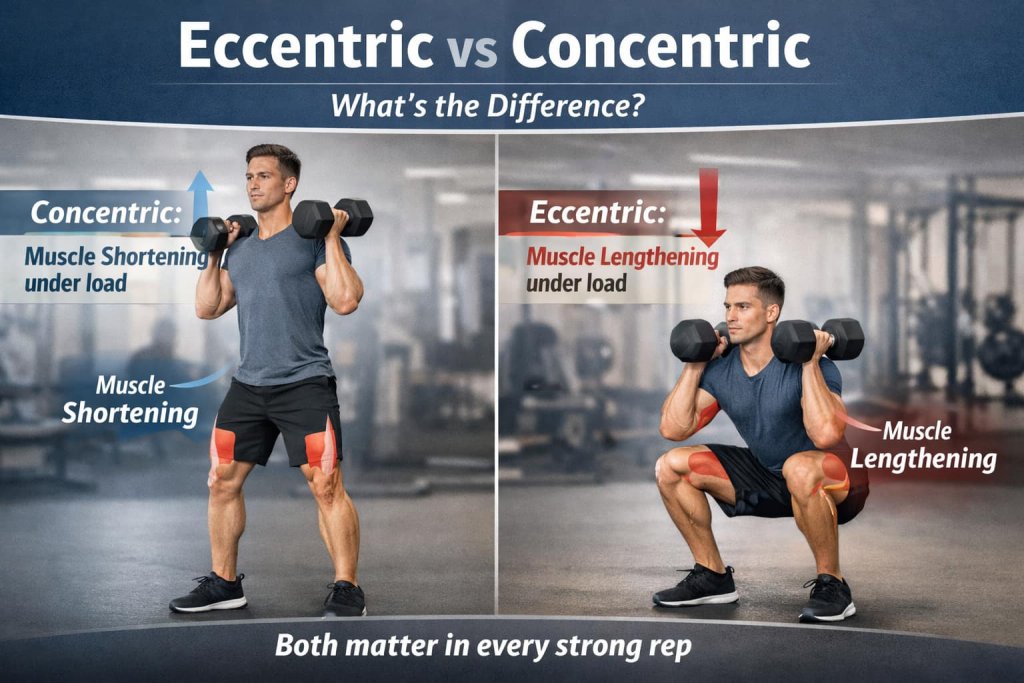
Neither is universally better. In most strength exercises, you use both in the same rep, and a balanced program usually gets the best results. A Cleveland Clinic guide to eccentric vs. concentric exercise and the CDC adult activity guidelines support the practical takeaway: train your muscles regularly, and do not ignore the lowering phase.
Understanding eccentric vs concentric matters because people often focus only on lifting the weight and rush through lowering it. That misses an important part of strength training, movement control, and tendon loading. It also leads to confusion about soreness, muscle growth, and rehab.
Eccentric vs concentric: the simple difference
A concentric action happens when a muscle produces force while shortening. In plain English, this is usually the part of the exercise where you move the weight up, press away from the floor, or rise out of the bottom of a rep. An eccentric action happens when a muscle produces force while lengthening, which is usually the controlled lowering or braking phase.
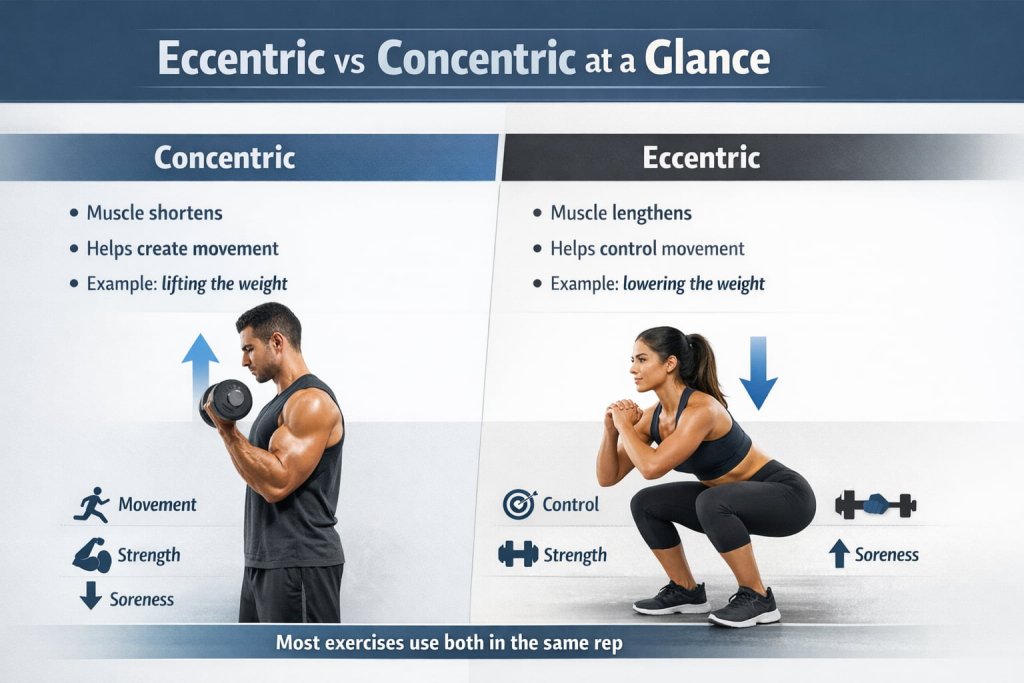
The easiest way to think about it is this: concentric helps create movement, while eccentric helps control movement. Most everyday lifts and bodyweight exercises include both. That is why comparing eccentric vs concentric as if you must pick only one is usually the wrong question.
One more term you may hear: isometric
There is also a third common muscle action: isometric. That is when a muscle produces force without changing length much, such as holding a plank, pausing during a squat, or stopping a weight and holding it still. As Cleveland Clinic explains in its strength training guide, many real exercises include concentric, isometric, and eccentric work within the same movement. That is helpful context because it reminds readers that the body does not always work in only two modes.
Eccentric vs concentric in common exercises
Here is how eccentric vs concentric looks in real workouts:
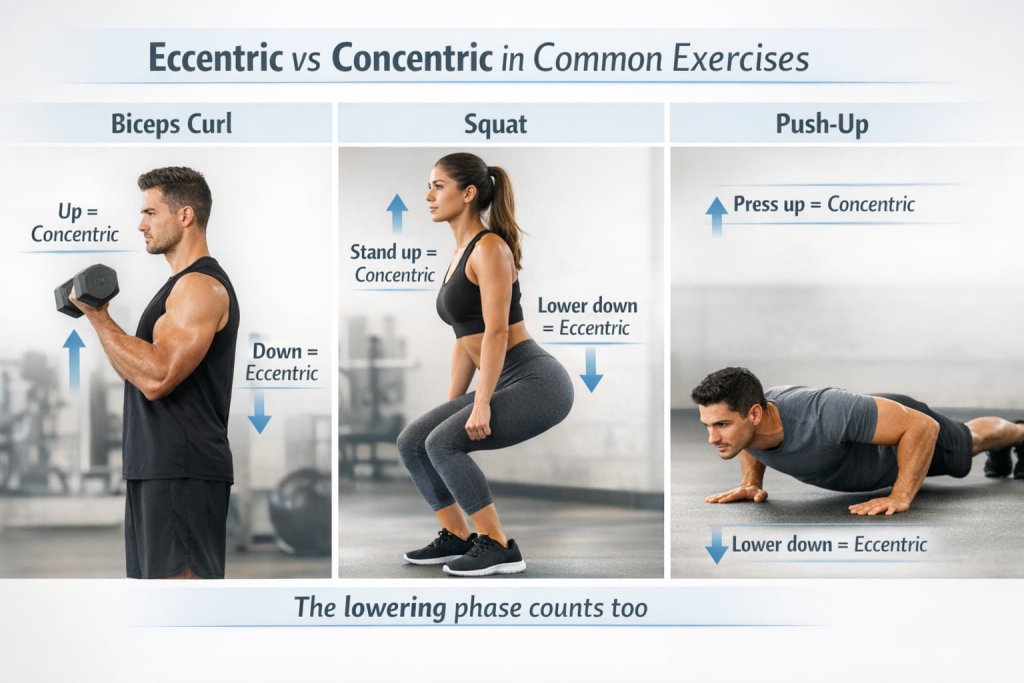
- Biceps curl: curling the dumbbell up is concentric; lowering it back down under control is eccentric.
- Squat: standing up from the bottom is concentric; lowering into the squat is eccentric.
- Push-up: pressing yourself away from the floor is concentric; lowering your body toward the floor is eccentric.
- Lunge: driving back up is concentric; lowering into the lunge is eccentric.
Once you start noticing this pattern, the distinction becomes easy: the “work” is not only the lift. The lowering phase is work too, and often very important work.
Why eccentric and concentric often work best together
In many athletic and everyday actions, eccentric and concentric phases are linked in a rapid sequence called the stretch-shortening cycle. This happens when a muscle is actively stretched and then quickly shortens, such as in jumping, sprinting, changing direction, or rising quickly out of a countermovement squat. As a Frontiers overview of the stretch-shortening cycle explains, this sequence can improve force, work, and power during the push-off phase compared with a purely concentric action performed from a dead stop. That is another reason the best practical question is usually not “eccentric or concentric?” but “how well are you using both together?”
Is eccentric or concentric better?
For most people, both matter
If your goal is general strength, muscle, and function, the best answer is usually both. The current CDC guidance recommends muscle-strengthening activity on at least 2 days per week, but it does not tell you to choose eccentric instead of concentric. Standard resistance training naturally includes both phases.
Eccentric training may have an edge for strength
Research reviews have repeatedly found that eccentric-focused training can produce larger strength gains than concentric-only training. A 2017 systematic review found greater improvements in muscle strength with eccentric training, and a newer 2026 systematic review reported that eccentric training consistently improved muscle strength more than concentric training.
A big reason is force capacity. Skeletal muscle can usually produce more force during eccentric actions than during concentric actions. ACSM notes in its overview of eccentric loading that muscle is capable of roughly 30% or more greater force production during maximal eccentric compared with concentric contractions. In practical terms, that helps explain why you can often lower more weight than you can lift. It also helps explain why eccentric-focused training can be such a strong strength stimulus when it is programmed carefully.
That does not mean concentric work is unimportant. Concentric training is still essential because it is the part that helps you move a load, stand up, press, pull, and produce force in the direction you actually want to go. If you care about real-world lifting and athletic movement, you still need to practice the concentric phase well.
Muscle growth is more nuanced
If your main goal is hypertrophy, the current evidence is more balanced than many social media claims suggest. A 2025 systematic review indexed in PubMed found similar hypertrophy between eccentric and concentric muscle actions in apparently healthy adults. That makes the safest evidence-based conclusion this: eccentric training can be very useful, but calling it automatically better for muscle growth is too broad.
Eccentric work is often especially useful for control
Even when eccentric training is not clearly superior for size, it is still very valuable because it trains deceleration, control, and resistance against gravity. That matters in sports, stair descent, downhill walking, landing mechanics, and everyday movement quality.
Why eccentric training often feels harder later
One reason eccentric exercise gets so much attention is that it is strongly linked with delayed-onset muscle soreness, especially when the work is new, high intensity, or repeated in high volume. ACSM notes that high-intensity eccentric contractions carry a risk of muscle damage, and that unfamiliar eccentric exercise is especially likely to produce soreness and temporary drops in muscle function.
This is why a slow lowering phase, downhill running, or your first hard leg workout after a break can leave you sore for a day or two afterward. The soreness does not automatically mean the workout was better. It often means the eccentric stress was new or too aggressive for your current conditioning.
The good news is that the same ACSM source notes the risk can be reduced by gradual progression. In practice, that means starting with manageable loads, keeping volume reasonable, and building up over time instead of jumping into very heavy negatives or a high number of eccentric reps on day one.
When eccentric training is especially useful
Strength training and controlled lowering
In regular gym training, eccentric emphasis can help you become more deliberate with your reps. Instead of dropping the weight, you lower it under control. That improves technique quality and makes each rep more complete. For many people, this alone is enough eccentric training to be useful without needing extreme negatives or specialized methods.
Tendon-loading and rehab programs
Eccentric loading is also widely used in rehab, especially for some tendon problems. A 2013 review on eccentric training for tendinopathies indexed in PubMed reported that eccentric exercise programs can be effective in tendinopathy treatment, especially for Achilles and patellar tendons. At the same time, another review found only limited or conflicting evidence that eccentric loading is superior to other loading programs, and a 2015 trial found that heavy slow resistance and traditional eccentric training produced similarly good long-term results in Achilles tendinopathy.
That is the key point for accuracy: eccentric training is commonly used and often helpful, but it is not the only valid approach and it is not a guaranteed fix for every tendon problem.
Older adults and people with chronic conditions
A useful reason eccentric training appears in clinical discussions is that eccentric work may create a lower metabolic and cardiorespiratory demand than concentric work at a given load. ACSM notes this as one reason eccentric exercise can be appealing in older adults and some clinical populations. More broadly, the National Institute on Aging guidance on exercising with chronic conditions says that for most people, moderate-intensity activity and weightlifting are safe if they build up slowly and work with a clinician when needed.
How to use eccentric vs concentric in your workouts
If your goal is general strength and muscle
Use normal full-range reps and pay attention to both halves of the lift. Lift with intent during the concentric phase, and lower with control during the eccentric phase. You do not need to turn every set into a slow-negative specialty workout to benefit from eccentric loading.
If your goal is strength
Adding some eccentric emphasis may help, especially if you already have decent form and recovery habits. That might mean being more disciplined about the lowering phase or programming some exercises where control and braking strength matter. But it still makes sense to keep standard concentric work in the program because strength is not just about resisting a load. It is also about moving it.
If you are a beginner
Start simpler than you think. The National Institute on Aging strength-training guidance recommends trying muscle-strengthening activity at least two days per week, working major muscle groups, and beginning with easier versions if you are new. It also advises warming up, avoiding overdoing it, and seeking guidance if you are unsure about a movement.
A smart beginner approach looks like this:
- learn the movement pattern first
- use a manageable load
- lower the weight under control instead of dropping it
- leave some room before failure while your technique is still improving
- avoid training the same muscle group hard on back-to-back days
If you are coming back after time off
Be especially careful with aggressive eccentric work after a break. This is one of the most common situations where soreness spikes. Reintroducing training gradually is usually a better plan than testing how much soreness you can survive.
Common mistakes people make with eccentric vs concentric training
Mistake 1: Treating the lowering phase as rest
It is not rest. If you let the weight drop, you are giving up an important part of the training stimulus and sometimes making the exercise less safe. Controlled lowering is a simple upgrade that improves many programs immediately.
Mistake 2: Chasing soreness as proof of effectiveness
More soreness does not automatically mean more progress. Eccentric training often causes more soreness because it is mechanically demanding, especially when it is unfamiliar. Progress comes from appropriate load, recovery, and consistency, not from trying to feel wrecked after every session.
Mistake 3: Assuming eccentric is always better
That is too simplistic. Eccentric-focused training may have an advantage for strength, but the latest review suggests hypertrophy is often similar overall, and many exercises work best when both phases are trained together.
Mistake 4: Using rehab ideas without context
Eccentric tendon programs can be helpful, but rehab is more individualized than internet advice often makes it sound. Load, pain tolerance, exercise selection, and progression all matter. If you are dealing with persistent tendon or joint pain, a physical therapist or sports medicine clinician can help you match the loading plan to the actual problem.
Eccentric vs concentric FAQ
Does eccentric training build more strength than concentric training?
Often, yes. Research reviews suggest eccentric-focused training tends to produce larger strength gains than concentric-only training. But that does not make concentric work optional, because you still need to practice producing force to move the load.
Does eccentric training build more muscle?
Not necessarily. The most current systematic review found similar overall hypertrophy between eccentric and concentric muscle actions in healthy adults.
Why do eccentric exercises make me so sore?
Because unfamiliar or high-intensity eccentric work is more likely to cause muscle damage and delayed-onset soreness, especially when you increase load or volume too quickly.
Should beginners do slow negatives?
Beginners should usually focus first on good form and controlled lowering, not extreme eccentric overload. A simple, controlled rep is usually enough at the start.
Is eccentric exercise good for tendon pain?
It can be, especially in some Achilles and patellar tendon programs, but it is not the only effective option and it should not replace individualized assessment when pain is persistent.
Safety note
Safety box
Eccentric training can be very effective, but it is also the part of training most likely to leave you sore if you progress too fast. Start gradually, use controlled reps, and back off if form breaks down or pain is sharp instead of normal effort-related discomfort. If you have a tendon injury, joint pain, osteoporosis, diabetes-related foot issues, cardiovascular concerns, or another chronic condition, talk with a qualified clinician or physical therapist before pushing intensity.
The bottom line on eccentric vs concentric
Eccentric vs concentric is not really a fight between two separate training styles. It is a way to understand two essential halves of movement. Concentric helps you move the load. Eccentric helps you control it. Eccentric-focused work may give you an edge for strength and controlled loading, but most people get the best results by training both on purpose and progressing gradually. If you want better workouts right away, the simplest fix is also the most practical: stop ignoring the lowering phase.
This content is for informational purposes only and not medical advice.
References
- National Institute on Aging — Three Types of Exercise Can Improve Your Health and Physical Ability
- National Institute on Aging — Exercising With Chronic Conditions
- PubMed — Eccentric vs. Concentric Training: A Systematic Review and Meta-Analysis of Changes in Muscle Strength
- PubMed — Chronic Adaptations to Eccentric Training: A Systematic Review
- PubMed — Eccentric Training for the Treatment of Tendinopathies
- PubMed — Achilles and Patellar Tendinopathy Loading Programmes: A Systematic Review Comparing Clinical Outcomes and Identifying Potential Mechanisms for Effectiveness
- PubMed — Heavy Slow Resistance Versus Eccentric Training as Treatment for Achilles Tendinopathy: A Randomized Controlled Trial