
Carbohydrate has 4 calories per gram. That is the standard number used for general nutrition guidance and on most Nutrition Facts labels, so if you eat 10 grams of carbohydrate, you are usually getting about 40 calories from those carbs.
That sounds simple, but it is still worth understanding because food labels can include a few exceptions, especially with fiber, sugar alcohols, and allulose. Once you know the standard rule and the label exceptions, it becomes much easier to estimate calories, compare foods, and read carb numbers correctly.
The Quick Answer to How Many Calories Per Gram of Carbohydrate
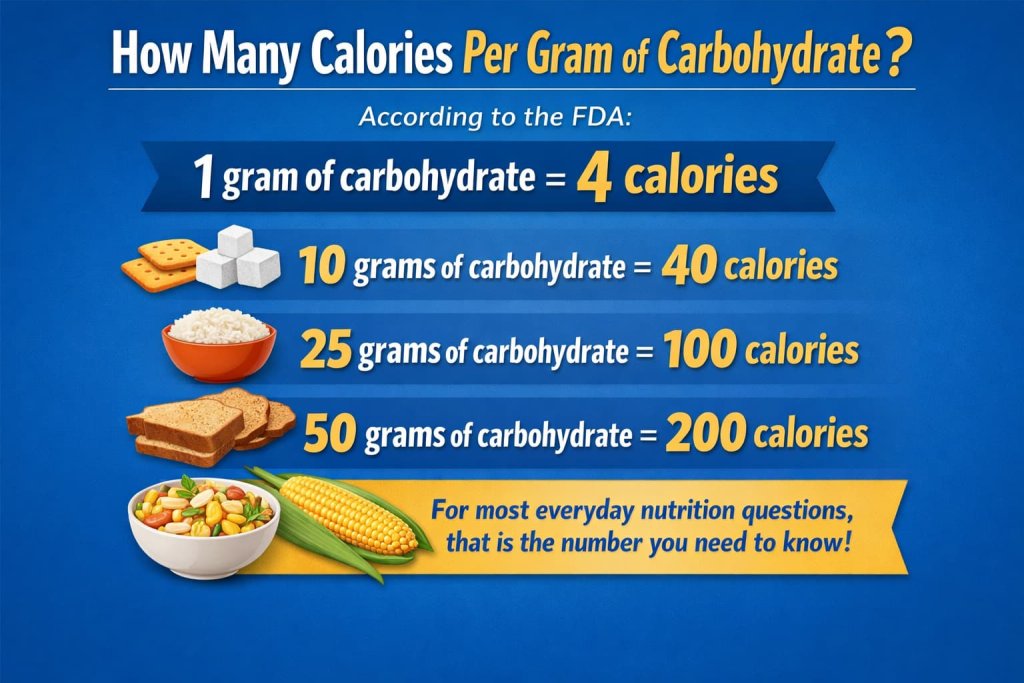
According to the FDA, the standard label rule is:
- 1 gram of carbohydrate = 4 calories
- 10 grams of carbohydrate = 40 calories
- 25 grams of carbohydrate = 100 calories
- 50 grams of carbohydrate = 200 calories
For most everyday nutrition questions, that is the number you need.
Why Carbohydrate Has 4 Calories Per Gram
Carbohydrate is one of the three main macronutrients that provide energy. The others are protein and fat. On standard U.S. food labels, carbohydrate and protein are listed at 4 calories per gram, while fat is listed at 9 calories per gram.
In practical terms, that means carbohydrate-rich foods such as bread, rice, fruit, beans, milk, and sweets all add to your calorie intake based largely on their carb grams. The exact food may differ in fiber, sugar, vitamins, and fullness, but the basic calorie rule for carbohydrate stays the same in normal diet planning.
It also helps to know that 4 calories per gram is a standard usable-energy estimate, not a perfectly exact value for every carb-containing food in every situation. In real foods, digestion, fiber content, and food structure can slightly affect how much energy your body actually absorbs, but 4 calories per gram is still the correct rule for everyday nutrition planning and label reading.
How Carbohydrate Appears on a Nutrition Facts Label
The FDA explains that the Nutrition Facts label shows total carbohydrate in grams per serving. Under that number, labels may also show parts of the total carbohydrate, including:
- dietary fiber
- total sugars
- added sugars
- sometimes sugar alcohols
This matters because the label is built around total carbohydrate, not just sugar alone. So when you check a package, the main carb number to start with is the total carbohydrate line.
A Simple Carbohydrate Calories Chart
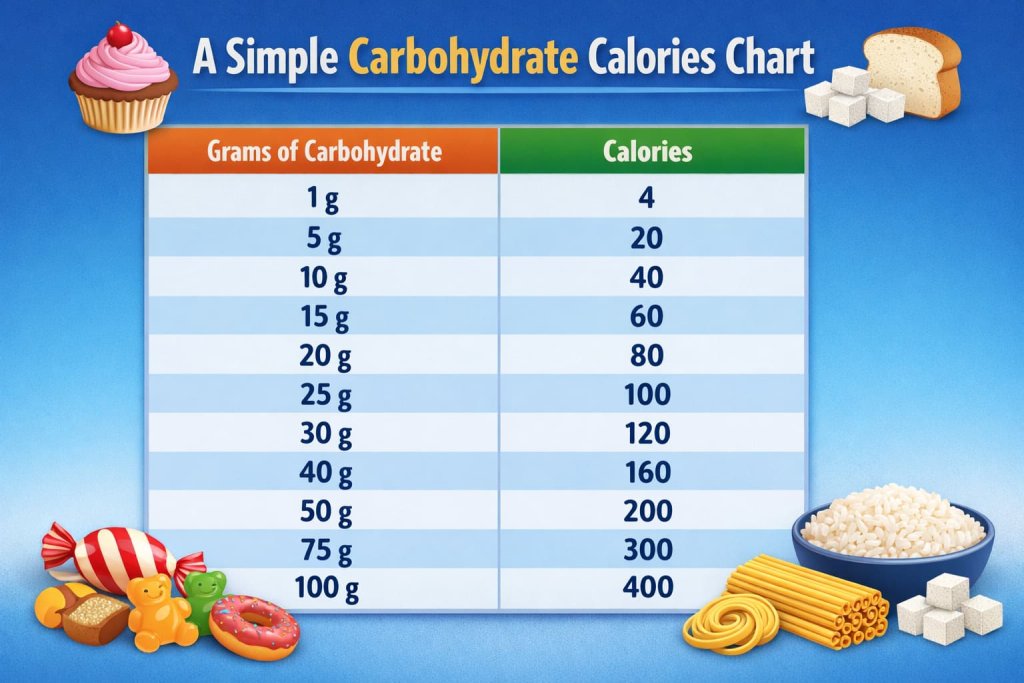
Here is a quick reference chart you can use:
| Grams of carbohydrate | Calories |
|---|---|
| 1 g | 4 |
| 5 g | 20 |
| 10 g | 40 |
| 15 g | 60 |
| 20 g | 80 |
| 25 g | 100 |
| 30 g | 120 |
| 40 g | 160 |
| 50 g | 200 |
| 75 g | 300 |
| 100 g | 400 |
A fast way to do the math is:
carbohydrate grams × 4 = calories from carbohydrate
So:
- 18 grams of carbs = 72 calories
- 32 grams of carbs = 128 calories
- 60 grams of carbs = 240 calories
Important Label Exceptions to the 4-Calorie Rule
For general nutrition advice, 4 calories per gram is correct. But food-label regulations are a little more detailed. The federal rule in the eCFR says manufacturers may calculate calories using the general factor of 4 calories per gram for total carbohydrate, while also allowing special handling for some non-digestible carbohydrates and sugar alcohols.
That same rule says:
- soluble non-digestible carbohydrates may be counted at 2 calories per gram
- sugar alcohols use different calorie factors depending on the type
- erythritol is listed at 0 calories per gram
So the standard answer is still 4 calories per gram of carbohydrate, but some packaged foods can end up with slightly different calorie totals when specific ingredients are involved.
Sugar Alcohol Calories Per Gram
The eCFR gives these general calorie factors for common sugar alcohols:
| Sugar alcohol | Calories per gram |
|---|---|
| Erythritol | 0.0 |
| Mannitol | 1.6 |
| Isomalt | 2.0 |
| Lactitol | 2.0 |
| Maltitol | 2.1 |
| Xylitol | 2.4 |
| Sorbitol | 2.6 |
| Hydrogenated starch hydrolysates | 3.0 |
This is why a low-sugar or sugar-free food may not follow the simple 4-calorie-per-gram rule exactly.
What About Allulose?
The FDA says manufacturers may use 0.4 calories per gram for allulose when calculating calories on Nutrition Facts and Supplement Facts labels under its guidance.
That makes allulose another useful exception. It still appears within carbohydrate-related labeling rules, but its calorie contribution is much lower than standard carbohydrate.
What About Net Carbs?
“Net carbs” usually means total carbohydrate minus fiber and sometimes minus certain sugar alcohols. This term is commonly used in low-carb marketing, but it is not the main number your body sees on the Nutrition Facts label. The label still starts with total carbohydrate, and that is the most reliable place to begin when estimating calories.
Net carbs can sometimes help people compare low-carb products, but they can also create confusion because different brands may calculate them a little differently. For general calorie math, use total carbohydrate first, then consider fiber, sugar alcohols, or allulose if the product clearly includes them.
Why Food Label Calories Do Not Always Match Perfectly
Sometimes people multiply carb grams by 4 and notice that the total package calories still do not line up exactly. There are a few common reasons for that.
First, labels combine calories from carbohydrate, protein, and fat, so you have to account for all three macronutrients, not carbs alone.
Second, some foods include fiber, sugar alcohols, or allulose, which can change the calorie math.
Third, the eCFR allows calorie declarations to be rounded. In general, calories are rounded to the nearest 5-calorie increment up to 50 calories and the nearest 10-calorie increment above 50 calories, with amounts under 5 calories allowed to be shown as zero. That rounding can create small differences when you try to reverse-engineer a label.
How Much Carbohydrate Do You Need Per Day?
For label-reading, the FDA sets the Daily Value for total carbohydrate at 275 grams per day on a 2,000-calorie diet.
For broader nutrition planning, the National Academies list an acceptable macronutrient distribution range of 45% to 65% of total calories from carbohydrate for adults. A separate National Academies reference notes that the adult Recommended Dietary Allowance for carbohydrate is 130 grams per day, based on the amount of glucose needed by the brain.
That does not mean everyone should aim for exactly the same carb intake. Your ideal amount can vary based on age, activity level, overall calorie needs, pregnancy, medical conditions, and personal eating style.
Is Every Type of Carbohydrate the Same?
Calories per gram and food quality are not the same thing.
Two foods can both contain 30 grams of carbohydrate, but they may affect fullness and nutrition very differently. For example, oats, beans, fruit, and lentils usually bring more fiber and nutrients than soda, candy, or pastries. So while the calorie math may be similar, the overall nutrition value is not.
That is why it helps to use carbohydrate grams as one tool, not the only tool. Calories matter, but so do fiber, protein, food quality, and portion size.
Best Way to Use This Information in Real Life
A practical approach looks like this:
- Check the serving size first.
- Look at total carbohydrate per serving.
- Multiply carb grams by 4 for a quick estimate.
- Remember that fiber, sugar alcohols, and allulose can change exact calorie calculations in some products.
- Compare foods based on both calories and overall nutrition.
For example, if a granola bar has 22 grams of total carbohydrate per serving, the quick estimate is 22 × 4 = 88 calories from carbohydrate. If that same bar also contains added fiber or sugar alcohols, the label’s final calorie total may be a little lower than that estimate. That is why the 4-calorie rule is the best starting point, while the full label gives the final per-serving calorie number.
Frequently Asked Questions
Are carbs always 4 calories per gram?
For most everyday nutrition questions, yes. Standard carbohydrate is counted as 4 calories per gram. Some labeling exceptions apply for certain fibers, sugar alcohols, and allulose.
Does fiber count as carbohydrate?
Yes. On the Nutrition Facts label, fiber is listed under total carbohydrate. But some non-digestible carbohydrates may contribute fewer calories than standard digestible carbs.
Are sugar and starch both 4 calories per gram?
In normal nutrition planning, yes. Both are carbohydrates and are generally counted at 4 calories per gram. The main exceptions show up with special ingredients used in some packaged foods.
Why do low-carb or sugar-free products sometimes have fewer calories than the carb grams suggest?
These products may contain sugar alcohols, non-digestible carbohydrates, or allulose, which can be counted with lower calorie factors than standard carbohydrate.
The Bottom Line
How many calories per gram of carbohydrate? The standard answer is 4. That is the number to use for most foods, most labels, and most day-to-day calorie calculations.
The only time the math gets more complicated is when a product includes ingredients such as certain fibers, sugar alcohols, or allulose. In those cases, label rules can lower the calorie contribution of part of the carbohydrate content.
If you are trying to read labels more confidently, start with total carbohydrate, use the 4-calories-per-gram rule, and then check for exceptions only when the product is clearly using specialty low-calorie carb ingredients.
Sources and References
- FDA — Examples of Different Label Formats That Use the New Nutrition Facts Label
- FDA — Interactive Nutrition Facts Label: Total Carbohydrate
- eCFR — 21 CFR 101.9 — Nutrition Labeling of Food
- FDA — Guidance for Industry: The Declaration of Allulose and Calories from Allulose on Nutrition and Supplement Facts Labels
- FDA — Daily Value on the Nutrition and Supplement Facts Labels
- National Academies — Rethinking the Acceptable Macronutrient Distribution Range for the 21st Century: A Letter Report
- National Academies — Dietary Reference Intakes Research Synthesis: Workshop Summary