
Maca root may help with libido and some menopause-related symptoms, but most claimed maca root benefits are not firmly proven.
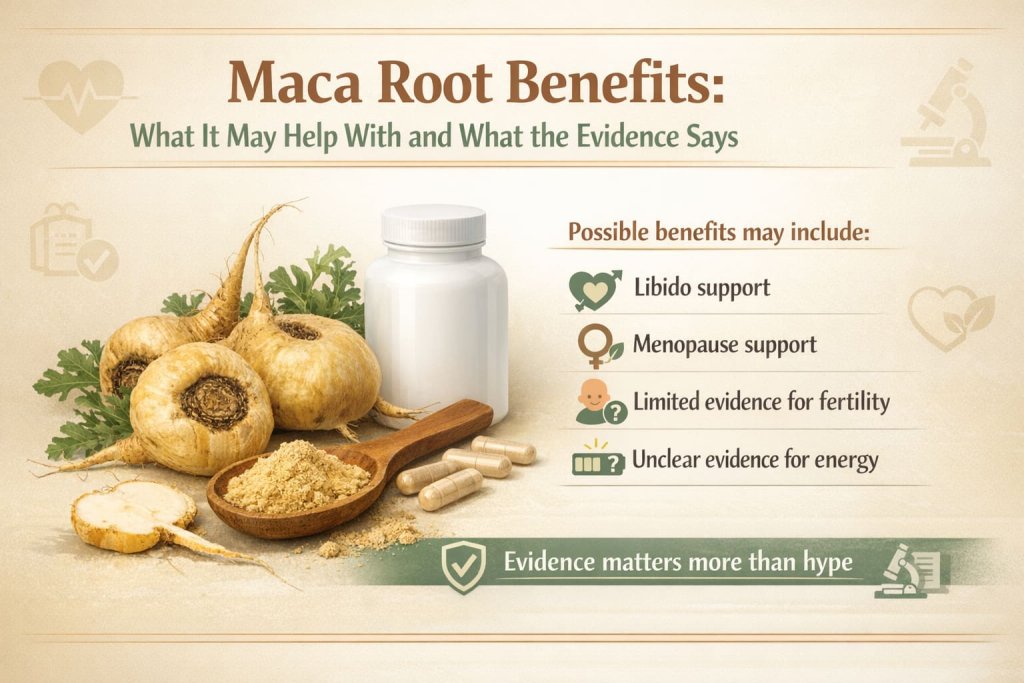
The strongest human research is on sexual well-being and menopause-related symptoms, while evidence for fertility, energy, and athletic performance is still limited. That makes it important to separate traditional use and marketing claims from what studies have actually shown.
What Is Maca Root?
Maca is a Peruvian plant in the cabbage family. The part used in supplements is usually the root or hypocotyl, and it is sold in powders, capsules, tablets, and extracts. It has a long history as a food and traditional remedy, but supplement use is different from simply eating the plant as part of a normal diet.
According to Memorial Sloan Kettering Cancer Center, maca is commonly used for energy, fertility, libido, and menopause symptoms.
Maca Root Benefits at a Glance
Based on current human evidence, the most reasonable way to think about maca root benefits is this:
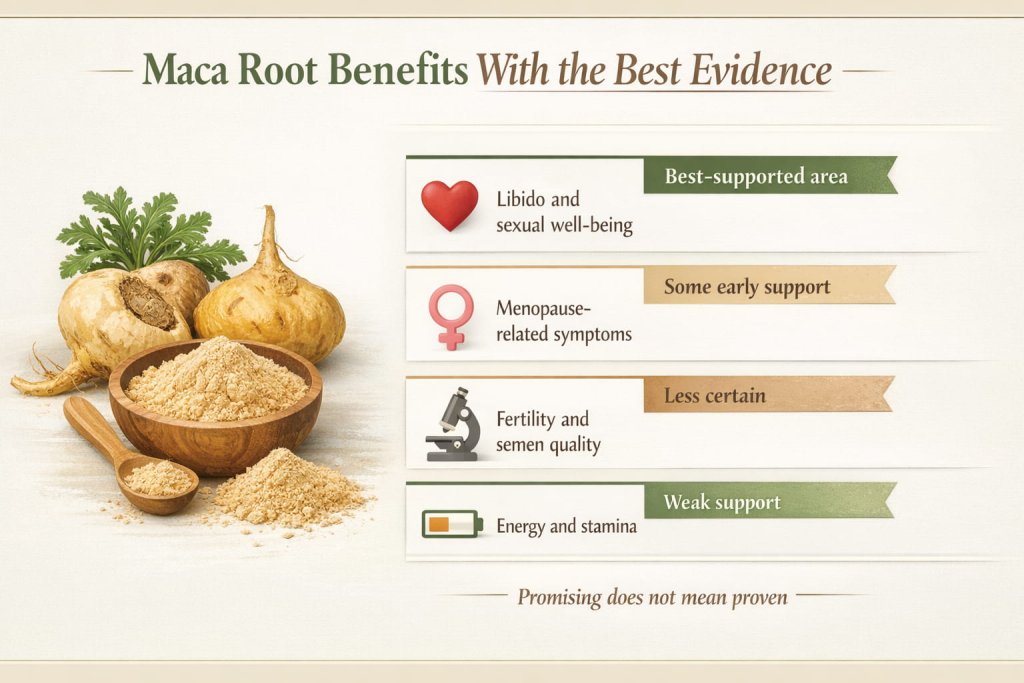
- Most promising: libido and sexual well-being
- Possibly helpful: some menopause-related symptoms, including mood and sexual concerns
- Still uncertain: male fertility and semen quality
- Weak evidence: energy, stamina, and performance claims
One reason maca can look more convincing in marketing than in research is that the evidence base is still small. Only a few small human trials have been conducted, and different studies have used different doses, outcomes, and product types.
Product differences matter too: maca is sold as powders, capsules, tablets, and extracts, and different phenotypes such as red, yellow, purple, and black may have different biological effects. In practice, that means results from one study should not be assumed to apply to every maca product on the market.
Maca Root Benefits With the Best Evidence
Maca Root Benefits for Libido and Sexual Well-Being
This is the area where maca has the best, though still limited, human evidence. A systematic review of maca for sexual function found limited evidence that maca may improve sexual desire or sexual dysfunction, but it also noted that the number of randomized trials was small and the overall evidence base was not strong enough for firm conclusions. A separate human trial in healthy men found improved sexual desire after 8 weeks of maca use, with no meaningful change in testosterone or estradiol levels.
One specific use that deserves mention is antidepressant-related sexual dysfunction. Some human research suggests high-dose maca may help in that setting, but the evidence is still limited and not strong enough to treat maca as a proven solution.
If sexual side effects began after starting an antidepressant, it is best to talk with the prescribing clinician before adding a supplement, since the safer long-term plan may involve medication review rather than self-treatment.
Maca Root Benefits for Menopause Symptoms
Some small studies suggest maca may help with certain menopause-related symptoms, especially psychological symptoms and sexual concerns. A systematic review of maca for menopausal symptoms concluded that early findings were promising but still too limited to support strong clinical claims.
In one postmenopausal study, 3.5 grams per day was associated with improvements in psychological symptoms and measures of sexual dysfunction, and the reported effects were not explained by increases in estrogen or androgen levels.
Maca Root Benefits for Fertility and Semen Quality
This is one of the most searched questions around maca, but the evidence is weaker than many supplement ads suggest. A systematic review on maca and semen quality found only suggestive evidence of benefit, with small trials and limited data. Memorial Sloan Kettering also notes that human findings on semen quality and sperm concentration are mixed rather than clearly positive.
Maca Root Benefits for Energy and Stamina
Energy is one of the most common claims attached to maca, but this is not one of its best-supported benefits in human research. Memorial Sloan Kettering lists energy and strength as common uses, but also notes that only a few small human trials have been done and that several benefit claims remain inadequately studied. In other words, maca may be worth studying further, but it should not be presented as a proven energy booster.
Does Maca Increase Testosterone?
Probably not, at least based on the small human studies people usually cite. The frequently referenced study in healthy men found improved sexual desire without corresponding changes in testosterone or estradiol. That is why it is more accurate to describe maca as a supplement that may affect sexual well-being in some people, not as a proven testosterone booster.
What Maca Supplement Labels May Say
This is where readers should be careful. The current Health Canada maca monograph allows certain label uses for adults, including “source of antioxidants,” “helps to support emotional aspects of sexual health,” and “helps to support healthy mood balance during menopause.”
Those are allowed label uses in that regulatory framework, but they should not be confused with proof that maca prevents or treats disease.
How Much Maca Do People Usually Take?
Exact dosing depends on the product and the reason for use, but the Health Canada monograph gives a useful evidence-based range for adults 18 and older:
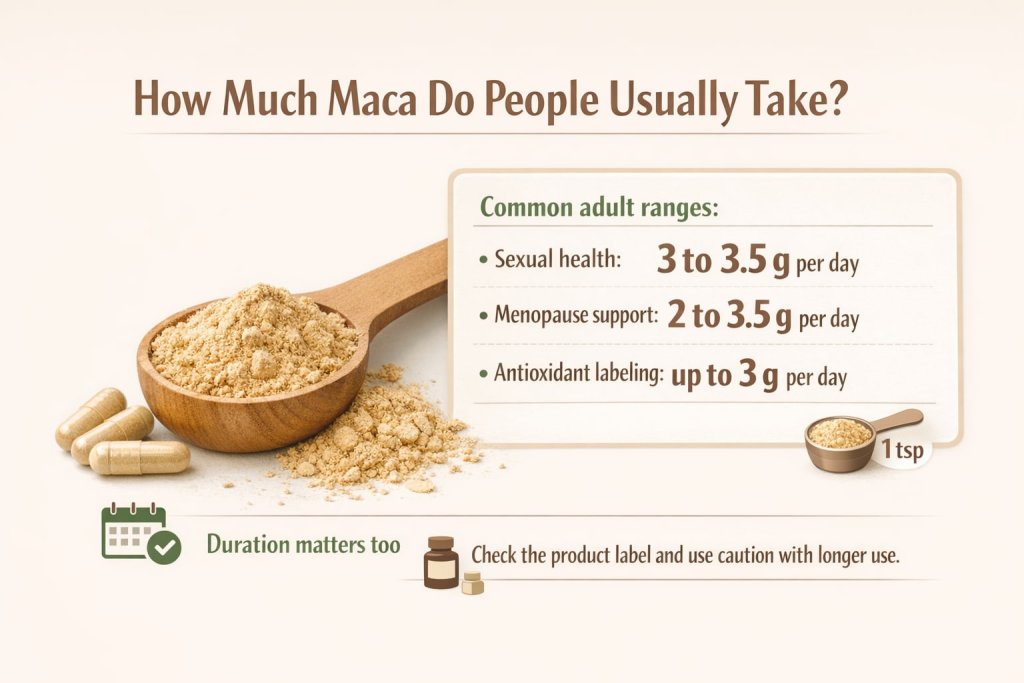
- For sexual health: 3 to 3.5 grams of dried root or hypocotyl per day
- For healthy mood balance during menopause: 2 to 3.5 grams per day
- For antioxidant labeling: not more than 3 grams per day
The same monograph advises checking with a clinician for use beyond 3 months at 0.6 to 3 grams per day, or beyond 6 weeks at more than 3 grams per day.
Safety Box: Who Should Be Careful With Maca?
Maca appears to be generally well tolerated in small, short-term studies. The NIH LiverTox entry on maca says it has not been convincingly linked to clinically apparent liver injury. Still, “generally well tolerated” does not mean universally safe.
You should be more cautious and speak with a clinician before using maca if any of these apply:
- You are pregnant or breastfeeding
- You have a blood pressure condition
- You take blood thinners
- You are considering it for mood or sexual concerns and have anxiety or depression
- You have a hormone-sensitive condition, including some cancers
- You are having lab work that measures testosterone, because maca may interfere with some testosterone tests
- You take prescription medicines or are preparing for surgery
These cautions are supported by Health Canada, NCCIH, ODS, FDA, and Memorial Sloan Kettering guidance on supplement safety and interactions.
How to Choose a Maca Supplement More Carefully
Supplement quality matters as much as the ingredient itself. The FDA dietary supplement guidance explains that FDA does not approve dietary supplements before they are marketed, and NCCIH notes that supplements sold online or in stores may differ from the products used in research.
The NIH Office of Dietary Supplements also says products should have a Supplement Facts panel listing active ingredients, dose, and other ingredients.
Also, do not assume all maca products are interchangeable. Some brands sell black, red, or yellow maca, while others use powder or extract forms. Different maca types may not behave the same way, and product labels do not always make that clear. That means the exact form, dose, and dried-root equivalent matter when comparing supplements or trying to match a product to the research.
A smarter shopping checklist looks like this:
- Choose a product with a clear Supplement Facts panel
- Check the dose per serving and serving size
- Read the other ingredients list
- Avoid products that claim to treat, cure, or prevent disease
- Prefer brands that provide a manufacturer contact and transparent labeling
- When possible, look for third-party quality seals such as USP, NSF, or ConsumerLab, as noted in NCCIH’s label-reading tips and the NIH Office of Dietary Supplements guide
Maca Root Benefits for Women vs. Men
For women, the better-studied potential benefits are libido-related concerns and some menopause-related symptoms. For men, the most studied questions are libido and fertility, but fertility findings remain mixed. For both groups, the evidence is still limited enough that maca should be seen as a possible adjunct, not a guaranteed solution.
When Maca Is Probably Not the Best Next Step
Maca is not a substitute for medical evaluation if you have:
- ongoing low libido
- erectile dysfunction
- infertility
- severe hot flashes or mood changes
- unexplained fatigue
- symptoms that may relate to thyroid, hormone, mental health, or cardiovascular issues
ODS notes that dietary supplements are not intended to diagnose, treat, mitigate, prevent, or cure disease, and they should not replace prescribed treatment or a full medical workup when symptoms persist.
FAQ About Maca Root Benefits
How long does maca take to work?
There is no guaranteed timeline, but one often-cited libido study found improvement after 8 weeks, and many clinical trials have lasted from about 6 weeks to 3 months. That means you should be skeptical of products promising immediate results.
Is maca root safe to take every day?
For many adults, short-term daily use appears to be tolerated reasonably well in studies, but safety is less certain in pregnancy, breastfeeding, children, and people with medication or health-condition concerns. Duration also matters, which is why Health Canada advises checking with a clinician for longer use.
Does maca help with weight loss?
Current authoritative sources do not support maca as a proven weight-loss supplement. Most serious research attention has focused on sexual function, menopausal symptoms, and fertility-related questions instead.
Is maca better as a powder or capsule?
There is no strong evidence that one form is automatically better for outcomes. Powders, capsules, tablets, and extracts all exist, so the more important issues are dose, label clarity, product quality, and whether the product matches how it was studied.
The Bottom Line
Maca root benefits are real enough to be interesting, but not strong enough to justify hype. The best evidence points to possible help with libido and some menopause-related symptoms, while the evidence for fertility, energy, and stamina remains less convincing.
If you want to try maca, use a well-labeled product, keep your dose realistic, and discuss it with a healthcare professional if you take medications, have a medical condition, or plan to use it for more than a short trial.
This content is for informational purposes only and not medical advice.
References
- Memorial Sloan Kettering Cancer Center — Maca
- National Center for Complementary and Integrative Health — How Medications and Supplements Can Interact: Tips on Reading Supplement Labels
- PubMed — Maca (L. meyenii) for improving sexual function: a systematic review
- PubMed — Maca (Lepidium meyenii) for treatment of menopausal symptoms: a systematic review
- PubMed — The use of maca (Lepidium meyenii) to improve semen quality: a systematic review
- PubMed — Effect of Lepidium meyenii (Maca) on sexual desire and its absent relationship with serum testosterone levels in adult healthy men
- PubMed — Beneficial effects of Lepidium meyenii (Maca) on psychological symptoms and measures of sexual dysfunction in postmenopausal women are not related to estrogen or androgen content