
There is no single official number of calories for breakfast. The right amount depends on your total daily calorie needs, activity level, and whether your goal is weight loss, weight maintenance, or weight gain. The most accurate way to answer how many calories for breakfast is to start with your full-day calorie target, then make breakfast fit that budget.

Understanding this matters because breakfast is only one part of your daily intake. A breakfast that is too small may leave you hungry and reaching for snacks later, while one that is too large can use up too much of your calorie budget early in the day. In most cases, the best breakfast is one that fits your daily needs and helps you include nutrient-dense foods such as fruit, whole grains, protein foods, and dairy or fortified soy.
The most accurate way to decide how many calories for breakfast
According to NIDDK, how many calories you need each day depends on your age, weight, height, metabolism, sex, and physical activity level. NIDDK also recommends using tools such as the NIH Body Weight Planner and MyPlate Plan to personalize calorie intake instead of guessing from a generic number.
According to NHLBI, estimated adult maintenance calorie needs commonly fall in these ranges:
| Group | Estimated daily calories |
|---|---|
| Women ages 19 to 30 | 2,000 to 2,400 |
| Women ages 31 to 50 | 1,800 to 2,200 |
| Women ages 51 and older | 1,600 to 2,200 |
| Men ages 19 to 30 | 2,400 to 3,000 |
| Men ages 31 to 50 | 2,200 to 3,000 |
| Men ages 51 and older | 2,000 to 2,800 |
These are maintenance estimates, not meal-by-meal rules.
This breakfast calorie guide is for generally healthy adults
It is important to note that the calorie ranges above are adult estimates. According to the CDC, pregnancy usually does not require extra calories in the first trimester, but typically requires about 340 extra calories a day in the second trimester and about 450 extra calories a day in the third trimester. CDC also notes that well-nourished breastfeeding mothers generally need about 330 to 400 extra calories a day compared with what they were eating before pregnancy.
NIDDK states that the NIH Body Weight Planner is for adults age 18 and older and is not intended for younger people or for women who are pregnant or breastfeeding. If you are pregnant, breastfeeding, under 18, or managing a medical condition that affects eating or metabolism, individualized guidance is a better choice than a general breakfast calorie estimate.
As a practical planning example, not an official rule, breakfast often ends up somewhere around 300 to 600 calories for many adults because that fits reasonably within common full-day calorie budgets. Someone eating 1,600 calories a day will usually need a smaller breakfast than someone eating 2,400 calories a day.
How many calories for breakfast by daily calorie goal
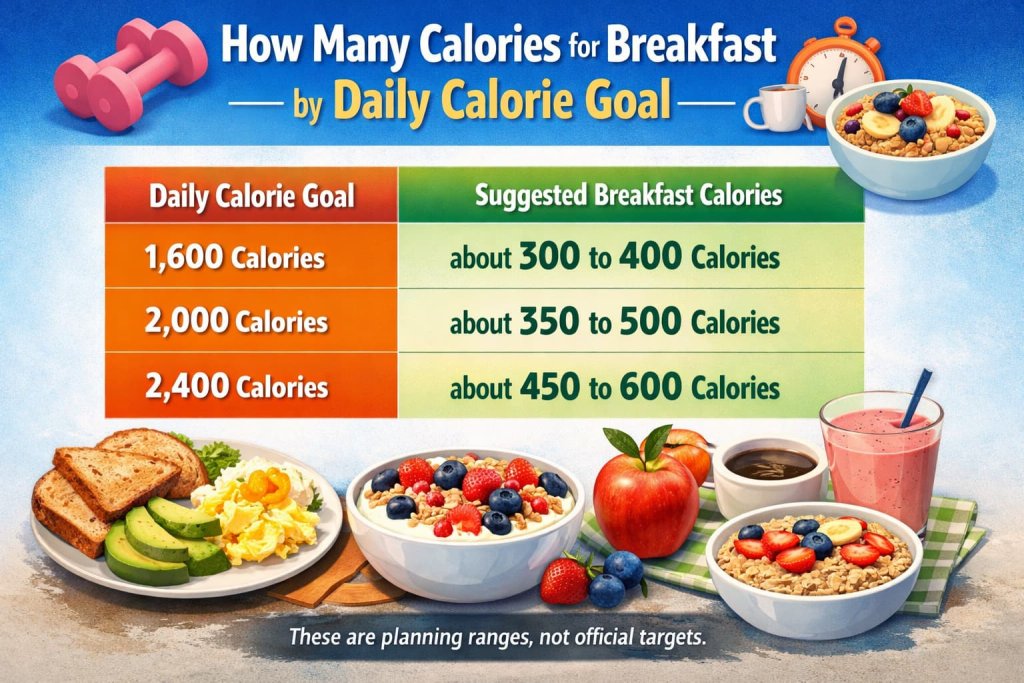
One simple way to plan breakfast is to size it so you still have enough calories left for lunch, dinner, and any snacks you regularly eat. Here is a realistic starting point:
| Daily calorie goal | Practical breakfast starting point |
|---|---|
| 1,600 calories | about 300 to 400 calories |
| 2,000 calories | about 350 to 500 calories |
| 2,400 calories | about 450 to 600 calories |
These are planning ranges, not official targets. The best breakfast size is the one that fits your full-day intake and keeps you satisfied without making the rest of the day harder to manage.
If you want a more personalized starting point, use the NIDDK Body Weight Planner to estimate your full-day calorie needs first. Once you have that number, breakfast becomes much easier to plan because you are fitting it into a real daily target instead of guessing from a generic breakfast rule.
The simplest way to use it is to choose a breakfast size that helps you feel satisfied and still leaves enough calories for the rest of your day. If you are hungry again very quickly, breakfast may be too small or low in protein and fiber. If breakfast takes up too much of your daily calorie budget, it may need smaller portions or fewer calorie-dense extras.
How many calories for breakfast if you want to lose weight

According to Nutrition.gov, healthy weight loss should come from a reduced-calorie but nutritionally balanced eating pattern, regular physical activity, and realistic goals. That means breakfast calories should be adjusted as part of your full-day plan, not treated as a separate rule.
In real life, that usually means choosing a breakfast that gives you enough protein, fiber, and volume to help control hunger, but not so many calories that lunch and dinner become hard to balance. For many people, a modest but filling breakfast works better than either skipping breakfast or eating a very large one.
Nutrition.gov also notes that regular meals, including breakfast, are common habits among people who lose weight and keep it off. That does not mean everyone must eat breakfast, but it does support using breakfast as a consistent structure point if it helps you stay on track.
How many calories for breakfast if you want to maintain or gain weight
If your goal is maintenance, breakfast calories should simply fit your normal daily needs. If your goal is healthy weight gain, breakfast can be one of the easiest places to add more calories because it gives you another chance to eat nutrient-dense foods early in the day.
A higher-calorie breakfast does not need to mean pastries, sugary drinks, or fast food. It can mean larger portions of oatmeal, yogurt, eggs, fruit, nut butter, nuts, avocado, or whole-grain toast instead of relying on foods that are high in added sugar but less filling.
What a balanced breakfast should include
According to USDA MyPlate, a healthy eating pattern is built around fruits, vegetables, grains, protein foods, and dairy or fortified soy. For a 2,000-calorie plan, MyPlate uses daily targets of 2 cups of fruit, 2.5 cups of vegetables, 6 ounce-equivalents of grains, 5.5 ounce-equivalents of protein foods, and 3 cups of dairy, while keeping added sugars, saturated fat, and sodium within recommended daily limits.
Breakfast does not need to include every food group at once, but it should help move you toward those daily targets. A strong breakfast usually includes:
- a protein source such as eggs, yogurt, milk, cottage cheese, beans, tofu, or nut butter
- a fiber-rich carbohydrate such as oatmeal, whole-grain toast, fruit, or high-fiber cereal
- optionally, a healthy fat such as nuts, seeds, avocado, or peanut butter for staying power
According to the American Heart Association, practical breakfast choices include unsweetened oatmeal with fruit, smoothies made with fruit and low-fat or fat-free milk or yogurt, hard-boiled eggs on whole-grain toast with avocado and tomato, and yogurt parfaits with fruit, oats, and nuts.
Real breakfast calorie examples
Breakfast does not need to hit one exact number to be reasonable. USDA MyPlate recipe examples show how much calorie totals can vary while still fitting a balanced eating pattern. Lighter options such as a breakfast parfait can be under 200 calories, while more substantial choices such as pancakes or smoothies can land closer to 300 to 400 calories per serving.
A single large egg is also about 78 calories, which makes it an easy way to add protein to a lighter breakfast without dramatically increasing calories. The bigger point is that breakfast calories should fit your total daily plan, not follow a magic number.
How to use the Nutrition Facts label at breakfast
According to the FDA, the Nutrition Facts label can help you compare breakfast foods by calories, saturated fat, sodium, added sugars, fiber, and key nutrients. FDA’s general guide is that 5% Daily Value or less is low and 20% Daily Value or more is high.
That means a better packaged breakfast choice is usually one that is lower in saturated fat, sodium, and added sugars and higher in fiber and useful nutrients. This matters especially for breakfast cereals, granola, flavored yogurt, breakfast bars, pastries, and coffee drinks, which can look healthy but add up quickly.
NIDDK also reminds readers that the serving size on a label is not a recommendation of how much you should eat. It is simply the standardized amount used to show calories and nutrients.
Hidden breakfast calories to watch for
One of the easiest ways for breakfast calories to climb is through drinks and extras rather than the meal itself. A breakfast that looks light can become much higher in calories once you add sweetened coffee, flavored creamers, fruit drinks, syrups, large smoothies, or multiple spreads and toppings.
FDA notes that current dietary guidance recommends keeping added sugars below 10% of total daily calories, and the Nutrition Facts label shows both grams and percent Daily Value for added sugars to help you compare products. The American Heart Association notes that common sources of added sugars include sweetened tea and coffee, fruit drinks, flavored milk, sweetened yogurts, and many breakfast cereals and bars.
A simple way to keep breakfast calories more reasonable is to focus first on the main meal, then check whether drinks and extras are adding more sugar and calories than you expected. Often, switching from a sweetened drink to water, plain coffee, or unsweetened tea makes breakfast easier to fit into your daily calorie budget.
Common breakfast calorie mistakes
Treating breakfast like it has a magic number
There is no universal perfect breakfast calorie amount. A 500-calorie breakfast may be too much for someone on a lower-calorie plan, but completely reasonable for someone with higher energy needs.
Focusing only on calories and ignoring quality
Two breakfasts can have the same calories but affect hunger very differently. A breakfast built from whole grains, fruit, and protein is usually more satisfying than one built mostly from refined grains, sugar, and saturated fat.
Choosing a breakfast that is too small to hold you
Very low-calorie breakfasts can backfire if they leave you hungry and make it harder to control portions later in the day. For many people, satisfaction matters just as much as the calorie number itself.
FAQ
How many calories should breakfast be on a 2,000-calorie diet?
There is no official fixed number, but on a 2,000-calorie plan, breakfast often works well in a moderate range that still leaves room for lunch, dinner, and snacks. For many adults, that means roughly 350 to 500 calories is a reasonable starting point, then adjusting based on hunger, activity, and the rest of the day.
Is 500 calories too much for breakfast?
Not necessarily. On a 2,000- to 2,400-calorie plan, 500 calories can be perfectly reasonable, especially if breakfast includes protein, fiber, and minimally processed foods. On a lower-calorie plan, it may be more than you want to spend early in the day.
Is 200 calories enough for breakfast?
Sometimes, but it depends on your appetite, schedule, and calorie goal. A 200-calorie breakfast can work for some people, especially if lunch comes soon, but many people do better with a little more food volume and protein.
What is the healthiest breakfast?
The healthiest breakfast is one that fits your calorie needs and includes nutrient-dense foods such as fruit, whole grains, protein, and low-fat dairy or fortified soy, while keeping added sugars, saturated fat, and sodium in check.
Conclusion
The best answer to how many calories for breakfast is simple: enough to fit your daily calorie target and keep you satisfied, but not so much that it throws off the rest of your day.
For many adults, that means a practical breakfast somewhere in a moderate range, built from real food rather than guesswork. Start with your daily calorie needs, then choose a breakfast size that matches your goal. A balanced breakfast with protein, fiber, and whole foods will usually do more for hunger control and overall nutrition than chasing one fixed number.
Sources and References
- NIDDK — Food Portions: Choosing Just Enough for You
- Nutrition.gov — Interested in Losing Weight?
- USDA MyPlate — Start Simple with MyPlate
- American Heart Association — How to Make Breakfast a Healthy Habit
- FDA — How to Understand and Use the Nutrition Facts Label
- CDC — Pregnancy Weight Gain
- CDC — Maternal Diet and Breastfeeding