
What is bee propolis? Bee propolis is a sticky, resin-rich substance that bees make from plant materials, wax, and their own secretions to seal and protect their hives. It is also called “bee glue.”
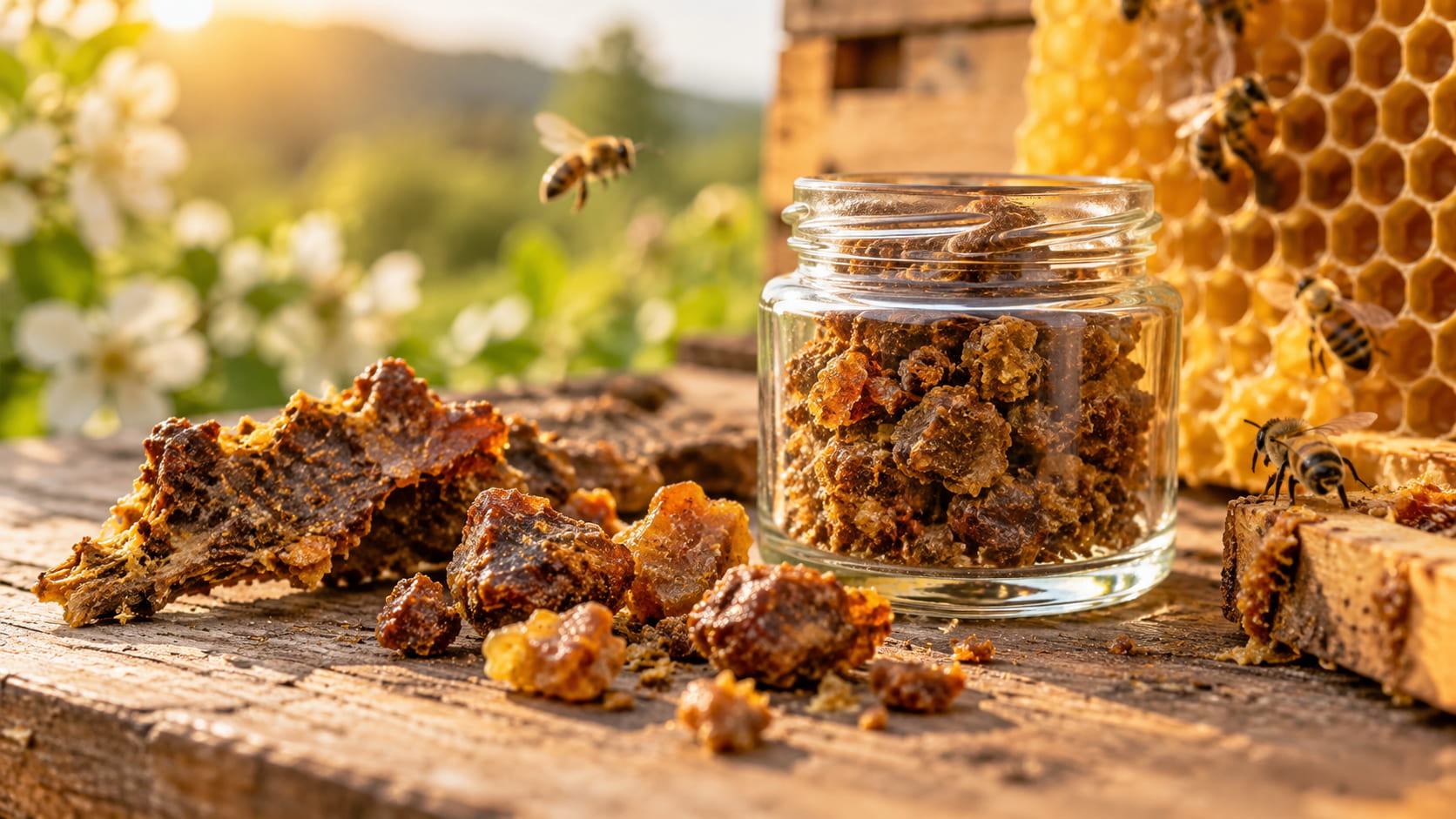
Propolis appears in supplements, mouthwashes, lip products, and skin creams. Some uses have promising research, but the benefits depend on the preparation. A clinical overview from Memorial Sloan Kettering Cancer Center emphasizes that human evidence remains limited and allergic reactions are possible.
Before using it, understand which claims have support, check the product’s intended use, and review any allergy or medication concerns.
What Is Bee Propolis?
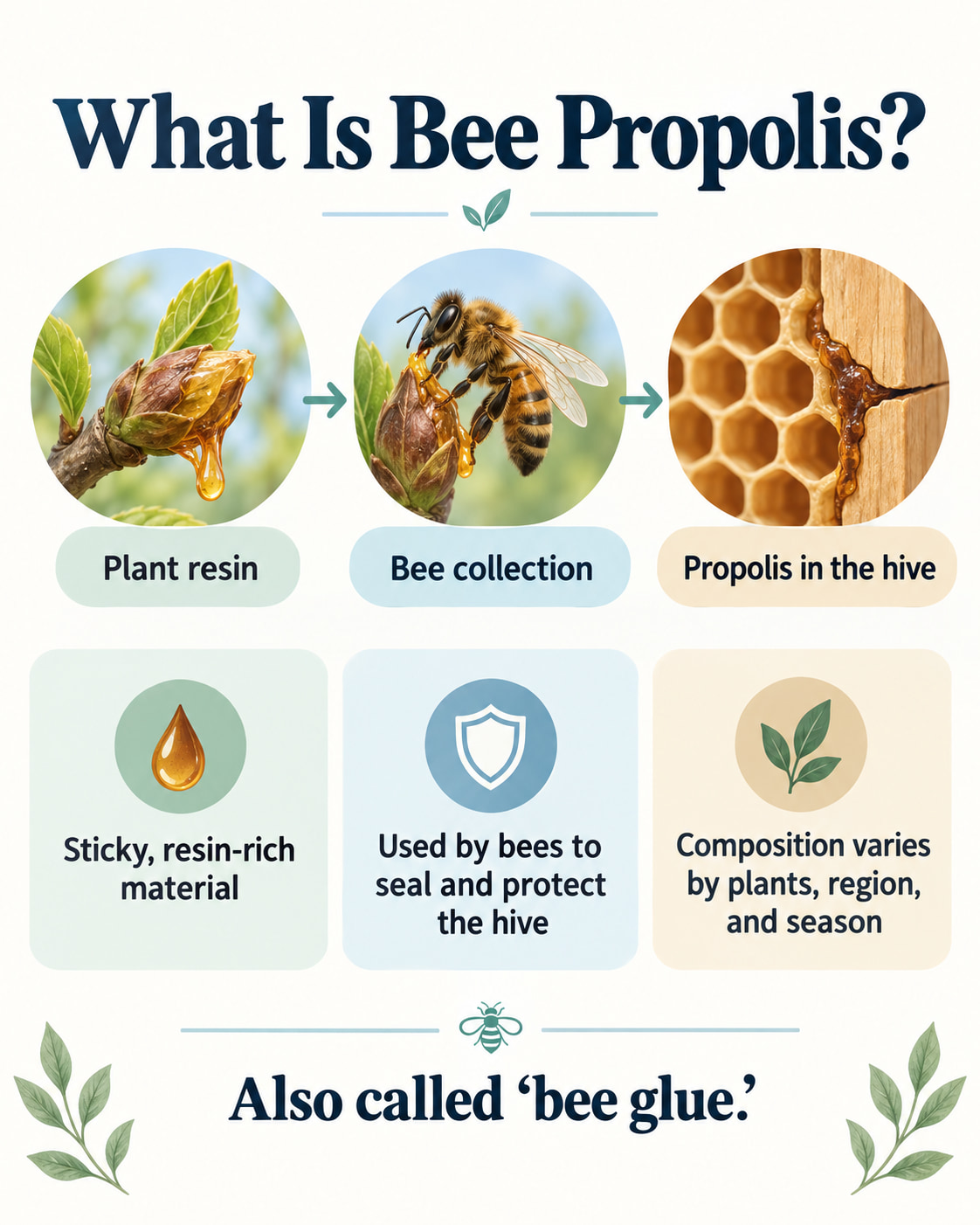
Bees collect sticky resins from plants and trees and bring them into the hive. Propolis helps seal gaps, smooth surfaces, and control the hive environment. Its antimicrobial properties also contribute to the colony’s defenses. However, protecting a hive does not establish that a propolis supplement protects people from illness.
Propolis is not one standardized ingredient. Its composition varies with the plants available, geographic region, season, and processing method. Two products labeled “propolis extract” may therefore contain different mixtures of compounds.
Is Propolis the Same as Honey or Bee Pollen?
No. Propolis, honey, and bee pollen are different bee products. Propolis is primarily a resinous hive material, while bee pollen consists of collected plant pollen mixed with nectar and bee secretions. Propolis can contain pollen, but that does not make the two interchangeable.
The distinction matters when reading research. A benefit demonstrated for honey cannot automatically be attributed to propolis.
How Does Bee Propolis Work?
Researchers study propolis partly because it contains plant compounds called polyphenols, including flavonoids and phenolic acids. Laboratory experiments have investigated antioxidant activity, effects on inflammatory signals, and activity against certain microbes.
These findings provide possible explanations for its effects, not proof that every commercial product works.
For example, an extract that inhibits bacteria in a laboratory may not produce the same result when swallowed. The concentration, preparation, and route of use all matter. Many of propolis’s actions in the human body remain incompletely understood.
The practical question is not simply whether propolis has biological activity. It is whether a particular product produces a meaningful benefit for a particular use.
Potential Benefits of Bee Propolis: What Research Shows
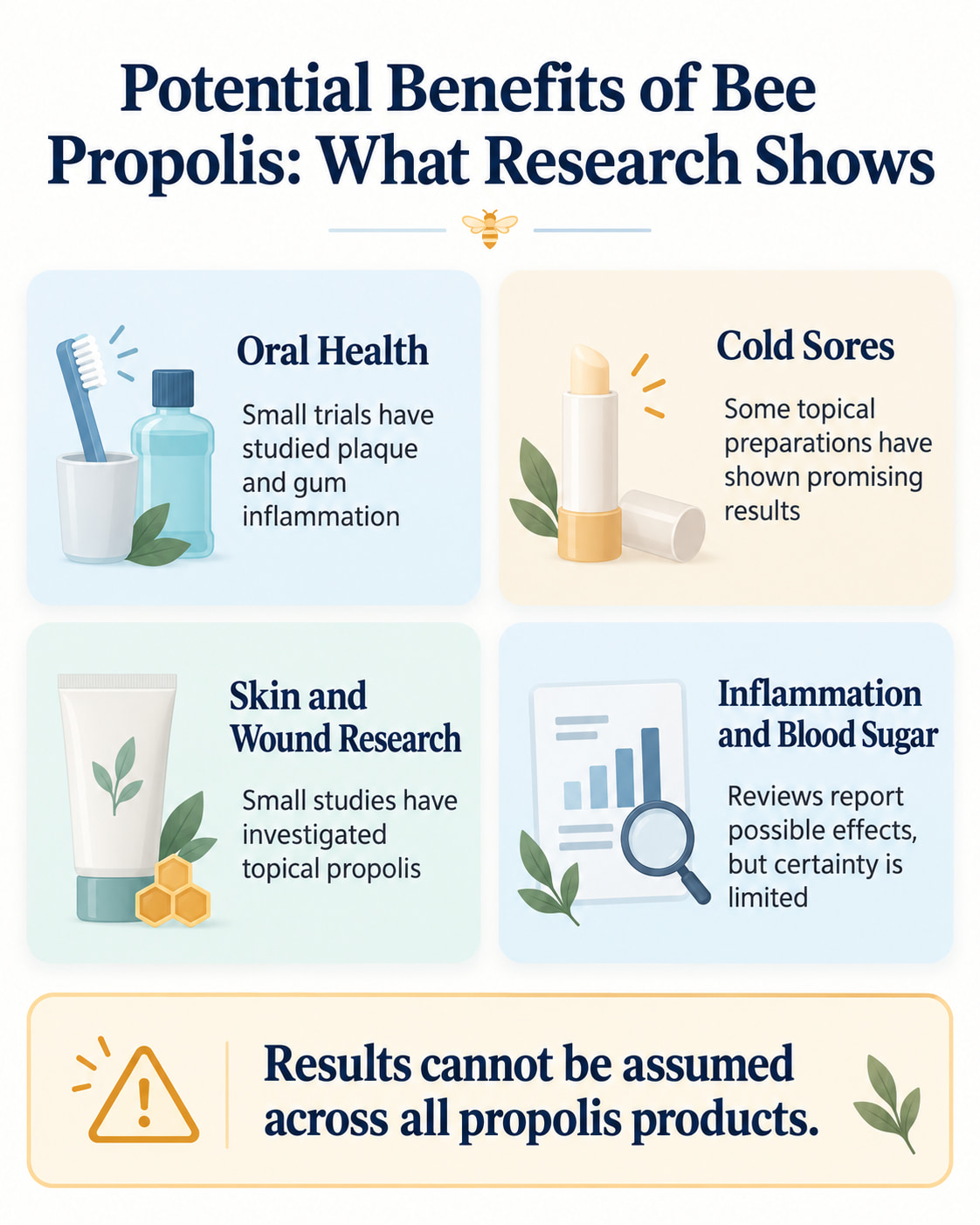
The evidence is easier to understand when mouth-care products, topical preparations, and swallowed supplements are considered separately.
Oral Health and Gum Inflammation
A 2024 randomized clinical trial published in BMC Complementary Medicine and Therapies studied 45 adults with gingivitis. Participants used propolis, chlorhexidine, and placebo mouthwashes during separate 21-day periods. The propolis preparation reduced plaque and gum-inflammation scores.
This is encouraging, but the study was small and conducted at one center. It does not establish that every propolis mouthwash produces the same results or that benefits persist with long-term use.
Participants also continued brushing during the study. The results should therefore be understood as evidence about an addition to oral hygiene—not a replacement for it.
For persistent gum bleeding or swelling, seek a dental assessment rather than relying on a new mouthwash.
Cold Sores and Skin Healing
A meta-analysis published online in January 2026 combined seven studies comparing topical propolis and/or honey with 5% acyclovir for oral or genital herpes lesions. Overall, the bee-product preparations were associated with faster lesion resolution and improvements in some pain outcomes.
An important limitation is that the analysis combined honey and propolis research, as well as different clinical settings. Its pooled result cannot be applied directly to every propolis cream—and says nothing about whether capsules offer the same benefit.
Cleveland Clinic’s January 2026 overview also notes promising topical cold-sore findings while emphasizing that established antiviral options have stronger supporting evidence.
Small studies have investigated topical propolis for certain wounds, including diabetic foot ulcers. These findings are preliminary and do not justify applying raw propolis or homemade extracts to an open wound. Diabetic ulcers and other concerning wounds require professional assessment and care.
Inflammation and Blood Sugar
A 2025 systematic review and meta-analysis in Frontiers in Nutrition included 27 trials. It found improvements in several inflammatory and antioxidant markers, but not all markers studied. The literature search covered research available through January 2024.
These are biomarker findings—changes in laboratory measurements. They do not, by themselves, demonstrate fewer illnesses, better symptoms, or longer life. Differences in participants, formulations, and doses also made the results harder to generalize.
For blood sugar, a separate October 2025 review included 12 randomized trials involving 731 people with type 2 diabetes. It reported improvements in fasting blood sugar and HbA1c, a measure of longer-term blood sugar levels. However, the authors rated the evidence for these outcomes as low certainty because of study limitations.
These results suggest a possible supplementary role worth further investigation. They are not a reason to stop diabetes medication or change an established care plan.
Does Bee Propolis Boost Your Immune System?
Laboratory effects on immune cells do not establish that propolis improves everyday immune protection. The available human evidence does not support treating it as a proven, general-purpose “immune booster.”
Be cautious with broad claims about preventing infections or resolving multiple unrelated conditions. Cleveland Clinic’s January 2026 overview concludes that science does not support most claims about propolis’s medicinal properties.
Allergy claims deserve particular caution. NCCIH warns that people with pollen allergies may react to bee products, including propolis. Taking it to manage allergies could therefore introduce an additional allergen rather than solve the problem.
Bee Propolis Side Effects and Risks
Allergic Reactions and Skin Irritation
Propolis is a recognized contact allergen. Reactions can occur with lip balms, creams, mouth products, or other forms of exposure. Symptoms may include itching, burning, a rash, cracked or inflamed lips, and mouth irritation.
A reaction may develop after previous use without problems. “Natural” labeling does not make a product suitable for sensitive skin, and tolerating one bee product does not establish tolerance to another.
Stop using a product that causes a suspected reaction. Do not keep applying it to see whether your skin will “get used to it.” Persistent symptoms warrant medical advice.
Who Should Avoid Propolis or Ask a Clinician First?
Avoid propolis if you have a known propolis allergy. People with pollen allergies or previous reactions to bee products should discuss it with an allergy professional before trying it.
Get individualized advice before use when any of the following applies:
- Asthma, eczema, or significant allergic conditions: These warrant additional caution with propolis.
- Pregnancy, breastfeeding, or use in children: Many supplements have not been adequately tested in these groups. Do not assume an adult product or dose is appropriate.
- Blood-thinning medication, a bleeding disorder, or planned surgery: Potential bleeding-related concerns and medication interactions require review.
Memorial Sloan Kettering specifically flags warfarin as a concern. Direct propolis-interaction evidence is limited, so a pharmacist or prescribing clinician should review the actual product rather than relying on a generic online interaction list.
Before surgery, tell your surgical team about all supplements and follow its instructions about stopping them.
When to Get Medical Help
Stop the product and seek advice for a new rash, persistent mouth irritation, or another suspected adverse reaction. Keep the packaging so a clinician can review the ingredients.
Call 911 or your local emergency number immediately for difficulty breathing, throat or tongue swelling, faintness, or rapidly worsening symptoms after use. These can indicate a severe allergic reaction. Use prescribed emergency epinephrine according to your allergy action plan while emergency help is being arranged.
Bee Propolis Forms, Dosage, and Product Labels
Propolis is sold in several forms, but they are not interchangeable. Always check whether the specific product is intended for swallowing, mouth care, or external application.
| Product form | What to check |
|---|---|
| Capsules or tablets | Amount per serving, other ingredients, and suitability with your medications |
| Liquid extracts or drops | Intended route of use, concentration, measuring instructions, and alcohol content |
| Mouthwashes, sprays, or lozenges | Whether to rinse and spit or swallow; age restrictions and added ingredients |
| Creams or lip products | Application instructions, other potential allergens, and external-use warnings |
Use the directions for that exact product. Do not swallow an external-use extract or assume a mouthwash has the same instructions as a lozenge.
Is There a Recommended Daily Dose?
There is no single, well-established daily dose that can be recommended across propolis products and purposes. Clinical research uses different extracts, concentrations, and treatment periods, while optimal dosing and long-term effects remain unresolved.
A dose from a study is not automatically a personal recommendation. Likewise, a product label provides directions for that product; it does not prove that taking it will produce the benefit you are seeking.
Before starting, ask a clinician or pharmacist whether there is a reasonable purpose for using it and how the formulation relates to the research.
How to Evaluate Product Quality
In the United States, dietary supplements do not receive FDA approval for safety and effectiveness before sale. However, they remain subject to manufacturing and labeling requirements. “Not FDA-approved” is not the same as “completely unregulated.”
Look for transparent ingredient amounts and credible independent quality testing. According to NIH supplement guidance, quality seals may help indicate that a product contains its listed ingredients and does not contain harmful levels of contaminants. They do not guarantee safety or effectiveness.
Avoid choosing a product solely because its label says “natural,” “high potency,” or makes sweeping health promises.
Frequently Asked Questions
Can You Take Bee Propolis Every Day?
Routine daily use is not established as necessary or beneficial for everyone. Long-term effects and optimal dosing remain uncertain. Discuss the purpose, product, and intended duration with a healthcare professional before making it a daily habit.
Is Propolis Safe to Swallow?
Some products are made for oral use, but others are not. Swallow only products specifically labeled for that purpose, and follow their directions. Oral-use labeling does not eliminate allergy risks or possible medication concerns.
Can Propolis Cause an Allergic Reaction Even After Previous Use?
Yes. Sensitization can develop over time, so earlier tolerance does not rule out a later reaction. Stop using it when new itching, burning, rash, or mouth irritation appears, and seek advice.
Is Propolis a Natural Antibiotic?
That description is misleading. Laboratory antimicrobial activity does not make a commercial propolis product equivalent to an antibiotic. Do not substitute it for prescribed medication or delay assessment of a suspected infection.
How Long Does Bee Propolis Take to Work?
There is no reliable universal timeline. Studies examine different products and outcomes over different periods. For example, the 2024 gingivitis trial assessed each mouthwash after 21 days; that result does not establish a timeline for capsules or skin products.
Is a Propolis Supplement Better Than a Cream or Mouthwash?
No form is universally better. Each delivers propolis differently and serves a different intended use. Evidence about a topical preparation cannot establish the effectiveness of a swallowed supplement, or vice versa.
The Bottom Line
Bee propolis has interesting biological properties and promising findings for some specific uses. However, the evidence does not support most broad health claims, and benefits cannot be assumed across products. Allergy risks and uncertainty about routine supplementation deserve attention.
Before using propolis, bring the product label and a clear goal to your pharmacist, dentist, or clinician. That is a more useful starting point than choosing a supplement because its marketing promises general wellness.
This content is for informational purposes only and not medical advice.
References
- University of Minnesota Bee Lab. Propolis: Its role in the hive.
- Sforcin JM. Biological Properties and Therapeutic Applications of Propolis.
- Propolis: An Update on Its Chemistry and Pharmacological Applications. 2022.
- Memorial Sloan Kettering Cancer Center. Propolis: Clinical evidence and safety information.
- Cleveland Clinic. Propolis: What Is It and Is It Worth Using?.
- Niode NJ, et al. Meta-analysis comparing topical propolis and honey with acyclovir for herpes simplex. International Journal of STD & AIDS, 2026.
- Bahari H, et al. Propolis supplementation and inflammatory and oxidative stress biomarkers.
- National Center for Complementary and Integrative Health. Seasonal Allergies at a Glance.