
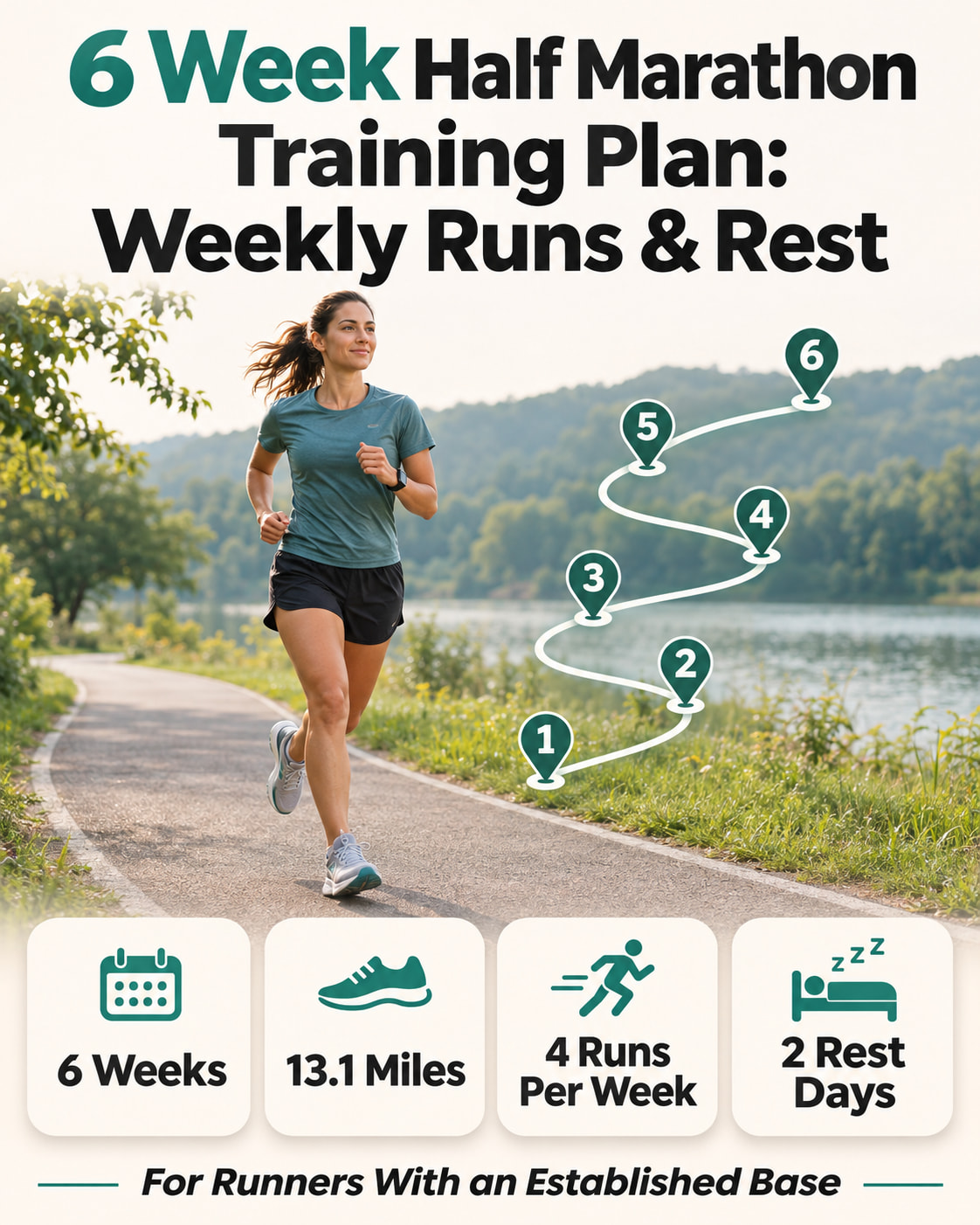
A 6 week half marathon training plan can be a practical final preparation block if you already run consistently and have a strong endurance base. The sample below uses four weekly runs, two rest days, and optional easy cross-training to prepare for 13.1 miles.
Start by checking the entry requirements. Your current training should already be close to the opening week. From there, the schedule builds your long run, gives you time to practice fueling, and reduces training before race day.
Is This 6 Week Half Marathon Training Plan Right for You?
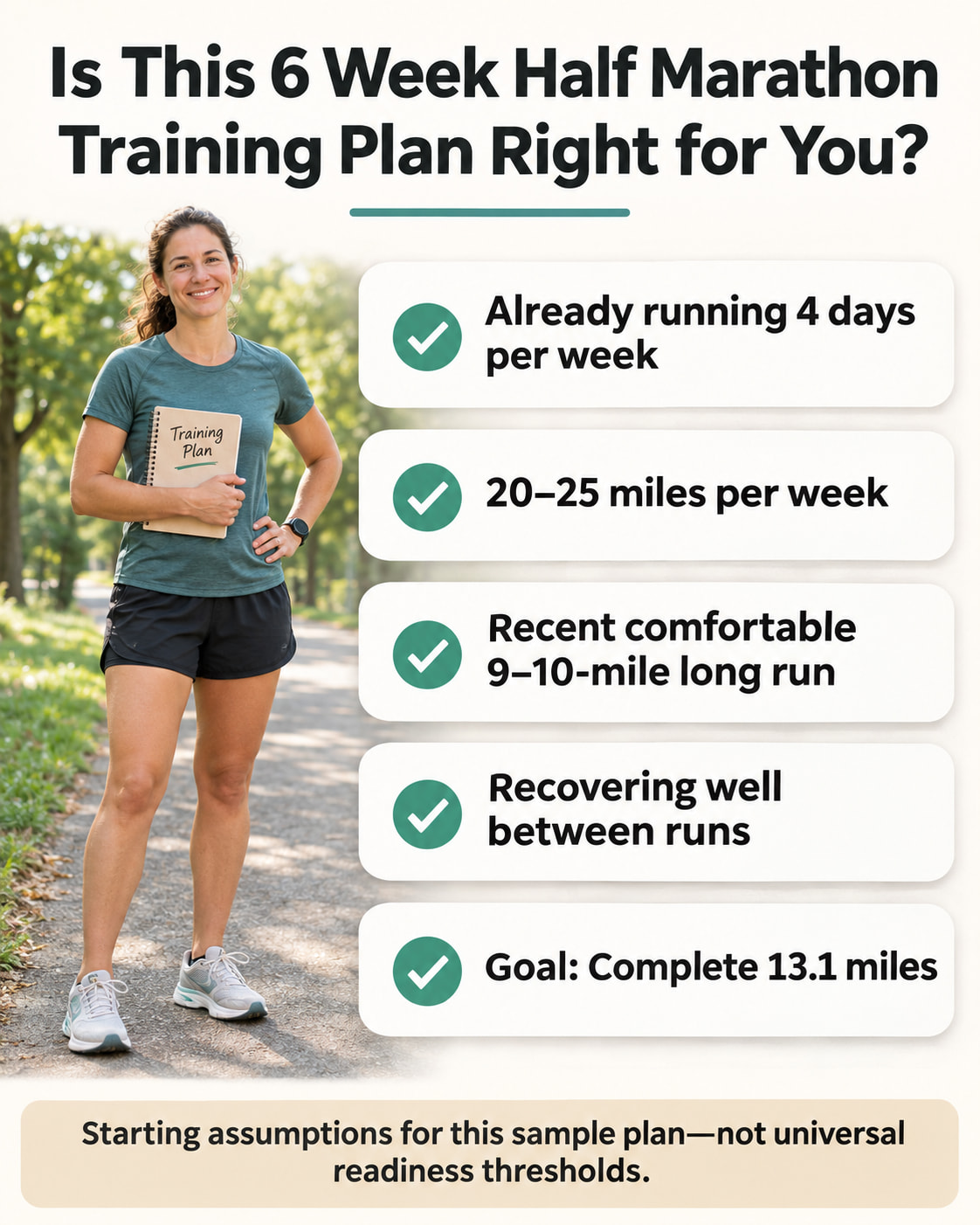
This sample schedule assumes that you:
- Already run four days per week.
- Have consistently covered about 20–25 miles per week, or approximately 32–40 kilometers, over several recent weeks.
- Have recently completed a comfortable 9–10-mile long run, approximately 14.5–16 kilometers.
- Recover well enough between runs to maintain your normal routine.
- Are aiming primarily to complete the distance rather than introduce an aggressive time goal.
These are starting assumptions for this particular schedule. They are not medically validated thresholds or guarantees of readiness.
If the first week would substantially increase your current running, choose a longer training period. A single difficult 10-mile outing does not establish the same base as consistent weekly training.
In October 2026, UTHealth Houston guidance recommended allowing at least 10–12 weeks of structured half-marathon preparation, with longer for people new to running.
Your first half marathon may fit this six-week schedule if your existing training meets its demands. If you are just beginning to run, allow time to build that foundation first.
6 Week Half Marathon Training Plan: Weekly Schedule
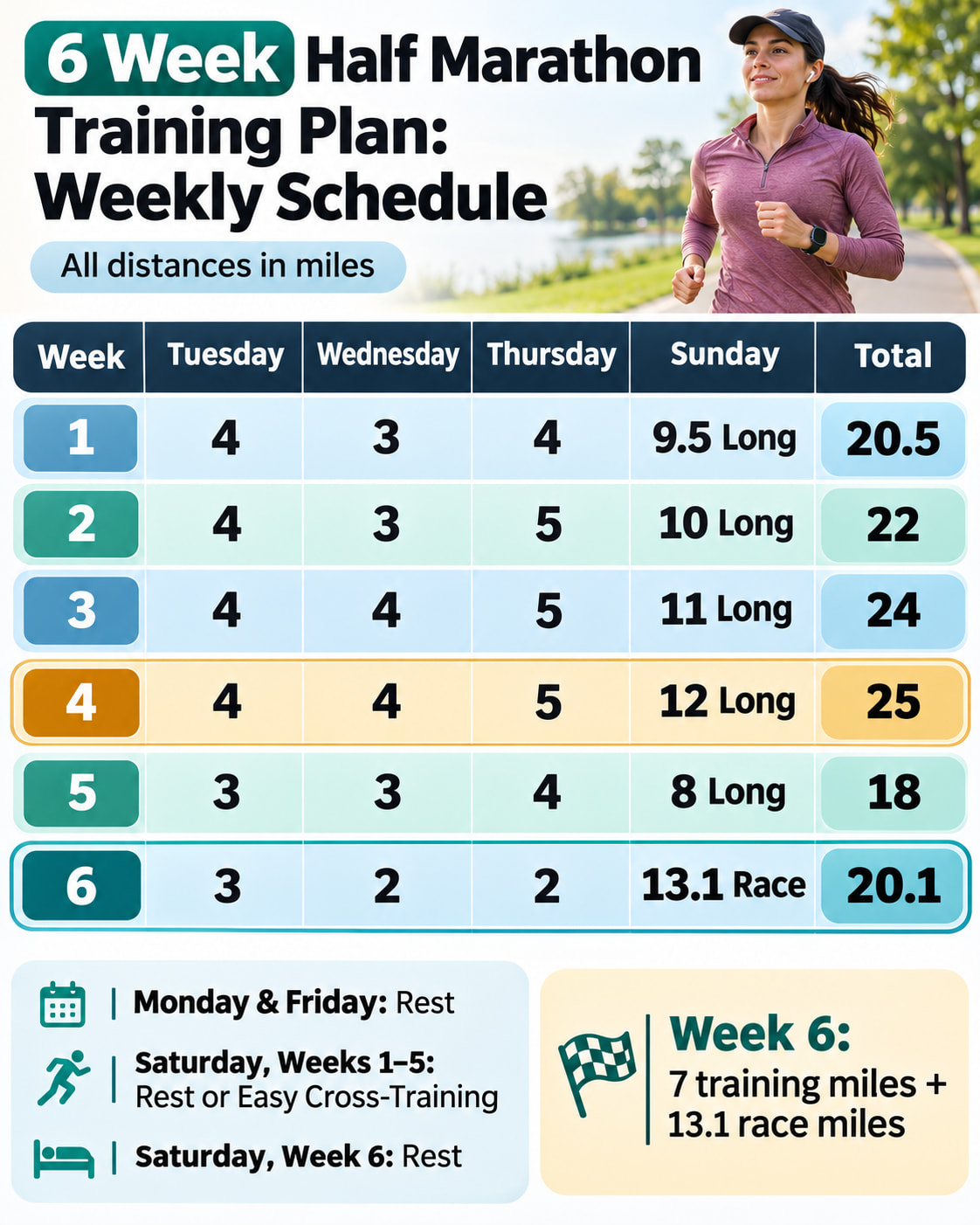
This is an original sample schedule informed by general running principles. It assumes a Sunday race and an established four-day running routine.
All distances in the table are miles. Keep every training run at a comfortable, conversational effort.
The non-running days stay consistent:
- Monday: Rest.
- Friday: Rest.
- Saturday, Weeks 1–5: Rest or 20–30 minutes of familiar, easy cycling or swimming.
- Saturday, Week 6: Rest.
| Week | Tuesday | Wednesday | Thursday | Sunday | Weekly miles |
|---|---|---|---|---|---|
| 1 | 4 easy | 3 easy | 4 easy | 9.5 long run | 20.5 |
| 2 | 4 easy | 3 easy | 5 easy | 10 long run | 22 |
| 3 | 4 easy | 4 easy | 5 easy | 11 long run | 24 |
| 4 | 4 easy | 4 easy | 5 easy | 12 long run | 25 |
| 5 | 3 easy | 3 easy | 4 easy | 8 long run | 18 |
| 6 | 3 easy | 2 easy | 2 easy | 13.1 race | 20.1 |
Race-week mileage: Week 6 contains only 7 training miles before the race. Its 20.1-mile total includes the half marathon.
For kilometer reference, 3 miles is about 4.8 km, 4 miles is 6.4 km, and 5 miles is 8 km. The longest training run is approximately 19.3 km; the race is 21.1 km.
Weeks 1–2: Settle Into the Routine
The opening week should feel similar to training you already handle. Use these runs to confirm that the schedule fits your recovery, work, and sleep.
Begin practicing the food, fluids, and gear you expect to use during the race. Keep the long run controlled rather than turning it into a fitness test.
Weeks 3–4: Complete the Main Endurance Work
The long runs reach 11 and 12 miles while the shorter runs remain easy.
The 12-mile run falls two weeks before race day. Complete it only if the preceding weeks have gone well. If you are struggling to recover or developing pain, reduce the workload and reassess the race plan instead of forcing the distance.
Weeks 5–6: Reduce Training Before the Race
Week 5 shortens the long run and lowers weekly mileage. Week 6 keeps a few brief runs while leaving more time for recovery.
You do not need a final hard workout to prove that you are ready. Follow the reduced schedule and use the extra time to organize race logistics.
Adjusting the Running Days
During Weeks 1–5, you can move Wednesday’s short run to Saturday and make Wednesday a rest day if you already tolerate running on consecutive weekend days. Skip optional cross-training in that arrangement. In race week, keep the table’s schedule and rest on Saturday.
Keep the day after your long run free from demanding training. Any rearrangement should fit a running pattern you already tolerate.
How to Pace Your Easy Runs and Long Runs
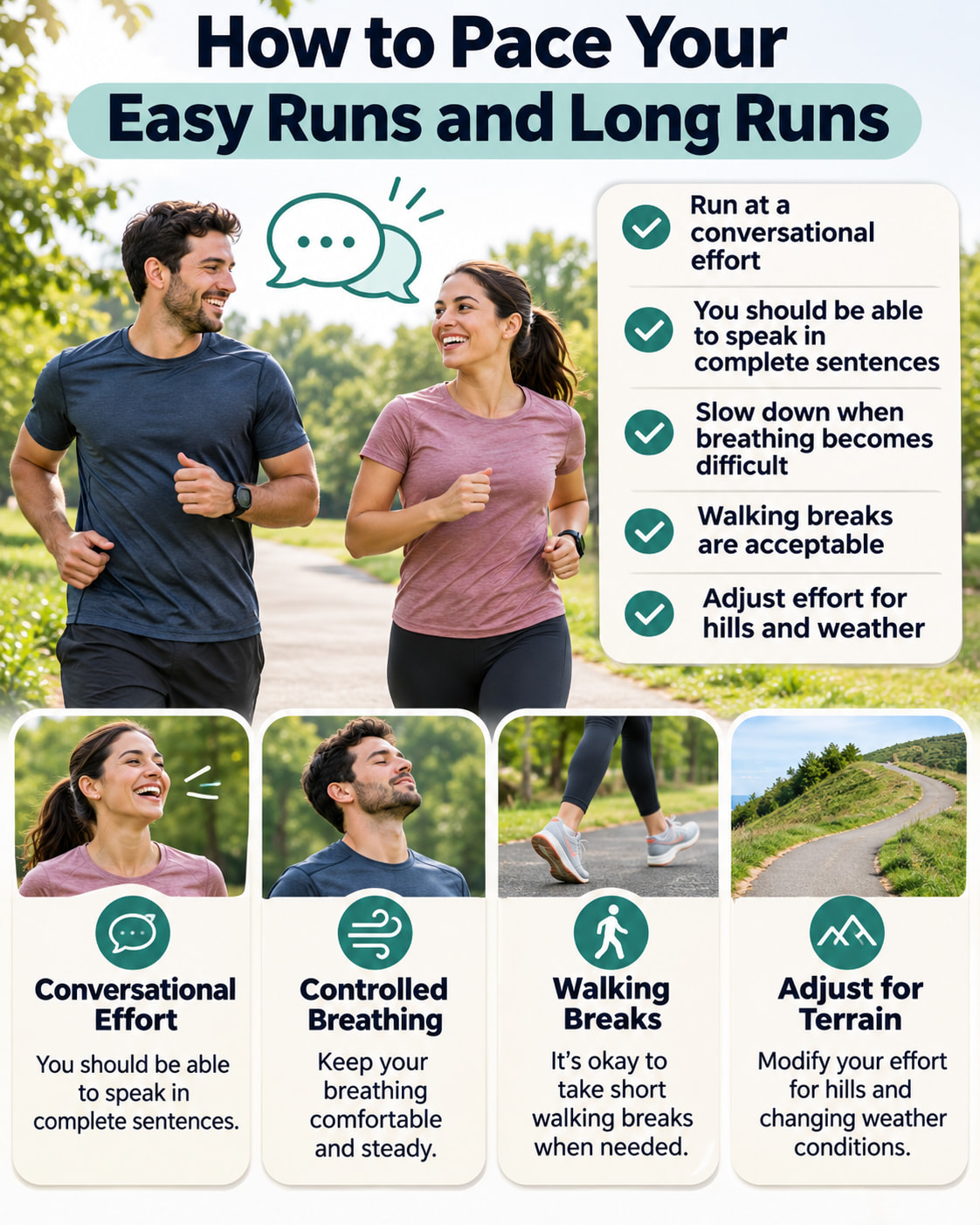
Use effort rather than a fixed pace. On an easy run, you should be able to speak in complete sentences without repeatedly stopping to catch your breath.
Slow down when the effort rises. Walking breaks are also an option, especially on hills or when you need to bring your breathing under control.
For this plan:
- Keep the first part of each run relaxed.
- Avoid turning the shorter runs into unplanned speed sessions.
- Let the long run develop endurance at a manageable effort.
- Account for hills and weather when judging pace.
A slower pace on a hot or hilly route does not automatically mean that your fitness has declined.
Start with several minutes of walking or gentle jogging before settling into your run. Finish with easy movement rather than an abrupt stop after a hard effort.
Progress Your Long Run Without Chasing a Percentage
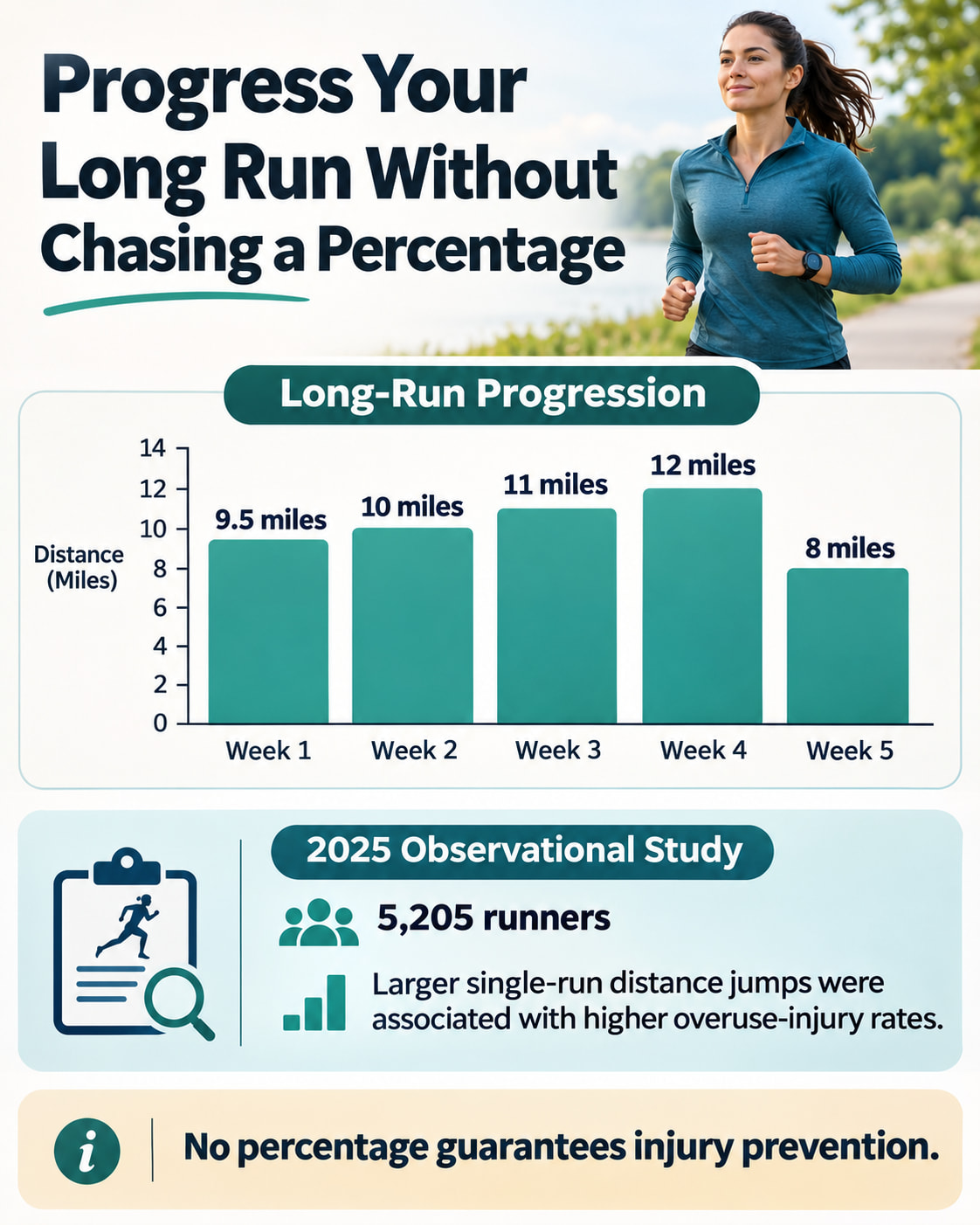
Your longest recent run matters alongside your weekly total.
A 2025 running-injury study followed 5,205 runners and found higher overuse-injury rates when a single run exceeded the runner’s longest run from the previous 30 days by more than 10%.
That was an association, not proof of a universal safe limit. It also concerned individual runs, rather than establishing a rule that weekly mileage increases below 10% prevent injury.
The practical lesson is to avoid concentrating missed mileage into one unusually long outing. A low weekly total does not make a large Sunday distance jump harmless.
Use the table as a guide that depends on recovery. If a distance becomes a major struggle, do not automatically advance because the calendar says it is time.
Rest Days, Cross-Training, and Strength Work
Protect Your Rest Days
Rest days are planned parts of the schedule. Normal daily movement is fine, but adding a demanding workout changes the purpose of that day.
Pay attention to how you feel across several sessions. Persistent fatigue, deteriorating sleep, or soreness that affects your running are reasons to reduce the load and reassess.
Keep Optional Cross-Training Easy
Cycling or swimming can provide variety without another running session. The optional Saturday session should leave you comfortable for Sunday’s long run.
Choose rest when your legs feel tired. You do not need to complete every optional activity to follow the plan.
Maintain Familiar Strength Work
If you already strength train, keep brief sessions with familiar exercises and manageable loads. Reduce lifting volume when running fatigue increases.
Avoid scheduling strenuous leg training immediately before the long run. This short preparation period is also a poor time to introduce a demanding new lifting routine.
Fueling and Hydration for Longer Runs
Practice Eating Before and During Long Runs
Before longer outings, use a familiar carbohydrate-containing meal or snack that sits comfortably in your stomach. Examples include oatmeal, toast, or a banana, depending on what you normally tolerate.
For endurance exercise lasting approximately 1–2.5 hours, Australian Institute of Sport guidance recommends 30–60 grams of carbohydrate per hour.
Practice that approach during appropriate training runs. Check labels because gels, chews, drinks, and foods contain different amounts.
For example, a gel containing 25 grams of carbohydrate taken twice in an hour provides 50 grams. Count carbohydrate from sports drinks toward the same hourly total.
If you expect a longer finish time, practice fueling for that duration. Higher carbohydrate intakes require an approach your stomach tolerates; race day is not the time to make a large untested change.
Match Fluids to Your Needs
Plan access to fluids on longer routes and practice your drinking approach before race day.
National Athletic Trainers’ Association guidance emphasizes individual needs based on factors such as sweat losses, weather, exercise duration, and tolerance.
Avoid forcing large amounts of water or sports drink. Starting adequately hydrated does not mean you should drink more fluid than you lose during exercise.
After running, return to regular meals and snacks containing carbohydrate and protein. Simple options include yogurt with fruit, eggs with toast, or rice with beans.
What to Do When Training Does Not Go as Planned
If You Miss a Run
Do not double your next run to replace the missed miles.
After an isolated missed easy session, continue with a manageable schedule when you are ready. If you miss several sessions or a full week, reassess before advancing to a longer run.
With only six weeks available, a substantial interruption may mean choosing a later race. Compressing the remaining workouts can create a workload you have not prepared for.
If Pain or Illness Develops
Stop if pain worsens or changes your stride. Persistent pain deserves assessment rather than repeated attempts to push through it.
Mayo Clinic Health System guidance specifically advises stopping when pain affects your gait and checking in with a clinician for concerning signs of excessive training fatigue.
Avoid racing while ill, especially with a fever. Return to training gradually after recovery rather than immediately attempting the sessions you missed.
Tapering and Preparing for Race Day
Tapering means reducing training before competition so that accumulated fatigue can ease.
A May 2023 systematic review of 14 studies supported tapering for endurance performance. However, it did not validate this exact six-week schedule or establish one ideal taper for every half-marathon runner.
In this example, the final two weeks progressively reduce training. Keep the short runs comfortable and avoid adding last-minute mileage.
Before race day:
- Check the event details. Confirm the start time, course, aid stations, and time limit.
- Use familiar gear. Wear shoes, socks, and clothing you have tested.
- Repeat your practiced fueling approach. Avoid introducing new products or an unfamiliar breakfast.
- Start at a controlled effort. Give yourself time to settle into the distance.
- Use planned walking breaks if needed. Include them in your pacing and time-limit calculations.
The goal is to arrive with a realistic plan based on your recent training.
Frequently Asked Questions
Can a Beginner Train for a Half Marathon in Six Weeks?
A runner preparing for their first half marathon may be able to use six weeks if they already have the required running base. Someone starting from little or no running generally needs a longer buildup.
Can I Follow This Plan With Three Runs Per Week?
This particular schedule assumes four runs. Three-day half-marathon programs exist, but dropping a run or redistributing all its mileage changes the workload. Choose a plan designed for your existing frequency instead of squeezing four sessions into three.
Do I Need to Run 13.1 Miles Before Race Day?
No. Some established programs finish their long-run buildup below race distance. Hal Higdon’s 12-week Novice 1 plan, for example, peaks at 10 miles.
The 12-mile peak here belongs to this sample’s stronger starting base. It is not a requirement for every half-marathon runner.
Can I Use a Run-Walk Approach?
Yes. Practice comfortable running intervals and walking breaks during training so the pattern is familiar. Walk breaks can help manage effort, but you still need preparation for the full distance and enough time to meet the event’s cutoff.
Can I Complete the Runs on a Treadmill?
Yes, you can use a treadmill for suitable sessions. Follow the intended distance and effort. If the race is outdoors, include outdoor practice when practical so you become familiar with the conditions you will face.
Will This Plan Help Me Run a Sub-Two-Hour Half Marathon?
The schedule is designed around completing the distance, not a specific finish time. A time goal should reflect your recent performances and training. Use a tailored plan if improving race pace is your main objective.
Conclusion
A 6 week half marathon training plan works best when its opening week matches the running you already do. Consistent easy runs, a manageable long-run progression, and protected recovery give the schedule its structure.
Compare your recent training with Week 1, then put both the runs and rest days on your calendar. If the starting workload is too demanding, give yourself a longer preparation period.
References
- UTHealth Houston: Running preparation and recovery guidance.
- Frandsen and colleagues: Running-distance increases and injury.
- Hal Higdon: Novice 1 Half Marathon Training Program.
- New York Road Runners: Coaches answer common training questions.
- Mayo Clinic Health System: Running performance and injury guidance.
- Australian Institute of Sport: Carbohydrate intake during exercise.