
A 12 week marathon training plan can be suitable for runners who already train consistently and can comfortably handle the opening week. It is not a couch-to-marathon program.

The schedule below combines four running days, planned recovery weeks, an 18-mile peak long run, and a three-week taper. Before starting, compare its requirements with your recent training—not the mileage you hope to manage.
In its June 2024 marathon preparation guidance, Hospital for Special Surgery recommends establishing running experience and aerobic fitness before beginning a formal plan. It also cautions against rushing the buildup.
Is 12 Weeks Enough to Train for a Marathon?
Twelve weeks may provide a focused preparation period when you already have a strong running base. It is a much tighter timeline when you also need to establish consistency, increase your weekly mileage, and learn how to manage long runs.
For comparison, Hal Higdon’s Novice 1 marathon program lasts 18 weeks, allowing more time for progression than the schedule in this article.
Being a first-time marathoner does not necessarily mean being a beginner runner. Someone who runs regularly and has completed shorter races starts from a different position than someone who is just beginning.
This plan focuses on preparing for the distance, not achieving a particular finishing time. Meeting its starting requirements does not guarantee race readiness.
Who Should Use This 12 Week Marathon Training Plan?
This example is designed around the following starting assumptions. They are requirements for this particular schedule, not scientifically established thresholds that apply to every runner.
| Starting point | What this plan assumes |
|---|---|
| Running experience | Several months of consistent running |
| Recent weekly mileage | Approximately 25–30 miles, or 40–48 kilometers, maintained comfortably for the previous 6–8 weeks |
| Recent long run | Approximately 12 miles, or 19.3 kilometers, completed comfortably within the past month |
| Training availability | Time for four runs each week, including a longer midweek run |
| Recovery | Your current routine does not leave you persistently exhausted or unable to recover between sessions |
Do not use one unusually long run as proof that you meet these requirements. The opening week should resemble training you already tolerate.
Existing pain also deserves attention before increasing your workload. HSS recommends getting workout-related pain assessed before beginning marathon training, particularly when there is a history of injury.
When the starting requirements are substantially above your current routine, choose a longer preparation period rather than trying to catch up during Week 1.
12 Week Marathon Training Plan: Weekly Schedule
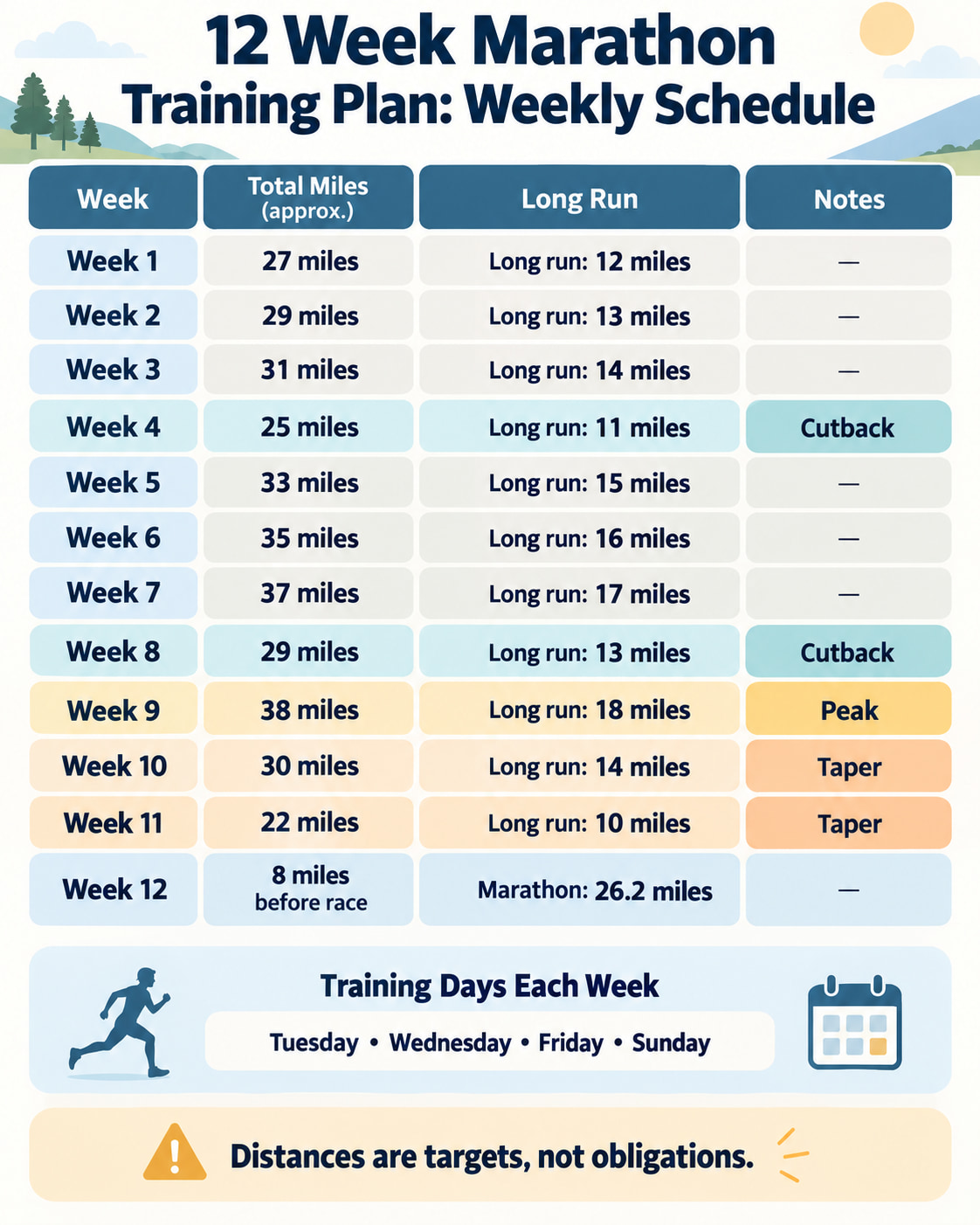
The following is an original sample schedule, not an official B.A.A. or Hal Higdon program. It has not been clinically validated and cannot account for your individual health, injury history, or recovery needs.
Your Weekly Layout
Run on Tuesday, Wednesday, Friday, and Sunday. Keep Monday and Saturday as rest days. Thursday can be another rest day or an optional easy cross-training session.
All scheduled runs should be at an easy, controlled effort. Wednesday is longer than the other weekday runs, but it is not intended to be a hard workout.
The table assumes a Sunday marathon.
The 12-Week Schedule
Individual run distances are in miles. Approximate weekly kilometer totals appear in parentheses.
| Week | Tuesday: easy | Wednesday: medium-length | Friday: easy | Sunday: long run | Weekly total: miles (km) |
|---|---|---|---|---|---|
| 1 | 5 | 6 | 4 | 12 | 27 (43.5) |
| 2 | 5 | 7 | 4 | 13 | 29 (46.7) |
| 3 | 5 | 7 | 5 | 14 | 31 (49.9) |
| 4 — Cutback | 4 | 6 | 4 | 11 | 25 (40.2) |
| 5 | 5 | 8 | 5 | 15 | 33 (53.1) |
| 6 | 6 | 8 | 5 | 16 | 35 (56.3) |
| 7 | 6 | 9 | 5 | 17 | 37 (59.5) |
| 8 — Cutback | 5 | 7 | 4 | 13 | 29 (46.7) |
| 9 — Peak | 6 | 9 | 5 | 18 | 38 (61.2) |
| 10 — Taper | 5 | 7 | 4 | 14 | 30 (48.3) |
| 11 — Taper | 4 | 5 | 3 | 10 | 22 (35.4) |
| 12 — Race week | 3 | 3 | 2 | Marathon: about 26.2 | 8 (12.9) before the race |
Distance guide: One mile is approximately 1.61 kilometers. The 18-mile peak long run is approximately 29 kilometers. A marathon is 42.195 kilometers.
Race-week training totals exclude the marathon. Including the race, Week 12 contains approximately 34.2 miles, or 55.1 kilometers.
How to Follow the Schedule
Treat the distances as targets rather than obligations. Do not extend a run through worsening pain or clear difficulty recovering simply to complete a table entry.
Weeks 4 and 8 deliberately reduce mileage. Week 9 contains the highest training volume, followed by three weeks of reduced running before race day. Reduced-mileage weeks and tapering also appear in established marathon coaching programs.
The increases after cutback weeks return toward previously completed distances. They are not instructions to make a comparable jump from an unfamiliar training level.
How Fast Should You Run During Marathon Training?
Use a pace that lets you speak comfortably in full sentences. The B.A.A. describes easy running as conversational or recovery-pace running.
For this completion-focused plan, apply that effort to your short runs, medium-length runs, and long runs. Medium-length does not mean medium intensity.
Start each session gently. Count any easy warm-up and cool-down running within the listed distance rather than automatically adding extra miles.
No speed sessions are required in this example. Avoid combining its mileage buildup with a new interval program or repeated all-out races.
In hot weather, reduce the demand rather than chasing your usual pace. CDC guidance recommends scheduling activity during cooler parts of the day and pacing exercise cautiously in the heat.
How to Complete Your Marathon Long Runs
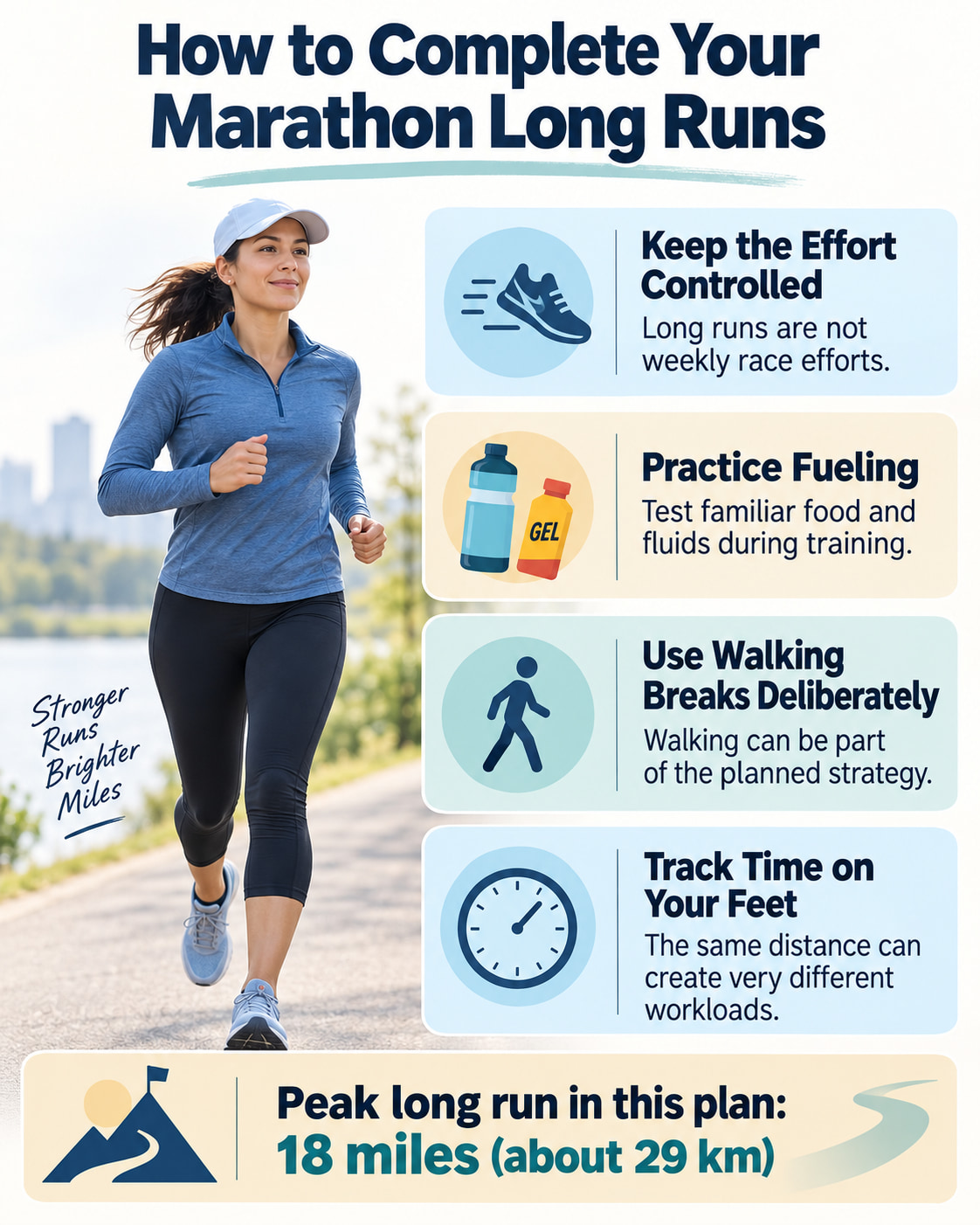
Keep the Effort Controlled
Long runs are opportunities to practice pacing, fueling, clothing, and equipment—not weekly attempts to prove how fast you can cover the distance.
Established coaching guidance recommends a comfortable, conversational long-run pace and allows walking breaks.
For this plan, begin conservatively and avoid adding a fast finish. Record the distance, duration, food and fluids consumed, and how you feel afterward. That log gives you something more useful than mileage alone when deciding whether to progress.
Use Walking Breaks Deliberately
Walking can be part of your strategy rather than a response reserved for exhaustion. You might practice short walk breaks at regular intervals or while drinking, provided the overall session remains manageable. Hal Higdon’s guidance specifically includes walking during training and at aid stations.
Include walking within the scheduled distance. Do not add extra running afterward to compensate for it.
Consider Time on Your Feet
The same distance can represent very different workloads.
For example, an 18-mile run takes 3 hours at 10 minutes per mile but 3 hours and 36 minutes at 12 minutes per mile, before stops.
When the longer sessions require far more time than you have previously tolerated, get help adapting the schedule. Do not force 18 miles simply because another runner completes that distance comfortably.
Avoid Abrupt Long-Run Increases
A 2025 observational study of 5,205 runners found higher overuse-injury rates when a single session exceeded the runner’s longest run from the previous 30 days by more than 10%. The study did not identify the same relationship for its week-to-week mileage ratio.
This does not prove that staying below 10% prevents injury. It supports being cautious about sudden increases in individual runs rather than monitoring only weekly totals.
Is an 18-Mile Long Run Enough?
There is no universal requirement to complete a 20-mile training run. The B.A.A.’s published Level One guidance describes four running days per week, approximately 25–40 weekly miles, and long runs reaching 16–18 miles.
That provides context for this example’s workload, but it does not validate compressing another program into 12 weeks. An 18-mile run alone is not proof that you are ready; consider it alongside your consistency and recovery throughout the training period.
Strength Training, Cross-Training, and Rest Days
Keep supporting exercise manageable. HSS identifies strength work, lower-impact cross-training, adequate nutrition, and sleep as useful components of marathon preparation.
For runners already accustomed to strength training, an example maintenance option is one or two brief sessions per week after shorter runs. Use familiar movements, such as squats, step-ups, calf raises, and a comfortable core exercise.
Keep the sessions well short of exhaustion. This is not the time to introduce a demanding lifting program alongside increasing running mileage. Hal Higdon’s novice guidance similarly distinguishes maintaining an existing strength routine from beginning one during marathon preparation.
Thursday cross-training is optional. An easy bike ride, swim, or elliptical session can fit the schedule, but rest is appropriate when fatigue is accumulating.
Protect sleep as well as days off. HSS recommends at least seven hours per night and emphasizes recovery between training sessions. Persistent fatigue or deteriorating running form should prompt reassessment rather than another hard workout.
Fueling and Hydration for Marathon Training
Before a Long Run
Choose familiar carbohydrate-containing food and allow enough time to digest it. Mayo Clinic’s guidance suggests allowing approximately 1–3 hours after a small meal or snack, with more time after a large meal.
A practical option might be toast and a banana or another breakfast you already tolerate. Test the timing and portion during training rather than changing everything on race morning.
During a Long Run
The International Society of Sports Nutrition’s 2017 position stand recommends approximately 30–60 grams of carbohydrate per hour during prolonged, high-intensity exercise. Individual needs depend on the session and the athlete.
Use training to establish a fueling routine you can tolerate. For runs lasting several hours, a sports dietitian can help determine an appropriate target rather than assuming one range fits every situation.
Read labels and count carbohydrates from all sources. As a calculation example, two gels containing 25 grams each provide 50 grams of carbohydrate. Adding a drink containing 20 grams brings the total to 70 grams—not 50.
That example demonstrates how to count intake; it is not a recommended target for every runner. Check preparation and water instructions, and avoid first-time experiments during the marathon. Mayo Clinic recommends trying sports foods and drinks before competition to assess tolerance.
Hydration: Avoid Both Too Little and Too Much
The National Athletic Trainers’ Association’s fluid-replacement position statement recommends individualizing hydration according to factors such as sweat rate, weather, exercise duration, and tolerance. It also warns that excessive fluid intake can cause dangerous exercise-associated hyponatremia, or low blood sodium.
Plan access to fluids during long runs and practice drinking under conditions similar to those expected on race day. Do not force a fixed amount simply because another runner uses it.
For many recreational exercisers, drinking in response to thirst is a useful approach. Longer events and difficult conditions may warrant a more individualized plan. Sports drinks do not make excessive drinking safe.
After a Long Run
Have a meal or snack containing carbohydrates and protein. Mayo Clinic suggests doing so within about two hours when possible. Examples include yogurt with fruit and cereal or a sandwich with a protein filling.
Avoid combining increasing mileage with aggressive food restriction. AAOS identifies inadequate energy intake relative to exercise demands as a risk factor for bone stress injuries.
What to Do If You Miss a Run or a Week
Do not stack missed workouts into the remaining days. HSS recommends adjusting training after interruptions rather than doubling mileage or compressing two weeks into one.
| Situation | Adjustment for this example |
|---|---|
| You miss one short easy run | Skip it rather than adding its mileage elsewhere. |
| You miss a long run | Reassess the next long-run target instead of automatically advancing. |
| You miss several days | Return with a shorter, easier session and reassess recovery. |
| You miss a week or more | Rebuild from what you can currently tolerate; the remaining schedule may no longer fit. |
Repeating a week may require choosing a later race. Do not repeat weeks and then squeeze the remaining training into less time.
An interruption caused by pain or illness also requires addressing the reason you stopped, not just rearranging the calendar.
Marathon Taper and Race-Week Tips
The taper begins after Week 9’s peak long run. In this example, weekly running falls from 38 miles to 30, then 22, followed by 8 miles before the marathon.
A three-week taper is an established coaching approach, including in Hal Higdon’s Novice 1 program, but the exact reduction is not universal.
Keep the Final Weeks Familiar
Follow the shorter distances rather than adding another endurance test. Keep supporting workouts light and avoid using newly available time for unusually demanding activities.
Continue eating adequately. Lower running mileage is not a reason to arrive at the start underfueled; sports-nutrition guidance emphasizes sufficient energy and carbohydrate availability for endurance exercise.
Prepare Your Race-Day Logistics
Before race week, write down your breakfast, practiced fueling routine, clothing, transportation, and arrival plan. Check the event’s official information for its cutoff time, aid-station locations, available drinks, and equipment rules.
Use familiar foods and products rather than a last-minute nutrition experiment.
For pacing, begin with the controlled effort you have practiced. Do not let an ambitious finish-time goal override the conditions or how you feel.
When to Stop Running and Get Medical Help
Pain That Needs Assessment
Stop the session and arrange a medical assessment for localized pain that worsens with running, causes limping, occurs during ordinary walking, or persists at rest or at night. Swelling or a repeatedly painful spot also warrants attention.
AAOS identifies these as possible features of bone stress injury and advises against continuing painful activity while awaiting assessment.
Symptoms That Need Urgent Help
Stop exercising and seek emergency help for chest pressure or pain, particularly with unusual shortness of breath, cold sweat, nausea, or lightheadedness. The American Heart Association identifies these as potential heart-attack warning signs. Call 911 in the United States, or your local emergency number elsewhere.
Confusion, collapse, seizures, or altered consciousness during exercise in the heat also require emergency attention. CDC guidance identifies these as possible heat-stroke symptoms. Move to a cooler place and begin cooling while help is being arranged.
Feeling faint or weak in hot conditions is a reason to stop activity and get somewhere cool—not push through the final miles.
Frequently Asked Questions
Can a Beginner Train for a Marathon in 12 Weeks?
This example is not designed for a beginner starting from little or no running. A first-time marathoner may use it only when the starting workload already matches their established training. Otherwise, build consistency first and allow a longer preparation period.
How Many Miles Should I Run Before Starting a 12-Week Marathon Plan?
For this particular schedule, the starting assumption is approximately 25–30 miles per week for 6–8 weeks, plus a comfortable recent 12-mile long run. Those numbers match the opening workload; they are not universal readiness standards.
Do I Need to Run 20 Miles Before a Marathon?
Not necessarily. The B.A.A.’s Level One guidance includes long runs reaching 16–18 miles. A suitable longest run depends on the broader program, and completing one distance does not guarantee readiness.
Can I Use Run-Walk Intervals During Marathon Training?
Yes. Walking breaks appear in established marathon coaching guidance. Practice the approach during training so it is familiar, and include both running and walking within the scheduled distance.
What Happens If I Miss a Week of Marathon Training?
Do not automatically jump to the next scheduled mileage. Resume at a manageable level and reassess the remaining timeline. HSS advises rebuilding gradually rather than making up missed training.
Should I Run the Full Marathon Distance Before Race Day?
This plan does not include a full-distance rehearsal. Established programs can also peak below marathon distance, including the B.A.A.’s Level One guidance. Adding a 26.2-mile training run would be a substantial departure from this example.
Conclusion
A 12 week marathon training plan is most useful when it builds on running you already tolerate. Use the schedule as a framework, practice fueling alongside your long runs, and make recovery part of the plan.
Before beginning Week 1, compare your recent training log with the starting requirements. When they do not match, give yourself more preparation time rather than forcing the calendar.
This content is for informational purposes only and not medical advice.
References
- Hospital for Special Surgery. How to Start Training for a Marathon or Half Marathon.
- Boston Athletic Association. Boston Marathon Training.
- Hal Higdon. Novice 1 Marathon Training Program.
- British Journal of Sports Medicine. How Much Running Is Too Much? Identifying High-Risk Running Sessions in a 5200-Person Cohort Study.
- Hospital for Special Surgery. Injury Prevention for First-Time Marathon Runners.
- International Society of Sports Nutrition. Position Stand: Nutrient Timing.
- National Athletic Trainers’ Association. Position Statement: Fluid Replacement for the Physically Active.