
Agility exercises for seniors are structured movements that train balance, coordination, and quick foot placement to help reduce fall risk and support safer daily movement. Understanding and practicing these exercises matters because falls are a leading cause of injury in older adults, and targeted balance and agility training is widely recommended by public-health and fitness organizations.
In this guide, you’ll learn what agility training means for seniors, why it’s important, how to do it safely, and the 6 best agility exercises for seniors you can start today.
What Are Agility Exercises for Seniors?
Agility exercises for seniors focus on controlled, safe movement patterns that improve how the body reacts to changes in position, direction, and speed. Unlike high-impact athletic agility drills, senior-friendly agility training emphasizes:
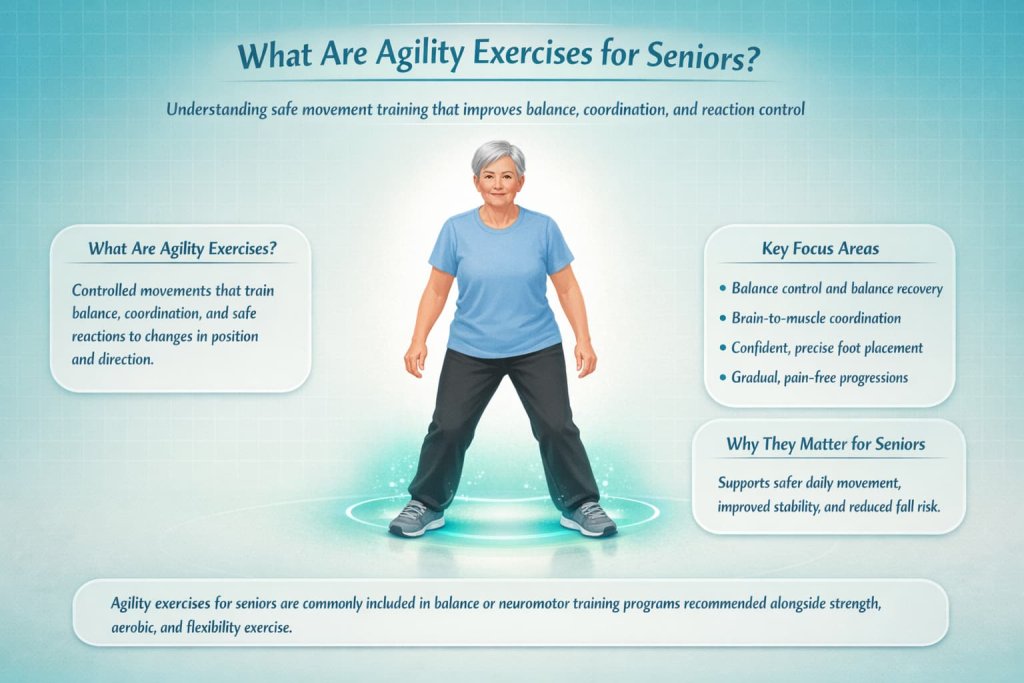
- Balance control and balance recovery
- Coordination between the brain and muscles
- Smooth, confident foot placement
- Gradual, pain-free movement progressions
In older adults, agility training is often grouped under neuromotor or balance training, which is recommended alongside strength, aerobic, and flexibility exercise by organizations such as the World Health Organization and the Centers for Disease Control and Prevention.
6 Best Agility Exercises for Seniors
These six agility exercises focus on improving balance, coordination, and confidence during everyday movement. They are beginner-friendly, low-impact, and designed to help reduce fall risk when practiced regularly
1. Side-to-Side Weight Shifts
How to do it
- Stand tall with feet hip-width apart and weight evenly distributed
- Shift your weight slowly onto your right foot
- Lightly tap your left foot out to the side for balance
- Return to center with control
- Repeat on the opposite side
Why it works
This exercise trains controlled weight transfer, which is essential for walking, changing direction, and regaining balance after a small slip. Practicing slow lateral shifts helps the nervous system coordinate balance responses and improves confidence during side movements commonly used in daily life.
Muscles worked
Gluteus medius and maximus, hip stabilizers, core muscles, ankles, and lower-leg stabilizers.
Trainer Tip
Move slowly and deliberately. The goal is control, not speed—imagine shifting your weight smoothly rather than leaning.
2. Heel-to-Toe Walk
How to do it
- Stand near a wall, railing, or countertop for light support
- Place one foot directly in front of the other so the heel touches the toe
- Walk forward in a straight line for 5–10 steps
- Pause, turn carefully, and repeat
Why it works
By narrowing your base of support, this exercise challenges balance and coordination. It mimics real-world walking demands and helps improve postural control, which is especially important for reducing fall risk during everyday movement.
Muscles worked
Ankle stabilizers, calves, hips, core stabilizers, and postural muscles.
Trainer Tip
Keep your gaze forward instead of looking down. Visual focus helps improve balance and posture.
3. Marching With Direction Changes
How to do it
- Stand upright and begin marching in place
- Lift one knee at a time in a controlled manner
- After 6–10 steps, slowly turn to one side
- Continue marching in the new direction
Why it works
Turning movements are a common moment when falls occur. This drill improves coordination between the upper and lower body while training balance during directional changes, making daily movements like turning around safer.
Muscles worked
Hip flexors, glutes, calves, quadriceps, and core muscles.
Trainer Tip
Keep steps slow and controlled. Knee height should stay within a comfortable, stable range.
4. Step-Out and Return
How to do it
- Stand with feet together and posture upright
- Step one foot forward, then return to center
- Step the same foot to the side, then return
- Step the foot backward, then return
- Switch legs and repeat
Why it works
This exercise builds multi-directional control, helping seniors feel more confident stepping forward, sideways, or backward—movements often required to avoid obstacles or maintain balance.
Muscles worked
Glutes, quadriceps, hamstrings, hips, and core stabilizers.
Trainer Tip
Think about placing your foot quietly and precisely on the floor to improve control and awareness.
5. Clock Taps
How to do it
- Stand on one leg while lightly holding a chair or wall
- Tap the free foot forward (12 o’clock)
- Tap to the side (3 or 9 o’clock)
- Tap backward (6 o’clock)
- Return to center between taps
- Switch legs
Why it works
Clock taps train single-leg stability and balance recovery, both of which are essential for safe walking and stepping. The exercise also improves joint awareness and coordination.
Muscles worked
Ankle stabilizers, glutes, hip muscles, core, and lower-leg muscles.
Trainer Tip
Keep a slight bend in your standing knee to reduce joint stress and improve balance control.
6. Obstacle Step-Overs
How to do it
- Place a low object, such as a rolled towel, on the floor
- Step over it with one foot, then the other
- Turn around slowly and repeat
- Continue for several controlled repetitions
Why it works
This drill improves foot clearance and reaction to obstacles, which are common causes of trips and falls. It helps reinforce safe stepping patterns and improves confidence when navigating uneven environments.
Muscles worked
Hip flexors, quadriceps, glutes, core muscles, and balance stabilizers.
Trainer Tip
Start with very low obstacles and focus on lifting the foot just enough to clear it safely.
Why Agility Exercises Matter for Seniors
Limited balance and slower reaction time can increase the risk of trips and falls. Well-designed agility exercises may help seniors by:
- Improving balance during walking and turning
- Enhancing coordination and body awareness
- Supporting faster, safer reactions to slips or uneven surfaces
- Increasing confidence in everyday movement
Public-health guidance consistently encourages adults over 65 to include balance-focused activities at least 3 days per week, especially for those with mobility concerns. Research reviews, including those summarized by the Cochrane Collaboration, report that balance and functional exercise programs are associated with meaningful reductions in fall rates among community-dwelling older adults.
How Often Should Seniors Do Agility Exercises?
Most seniors can benefit from performing agility exercises 2 to 3 times per week, with at least one rest day between sessions. This frequency allows the nervous system and muscles to adapt while minimizing fatigue and injury risk.
Agility exercises are most effective when combined with:
- Strength training at least 2 days per week
- Moderate-intensity aerobic activity on most days
- Gentle flexibility or mobility work
Public-health guidance consistently highlights balance and coordination training as a regular component of healthy aging, especially for adults with mobility concerns or a history of falls. Short sessions of 10–20 minutes can be effective when practiced consistently.
Safety Guidelines Before Starting Agility Exercises
Before beginning agility exercises for seniors, keep these safety principles in mind:
- Use a stable surface and supportive footwear
- Perform exercises near a wall, chair, or countertop for support
- Move slowly at first; speed comes later
- Stop if you feel pain, dizziness, or instability
- Consult a healthcare or fitness professional if you have recent injuries, severe balance issues, or medical conditions affecting movement
Who Should Avoid or Modify Agility Exercises?
Agility exercises may need to be avoided, delayed, or modified for seniors who:
- Have experienced a recent fall or fracture
- Have uncontrolled dizziness or fainting episodes
- Are recovering from surgery or acute injury
- Have neurological or balance disorders that affect safe movement
In these situations, exercises should be adjusted to include more support, slower pacing, or professional supervision. Seniors with chronic health conditions should consult a qualified healthcare or fitness professional before starting a new agility program to ensure exercises are appropriate for their individual needs.
How to Progress Agility Exercises Safely Over Time
Progression in agility training should be gradual and based on improved control rather than speed. Seniors can safely progress by:
- Increasing repetitions before increasing complexity
- Reducing hand support only when balance feels stable
- Adding gentle direction changes or longer movement sequences
- Improving movement precision rather than moving faster
The goal is to enhance confidence, coordination, and balance without rushing. Progress should feel manageable and controlled, not challenging to the point of instability. If balance feels compromised, returning to an earlier variation is a safe and effective strategy.
Common Mistakes Seniors Should Avoid During Agility Training
One of the most common mistakes is moving too quickly before developing adequate balance control. Agility exercises should prioritize stability and precision over speed.
Other common mistakes include:
- Holding the breath during movement
- Looking down constantly instead of keeping the head upright
- Skipping warm-up movements
- Practicing on slippery or uneven surfaces
- Ignoring early signs of fatigue or dizziness
Avoiding these mistakes helps reduce injury risk and improves the effectiveness of agility training over time.
Frequently Asked Questions
Are agility exercises safe for seniors?
Yes, when exercises are low-impact, well-controlled, and matched to individual ability.
Can agility exercises really help prevent falls?
Research shows that balance and functional training programs are associated with lower fall rates in older adults.
Do seniors need equipment for agility training?
Most agility exercises for seniors use body weight only and simple household support.
How long should an agility workout last?
Even 10–20 minutes can be effective when performed consistently.
Can beginners start agility exercises at home?
Yes, many beginner-friendly agility exercises are suitable for home practice.
Should agility exercises replace strength training?
No. Agility works best when combined with strength, aerobic, and flexibility exercises.
Conclusion
Agility exercises for seniors play a key role in improving balance, coordination, and confidence in everyday movement. By practicing safe, controlled drills consistently, older adults may reduce fall risk and support long-term independence. Start with simple movements, progress gradually, and make agility training a regular part of your weekly routine.
References
- Older Adult Falls Data (CDC)
- Facts About Falls (CDC)
- STEADI Older Adult Fall Prevention (CDC)
- Physical Activity Guidelines for Older Adults (CDC)
- WHO Physical Activity Recommendations for Adults 65+
- Exercise for Preventing Falls in Older Adults Living in the Community (Cochrane)
- Exercise Reduces Falls in Older People, Systematic Review and Meta-Analysis (BJSM, 2020)
- World Guidelines for Falls Prevention and Management for Older Adults (Age and Ageing, 2022)