
Chair exercises can help seniors lose belly fat by increasing total weekly movement and building strength, which supports overall fat loss over time (not “spot reduction”). The key is consistency: mix low-impact, seated cardio-style moves with simple strength and core work, then gradually progress.
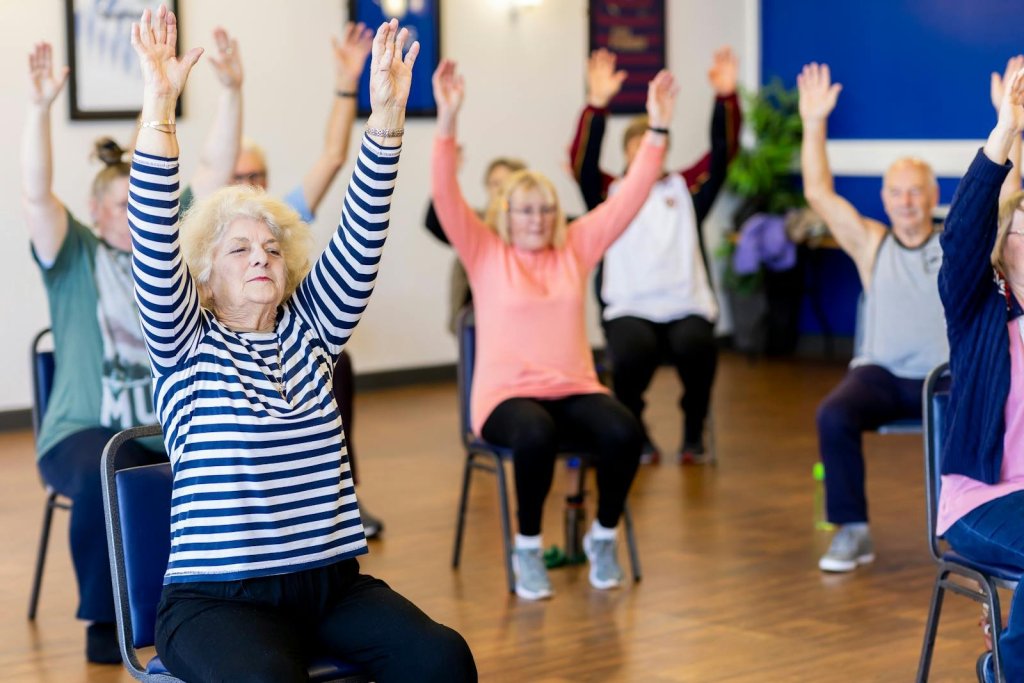
It’s also important to know that “belly fat loss” can’t be targeted to one exact area. Core exercises strengthen the midsection, but body fat reduction happens system-wide. A clear explanation of the spot-reduction myth is outlined by the University of Sydney.
What Are Chair Exercises for Seniors to Lose Belly Fat?
Chair exercises for seniors to lose belly fat are low-impact, seated movements designed to increase total body activity while protecting joints and balance. These exercises combine gentle cardio-style movements with light strength training to help seniors stay active at home.
It’s important to understand that no exercise directly “burns belly fat” from one specific area. Fat loss happens throughout the body when overall activity increases and calorie balance improves. Chair exercises support this process by:
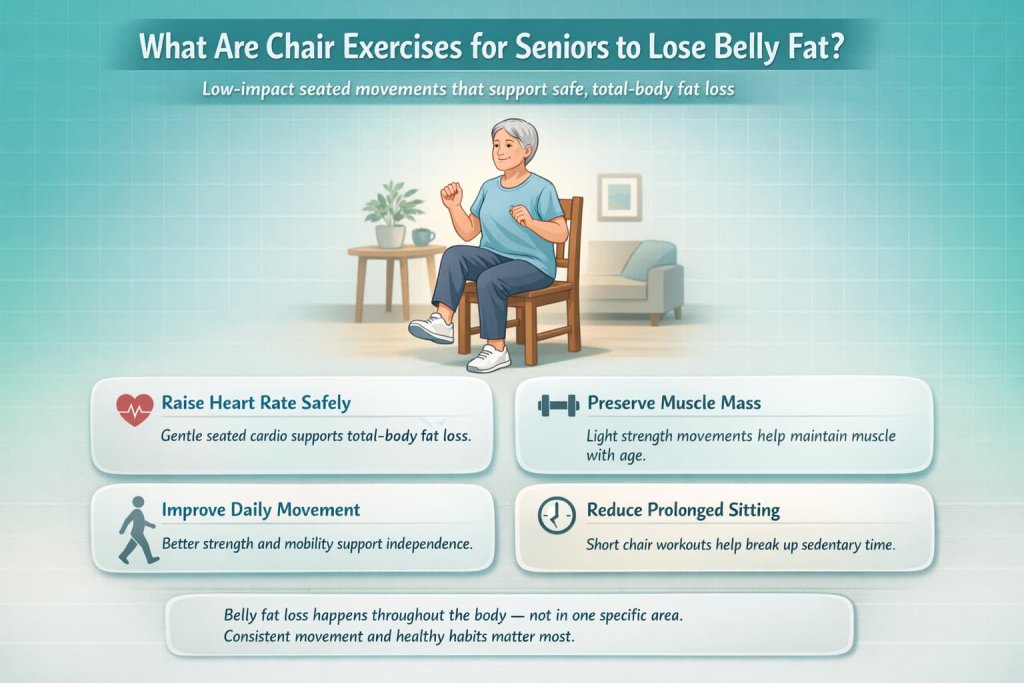
- Raising heart rate safely
- Preserving muscle mass
- Improving daily movement capacity
- Reducing prolonged sitting time
Because they are performed in a stable seated position, chair workouts are especially helpful for seniors who may have knee discomfort, balance concerns, or limited mobility.
Can Seniors Really Lose Belly Fat With Chair Exercises?
Yes — seniors can reduce overall body fat, including belly fat, by consistently performing chair exercises as part of a broader activity routine.
However, it’s important to set realistic expectations. Research consistently shows that “spot reduction” is not possible. Strengthening the abdominal muscles improves tone and posture, but fat loss occurs system-wide when total energy expenditure increases.
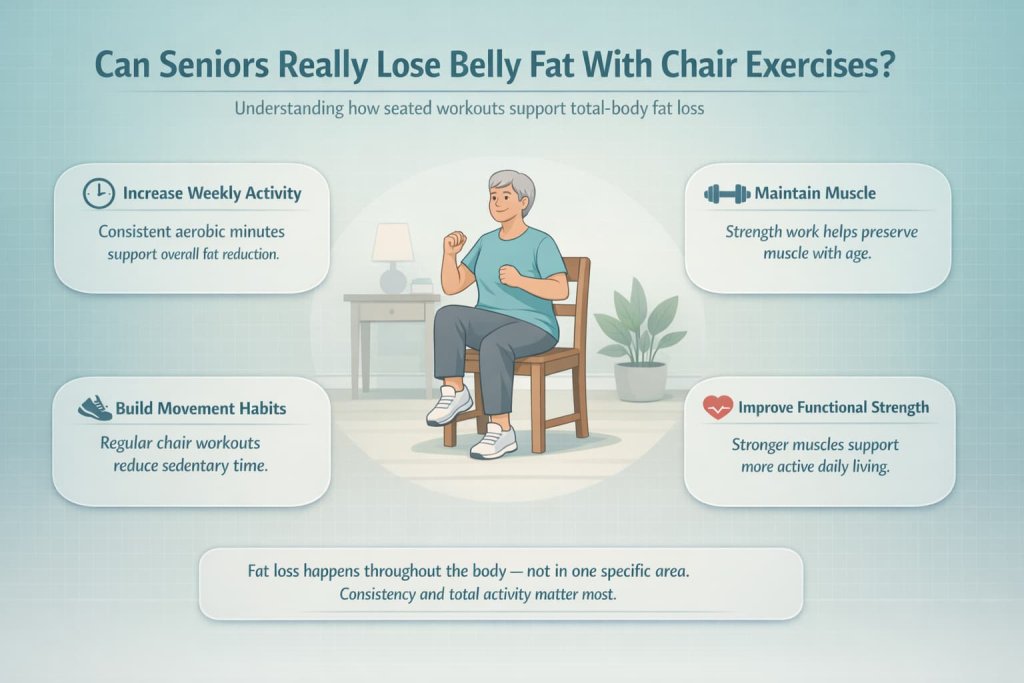
Chair workouts contribute to fat reduction by:
- Increasing weekly aerobic minutes
- Supporting muscle retention (which helps metabolic health)
- Encouraging consistent movement habits
- Improving functional strength for more active daily living
When combined with balanced nutrition, adequate sleep, and regular activity, chair exercises can be an effective and sustainable strategy for seniors.
8 Best Chair Exercises for Seniors to Lose Belly Fat Safely at Home
Keep breathing steady, move slowly, and stop if symptoms worsen.
1) Seated March With Arm Drive
Why it works:
This gentle cardio movement increases heart rate without placing stress on the joints. It also improves coordination between the upper and lower body. Over time, consistent seated marching helps accumulate weekly aerobic activity, which supports overall fat loss and cardiovascular health.
Muscles worked:
Hip flexors, quadriceps, glutes, core stabilizers, shoulders, and upper back muscles.
How to do it:
- Sit tall on the front half of a sturdy chair with feet flat on the floor
- Keep your chest lifted and shoulders relaxed
- Gently brace your core as if preparing for a light cough
- Lift one knee toward your chest
- Lower it slowly and switch sides
- Add a natural arm swing or pump your arms for more intensity
- Continue for 30–60 seconds, then rest
Trainer Tip:
Maintain an upright posture and steady breathing. You should be able to talk in short sentences. If you feel breathless, slow the pace.
2) Seated Knee Extensions
Why it works:
This strength-building exercise targets the front of the thighs, which are essential for walking, standing, and climbing stairs. Maintaining leg strength supports independence and helps preserve muscle mass as you age.
Muscles worked:
Quadriceps, hip stabilizers, and lower leg muscles.
How to do it:
- Sit tall with your back straight and feet flat
- Keep knees bent at 90 degrees
- Slowly straighten one leg until it is comfortably extended
- Hold briefly at the top
- Lower the leg slowly with control
- Alternate sides for 8–12 repetitions each
Trainer Tip:
Avoid snapping or locking the knee. Focus on slow, controlled movement both up and down.
3) Seated Leg Lift With Core Hold
Why it works:
This movement combines lower-body activation with gentle core engagement. Lifting one leg at a time increases heart rate slightly while strengthening hip muscles and improving seated balance control.
Muscles worked:
Hip flexors, lower abdominals, quadriceps, and deep core stabilizers.
How to do it:
- Sit tall on the front half of the chair with both feet flat
- Gently brace your core
- Slowly lift one foot a few inches off the floor
- Hold for 2–3 seconds while maintaining posture
- Lower with control
- Alternate sides for 8–12 repetitions each
Trainer Tip:
Avoid leaning backward when lifting your leg. If balance feels difficult, lift the foot only slightly off the floor and focus on posture first.
4) Seated Torso Rotations
Why it works:
Rotational strength supports daily activities such as reaching, turning, and getting in and out of a car. This movement improves trunk mobility while strengthening the core safely in a seated position.
Muscles worked:
Obliques, transverse abdominis, multifidus, and spinal stabilizers.
How to do it:
- Sit tall with feet flat and spine neutral
- Cross arms over your chest or clasp hands in front
- Gently rotate your upper body to one side
- Pause briefly
- Return to center
- Rotate to the opposite side
- Perform 8–12 slow repetitions per side
Trainer Tip:
Rotate through the ribcage, not just the shoulders. Keep movements smooth and within a comfortable range.
5) Seated Side Bends
Why it works:
Side bending strengthens the muscles that stabilize the spine laterally. Strong lateral core muscles help improve posture and support daily movements like reaching or bending.
Muscles worked:
Obliques, quadratus lumborum, and deep trunk stabilizers.
How to do it:
- Sit tall with both feet planted
- Keep your shoulders relaxed
- Slowly slide one hand down the side of your thigh
- Lean gently to the side without lifting your hips
- Return to upright
- Repeat on the other side
- Perform 8–10 repetitions per side
Trainer Tip:
Keep both sit bones evenly grounded on the chair to avoid twisting.
6) Seated Punches
Why it works:
This rhythmic upper-body movement elevates heart rate while strengthening the shoulders and upper body. It is an effective way to add low-impact cardio without stressing knees or hips.
Muscles worked:
Deltoids, chest, triceps, upper back, and core stabilizers.
How to do it:
- Sit tall with hands near chest height
- Engage your core gently
- Extend one arm forward in a controlled punch
- Retract the arm and alternate sides
- Keep elbows soft and shoulders relaxed
- Continue for 30–45 seconds
Trainer Tip:
Avoid shrugging your shoulders. If comfortable, add a slight controlled torso rotation.
7) Sit-to-Stand
Why it works:
This functional strength movement mimics everyday tasks such as getting out of a chair or car. It builds lower-body strength and improves balance, both essential for maintaining independence.
Muscles worked:
Glutes, quadriceps, hamstrings, calves, and core muscles.
How to do it:
- Sit toward the front edge of the chair
- Place feet hip-width apart under your knees
- Lean slightly forward from the hips
- Press through your heels to stand up
- Pause briefly in standing
- Slowly lower back down with control
- Perform 6–10 repetitions
Trainer Tip:
If needed, use your hands lightly on the chair arms. For easier variation, use a higher chair or cushion.
8) Seated Pelvic Tilts and Brace
Why it works:
This exercise teaches core engagement and spinal awareness. Learning to control pelvic positioning supports safer movement and helps activate deep abdominal muscles.
Muscles worked:
Transverse abdominis, pelvic floor muscles, lower abdominal wall, and spinal stabilizers.
How to do it:
- Sit tall with hands resting on hips
- Gently tilt pelvis forward to create a small arch
- Slowly tilt pelvis backward to tuck slightly
- Find a neutral middle position
- Engage your core gently without holding your breath
- Hold for 5–10 seconds
- Repeat 5–8 times
Trainer Tip:
Breathe normally during the hold. If you feel tension in your neck or shoulders, reduce effort.
How Often Should Seniors Do Chair Exercises?
For general health and fat-loss support, seniors should aim to meet established physical activity guidelines.
A practical and safe target includes:
- At least 150 minutes per week of moderate-intensity activity
- Strength-focused exercises at least 2 days per week
- Light balance or mobility work most days
Chair workouts can be performed:
- 20–30 minutes per session, 3–5 days per week
- Or in shorter 5–10 minute sessions spread throughout the day
Consistency matters more than intensity. Starting slowly and gradually increasing duration or repetitions helps reduce injury risk and improves long-term success.
If a senior has medical conditions, recent surgery, or new symptoms such as chest pain, dizziness, or severe joint discomfort, medical clearance should be obtained before beginning a new exercise routine.
Chair exercises for seniors to lose belly fat: what actually works
Belly fat reduction is most strongly supported by:
- Meeting weekly activity targets (aerobic plus strength)
- Reducing long sitting time by adding short activity “snacks”
- Building muscle to support metabolism and daily function
For adults 65+, the CDC recommends at least 150 minutes per week of moderate-intensity aerobic activity, muscle-strengthening activities on two or more days per week, plus balance-focused work.
Quick safety checklist before you start
Use a sturdy chair (no wheels), wear supportive shoes, and stay in a pain-free range.
Modify or pause and seek medical guidance first if you have:
- New or worsening chest pain, severe shortness of breath, fainting, or dizziness
- A recent fall with injury, new severe back pain, or sudden weakness or numbness
- Recent surgery without clearance, or uncontrolled blood pressure or blood sugar
If balance is a concern, place the chair near a wall or countertop for extra support.
Who should modify or avoid these chair exercises?
You can usually do chair workouts with modifications, but you may need a clinician’s input if you have:
- Severe osteoporosis, recent fracture, or significant joint instability
- Advanced heart or lung conditions or symptoms that change with mild exertion
- Significant vertigo, frequent falls, or severe neuropathy
When in doubt, start with smaller ranges of motion and slower pacing.
Simple 10-Minute Chair Routine
Do this 3–5 days per week:
- Seated march: 45 seconds
- Toe taps + heel digs: 45 seconds
- Seated punches: 45 seconds
- Rest: 30–45 seconds
- Sit-to-stand: 8 reps
- Knee extensions: 10 reps each side
- Torso rotations: 10 reps each side
- Side bends: 8 reps each side
- Pelvic tilt + brace: 6 reps
To align with national guidance, build toward the weekly targets outlined by the U.S. Department of Health and Human Services and the American Heart Association.
Nutrition basics that support belly fat loss
Chair workouts work best when paired with steady, sustainable eating habits. Practical lifestyle strategies for reducing visceral fat are explained by the Cleveland Clinic.
Focus on:
- Balanced meals with protein and fiber
- Minimizing added sugars and liquid calories
- Getting adequate sleep
- Managing stress consistently
Common mistakes to avoid
- Moving too fast and losing form
- Holding your breath
- Using an unstable chair
- Pushing into sharp pain
- Doing only core exercises without full-body movement
FAQs
Can seniors really lose belly fat with chair exercises?
Yes. Chair exercises support overall fat loss when combined with consistent weekly activity and supportive nutrition habits.
How long before results appear?
Many people notice improved stamina within a few weeks. Visible fat changes typically take longer and depend on consistency.
Do I need equipment?
No. Bodyweight is enough to start.
Are chair ab exercises enough?
Core strength helps, but total-body activity and weekly movement goals matter most.
What if I have knee pain?
Prioritize upper-body cardio-style moves and reduce range on leg exercises.
Is walking better?
Walking is excellent if comfortable. Chair workouts are a safe alternative or supplement.
Conclusion
Chair exercises for seniors to lose belly fat are a practical, low-impact way to increase weekly activity, strengthen muscles, and support gradual fat reduction. Start with short sessions, stay consistent, and progress slowly as your strength and confidence improve.
References
- Office of Disease Prevention and Health Promotion — Current guidelines overview and practical recommendations
- American Heart Association — Weekly aerobic and strength activity recommendations
- American Heart Association — Strength training guidance and safety basics
- JAMA Network Open — Evidence on aerobic exercise and changes in waist circumference/body weight