
Frog pumps are a glute-bridge variation that can help you feel stronger, more targeted glute contraction by changing your hip and knee position (soles together, knees out). Frog pumps are popular because they’re simple, equipment-free, and easy to use as a warm-up or high-rep finisher for glute-focused training.
Done correctly, they emphasize controlled hip extension (lifting your hips with your glutes) while keeping your core braced to avoid dumping into your lower back—key form principles also used in standard glute bridge technique guidance from the American Council on Exercise (ACE).
What Are Frog Pumps
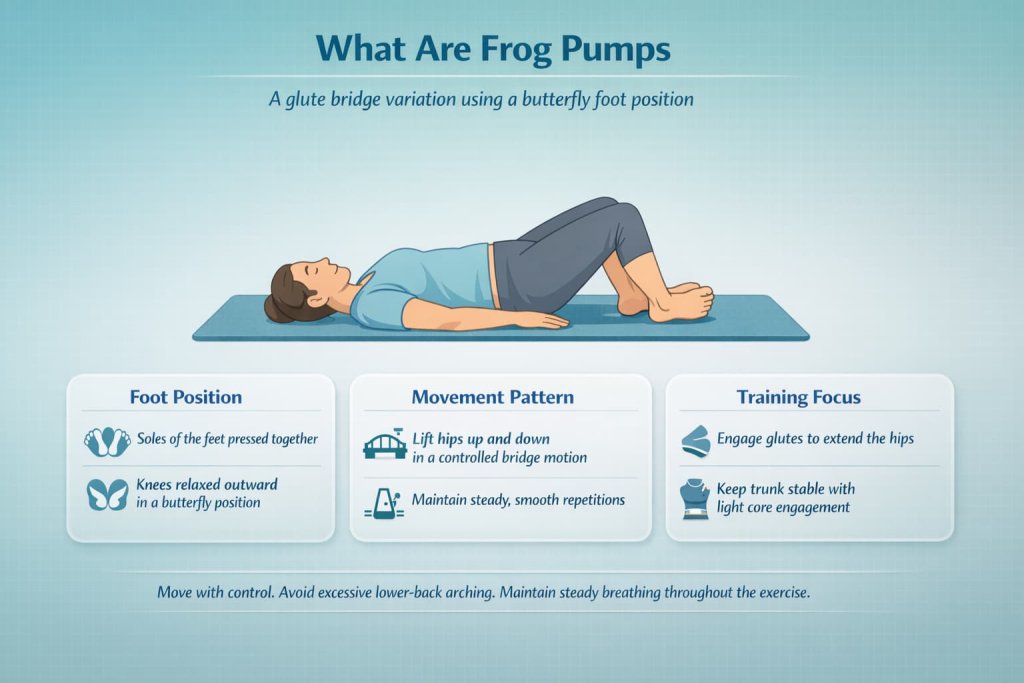
Frog pumps are performed lying on your back with:
- Soles of your feet pressed together
- Knees dropped outward (butterfly position)
- Hips lifting up and down in a bridge-like motion
Even though the setup looks different, the goal is the same as a glute bridge: extend your hips by squeezing your glutes and keeping your trunk stable.
How to Do Frog Pumps Correctly
Set up
- Lie on your back with knees bent
- Bring the soles of your feet together and let your knees fall out comfortably
- Keep your arms on the floor for support
- Gently brace your core (think “ribs down”) so your lower back stays controlled
Perform the rep
- Exhale and squeeze your glutes to lift your hips
- Lift until your torso forms a smooth line (avoid over-arching your low back)
- Pause briefly at the top while keeping tension in your glutes
- Lower slowly and repeat with control
Benefits of Frog Pumps for Lower-Body Training
Frog pumps are simple, accessible, and effective when used correctly in a lower-body routine. They are most often used to increase controlled glute tension without heavy loading.
Key benefits include:
- May improve glute activation awareness due to the knees-out hip position
- Supports higher time-under-tension training with moderate to high reps
- Requires no equipment, making it ideal for home workouts
- Can be used as a warm-up before heavier lifts
- Works well as a high-rep finisher to increase training volume
Research available through PubMed Central (PMC) shows that bodyweight hip extension exercises can meaningfully activate the gluteus maximus, supporting their inclusion in glute-focused programs.
If frog pumps cause hip or low-back discomfort, reduce the range of motion or switch to a standard glute bridge and seek professional guidance if symptoms persist.
Why Frog Pumps Work for Glute Activation
Frog pumps combine two ideas that show up repeatedly in glute training research and coaching:
- Hip extension (the “bridge” pattern) is a reliable way to load the gluteus maximus in bodyweight training.
- Hip abduction and external rotation (knees out) are commonly associated with strong glute involvement in EMG research on glute-focused exercises.
A systematic review published on PubMed examining hip abduction and external rotation exercises reported meaningful gluteus maximus and gluteus medius activation across several movement patterns.
Another systematic review available through PubMed Central (PMC) discusses how bodyweight hip extension exercises—such as bridge variations—can produce notable gluteus maximus muscle excitation, supporting their role in glute-focused training.
Frog Pump Variations and Progressions
Beginner-friendly options
- Smaller range frog pumps (lift only a few inches with perfect control)
- Iso-hold frog pump (hold the top for 10–20 seconds)
Make it harder (without heavy weights)
- Banded frog pumps (loop a mini-band above the knees to increase tension)
- Tempo frog pumps (3 seconds down, 1 second up)
- High-rep burn set (25–40 reps with strict form)
Research examining bridging with added hip abduction resistance, available via PubMed Central (PMC), shows that abduction-focused resistance can influence muscle activity around the hips and trunk—supporting the use of banded progressions.
Muscles Worked in Frog Pumps
Frog pumps primarily involve:
- Gluteus maximus (main hip extensor)
- Gluteus medius and other hip stabilizers (supporting hip position with knees out)
- Hamstrings (assist hip extension)
- Core (helps control pelvic position and prevent low-back arching)
These findings align with EMG-based reviews of hip extension and hip abduction exercises published through PubMed Central (PMC).
Common Frog Pump Mistakes (And Quick Fixes)
Overarching the lower back at the top
Fix: Stop the lift when your ribs start flaring and keep a light core brace, as emphasized in bridge form guidance from the American Council on Exercise (ACE).
Bouncing through reps
Fix: Slow the lowering phase and add a 1-second squeeze at the top.
Feet too far from your hips
Fix: Scoot your feet slightly closer so you can lift without shifting pressure into your low back.
Knees forced too wide
Fix: Let your knees fall out naturally—comfort first. If your hips pinch, reduce range or swap to a standard glute bridge.
Sets, Reps, and How to Program Frog Pumps
Frog pumps are usually best as an accessory, primer, or finisher—because they’re typically lighter and more time-under-tension focused than heavy hip thrusts or loaded bridges.
Good starting points
- Warm-up glute activation: 2 sets of 12–20 reps, controlled tempo
- Hypertrophy accessory: 3–4 sets of 15–30 reps, 60–90 seconds rest
- Finisher: 1–2 sets of 30–50 reps (stop if form breaks)
Bridge-type hip extension patterns are commonly discussed in EMG literature available through PubMed Central (PMC) as effective bodyweight options for glute engagement.
Frog Pumps vs Glute Bridges: Which Is Better?
Glute bridges are often the better baseline exercise
- Easier to keep knees aligned
- Easier to load progressively (dumbbell, barbell, bands)
- Often more comfortable for people who dislike the knees-out position
These foundational form principles are emphasized in technique guidance from the American Council on Exercise (ACE).
Frog pumps may be better when your goal is “glute feel” and high-rep tension
- Quick setup
- Great for warm-ups and finishers
- Useful when you want a different hip angle without heavy loading
Many training plans use both: heavier bridge or thrust patterns first, then frog pumps for controlled high reps.
Safety Notes and Who Should Be Careful
Consider modifying or skipping frog pumps if you notice:
- Hip pinching or sharp hip/groin discomfort in the knees-out position
- Low-back pain that increases during the lift
- Symptoms that are persistent, worsening, or unclear
In those cases, a standard glute bridge setup may be a safer option while you rebuild control and comfort. Use a pain-free range and prioritize bracing, consistent with guidance from the American Council on Exercise (ACE).
Frequently Asked Questions About Frog Pumps
Are frog pumps good for glutes?
They can be, especially as a high-rep accessory or finisher. Bridge-style hip extension patterns and knees-out positioning are commonly discussed in EMG research accessible through PubMed Central (PMC) as effective strategies for glute involvement.
Where should I feel frog pumps?
Most people feel them mainly in the glutes, with some hamstring support. If you feel them mostly in your lower back, reduce range and re-brace your core, following the form cues outlined by the American Council on Exercise (ACE).
How many frog pumps should I do?
A common range is 15–30 reps per set for 2–4 sets. If using them as a finisher, higher reps can work as long as form stays controlled.
Can beginners do frog pumps?
Yes. Start with a smaller lift and slower tempo. If the knees-out position feels uncomfortable, begin with a standard glute bridge first, as described in guidance from the American Council on Exercise (ACE).
Do I need a band for frog pumps?
No. A band is optional and simply increases tension. It’s a progression, not a requirement.
Frog pumps vs hip thrusts: which builds more strength?
Hip thrusts are generally easier to load progressively and are commonly used for heavier strength development. Frog pumps are typically better suited as accessory volume, activation work, or a burn-focused finisher.
Conclusion
Frog pumps are a simple, glute-focused bridge variation that can fit into almost any lower-body program—especially as a warm-up, accessory, or high-rep finisher. Keep your reps controlled, brace your core, and stop the lift before your lower back takes over.
If you want, tell me your training level (beginner, intermediate, advanced) and whether you’re training at home or the gym—and I’ll help you structure frog pumps into a practical glute workout.
References
- Neto, W. K., Soares, E. G., Vieira, T. L., Aguiar, R. A., Oliveira, R., & Gama, E. F. (2020). Gluteus maximus activation during common strength and hypertrophy exercises: A systematic review. Journal of Sports Science & Medicine, 19, 195–203. PubMed Central (PMC)
- Kennedy, D., Casebolt, J. B., Farren, G. L., & Bartlett, M. (2023). Effects of band-resisted abduction on muscle activity between the barbell hip thrust and barbell glute bridge. International Journal of Strength and Conditioning, 3(1). International Journal of Strength and Conditioning
- Graber, K. A., Sell, T. C., & Lephart, S. M. (2021). Hip and trunk muscle activity and mechanics during bridging variations. Journal of Applied Biomechanics, 37(4), 351–360. Human Kinetics Journals