
IT band stretches for seniors can help reduce outer-thigh tightness and support smoother walking by gently improving flexibility in the hip and outer leg area. For many older adults, the safest and most effective approach is supported, low-impact stretching that avoids strain, improves comfort, and pairs well with basic hip-strength habits.
What is the IT band and why it can feel tight with age
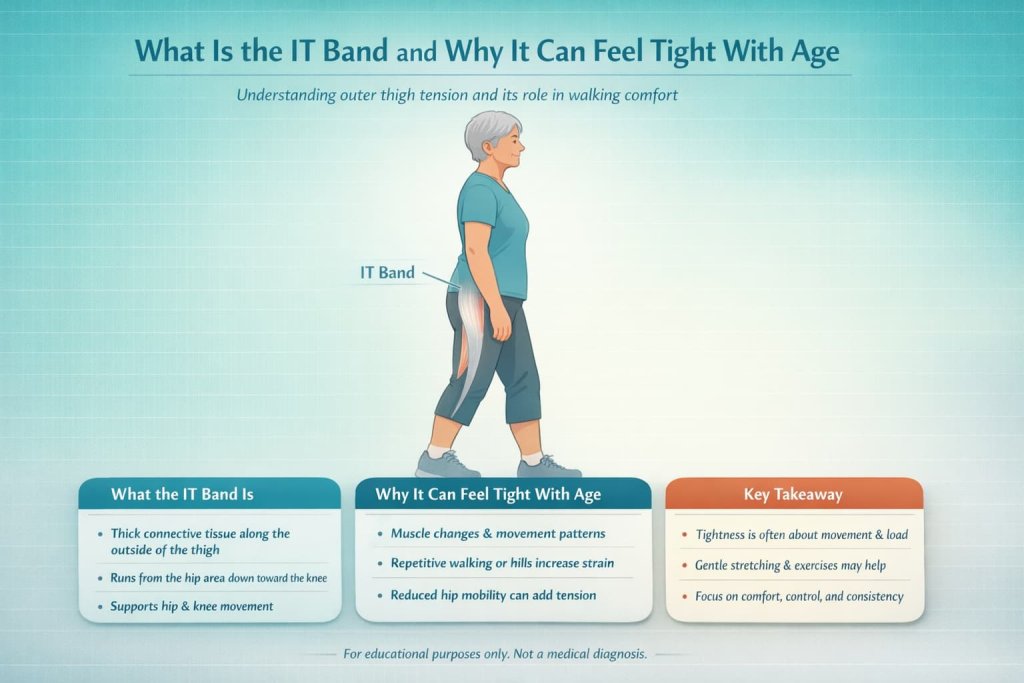
The iliotibial band (IT band) is a thick band of connective tissue that runs along the outside of your thigh from the hip area down toward the knee. When it becomes irritated or overly tense, it can contribute to discomfort along the outer knee, hip, or thigh—especially during repetitive activities like walking longer distances or navigating hills. Clinical explanations from the Cleveland Clinic note that IT band irritation is often related to friction and load management rather than a single structural problem.
What Are IT Band Stretches for Seniors?
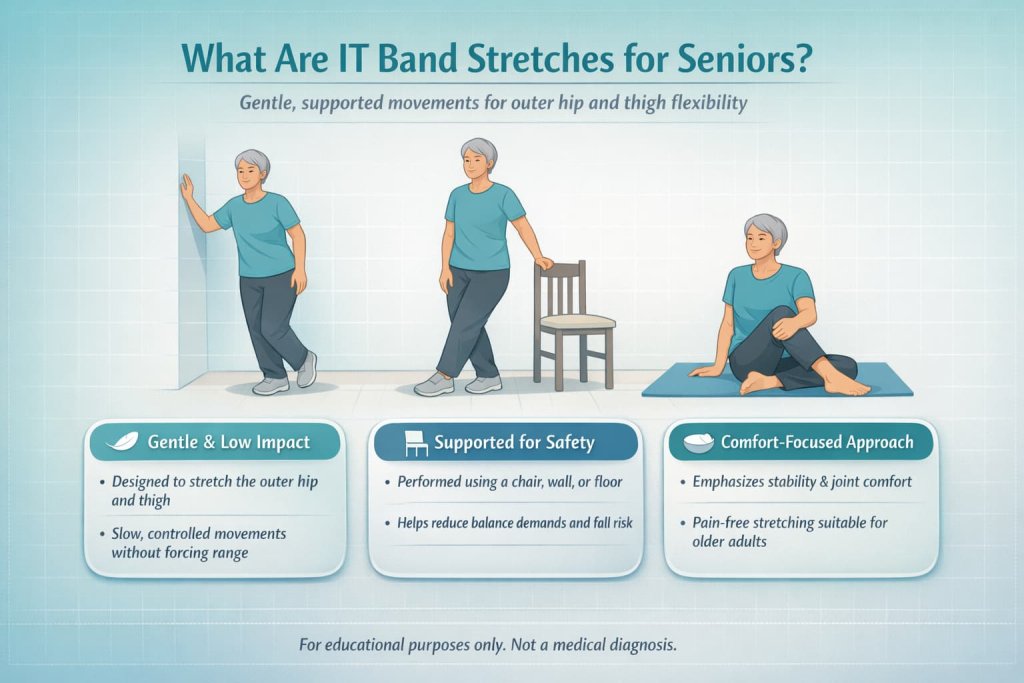
IT band stretches for seniors are gentle, low-impact movements that target the outer hip and thigh while prioritizing balance and joint comfort. They are designed to be slow, supported, and pain-free, making them suitable for older adults.
Key features include:
- Performed with chair, wall, or floor support
- Controlled range of motion without forcing flexibility
- Focus on comfort, stability, and safety
Why IT Band Stretches Matter for Senior Mobility and Walking Comfort
Outer-thigh and hip tightness can affect walking mechanics as we age. Gentle IT band stretches help support smoother movement and better walking comfort when practiced consistently.
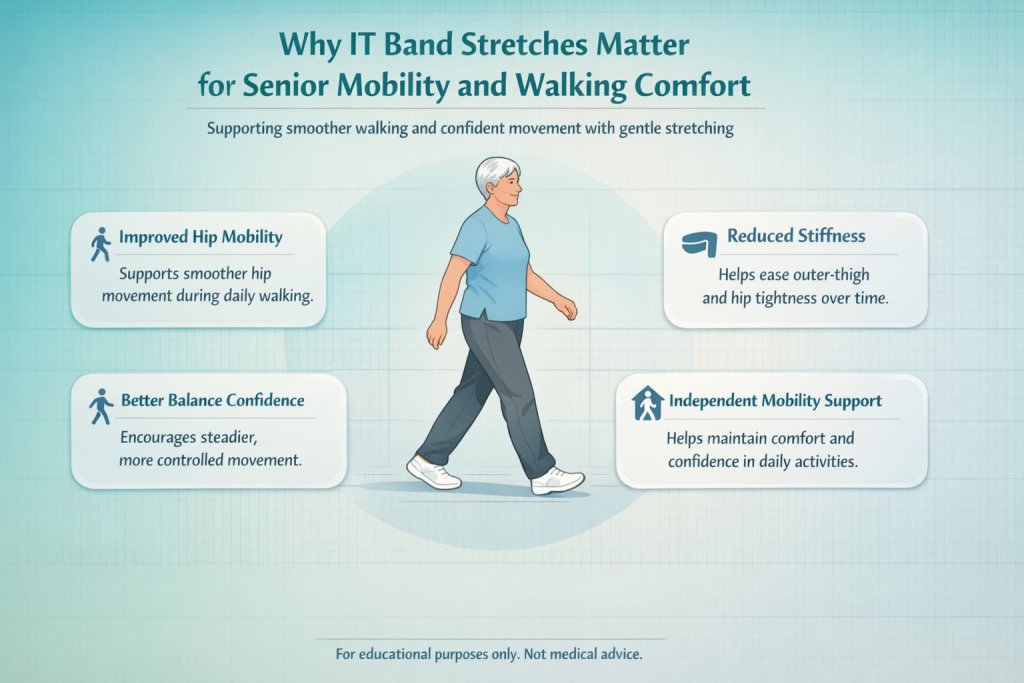
Potential benefits include:
- Improved hip mobility for daily walking
- Reduced stiffness around the outer thigh and hip
- Better balance confidence during movement
- Support for maintaining independent mobility
Quick safety checklist before you stretch
Stop and seek medical guidance before stretching if you experience:
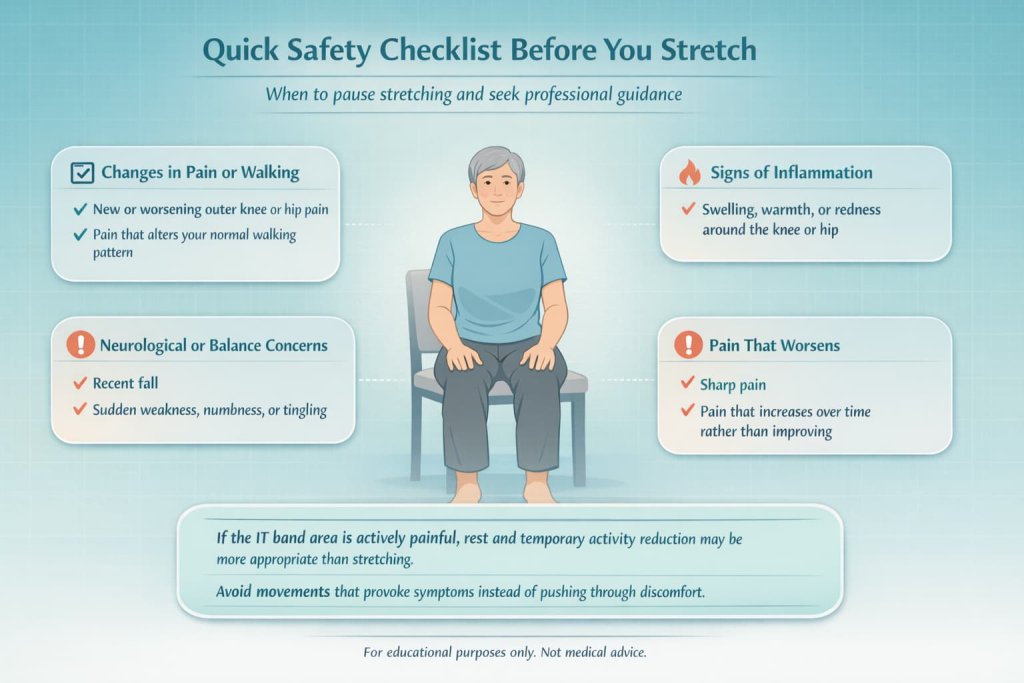
- New or worsening outer knee or hip pain that alters how you walk
- Swelling, warmth, or redness around the knee or hip
- A recent fall, sudden weakness, numbness, or tingling
- Sharp or progressively worsening pain
If the IT band area is actively painful, rest and temporary activity reduction may be the first step rather than stretching. Conservative care guidance commonly emphasizes avoiding movements that provoke symptoms instead of pushing through discomfort.
6 best IT band stretches for seniors
Use a sturdy chair, countertop, or wall for balance support. Move slowly and breathe normally throughout each stretch.
1) Wall-Supported Standing IT Band Stretch
Why it works:
This stretch gently lengthens the outer hip and lateral thigh while allowing you to remain upright and supported. The wall provides balance assistance, making it a safer option for seniors while still effectively addressing lateral hip tightness that can affect walking comfort.
Muscles worked:
Outer hip region, lateral thigh tissues, and supporting hip stabilizers.
How to do it:
- Stand sideways next to a wall and lightly place one hand on it for balance
- Cross the leg closest to the wall behind the other leg
- Slowly shift your hips toward the wall
- Lean your upper body slightly away from the wall until you feel a gentle stretch
- Hold the position, then switch sides
Trainer Tip:
If balance feels uncertain, reduce how much you cross the legs and keep your feet closer to parallel while focusing on the hip shift.
2) Chair-Supported Cross-Over Stretch
Why it works:
This variation targets the same outer-hip tissues as standing IT band stretches but offers additional stability. Using a chair helps reduce balance demands while still allowing controlled lateral hip stretching.
Muscles worked:
Outer hip and lateral thigh region.
How to do it:
- Stand behind a sturdy chair and hold the backrest with both hands
- Step one leg slightly behind and across the other
- Keep your chest lifted and spine tall
- Gently shift your weight forward
- Add a small side lean away from the back leg
- Hold, then switch sides
Trainer Tip:
If you feel knee discomfort, lessen the crossover and focus more on the sideways hip shift rather than the lean.
3) Supine Strap Stretch With Outer-Thigh Emphasis
Why it works:
This stretch removes balance challenges entirely and allows you to control the range of motion precisely. It is especially useful for seniors who feel unsteady standing or prefer floor-based stretching.
Muscles worked:
Outer hip region and lateral thigh tissues.
How to do it:
- Lie on your back with both knees bent
- Loop a strap, towel, or belt around one foot
- Slowly straighten that leg toward the ceiling as comfort allows
- Gently guide the raised leg a few inches across your body
- Hold the stretch, then switch sides
Trainer Tip:
Keep both hips heavy on the floor. If your lower back feels strained, slightly bend the raised knee to reduce tension.
4) Figure-4 Stretch
Why it works:
Tightness often associated with the IT band is frequently influenced by the glutes and deep hip rotators. This stretch improves mobility in those areas, which can reduce lateral thigh tension during walking.
Muscles worked:
Glutes and deep outer hip rotator muscles.
How to do it:
- Lie on your back or sit tall in a sturdy chair
- Cross one ankle over the opposite knee, forming a “4” shape
- If lying down, gently draw the supporting leg toward your chest
- If seated, hinge forward slightly from the hips
- Hold the stretch, then switch sides
Trainer Tip:
In seated versions, keep your spine long and hinge from the hips rather than rounding your back.
5) Side-Lying Ober-Style Stretch (Gentle Modification)
Why it works:
The traditional Ober stretch is commonly referenced for lateral thigh tightness, but this modified version reduces strain and improves comfort. It allows gravity-assisted stretching without forcing the leg downward.
Muscles worked:
Outer thigh and hip region.
How to do it:
- Lie on your side with the bottom knee bent for stability
- Keep the top leg straight and slightly behind your body
- Slowly allow the top leg to lower toward the floor
- Stop at a gentle stretch—do not force the movement
- Hold, then switch sides
Trainer Tip:
If this position causes hip or back discomfort, skip it and use the figure-4 stretch instead.
6) Supported Forward Fold Variation
Why it works:
This stretch helps release overall lower-body tension and can indirectly ease lateral thigh stiffness. The supported position allows safe hip hinging without placing stress on the lower back.
Muscles worked:
Posterior chain muscles with secondary involvement of lateral thigh tissues.
How to do it:
- Stand facing a countertop or sturdy chair
- Place your hands on the support surface
- Hinge forward at the hips while keeping your spine long
- Keep your knees slightly bent
- Hold the position while breathing comfortably
Trainer Tip:
Avoid hanging or collapsing into the stretch. Think of controlled movement and steady breathing instead.
How long should seniors hold an IT band stretch
A simple, senior-friendly guideline:
- Hold each stretch for about 30 seconds
- Repeat 2–4 times per side
- Stay in a gentle pull, not pain
General flexibility guidance from the Mayo Clinic supports holding stretches for roughly 30 seconds and repeating them a few times without bouncing.
Common mistakes to avoid with IT band stretches for seniors
- Stretching into sharp or worsening pain
- Skipping balance support when needed
- Twisting the knee during cross-over positions
- Holding your breath
- Focusing only on stretching while ignoring hip strength and walking habits
When to stop or seek professional guidance
Consider consulting a clinician or physical therapist if:
- Pain lasts longer than one to two weeks
- Symptoms worsen or cause limping
- You notice swelling, warmth, or instability
- Recent changes in walking volume, terrain, or footwear triggered symptoms
Orthopedic guidance, including information from the American Academy of Orthopaedic Surgeons, often emphasizes combining stretching with targeted hip and knee strengthening for better long-term outcomes.
Simple weekly routine for seniors
A practical structure to follow:
- 3–5 days per week
- Choose 2–4 stretches from the list
- Hold each stretch for 30 seconds
- Repeat 2–4 times per side
- Stretch after walking or light activity when muscles feel warm
General flexibility advice from the Mayo Clinic supports slow, controlled stretching rather than bouncing or forcing range.
Who Should Be Careful With IT Band Stretches
Some seniors may need extra caution or professional guidance before stretching the IT band.
Be cautious if you have:
- Recent falls or balance difficulties
- Worsening hip or knee pain
- Recent joint replacement or surgery
- Swelling, warmth, or sharp pain during movement
If stretching causes discomfort beyond mild tension, stop and seek guidance before continuing.
FAQs
What is the best IT band stretch for seniors with poor balance?
Wall-supported standing stretches and supine strap stretches are usually the safest because they reduce fall risk.
Can IT band tightness cause knee pain when walking?
It can contribute to outer knee discomfort in some individuals, especially during repetitive walking or downhill movement.
How often should seniors stretch the IT band?
Many older adults do well stretching three to five days per week using gentle, pain-free holds.
Should seniors foam roll the IT band?
Foam rolling may help some people, but pressure should be light and discontinued if it increases pain or bruising risk.
What if stretching doesn’t help?
Persistent or worsening symptoms may require professional guidance, and many programs also include hip and knee strengthening.
Is it okay to stretch the IT band every day?
Yes, as long as stretching remains gentle and does not increase soreness or pain.
Conclusion
IT band stretches for seniors are most effective when they are gentle, supported, and consistent. Prioritize balance-friendly positions, hold stretches comfortably, and avoid forcing range of motion. If symptoms persist or interfere with walking, a physical therapist can help tailor a safe, individualized plan.
This content is for informational purposes only and not medical advice.
References
- American Academy of Orthopaedic Surgeons (AAOS) OrthoInfo: Iliotibial Band (IT Band) Syndrome
- AAOS OrthoInfo: Hip Conditioning Program (Standing Iliotibial Band Stretch)
- MedlinePlus: Iliotibial Band Syndrome Aftercare
- NCBI Bookshelf (StatPearls): Iliotibial Band Friction Syndrome
- CDC: Physical Activity Guidelines for Older Adults