
Most healthy seniors do best starting with the standard adult water targets: about 3.7 liters a day for men and 2.7 liters a day for women, with some of that coming from food, not just drinks. A good daily water intake chart for seniors should also explain when older adults need more fluids, when they may need less, and when a doctor’s advice matters most. Health Canada dietary reference tables use these same adequate intake targets for adults ages 51–70 and over 70.
Daily water intake chart for seniors
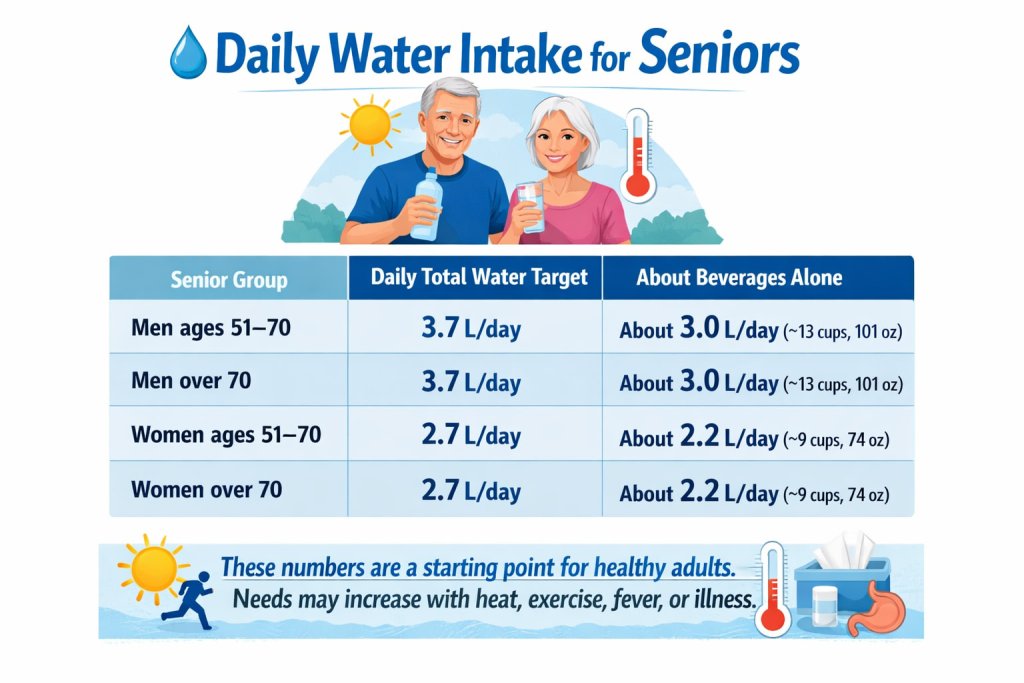
The most useful chart for older adults is based on total daily water, which includes plain water, other beverages, and moisture from food. Official dietary reference tables keep the same total-water target for adults ages 51–70 and over 70: 3.7 liters for men and 2.7 liters for women. The National Academies also notes that, on average, about 81% of total water comes from beverages and about 19% comes from food. The National Academies report on water intake explains this clearly.
| Senior group | Daily total water target | About beverages alone |
|---|---|---|
| Men ages 51–70 | 3.7 L/day | about 3.0 L/day (about 13 cups, 101 oz) |
| Men over 70 | 3.7 L/day | about 3.0 L/day (about 13 cups, 101 oz) |
| Women ages 51–70 | 2.7 L/day | about 2.2 L/day (about 9 cups, 74 oz) |
| Women over 70 | 2.7 L/day | about 2.2 L/day (about 9 cups, 74 oz) |
These numbers are best used as a starting point, not a rigid rule for every person. They were set for generally healthy people, and actual needs can rise with heat, exercise, fever, vomiting, or diarrhea.
What this senior water chart really means
A common mistake is assuming every older adult should force down the same number of glasses every day. That is not how hydration works. The water chart helps with planning, but your real needs can shift based on your body size, activity level, climate, health conditions, and medications. The National Academies specifically notes that there is no single daily water requirement that fits every person.
That said, older adults are more likely to run into dehydration problems because aging can make heat harder to tolerate, chronic illness is more common, and some medicines change thirst, sweating, or fluid balance. CDC guidance for older adults and heat warns that adults age 65 and older are more prone to heat-related health problems and may not adjust as well to sudden temperature changes.
Why seniors are at higher risk of dehydration
Older adults often feel thirst later than they used to, which means they may not drink soon enough on hot days or when they are sick. The CDC advises older adults to drink more water than usual during hot weather and not wait until they feel thirsty.
There is also real-world evidence that many older adults drink less than the benchmark amounts. In a CDC National Center for Health Statistics data brief, men age 60 and older averaged 2.92 liters of total water a day and women age 60 and older averaged 2.51 liters, both lower than the standard adequate-intake targets.
When seniors need more water
Hot weather
Hot weather raises fluid needs. The CDC says people 65 and older should stay hydrated in the heat, drink more water than usual, and check with a clinician if they normally follow a fluid restriction or take water pills.
Physical activity
Even moderate activity can increase water needs, especially outdoors or in warm conditions. The National Academies notes that higher intakes are needed when people are physically active or exposed to hot environments.
Fever, vomiting, or diarrhea
Illness can cause fluid loss quickly. CDC water and healthy drinks guidance says dehydration risk rises with fever, diarrhea, and vomiting, and MedlinePlus dehydration guidance notes these problems can lead to low urine output, dark urine, dizziness, confusion, and other signs of dehydration.
When plain water may not be enough
If an older adult has vomiting or diarrhea, plain water alone may not be the best replacement fluid because it does not replace lost electrolytes. CDC guidance says oral rehydration fluids sold over the counter are usually more helpful for mild dehydration than sports drinks when fluid loss is ongoing. Get medical help promptly if the person cannot keep fluids down, has very little urine, feels faint, or becomes confused.
When seniors may need less water or a customized limit
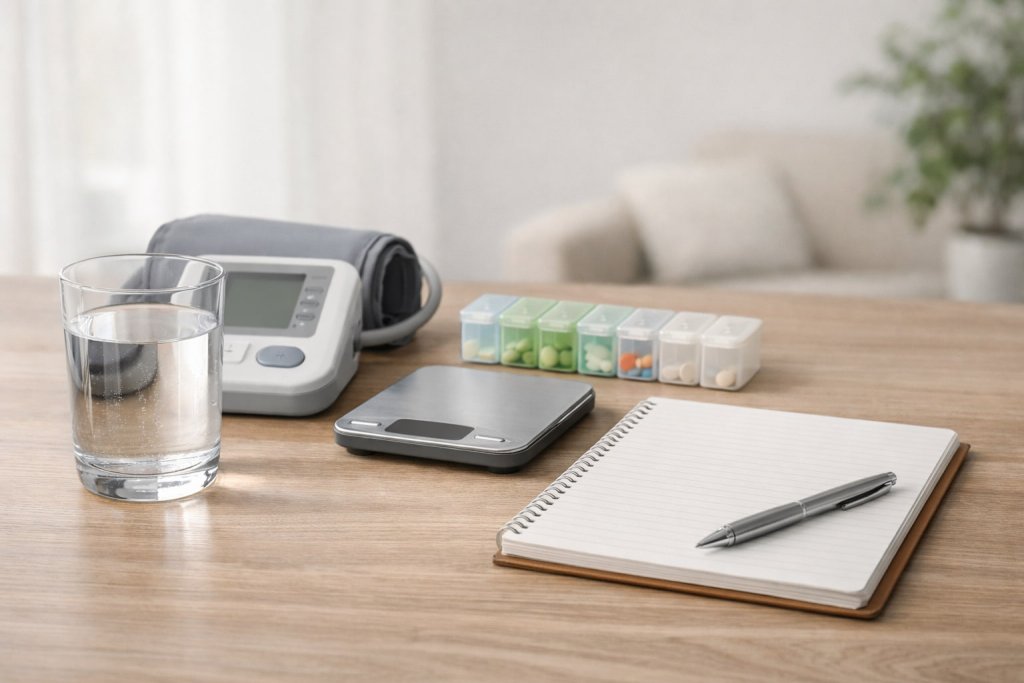
This is one of the most important safety points in any daily water intake chart for seniors: some older adults should not simply push fluids to hit a generic target. The National Institute on Aging says some people need less water because of conditions such as kidney failure or heart disease and should ask a health care provider what amount is healthy for them.
NIDDK guidance for chronic kidney disease explains that some people with CKD may need to limit liquids because damaged kidneys may not remove extra fluid well. The American Heart Association’s heart failure lifestyle guidance also notes that people with heart failure may be told to limit liquid intake.
Watch for signs of too much fluid
For seniors with heart failure, advanced kidney disease, or a prescribed fluid limit, too much fluid can also be a problem. Contact a clinician if swelling in the feet, ankles, legs, hands, or face gets worse, breathing becomes harder, or weight rises suddenly over a day or a week. These can be signs that the body is retaining fluid instead of clearing it normally.
Medications that can change hydration needs
Many older adults take medicines that affect hydration. CDC clinician guidance on heat and medications explains that certain drugs can reduce thirst, increase sweating, impair sweating, deplete fluid volume, or upset electrolyte balance. Examples include diuretics, some blood pressure medicines, some antidepressants, anticholinergic drugs, laxatives, and certain psychiatric medications.
This does not mean you should stop a medicine on your own. It means hydration plans should be more individualized if an older adult is on these medicines, especially in summer, during exercise, or when sick.
A practical way to use the chart each day
A senior water chart works best when you spread fluids across the day instead of trying to “catch up” late at night. A simple routine can look like this:
- Drink a glass of water with breakfast, lunch, and dinner.
- Add fluids between meals.
- Include water-rich foods as part of meals.
- Increase fluids during hot weather or activity unless a clinician has told you to limit them.
- Avoid long stretches of the day with nothing to drink.
For many older adults, this feels easier and more realistic than counting every sip. The National Institute on Aging offers a practical checkpoint: in general, drink enough fluids so that you need to urinate every few hours.
If bathroom trips make you drink less
Some older adults cut back on fluids because they worry about urgency, leakage, or waking up at night. That can raise dehydration risk. A better approach is to drink enough earlier in the day, choose water more often, and cut back on caffeine or alcohol if they make bladder symptoms worse. If nighttime bathroom trips are the main problem, limiting drinks close to bedtime may help without reducing fluids too much overall. National Institute on Aging guidance on urinary incontinence in older adults supports these practical steps.
Signs a senior may not be drinking enough
A good hydration plan should always include warning signs. MedlinePlus lists common symptoms such as:
- thirst
- dry mouth
- urinating less
- dark yellow or amber urine
- dizziness or lightheadedness
- tiredness
- confusion
- rapid heartbeat
In hot weather, the CDC also advises checking urine color. Light yellow or clear usually suggests better hydration, while darker urine can be a sign you need more fluids.
When dehydration is an emergency
Seek urgent medical care if dehydration is severe or if an older adult has confusion, fainting, very little or no urination, rapid breathing, rapid heartbeat, shock, or loss of consciousness. These are not “wait and see” symptoms. MedlinePlus Medical Encyclopedia describes these as serious warning signs.
Who this advice is for and who should be careful
This chart is most useful for:
- healthy older adults living at home
- seniors trying to build a better daily hydration routine
- family caregivers who want a practical starting point
Extra caution is needed for older adults with:
- chronic kidney disease
- heart failure
- a clinician-prescribed fluid restriction
- frequent diarrhea or vomiting
- heat exposure
- multiple medications that affect fluid balance
- memory problems that make drinking regularly harder
FAQ: Daily water intake chart for seniors
How much water should an 80-year-old drink per day?
For a generally healthy 80-year-old, the standard chart is still about 3.7 liters of total water a day for men and 2.7 liters for women, with some of that coming from food. But the right amount may be lower or higher depending on heat, activity, illness, and medical conditions.
Does food count toward a senior’s daily water intake?
Yes. Total water includes drinking water, other beverages, and water in food. National Academies data indicates food accounted for about 19% of total water intake in the U.S. survey used to set the benchmark.
Is the old “8 glasses a day” rule enough for seniors?
Sometimes, but not always. It may be too little for some older men and can also miss the fact that needs rise in heat, activity, or illness. A senior water chart based on sex, health status, and environment is more useful than one fixed glasses-per-day rule.
Should seniors drink more water in summer?
Usually yes, unless they have been told to limit fluids. The CDC says older adults should drink more water than usual during hot weather and should not wait until they feel thirsty.
What if a senior has kidney disease or heart failure?
They should ask their clinician for an individualized fluid target. People with CKD or heart failure may need a fluid limit instead of a higher intake goal.
Safety box
Use a personalized hydration plan instead of a generic chart if an older adult has kidney disease, heart failure, severe swelling, low sodium problems, frequent vomiting or diarrhea, or a clinician-prescribed fluid restriction. Get urgent medical care for confusion, fainting, no urination, or other signs of severe dehydration.
Conclusion
A reliable daily water intake chart for seniors starts with the standard adult targets, then adjusts for real life. For most healthy older adults, that means aiming around 3.7 liters a day for men or 2.7 liters a day for women, remembering that food counts too. The safest approach is simple: drink regularly through the day, increase fluids when heat or illness raises your needs, and get personalized advice if you have kidney disease, heart failure, or take medicines that affect hydration.
If you are building this into a care routine, make the chart visible, keep water easy to reach, and review any fluid limits with a clinician before making big changes.
Sources/References
- National Academies — Dietary Reference Intakes for Water
- Health Canada — Dietary reference intakes tables: Reference values for macronutrients
- CDC — About Water and Healthier Drinks
- CDC — Heat and Older Adults (Aged 65+)
- CDC — Heat and Medications – Guidance for Clinicians
- CDC National Center for Health Statistics — Daily Water Intake Among US Men and Women, 2009–2012
- National Institute on Aging — 15 Tips To Keep Your Bladder Healthy
- National Institute on Aging — Urinary Incontinence in Older Adults
- NIDDK — Healthy Eating for Adults with Chronic Kidney Disease
- American Heart Association — Lifestyle Changes for Heart Failure
- MedlinePlus — Dehydration
- MedlinePlus Medical Encyclopedia — Dehydration
This content is for informational purposes only and not medical advice.