
The best exercises for seniors over 80 are simple, supported moves that build leg strength, balance, and walking endurance without stressing the joints. If you focus on strength, balance, and light cardio a few days per week, you can support safer mobility, easier daily tasks, and more confidence while moving around.

For a safe baseline, CDC guidance for older adults recommends weekly aerobic activity, muscle-strengthening at least 2 days per week, and regular balance work, which is a practical structure for adults over 80 when you start gently and progress slowly.
What You Need to Do These Exercises at Home
You only need a safe, stable setup—no gym required.
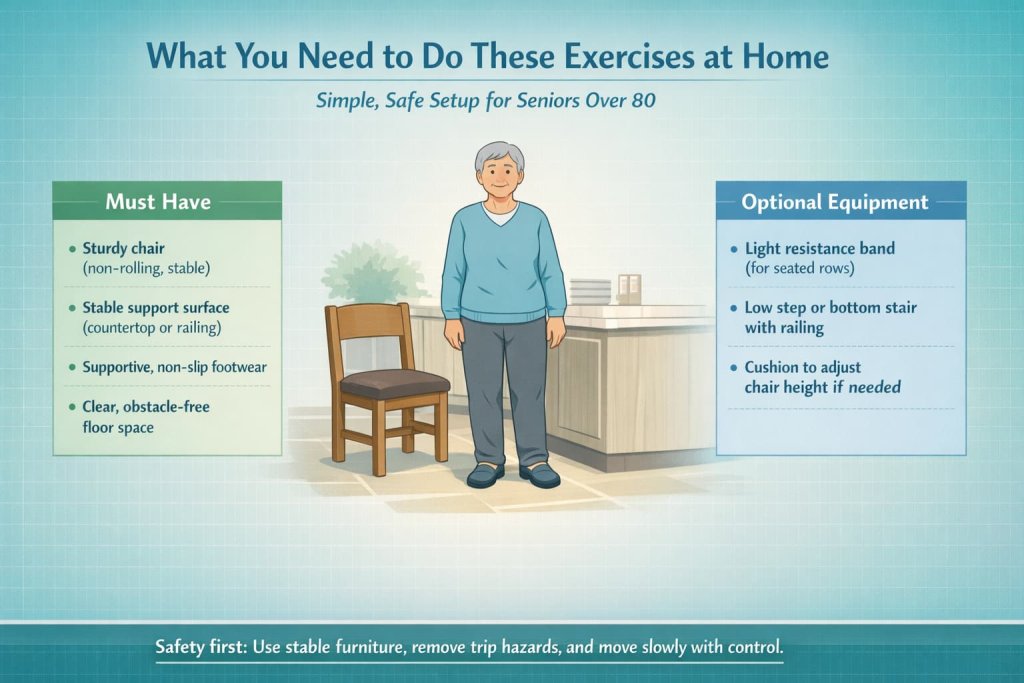
- Sturdy chair: Non-rolling, won’t slide
- Stable support: Countertop, heavy table, or railing for balance drills
- Good grip footwear: Supportive, non-slip shoes (or bare feet if safer indoors)
- Resistance band (optional): For seated rows
- Low step (optional): Bottom stair/step with a railing for step-ups
- Clear space: Remove loose rugs, cords, clutter, and low obstacles
Before You Start Safety Checklist for Seniors Over 80
If you’re new to exercise (or restarting), these quick checks help keep training safe and comfortable:
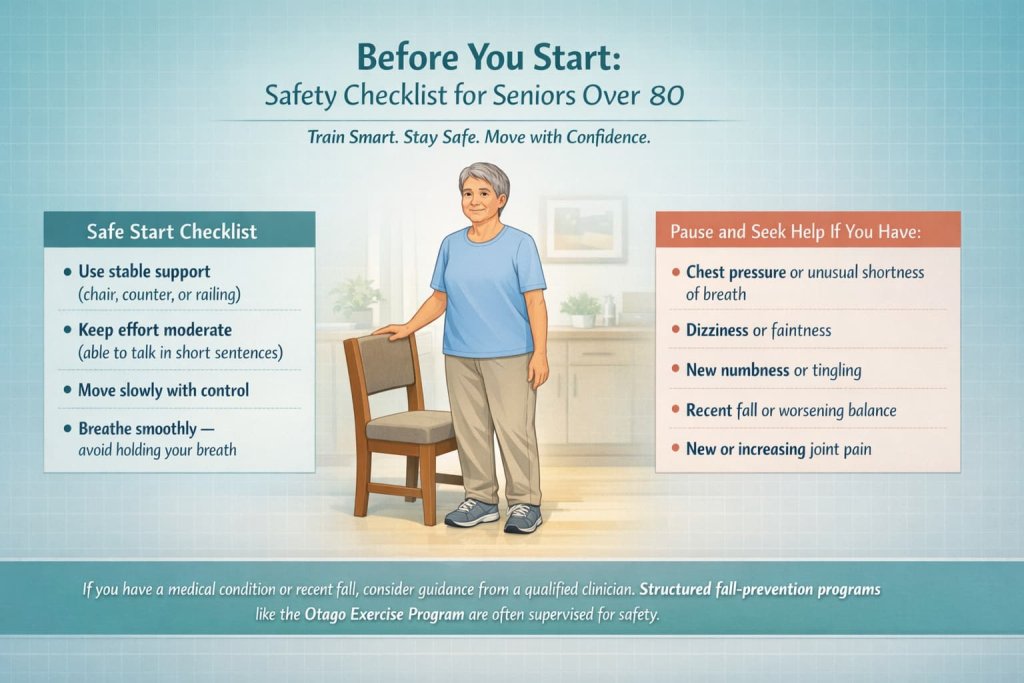
- Use stable support: a sturdy chair, countertop, or railing for balance moves
- Keep effort moderate: you should be able to talk in short sentences
- Prioritize control over speed: slow reps, smooth breathing
- Stop if you feel chest pressure, unusual shortness of breath, dizziness, or new numbness/tingling
- If you have a recent fall, new pain, or a medical condition that affects balance, consider guidance from a qualified clinician (many fall-prevention programs are supervised, like the Otago Exercise Program)
How to Use This “Top 10” List
Do 4–6 of these exercises 3–5 days per week. Start with 1 set, and build up gradually.
A simple progression:
- Week 1–2: 1 set of each, 6–8 reps (or 10–20 seconds for holds)
- Week 3–4: 2 sets, 8–10 reps
- Week 5+: 2–3 sets, add small challenges (slower tempo, slightly lower chair, lighter hand support)
10 Best Exercises for Seniors Over 80
Safe, low-impact moves that build leg strength, balance, and walking confidence for everyday independence. Use a chair or counter for support and progress slowly with control.
1) Sit-to-Stand From a Chair
How to do it:
- Sit tall near the front half of a sturdy chair, feet flat and hip-width
- Scoot feet slightly back so shins are more vertical
- Lean forward slightly and stand up using legs (use hands on armrests only if needed)
- Pause, then sit down slowly with control
- Do 6–10 reps
Why it works: Sit-to-stand strengthens the exact pattern you use for getting up from chairs, toilets, and beds—one of the biggest “independence” skills over 80.
Muscles worked: Glutes, quads, hamstrings, calves, deep core.
Trainer Tip: Make it easier by using a higher chair or adding a cushion; make it harder by slowing the “sit” down to a 3–4 second lower.
2) Supported Heel-to-Toe Walk
How to do it:
- Stand near a countertop or railing with fingertips lightly touching
- Step one foot forward so the heel touches the toes of the other foot (like walking a straight line)
- Take 6–10 slow steps forward, then back
- Keep your eyes forward and posture tall
Why it works: Heel-to-toe walking challenges balance in a controlled, low-impact way and helps train steadier walking.
Muscles worked: Ankles/feet stabilizers, calves, hips, core.
Trainer Tip: If it feels too challenging, widen your stance slightly (small gap between feet) and build toward true heel-to-toe.
3) Standing Weight Shifts
How to do it:
- Stand behind a chair and hold the backrest lightly
- Shift your weight to the right foot until you feel the left foot get “lighter”
- Shift to the left foot
- Move slowly for 30–60 seconds total
Why it works: Weight shifts train balance reactions and improve comfort transferring body weight—key for turning, stepping, and avoiding stumbles.
Muscles worked: Glutes, hips, calves, core.
Trainer Tip: Progress by reducing hand support from a full grip to fingertips only.
4) Supported Single-Leg Stand
How to do it:
- Stand near a counter, both hands ready to assist
- Lift one foot a few inches off the floor (knee stays soft)
- Hold 10–20 seconds, then switch sides
- Do 2–3 rounds each side
Why it works: Single-leg balance supports safer stepping and helps with tasks like stairs, curbs, and changing directions.
Muscles worked: Ankles, calves, glute medius (side hip), core.
Trainer Tip: Don’t chase big hold times. A steady 10 seconds with good posture beats 30 seconds with leaning or gripping hard.
5) Calf Raises With Chair Support
How to do it:
- Hold the back of a sturdy chair
- Rise onto the balls of your feet slowly
- Pause 1 second at the top
- Lower down slowly
- Do 8–12 reps
Why it works: Stronger calves improve push-off in walking and help with balance corrections.
Muscles worked: Calves (gastrocnemius/soleus), foot stabilizers.
Trainer Tip: If you cramp, reduce range of motion and increase hydration; build up gradually.
6) Seated Knee Extensions
How to do it:
- Sit tall on a chair, feet flat
- Straighten one knee until the leg is almost fully extended
- Pause 1 second, then lower slowly
- Do 8–12 reps per side
Why it works: This strengthens the front of the thigh to support walking, standing up, and stair control—without needing to get on the floor.
Muscles worked: Quadriceps, hip flexors (light), core (postural).
Trainer Tip: Add a light ankle weight only after you can do 12 reps easily with no knee discomfort.
7) Wall Push-Ups
How to do it:
- Stand facing a wall, hands on wall at shoulder height
- Step feet back so your body forms a straight line
- Bend elbows and bring chest toward the wall
- Push back to start
- Do 6–12 reps
Why it works: Wall push-ups build upper-body strength for daily tasks like pushing doors, rising from chairs (with armrests), and general posture support.
Muscles worked: Chest, shoulders, triceps, upper back stabilizers.
Trainer Tip: The farther your feet are from the wall, the harder it becomes—change distance before adding more reps.
8) Seated Band Row
How to do it:
- Sit tall and loop a resistance band around your feet (or a sturdy anchor)
- Hold band ends, shoulders relaxed
- Pull elbows back, squeezing shoulder blades gently
- Return slowly
- Do 8–12 reps
Why it works: Rows improve upper-back strength and posture, which can make walking and standing feel easier and more upright.
Muscles worked: Upper back (lats/rhomboids), rear shoulders, biceps.
Trainer Tip: Keep ribs down and avoid shrugging—think “shoulders away from ears.”
9) Step-Up to a Low Step (Optional, With Support)
How to do it:
- Use a low step (or bottom stair) and hold a railing
- Step up with one foot, then bring the other foot up
- Step down one foot at a time with control
- Do 4–8 reps per leading leg
Why it works: Step-ups train real-life stair ability and strengthen legs while practicing balance and coordination.
Muscles worked: Glutes, quads, calves, core.
Trainer Tip: Start with the lowest step possible. If you feel knee pain, switch to sit-to-stands and calf raises first.
10) Easy Walking or Marching in Place
How to do it:
- Choose a safe route indoors or outdoors (or march near a counter)
- Walk at a comfortable pace for 5–15 minutes
- Rest as needed
- Add 1–2 minutes per week
Why it works: Light cardio supports heart and lung fitness, circulation, and stamina for daily life, and the NIH National Institute on Aging emphasizes endurance, strength, and balance as key exercise categories for older adults.
Muscles worked: Whole body (legs, hips, core, posture muscles).
Trainer Tip: Use the “talk test.” If you can’t speak a short sentence comfortably, slow down.
A Simple Weekly Routine for Seniors Over 80
Try this beginner-friendly schedule:
- Monday: Sit-to-stand, seated knee extensions, easy walking
- Tuesday: Weight shifts, supported single-leg stand, heel-to-toe walk
- Wednesday: Wall push-ups, seated band row, easy walking
- Thursday: Balance day repeat (Tuesday)
- Friday: Sit-to-stand, calf raises, easy walking
- Weekend: Light walking, gentle mobility as needed
If you prefer a global guideline benchmark, World Health Organization recommendations for older adults include weekly aerobic activity, strength training, and multicomponent work that includes balance.
How to Progress Safely After Age 80
Progress slowly by changing one thing at a time while keeping form solid.
- Start: 1 set of 6–8 reps (or 10–20 sec holds)
- Build: Move to 2 sets after 1–2 comfortable weeks
- Then: Work up to 8–12 reps before making it harder
- Safer progressions:
- Reduce hand support (hands → fingertips → hover)
- Slow the lowering phase (especially sit-to-stand and step-ups)
- Add walking time by 1–2 minutes per week
- Back off if: sharp pain, increasing joint pain, unusual dizziness, or you feel unsteady
Common Mistakes to Avoid Over Age 80
- Doing too much too soon (soreness is okay; lingering joint pain is not)
- Holding your breath during effort (exhale gently on the “hard part”)
- Skipping balance work and only walking
- Rushing reps instead of using slow, steady control
- Using unstable chairs or rolling furniture for support
When to Talk to a Doctor or Physical Therapist
Get medical guidance if any of these apply:
- Recent fall or frequent near-falls
- Chest pressure/pain with activity
- New or worsening dizziness, fainting, or unusual shortness of breath
- New numbness/tingling/weakness in arms or legs
- Severe joint pain, swelling, or pain that worsens over sessions
- Balance or walking conditions (neuropathy, Parkinson’s, stroke history)
- You’re unsure how to exercise safely with osteoporosis, arthritis, or joint replacement
FAQs About Exercise for Seniors Over 80
Is it safe to start exercising after 80?
For most people, yes—when you start gently, use support for balance, and progress slowly. If you have major symptoms (like dizziness, chest pressure, or recent falls), get medical guidance first.
How many days a week should seniors over 80 exercise?
Many do well with movement most days, but a practical goal is 3–5 days per week, mixing strength, balance, and short walks.
What are the best strength exercises for seniors over 80?
Sit-to-stands, seated knee extensions, calf raises, wall push-ups, and band rows are reliable, joint-friendly options.
What’s the best exercise to improve balance at 80+?
Supported single-leg stands, weight shifts, and heel-to-toe walking are simple and effective—especially when done consistently.
Should seniors over 80 lift weights?
They can, but “weights” can be very light (even 1–3 lb dumbbells) and should only be added after mastering bodyweight versions with excellent control.
How long should workouts be for someone over 80?
Short sessions work great. Even 10–20 minutes is meaningful, and you can split it into two mini-sessions if that feels better.
What if walking hurts the knees or hips?
Use lower-impact options like marching in place with support, shorter bouts, or a stationary bike if available, and prioritize strengthening (sit-to-stand, calf raises) to support joints.
Conclusion
If you want the best results from exercise for seniors over 80, keep it simple: train legs, practice balance, and add easy walking most weeks. Pick 4–6 moves from this list, do them consistently, and progress one small step at a time for stronger, steadier movement and more independence.
This content is for informational purposes only and not medical advice.
References
- Exercise and Physical Activity — National Institute on Aging (NIH).
- Falls Prevention in Community-Dwelling Older Adults: Interventions — U.S. Preventive Services Task Force (USPSTF), 2024.
- Interventions to Prevent Falls in Older Adults: Updated Evidence Report and Systematic Review for the USPSTF — JAMA, 2024.
- Exercise for Preventing Falls in Older People Living in the Community — Cochrane Database of Systematic Reviews (PubMed record), 2019.
- Tools to Implement the Otago Exercise Program — UNC School of Medicine (CGWEP), updated 2024 (PDF).