
Yes, plyometric exercises for seniors can help build power and balance when they are low-impact, well progressed, and matched to the person’s abilities. For older adults, the goal is not big jumps or hard landings. It is controlled, fast-force movement that helps with daily tasks like standing up, stepping quickly, and recovering balance.
Research on older adults suggests properly programmed lower-limb plyometric training can be feasible and safe, with potential benefits for strength, jump performance, and physical function. PMC reports that falls prevention also matters here, since the CDC says more than 1 in 4 adults age 65 and older falls each year, with about 3 million emergency department visits and about 1 million hospitalizations annually.
Older adults are also advised to include balance work and muscle-strengthening activity in their weekly routine. The CDC recommends at least 150 minutes of moderate aerobic activity per week, muscle-strengthening activity on at least 2 days per week, and activities that improve balance. The National Institute on Aging adds that balance exercises are worth doing about three times per week.
What are plyometric exercises for seniors?
Plyometric exercises are movements that train you to produce force quickly. In younger athletic settings, that often means jumping, hopping, or bounding.
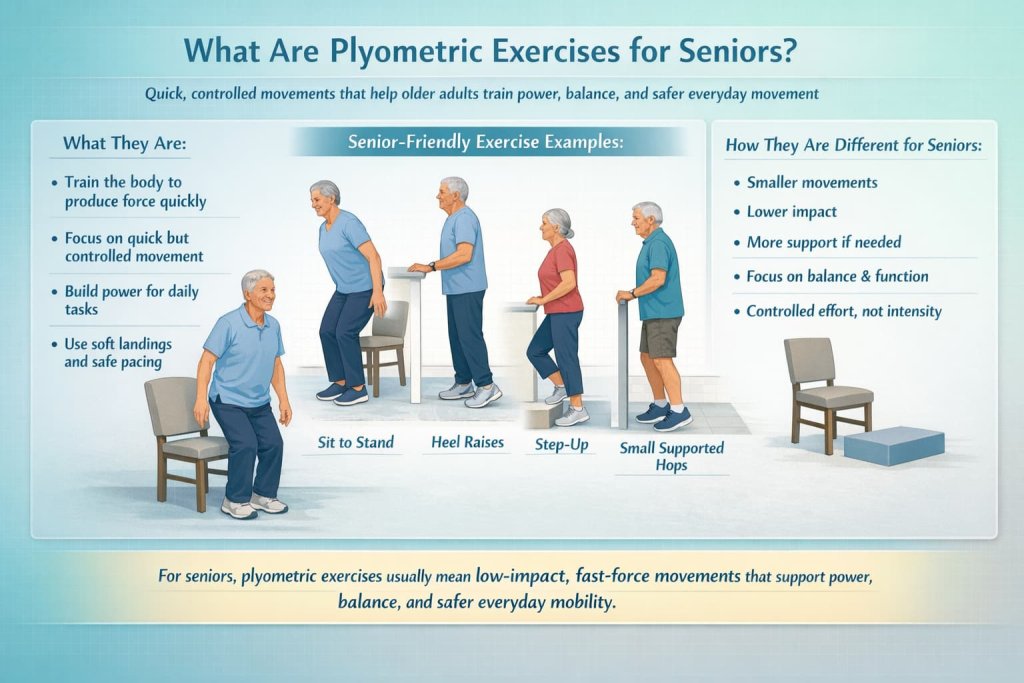
For seniors, the safer and more useful version usually looks like quick sit-to-stands, fast heel raises, controlled step-ups, and small supported hops or rebounds. The focus is on quick but controlled effort, soft landings, and staying within a comfortable range. That approach lines up better with the evidence and with public-health guidance for older adults.
Why power matters as you get older
Strength matters, but power matters too. Power is how quickly you can use your strength. That matters when you need to catch yourself after a trip, step onto a curb, rise from a chair, or move fast enough to stay steady.
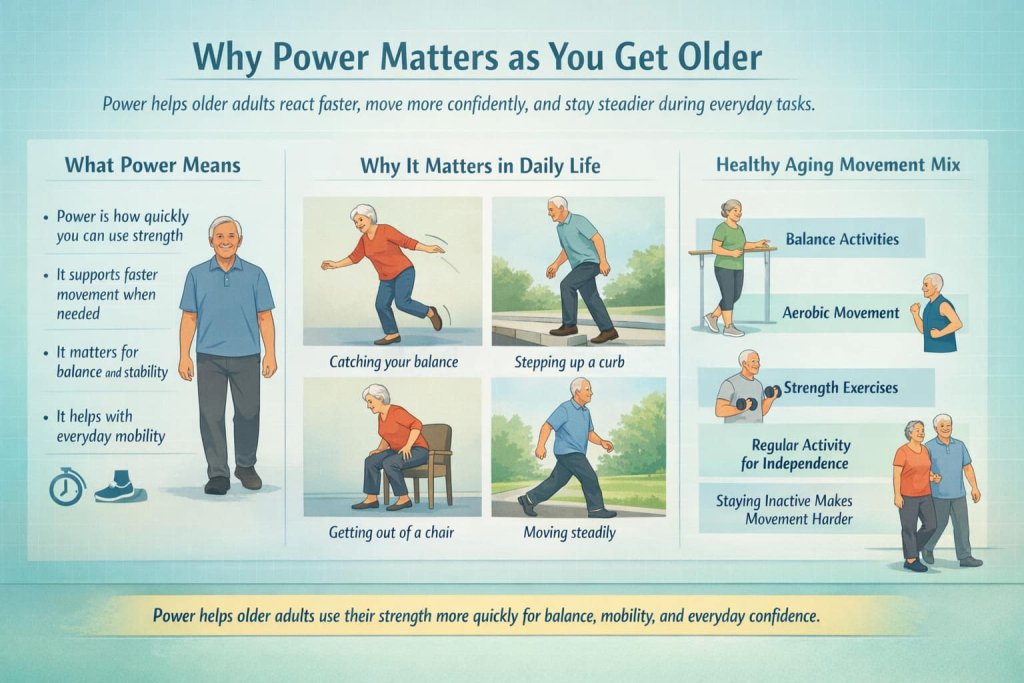
A 2024 review in Physical Activity in Older Adults: What Every Internist Needs to Know explains that older adults should do multicomponent activity that includes balance, aerobic, and muscle-strengthening work, and that inactivity is strongly linked to disability in later life.
Are plyometric exercises safe for seniors?
They can be, but only when the exercises are scaled properly. The systematic review of lower-limb plyometric training in older adults found this type of training was a feasible and safe option with potential to improve muscular strength, jump performance, and physical performance. It also emphasized proper programming and supervision, especially because these movements require control and coordination.
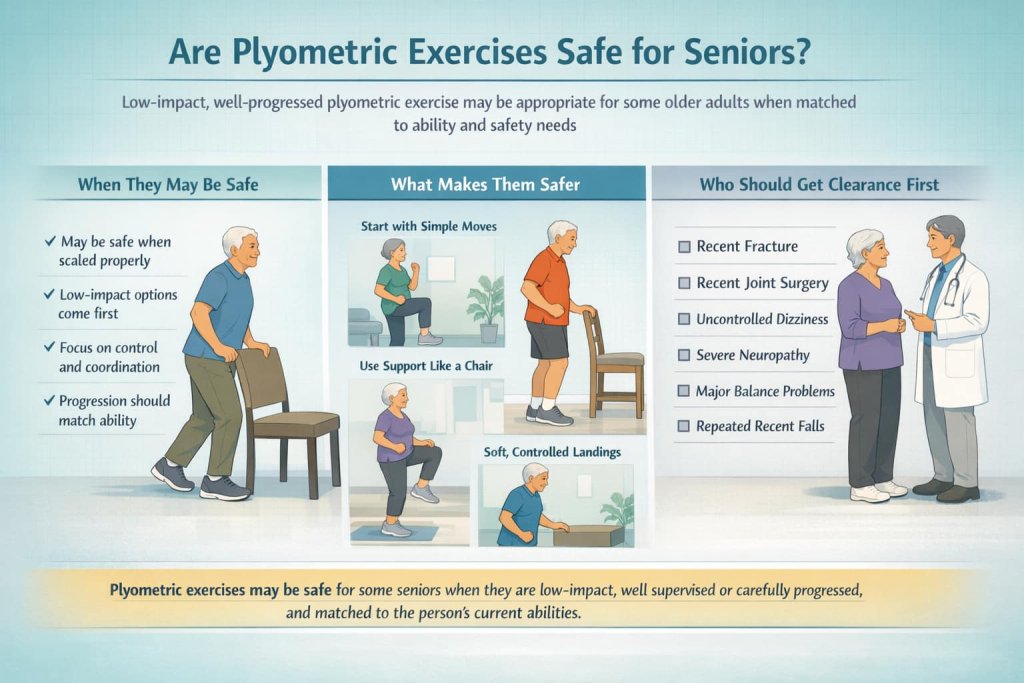
That does not mean everyone should start with jumping. Seniors with recent fractures, uncontrolled dizziness, severe neuropathy, recent joint surgery, major balance problems, or repeated recent falls should get individual medical clearance first. The CDC also notes that older adults should be as active as their abilities and conditions allow.
7 best plyometric exercises for seniors
Improve power, balance, and confidence with these senior-friendly plyometric exercises designed for safe, low-impact movement. Each exercise focuses on quick, controlled effort to support better stability and everyday function.
1. Sit-to-Stand
How to do it:
- Sit on a sturdy chair with your feet about hip-width apart.
- Lean slightly forward from the hips.
- Stand up with quick, controlled intent.
- Pause at the top.
- Sit back down slowly and under control.
- Use your hands on the chair only if needed at first.
Why it works:
This is one of the safest ways to train lower-body power for older adults. It builds the ability to rise quickly from a chair, which is a real-life movement tied to independence and balance recovery.
Muscles worked:
This mainly works the glutes, quadriceps, and calves, with help from the core for posture control.
Trainer Tip:
Think “fast up, slow down.” The quick upward phase gives you the power benefit, while the slow lowering phase helps you stay in control.
2. Supported Heel Pop
How to do it:
- Stand tall while lightly holding a chair or countertop.
- Rise onto the balls of your feet a little faster than you would in a normal calf raise.
- Keep the movement small and controlled.
- Lower your heels slowly.
- Repeat without bouncing hard.
Why it works:
This trains ankle stiffness and push-off ability, which are important for walking, stepping, and reacting quickly.
Muscles worked:
The calves do most of the work, while the feet, ankles, and lower legs help with control.
Trainer Tip:
Do not chase height. A small, crisp push through the floor is enough.
3. Mini Squat to Quick Reach
How to do it:
- Stand with feet about shoulder-width apart.
- Lower into a small squat.
- Push back up quickly and reach your arms forward or overhead.
- Return to standing.
- Reset before the next rep.
Why it works:
This is a gentle introduction to power training without leaving the ground. It teaches faster force production while keeping the impact low.
Muscles worked:
This targets the glutes, quads, calves, and core, with the shoulders assisting in the reach.
Trainer Tip:
Keep the squat shallow. You only need a small dip before the quick stand.
4. Step-Up With Power
How to do it:
- Stand in front of a low step.
- Place one foot fully on the step.
- Push through that foot and step up with more speed than a normal step-up.
- Bring the other foot up to meet it.
- Step down slowly.
- Repeat all reps on one side, then switch.
Why it works:
This improves fast leg drive in a practical pattern that transfers to stairs, curbs, and daily mobility.
Muscles worked:
This exercise works the glutes, quads, calves, and hip stabilizers.
Trainer Tip:
Use a lower step than you think you need. Power should never come from losing alignment or using momentum.
5. Side Step and Stick
How to do it:
- Stand next to a chair or wall if needed.
- Take a quick step to one side.
- Land and hold the position for 2 to 3 seconds.
- Step back to the start.
- Repeat to the other side.
Why it works:
Many falls happen when balance is challenged sideways, not just forward. This drill builds lateral push-off and teaches you to regain control after movement.
Muscles worked:
This works the glute medius, glutes, quadriceps, and core.
Trainer Tip:
The “stick” matters. Hold the landing long enough to prove you are stable.
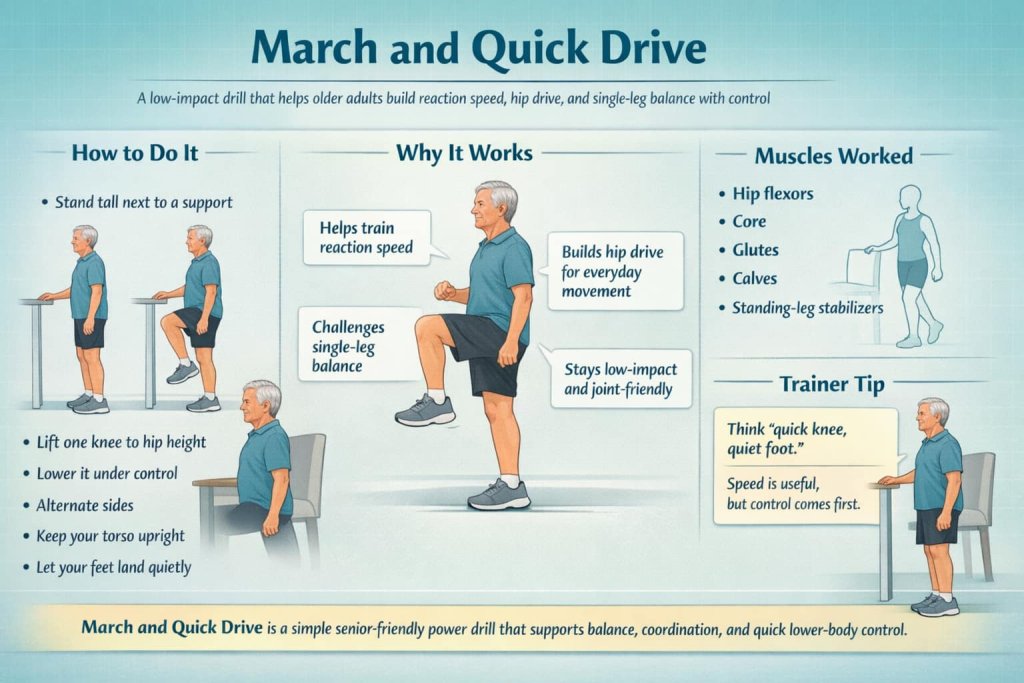
6. March and Quick Drive
How to do it:
- Stand tall next to a support.
- Lift one knee quickly to hip height or as high as comfortable.
- Lower it under control.
- Alternate sides.
- Keep your torso upright and your feet landing quietly.
Why it works:
This improves reaction speed, hip flexor drive, and single-leg balance in a low-impact way.
Muscles worked:
This uses the hip flexors, core, glutes, calves, and standing-leg stabilizers.
Trainer Tip:
Think “quick knee, quiet foot.” Speed is useful, but control comes first.
7. Low Pogo Hold-Support Version
How to do it:
- Stand tall while lightly holding a chair or countertop.
- Perform tiny, quick ankle-driven rebounds.
- Keep the knees soft and the hops very low.
- Land quietly on the balls of the feet, then let the heels kiss the floor if needed.
- Stop after a few seconds if the rhythm fades.
Why it works:
This is the closest thing to a classic plyometric drill, but scaled for safety. It trains the ankles and calves to absorb and release force quickly.
Muscles worked:
This mainly targets the calves and ankles, with help from the feet and lower-leg stabilizers.
Trainer Tip:
Only use this drill if the earlier exercises feel easy and stable. Tiny rebounds are enough.
Before you start plyometric exercises for seniors
Use these quick rules before trying the exercises below:
- Warm up for 5 to 10 minutes with marching, ankle circles, easy sit-to-stands, and light calf raises.
- Keep a chair, wall, or countertop nearby for support.
- Start with 1 set of 5 to 8 reps for each drill.
- Focus on soft landings and steady posture.
- Stop if you feel sharp pain, dizziness, chest symptoms, or loss of control.
- Leave at least 48 hours between harder power sessions at first.
The National Institute on Aging recommends listening to your body, warming up before strength work, and seeking guidance from a doctor or physical therapist if you are unsure about a movement.
A simple beginner plan
A practical starting point is 2 sessions per week on nonconsecutive days. Choose 3 to 5 exercises and do 1 to 2 sets of 5 to 8 reps each. For the low pogo drill, start with 5 to 10 seconds. Rest 30 to 60 seconds between sets. Keep the total session short and stop while you still feel fresh.
This fits the broader idea that older adults benefit from multicomponent activity that includes balance and strength, while staying within their own ability level.
How to progress safely
Progress one thing at a time:
- first increase control
- then add a few reps
- then add a second set
- only later add a little speed or range
A good sign is that the exercises feel crisp and steady, not rushed and sloppy. National Institute on Aging guidance also stresses body awareness, sensible effort, and recovery between sessions.
Who may benefit most from plyometric exercises for seniors
These exercises may be a good fit for older adults who:
- can already walk independently or with minimal support
- can do basic sit-to-stands safely
- want to improve reaction speed and balance confidence
- want to make lower-body training more functional
They are often especially useful when paired with regular walking, strength training, and balance work, which matches current older-adult exercise guidance from the CDC and the National Institute on Aging.
Who should be cautious or avoid them for now
Hold off and seek professional advice first if you have:
- a recent fracture
- recent joint replacement or orthopedic surgery
- uncontrolled dizziness
- severe arthritis flare-ups
- active foot or ankle pain that changes your walking
- repeated unexplained falls
- chest symptoms with exertion
For people with medical conditions, the CDC says activity should be adjusted to what their abilities and conditions allow.
Common mistakes to avoid
The biggest mistake is assuming plyometrics means jumping high. For seniors, the smarter goal is quick, clean movement with safe landings. Other common mistakes include doing too many reps, skipping the warm-up, progressing too fast, and training power when already tired. Research in older adults supports simple, properly programmed approaches rather than aggressive high-impact work.
Do plyometric exercises help prevent falls?
They can support parts of fall prevention, especially lower-body power, stepping ability, and balance reactions, but they are not a complete fall-prevention program on their own. Because falls are so common in adults 65 and older, the best approach is broader: balance work, strength training, aerobic activity, medication review when needed, vision care, and home safety. The CDC’s fall data underline how important prevention is, and the National Institute on Aging highlights balance training as part of healthy aging.
FAQ
Are plyometric exercises good for seniors?
They can be good for some seniors when they are low-impact, supervised or carefully scaled, and based on a solid strength and balance foundation. The best versions are small, controlled power drills, not advanced jumping workouts.
How often should seniors do plyometric exercises?
A reasonable starting point is 1 to 2 times per week on nonconsecutive days, especially for beginners. That leaves room for recovery and for the rest of a balanced weekly exercise routine.
What is the safest plyometric exercise for seniors?
Fast sit-to-stands are often one of the safest starting points because they train power in a familiar movement with low impact.
Can seniors do jumping exercises?
Some can, but not all should. Very small supported hops or rebounds may be appropriate for certain older adults, while others should stay with no-jump power drills such as quick stands, fast heel raises, and step-ups.
Do plyometric exercises build balance?
They may help support balance by improving reaction speed, lower-body power, and control during stepping and landing. Still, dedicated balance training should remain part of the plan.
What if I have arthritis or osteoporosis?
That depends on the person, the joints involved, and symptom severity. A clinician or physical therapist can help decide which drills are appropriate and how much impact is safe.
Should seniors do plyometrics at home?
Yes, many low-impact versions can be done at home if the environment is safe, support is nearby, and the exercises match the person’s current ability.
Conclusion
Plyometric exercises for seniors can be a smart addition to a training plan when they are simple, low-impact, and progressed carefully. The best place to start is not with big jumps. It is with fast, controlled versions of everyday movements that build confidence, power, and balance over time. Start small, stay consistent, and choose quality over intensity.
For the best results, combine these drills with regular walking, strength training, and balance work so your routine supports both daily function and healthy aging.
References
- Van Roie E, Bautmans I, Boen F, et al. An Age-Adapted Plyometric Exercise Program Improves Dynamic Strength, Jump Power, and Functional Capacity in Older Men. Journal of Geriatric Physical Therapy. 2020.
- Centers for Disease Control and Prevention. Older Adult Activity: An Overview.
- National Institute on Aging. Exercise and Physical Activity.
- National Institute on Aging. Exercise and Physical Activity for Older Adults.
- Centers for Disease Control and Prevention. What You Can Do to Meet Physical Activity Recommendations for Older Adults.
- Davies G, Riemann BL, Manske R. Current Concepts of Plyometric Exercise. International Journal of Sports Physical Therapy. 2015.