
Posterior chain exercises for seniors can help support stronger hips, glutes, hamstrings, calves, and back muscles, which are all important for balance, posture, standing up, and walking safely. That matters because older adults are encouraged to do muscle-strengthening activity at least 2 days per week and include balance work as part of their routine, according to the CDC. Falls are also a major concern in later life, with the CDC reporting that more than 1 in 4 older adults fall each year.
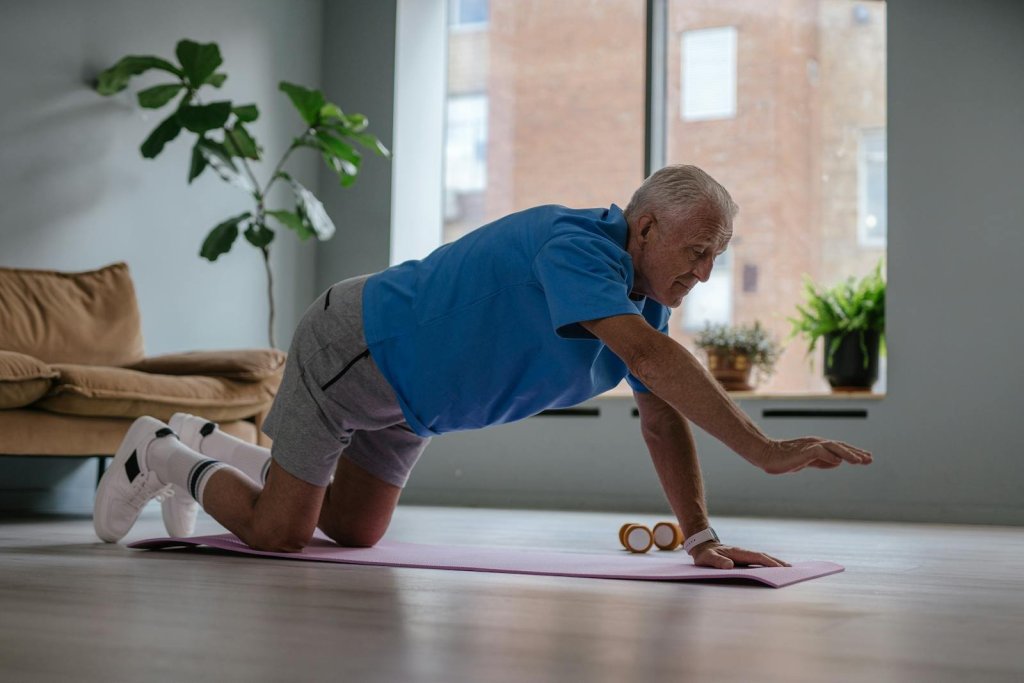
A smart posterior-chain program does not need to be intense or complicated. The best approach is usually simple, steady, and form-focused: start with supported movements, train the muscles on the back side of the body, and progress gradually. Recent research and expert guidance support multicomponent exercise that combines strength and balance training for older adults, as outlined in a 2025 consensus paper available through PMC.
What Are Posterior Chain Exercises for Seniors?
Posterior chain exercises train the muscles along the back side of the body. For seniors, that usually means the glutes, hamstrings, calves, spinal erectors, and upper-back support muscles. These muscles help you stand tall, hinge at the hips, climb stairs, rise from a chair, and stay steadier while walking, which is why the National Institute on Aging emphasizes both strength and balance activity for older adults.
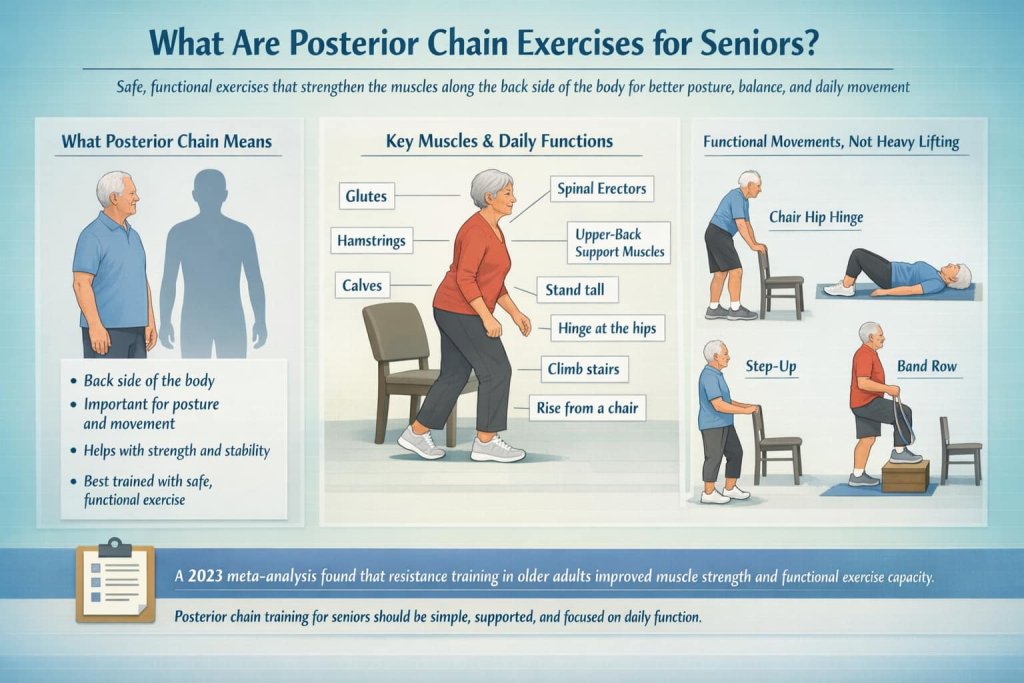
In practical terms, posterior chain training for older adults should focus on safe, functional patterns rather than heavy lifting. Supported hip hinges, bridges, step-ups, rows, and calf raises all fit well because they build strength that transfers to everyday movement. A 2023 meta-analysis indexed in PubMed found that resistance training in older adults improved muscle strength and functional exercise capacity.
Why Posterior Chain Exercises Matter for Seniors
The posterior chain plays a big role in stability and independence. When these muscles get weaker, common daily tasks can feel harder. Standing up from a chair, maintaining posture, walking uphill, getting in and out of a car, and controlling balance during small stumbles all depend on the back side of the body doing its job. The National Institute on Aging also notes that older adults should include strength and balance activities each week.
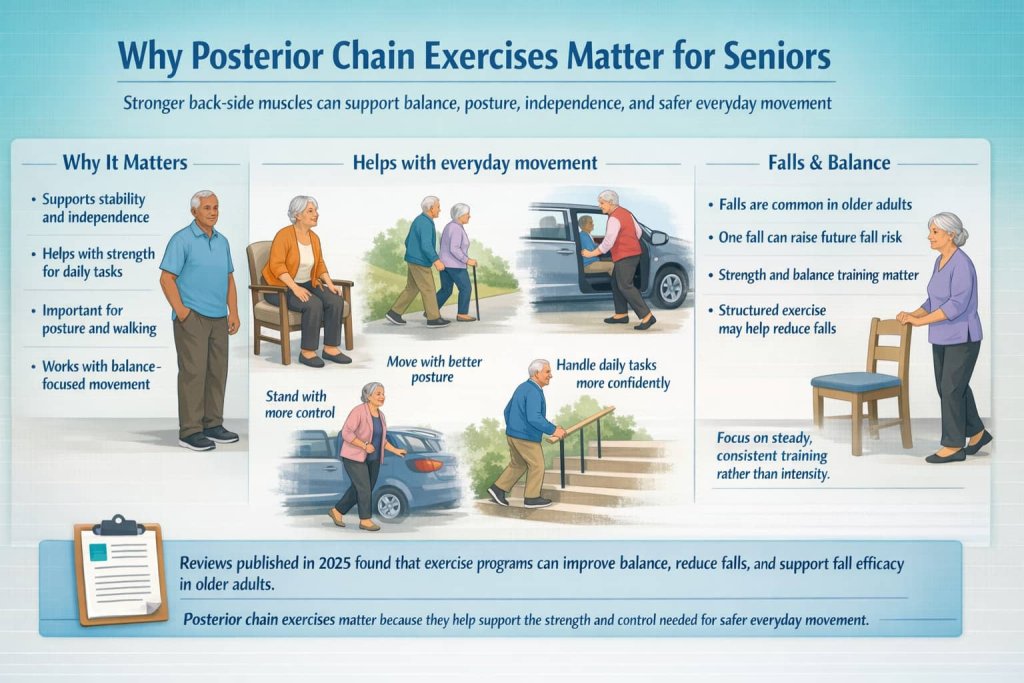
This is also one reason falls prevention matters so much. The CDC says more than one out of four older adults falls each year, and falling once doubles the chance of falling again. Reviews published in 2025 through PMC found that exercise programs can improve balance, reduce falls, and support fall efficacy in older adults, especially when training is structured and consistent.
Do Posterior Chain Exercises for Seniors Actually Work?
Yes, when they are selected appropriately and progressed safely, posterior chain exercises for seniors can work well. The evidence is strongest for exercise programs that improve strength, balance, and functional capacity rather than for one single exercise alone. A 2025 global consensus paper available through PMC recommends multicomponent training with functional balance work and progressive resistance training, while a 2023 meta-analysis in PubMed found resistance training improved muscle strength and functional exercise capacity in older adults.
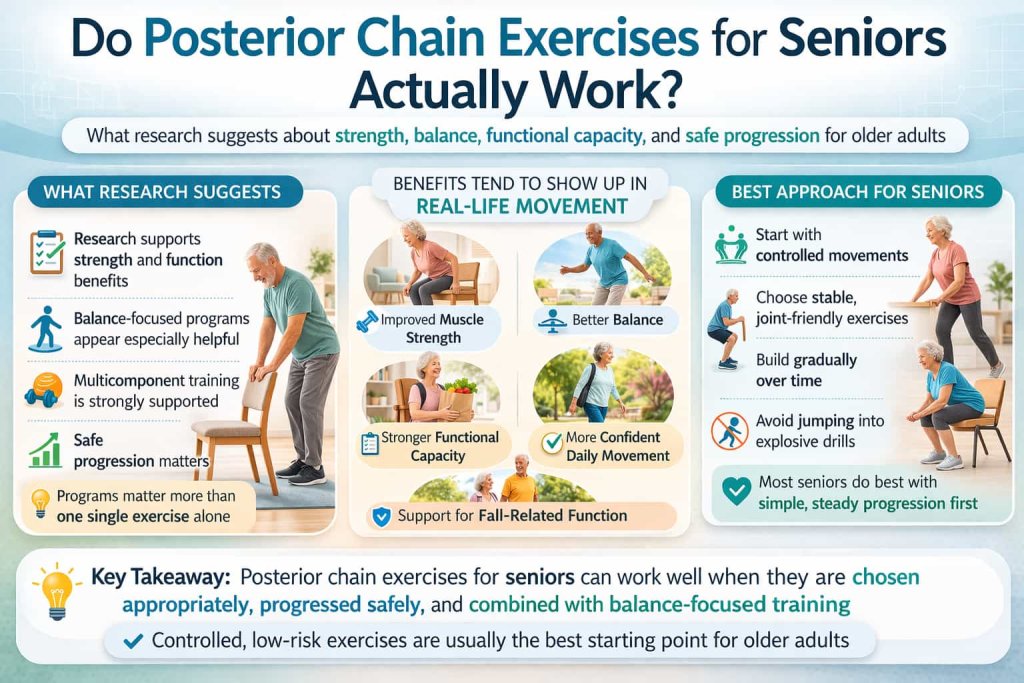
Some evidence also suggests that power-oriented training may further improve fall-related functional capacity in older adults, but most seniors do best starting with controlled, low-risk movements first. That is why this list focuses on stable, joint-friendly options rather than explosive drills, which is consistent with findings indexed in PubMed.
Before You Start Posterior Chain Exercises for Seniors
Use these quick safety basics before beginning:
- Warm up for 5 to 10 minutes with easy marching, ankle circles, shoulder rolls, and sit-to-stands.
- Keep a sturdy chair, countertop, or wall nearby for support.
- Start with bodyweight only unless the movement feels easy and steady.
- Move slowly enough that you can control each rep.
- Stop if you feel dizzy, sharply painful symptoms, chest pain, or unusual shortness of breath.
- Ask a clinician or physical therapist before starting if you have a recent fracture, uncontrolled heart symptoms, major balance problems, or a new injury, as advised by the National Institute on Aging.
10 Best Posterior Chain Exercises for Seniors
Build strength where it matters most with these senior-friendly posterior chain exercises for the glutes, hamstrings, calves, and back. These 10 moves can help support better balance, posture, and safer everyday movement.
1. Glute Bridge
How to do it:
- Lie on your back with knees bent and feet flat on the floor.
- Keep your feet about hip-width apart.
- Tighten your stomach gently and press through your heels.
- Lift your hips until your body forms a straight line from shoulders to knees.
- Pause briefly, then lower with control.
- Repeat for 8 to 12 reps.
Why it works:
The glute bridge strengthens the hips without placing much stress on the knees. It is one of the simplest ways to train hip extension, which is a key posterior-chain action for standing, climbing stairs, and walking.
Muscles worked:
Glutes, hamstrings, and deep core stabilizers.
Trainer Tip:
Do not overarch your lower back. Think about lifting from the hips, not from the ribs.
2. Sit-to-Stand
How to do it:
- Sit tall near the front of a sturdy chair.
- Place your feet flat and slightly behind your knees.
- Lean forward a little from the hips.
- Press through your feet and stand up.
- Lower back down slowly with control.
- Repeat for 6 to 10 reps.
Why it works:
This is one of the most functional strength exercises for seniors. It trains the hips and legs in a way that directly carries over to daily life.
Muscles worked:
Glutes, hamstrings, quadriceps, and core.
Trainer Tip:
Use your hands on the chair only as much as needed. Over time, try to rely more on your legs.
3. Chair-Assisted Hip Hinge
How to do it:
- Stand behind a chair and lightly hold the backrest.
- Soften your knees slightly.
- Push your hips backward while keeping your spine long.
- Lean your torso forward a little without rounding.
- Return to standing by squeezing your glutes.
- Repeat for 8 to 12 reps.
Why it works:
The hip hinge teaches one of the most important movement patterns in posterior chain training. It strengthens the muscles used for bending, lifting, and controlling posture.
Muscles worked:
Glutes, hamstrings, and spinal erectors.
Trainer Tip:
Think “hips back” rather than “bend forward.” That cue usually makes the movement safer and clearer.
4. Supported Romanian Deadlift
How to do it:
- Stand tall with one hand on a chair or countertop.
- Hold a light dumbbell, kettlebell, or no weight in the other hand.
- Keep a soft bend in the knees.
- Hinge at the hips and lower the weight toward your shin.
- Stop when you feel a gentle stretch in the back of the legs.
- Return to standing slowly.
- Repeat for 6 to 10 reps per side or both sides together.
Why it works:
This is a progression from the hip hinge. It adds a little more challenge for the hamstrings and glutes while still allowing support.
Muscles worked:
Hamstrings, glutes, lower back, and grip.
Trainer Tip:
Keep the weight close to the leg. Reaching too far forward can strain the back.
5. Step-Up
How to do it:
- Stand facing a low step.
- Hold a railing or sturdy support if needed.
- Place one foot fully on the step.
- Press through that foot and step up.
- Step back down slowly.
- Complete all reps, then switch sides.
- Aim for 6 to 10 reps per side.
Why it works:
Step-ups improve lower-body strength and help with real-life tasks such as stairs and curbs. They also challenge balance in a practical way.
Muscles worked:
Glutes, hamstrings, calves, and quadriceps.
Trainer Tip:
Start with a very low step. Height matters less than control.
6. Calf Raise
How to do it:
- Stand behind a chair or at a countertop.
- Place feet about hip-width apart.
- Rise up onto your toes slowly.
- Pause briefly at the top.
- Lower your heels with control.
- Repeat for 10 to 15 reps.
Why it works:
The calves are part of the posterior chain and help with walking, push-off, and balance corrections. They are easy to overlook, but they matter.
Muscles worked:
Calves, feet, and ankle stabilizers.
Trainer Tip:
Try not to rush the lowering phase. The slow descent helps build control.
7. Bird Dog
How to do it:
- Start on hands and knees.
- Tighten your midsection gently.
- Extend one leg behind you.
- If stable, extend the opposite arm forward.
- Pause briefly, then return.
- Alternate sides for 6 to 8 reps each.
Why it works:
Bird dog trains coordination and trunk control while also targeting the posterior chain. A 2025 review in PubMed found that core training can improve balance performance in older adults, which makes this a strong addition to a senior program.
Muscles worked:
Glutes, spinal erectors, shoulders, and deep core muscles.
Trainer Tip:
Keep the movement small if needed. A shorter reach is better than losing alignment.
8. Standing Hip Extension
How to do it:
- Stand tall and hold a chair or countertop.
- Shift your weight onto one leg.
- Move the other leg straight back a few inches.
- Pause without arching your back.
- Return slowly.
- Repeat for 8 to 12 reps, then switch sides.
Why it works:
This is a beginner-friendly way to strengthen the glutes while staying upright and supported. It can be easier for people who do not want to get down on the floor.
Muscles worked:
Glutes, hamstrings, and core stabilizers.
Trainer Tip:
Keep the motion small and controlled. Swinging the leg back too far usually shifts the work into the lower back.
9. Resistance Band Row
How to do it:
- Sit or stand tall with a resistance band anchored securely in front of you.
- Hold one end in each hand.
- Pull your elbows back while squeezing the shoulder blades gently together.
- Pause briefly.
- Return slowly to the start.
- Repeat for 8 to 12 reps.
Why it works:
A strong posterior chain is not only about the lower body. The upper back also helps support posture, shoulder position, and overall stability.
Muscles worked:
Upper back, rear shoulders, mid-back, and biceps.
Trainer Tip:
Do not shrug your shoulders. Think about sliding the shoulder blades back and down.
10. Wall-Supported Back Extension
How to do it:
- Stand a few inches away from a wall with your back facing it.
- Hinge slightly forward at the hips.
- Place your hands on your thighs if needed.
- Gently straighten and lengthen your torso back to upright.
- Pause, then repeat for 8 to 10 reps.
Why it works:
This exercise trains the muscles that help keep the spine tall and resist slumping. Better postural endurance can make walking and standing feel easier.
Muscles worked:
Spinal erectors, glutes, and upper-back support muscles.
Trainer Tip:
Think “grow tall” rather than “lean backward.” The goal is posture, not a deep back bend.
How Often Should Seniors Do Posterior Chain Exercises?
For most older adults, 2 to 3 sessions per week is a practical starting point. This matches general guidance to include muscle-strengthening activity at least 2 days per week along with balance work. Sessions do not need to be long. Even 20 to 30 minutes of focused exercise can be useful.
A simple starting format is 5 to 6 exercises per workout, with 1 to 2 sets of 6 to 12 controlled reps for each movement. Beginners usually do not need a high training volume to benefit.
- Aim for 2 to 3 sessions per week
- Keep sessions around 20 to 30 minutes
- Start with 5 to 6 exercises
- Do 1 to 2 sets of 6 to 12 reps
- Focus on control, not speed
Common Mistakes to Avoid
Many seniors do better when they avoid a few common mistakes. The biggest ones are moving too fast, using too much resistance too soon, and choosing exercises that feel unstable. It is also common to focus too much on the front of the body while neglecting the hips, calves, and back.
It is important not to push through sharp pain. Mild effort is normal, but sharp pain, dizziness, or worsening symptoms are not.
- Moving too fast
- Adding resistance too early
- Choosing unstable exercises
- Ignoring the hips, calves, and back
- Pushing through sharp pain or dizziness
Who Should Be More Careful With These Exercises?
Extra caution may be needed if you have osteoporosis, recent surgery, major arthritis flare-ups, serious balance limitations, uncontrolled blood pressure, or a recent fall injury. Many older adults with health conditions can still exercise, but the program should match their needs and start gradually.
In these cases, a clinician or physical therapist can help adjust the exercise plan safely.
- Recent fall injury
- Osteoporosis
- Recent surgery
- Arthritis flare-ups
- Serious balance problems
- Uncontrolled blood pressure
FAQ About Posterior Chain Exercises for Seniors
Are posterior chain exercises safe for seniors?
Yes, they can be safe for many seniors when the exercises are matched to current ability, done with good support, and progressed gradually. Chair support, light resistance, and controlled reps make a big difference, which aligns with guidance from the National Institute on Aging.
What muscles are included in the posterior chain?
The posterior chain generally includes the glutes, hamstrings, calves, spinal erectors, and many upper-back support muscles. These muscles help with posture, walking, lifting, and balance.
How many times a week should seniors train the posterior chain?
Two to three times per week is a practical target for many people. Public health guidance from the CDC recommends muscle-strengthening activities at least 2 days per week for older adults.
What is the best posterior chain exercise for beginners?
The glute bridge, sit-to-stand, chair-assisted hip hinge, and calf raise are among the best beginner options because they are simple, functional, and easy to modify.
Can posterior chain exercises help with balance?
They may help support balance because stronger hips, calves, trunk muscles, and upper-back muscles all contribute to steadier movement. Research reviews available through PMC support exercise programs for improving balance and reducing fall risk in older adults.
Do seniors need weights for posterior chain training?
No. Many effective posterior chain exercises start with bodyweight only. Light dumbbells or resistance bands can be added later if form stays solid.
What should seniors avoid during these exercises?
Avoid rushing, holding your breath, using resistance that changes your form, or pushing through sharp pain. If you feel unsteady, use support or switch to a simpler version.
Conclusion
Posterior chain exercises for seniors are a smart way to build strength where it counts most for posture, balance, and daily function. The best plan is usually simple: supported movements, steady progression, and consistency over time. Start with a few of the exercises above, focus on control, and build from there.
References
- National Institute on Aging: Exercise and Physical Activity
- PubMed: Effects of Resistance Training Dose on Strength and Function in Middle-Aged and Older Adults (2023)
- PubMed: Effect of Elastic Resistance Training on Functional Capacity in Older Adults (2023)
- National Institute on Aging: Health Benefits of Exercise and Physical Activity